Sunday, January 27, 2013

Costa Rican GPS

We'd arranged to stay our last night in the Marriott near San Jose airport so set out bright and early with Jimmy's younger brother Juan Carlos as our driver/guide.  The aim was to take a coffee plantation tour and then visit the Poas Volcano near San Jose.

Poas is the nearest of a number of active volcanos that ring San Jose which itself is in a large plain surrounded by mountains.  They are aligned like pearls on a chain, due to the 'north east subduction' of the Pacific tectonic plate under the Caribbean plate.  Poas is one of the most active volcanoes along with Arenal and Irazu.  It is also really near to the Doka coffee plantation, the one that we intended to visit as its coffee plantations were dotted all over the slopes of the volcano.

Poas crater ... on a clear day!

First of all though we had to find it.

I'd noticed that both Jimmy and Juan Carlos while being the most agreeable and pleasant of guys never either spoke ill of anyone or anything or spoke in anything other than superlatives.  It also meant that when they suggested something that it was the best of its kind, no doubt.  100% the best.  However they were also incredibly vague.  I'd asked to do the Classic Britt coffee tour and Jimmy had agreed yet at the last moment he recommended the absolute best tour of all, which was undoubtedly Doka Estates and as it was conveniently on the way to Poas we could really take our time and enjoy it thoroughly.

So Doka it was.

The way there was via what seemed like backroads and as we got ever nearer it became clear that Juan Carlos really didn't know the way.  He called Jimmy a couple of times who seems to have put him straight but as the road steepened as we neared a mountain of some sort, he started looking around for inspiration even after stopping on several occasions to ask the way.  Culmination came when we spotted directions to the coffee estate on a sign post and Juan Carlos took the other fork down a hill saying that they must have changed the way in.

A bit late to help Juan Carlos, I know!

However his curious method of navigation which followed few of the suggested roads shown on the map finally bore fruit as we rolled into the estate half an hour ahead of the 11 am tour.  It gave us the chance to try some of their coffees but more importantly tour the estate (not the coffee tour) which was laid out in a very nice, one might say harmonious, manner.

Note the bean motif in the pathway.  A nice touch.

They had a butterfly enclosure.  Butterflies are all over Costa Rica, all throughout South America too  due to the proliferation of forests and the fabulous flora.  The ones we saw in the enclosure were simply gorgeous.  Doka exports containers full of butterfly larvae all over the world in addition to their coffee.


The tour itself was great too.  The guide was enthusiastic which is always an important first point and took us through the various stages of the process starting with the planting of seeds -- they germinate really slowly and stay in small containers for a year -- and then the planting out of yearlings within the various plantations -- Doka controls 24,000 acres of plantations, all but 3,000 of which are independent.  Plants produce their first cherries after 4 years and then for 24 or so more years after that.

Coffee seedlings

The red coffee cherries on a mature plant

The cherry itself is in 4 parts -- the skin, the pulp, the inner skin, and then the bean itself.  Usually there are 2 beans in each cherry but sometimes there are hybrids -- that producing one bean is called a 'peaberry' and produces a premium bean and hence coffee.  The one producing 3 are rolled into the general melange.  They taste awful raw -- I tried one!

24,000 Guatemalan temporary workers (one per acre) come to Costa Rica each picking season to work the Doka plantations where they stay for 4 months picking up to 15 baskets of cherries per day (value to them $2 per basket) at the end of which a family of 4 has earned enough for a year in Guatemala.  Apparently 25% of the total cost is labour which is statutorily controlled by government so as to ensure nobody is ripped off.  Doka's main customers are Starbucks and Green Mountain who take 80% of the total output -- they make dead sure that the Fair Trade label on their cartons is just that.

Then comes the washing, shredding, drying and finally 3 months worth of aging before the final peeling, grinding and roasting. None of it is hi tech at all -- the machinery is 115 years old for goodness sake, made in London too!  As for the drying, even I had a go at the drying process!

Beans air and sun dry for 5 days to produce the best quality coffee being turned every 45 minutes.

OK I'm a fan of coffee, I admit.  But think of the statistics.  Coffee is the 2nd most traded commodity (Oil being #1) and 2nd most drunk beverage (behind water) but ahead of in order tea, beer, wine and then ... wait for it ... Coca Cola.  Numbers 1 through 5 are generic but Coke (the guys who invented Santa in red) are well Coke.  That is an amazing statistic and one that we should all remember when putting together our investment portfolios (and no that's not a recommendation, just a thought!).

Pre-roasted green beans at the front, roasted at the back.  The best quality roasted beans are at back left.  The decaf beans are bottom left -- an ugly brown color with all the caffeine sweated out of them in Germany of all places.  The German plant does it for nothing incidentally just keeps the caffeine that it sells to Red Bull!

Juan Carlos suggested we stay at the estate for lunch as it is wonderful and provides typical cuisine but we were adamant and found a place nearer to the volcano which was wonderful and provided typical cuisine too.  Interestingly one table with local businessmen drank nothing but imported beers -- Stella Artois, Heineken and Corona -- over the local brew which are all uniformally very good indeed.  Perhaps it is a status symbol.

As we neared the entrance to the Poas volcano it became clear that the weather was against us.  When we reached the top we could see no more than 50 metres in any direction -- Juan Carlos helpfully said he'd been there 5 times before and each time it was nice and clear.  Oh well, better luck next time.

At the top of Poas -- that is mist not my lousy camera

The way back to the hotel utilized all Juan Carlos' skill and ingenuity, not to mention charm and persuasiveness with complete strangers to manage but he did in the end so all's well that ended well.
So fare well Costa Rica.  Its been a blast!

Gone Fishing

The departure of our friends meant that the fishermen friends of ours would be on the water every day until we left (although we would be joining them one day on the water) so Viv and I and our two remaining tour party, Keith and Judy, would be fending for ourselves.

Viv and I had on our list of must do's: volcano, coffee plantation and a local specialty called 'chiccaron' -- crispy pork.  Keith and Judy had been to Costa Rica before and had toured to several other locations as well (in my opinion retrospectively, this is a must do) so were less driven to tick boxes than we were.  So we took it easy for a day, only playing the front 9 holes of the resort golf course that were in the rain forest -- the back 9 were alongside the water -- and checking out all parts of the resort.

Advertisements that I saw said that Los Suenos was the #1 resort in Costa Rica.  I can believe it too as it is built around a nice Marriott Hotel resort as anchor and includes a large marina for the sometimes enormous deep sea fishing boats that congregate there.  In fact a major international fishing competition was just winding up when we arrived that had been relocated from Cabo San Lucas in Mexico due apparently to Mexican drug gangs wanting a piece of the action.  How true that is, I do not know but it does reinforce the friendly reputation of the country.


Walking around the marina, it strikes me that this is something that could easily be replicated in St. George's in Bermuda.  In fact probably far easier as in Los Suenos a man made harbor had to be constructed to provide adequate shelter.  By contrast St. George's harbor is one of the most magnificent natural harbors in the world sited in a Unesco World Heritage city, one of the first Anglo-Saxon settlements in the western hemisphere.  Progress comes to those with vision, capital and the energy to make it happen.  Bermuda please take note!

Furthermore this type of tourism attracts big money.  The cost of these boats runs into the millions and the costs to run them for even 1 day's fishing runs into the thousands.  The people that can afford this kind of activity have to have big money.  The perfect tourist in fact for as we found our fishing friends had rarely if ever been outside the resort in all the times they had visited, they had fished and hung around swapping 'ones that got away' stories in the local bar, called 'Hooked Up', with other like minded fishermen.  Just as I said the perfect tourist.


Our fisher friend, Bruce is a member of a fishing club called Black and Blue fishing (see website) that operates out of Bermuda, Panama and Costa Rica.  It seems like a sort of fishing boat/condo time share where a group of people buy participations in this very expensive hobby.  Consequently there's quite a few Bermudians in Costa Rica too -- we ran into a couple actually.


The local fishing as we found is different to what is found in Bermuda.  For one thing the fish are obviously different.  But also the big one for poor sailors like me is the fact that for some reason the ocean swell hereabouts is nothing like the Atlantic swell is in Bermuda.  A BIG difference indeed!  I'd been on boats beyond the reefs in Bermuda before and had always suffered miserably so the attractions of fishing in Bermuda were zero to less than that.  In fact I only agreed because our friends had 2 forms of drugs that supposedly combat seasickness and planned to take both.

In the end I didn't and only took Sturgeron 15, which turned out for me to be a wonder drug.  My friends said it was because the sea was flat calm too but I don't believe it.  It just worked.

The fishing was therefore something I was able to enjoy.

First of all though, I'd never before realized just how hi tech this enterprise was and also just how much gear the boats carried.  Of course GPS, radio and radar.  GPS was to track where you'd found fish in quantities before -- you'd just mark the place electronically and set a course to get back next time.

Talk about fishing rods.  The vision I'd had before was that of a seat at the back of the boat you were strapped into with a big rod to play the big fish.  I'd seen the movies.  Well it wasn't like that at all.  It could have been I suppose if the fish you were catching were 800+ pound marlins like you would in Bermuda (where fish were far fewer but also far bigger) but we'd be after 100 pound sailfish.  So you didn't need the seat, you just needed a whole bunch of smaller rods and those metal bits that stick up in harbor (called outriggers) spread out and then you'd attach up to 5 or 6 rods plus 2 types of plastic squids (actually shaped rather like phalluses) which were brightly colored and attracted the fish in the first place.  This was the odd thing to me as I thought the fish would just go after the bait fish but no, once the fish rolls up chasing the plastic squids, someone rushes out and picks up one of the rods and skillfully waves the fish baited hook in front of the fish so that when it spits out the plastic, the next thing it tastes is a scrummy hook filled fish.

That was what Bruce did whilst his wife Kathy kept a little notebook with statistics: time of strike (that's what its called when the fish bite), what type of fish, whether Bruce was successful converting the first contact with the squid into a hookable action (i.e. reeling them in), how long it took to reel them in, the state of the fish when released (it was all catch and release), and I suspect other stuff that I have no notion about.

Bruce improving his stats!

In Bermuda, some days you could go all day and only get 1 or 2 strikes (some days none at all), however Bruce told me that Costa Rica and Panama were the best fishing he'd ever come across as the fish bit all day.

We headed off around 7 am and set out full speed for about an hour before the captain slowed down, set out all the outriggers and various lines and rods and began to trawl -- I think that's what it is called.  Basically it was motoring around at slow speeds until something happened which in our case was after about 20 minutes at which point the skipper said "left lure" -- which meant that a fish he'd seen had gone after the lure on the left which was the green one (the other was bright pink).  Bruce jumped up and grabbed a rod whose line plus bait was in the same direction as the lure and started to reel the bait fish in so that it ran in front of the sail fish that was nibbling the lure.

A few minutes later I heard Bruce say something and he began reeling the line in furiously while the boat attendant (who did essentially everything the skipper didn't) strung up a replacement rod -- he'd prepared several others.  When he'd reeled the line in Bruce showed us the fish head on the hook which was all that was left after the sailfish had had his snack.

According to Kathy that meant Bruce's stats on the day were 0 and 1.

No matter as no more than a couple of minutes later another fish was sighted. I never figured out how the fishermen knew there was a fish nearby.  The captain said he saw them.  Bruce and the attendant said that they knew from the action of the rods.  This time Bruce was successful in hooking the fish and he passed the rod to me!

We'd drawn playing cards to see in which order each of us would have a turn reeling in the fish.  Bruce said he didn't want a turn today as he'd done nothing but fish yesterday and would be doing the same for the rest of the week.  Kathy too.  I'd drawn the high card so had the plastic waist thing attached which you used to secure the rod when reeling the fish in.  Bruce had said "hold the rod up, make sure you keep the line tight, but whatever you do if the fish is running, don't reel.  Let it go.  You can always reel it in later on when its stopped running."


Now it took just about as long for him to say that as it took for me to type -- which is not long.  Also at the time when nothing much is happening, its easy to think "Sure, no problem" but when Bruce passed me the rod a number of things quickly passed through my mind:

1) Bahamas -- why Bahamas?  Well in the early 1980's I'd worked in Nassau for a while with my then bank employer and one weekend took a resort diving course.  Sean Connery's favorite diving spot was the Bahamas so I thought why not?  After a brief session learning in a hotel pool I went out onto the dive boat, the dive master said "ready?" and when I nodded he pushed me in and I went straight down to the bottom in about a second and a half.  Now I knew I shouldn't panic, only breathe deeply and evenly, calmly clear my mask and all the rest of it.  But I only knew that when I was on dry land, not when I was sitting on the bottom of the sea.  (I did survive though!).

2) Corporal Jones -- this was a character in a wonderful British TV comedy called Dad's Army.  Cpl Jones was an old soldier who'd fought everywhere for the empire and whenever things got hairy he used to go rigid and say "Don't Panic. Don't Panic."  Well of course he was panicking like crazy.

Well of course lots of people do this, some older and less fit than me, so really! So I grabbed the rod and reeled that sucker in!  It was a 100 pound sail fish apparently.  I only saw it when it was jumping out of the water some 100 metres away from the boat and it did look magnificent.  The attendant cut the line as soon as the fish came near enough but that counts as a catch.  And it was my very first catch too!


All 4 of us pulling in our fish -- Me (2), Viv (3), Keith (3) and Judy (3)

In all we caught 11 sail fish out of 20 that struck (Bruce's stats for the day therefore were 11 and 20) while Keith was lucky enough to catch a 30 pound mahi mahi (aka dolphin fish -- see below) which meant that not only was it a good day's fishing, we also had 2 monster bags of very fresh fish that we could take down to the Hooked Up restaurant and bar and have cooked for us in a variety of different ways.

Keith's Mahi Mahi
What a day!

Living the Pura Vida!!

I don't remember exactly when it was that Viv suggested we go to Costa Rica but it was probably at tennis as one of her tennis friends recently bought a condo on the Pacific coast as they like the deep sea fishing there.  The intent was that a group of tennis ladies go for a week of yoga while husbands would be invited for a second week to enjoy the eco-friendly tourism that the country is famous for.

Nicaragua to the North and Panama to the South, in olden times Costa Rica was miles from anywhere by land and sea, lucky for them.  These days you can fly in every day from Miami -- takes just over 2 hours!
Costa Rica means "rich coast" in Spanish and is bordered by Nicaragua to the north, Panama to the southeast, the Pacific Ocean to the west, and the Caribbean Sea to the east. Costa Rica constitutionally abolished its army permanently in 1949 and is the only Latin American country in the list of the world's 22 older democracies. Costa Rica has consistently been among the top Latin American countries in the Human Development Index (HDI), ranked 69th in the world in 2011. The country is ranked fifth in the world, and first among the Americas, in terms of the 2012 Environmental Performance Index. The New Economics Foundation also ranked Costa Rica in 2009 as the greenest country in the world.


You have to hand it to Costa Rica for achieving all this voluntarily and still remaining both independent and relatively safe.  This is probably to do with its colonial and post-colonial history when it was rather fortunately miles away from both seats of colonial government -- Guatemala to the north and Colombia to the south.  The fact that it is unbelievably mountainous mostly covered with tropical rain forest meant that the Spanish governors couldn't be bothered to go anywhere near Costa Rica and left them pretty much to their own devices.  That also meant no big property seizures that happened elsewhere in the Spanish colonial empire (which created enormous haciendas) so the few locals that were around were never thrown off their lands and consequently never enslaved.

Costa Rica's coat of arms on its first postage stamp from 1849.  There are a lot of volcanos in the country so very appropriate to have them front and centre.
Colonial history makes for fascinating reading.  The Scottish historian, Niall Ferguson, presents a nice perspective in his books Empire and more recently Civilisation particularly in how empires were created, their differences and how they ultimately fall.  Spain's was very different to Britain's -- and interestingly Portugal's too proving its not a lot to do with Latins versus Anglo Saxons or for that matter religion.  Their primary focus was exploit and strip bare and this they did with gusto using the local natives as forced labour.  The fruit of their work (gold, silver, etc) was sent back home to Spain who from the early 1500's were broke (Ferguson suggests Spain's debt service cost in 1500 was nearly 100% of revenues, a function of not taxing the nobility who controlled most of the land and wealth of the country) and needed it to simply keep going.  As Costa Rica was miles away from anywhere and covered with both mountains and impassable forests, they were simply ignored.


When the Spaniards upped and left after their final defeat in Mexico in 1821, the provinces declared independence (15th September is still celebrated as "Independence Day") and went into the new First Mexican Empire which lasted all of 2 years then morphing into the Federal Republic of Central America which lasted only a few years more.  The collapse of both led to civil wars a-plenty and wars between neighbors but Costa Rica's mountains and isolation again worked in its favor as nothing much happened until 1838 when they had had enough and simply declared independence in their own right.

After this there were a couple of military dictators and in the 1940's a civil war that resulted in 2,000 deaths after which the winner (Jose Figueres Ferrer) banned the army and declared free and fair elections.  There's not many examples in history of that!  Little wonder Figueres is considered a national hero.

Being independent was one thing, how to pay for stuff was another.  Coffee was the first answer being planted in the early 19th century for export to Europe.  However the good areas for growing were on the Pacific side so they hired an American to build a railway and sea port on the Caribbean side (Limon) giving him large tracts of land that he promptly turned over to agriculture which laid the foundations for the country's magnificent fruit and veg trade.  Bananas soon overtook coffee and having decided to remain eco-friendly, tourism kicked in too.  Its a stretch to say that Costa Rica is a wealthy nation these days but more recently they've encouraged bio-tech, IT and medical tourism into the country (Intel has a large plant outside San Jose) which probably wouldn't have come had it not been a peaceful country in the first place.

This said, driving through the countryside out to the Pacific Coast (we were staying at Los Suenos Resort near the surf town Jaca) it looked like any other 3rd world country, lacking infrastructure of most kinds.  However as we discovered the people were very friendly as a whole and tried very hard to be helpful ... and speak English, which was just as well as our touring party were the usual monolingual twits, as a friend of mine calls us (he speaks 5 languages).

The resort was very comfortable in the North American style, around a golf course and marina, and we discovered that the ladies had found a great driver (Jimmy and his brother, Juan Carlos) who were official tour guides, took annual tests for knowledge, personality and friendliness (!) and spoke great English, and had booked a rain forest tour followed by crocodile safari the following day.

Los Suenos in the early morning. Beach to the far right, mountains and forest everywhere else.

The Carara National Park is on the coast road north of Los Suenos, about 15 minutes away.  A work colleague of mine had told me that she'd been on a 3-week bird watching trip in Costa Rica and described the range of different birds around.  Certainly as we walked into the forest there seemed plenty of them around as was my very first bird watching party.

It would be fairly easy to poke fun at this group as the first we knew of them was a very loud "Shhhhh!" from several earnest looking, khaki clad individuals, mostly middle aged, all carrying powerful looking binoculars and cameras with huge lenses.  Jimmy told us that any birds around would be spooked by any loud noises so we should try and keep quiet.  Given the spot where the group had stopped was on the main pathway and the 'Shhhhh' could likely have been heard a mile away, I was skeptical.  However, they had spotted a group of brightly colored macaws (which I pointed out were making more noise than we were) so we were able to enjoy the fruits of what they had spotted.

Personally speaking, I preferred the plant life which was wonderful.  The colors of many of the plants were wonderful to behold and reminded me of another of the benefits of imperialism -- flora and fauna.  We tend to forget that 500 years ago Northern European gardens were largely brown and green, the only color coming from the odd wild flower in spring time.  Virtually every plant we know and love today comes from the colonies, someone's colonies that is.  Hydrangea for example grow wild to huge size in Costa Rican rain forests.  They did not get imported from Chipping Sudbury!  


Jimmy pointed out a bird he said was native to Costa Rica that was called after its odd cry -- coincidentally none other than our friend the kiskadee which is today endemic in Bermuda after being introduced to combat the mosquitos.

We ran into a family of white faced monkeys busily gorging themselves on bananas which were starting to fruit.  Rather than being afraid of humans, they seemed curious in the extreme and followed us quite a way down the path cheerfully swinging around, making a heck of a racket and in short doing the full Tarzan swinging from tree to tree.

Next stop was a boat trip along the River Tarcoles to check out the crocodiles.  The river is a little further north of the Camara National Park and runs from the coast into San Jose.  The boats are the same sort of river boat you see on other Latin American rivers holding around 30 people and was totally English speaking.  To get there we drove through Jimmy's home town of Orotina where every other person called out and waved -- apparently he's a bigwig there.  (He gave us his email address for future reference, just in case).

The crocodiles we saw were pretty tired out seeing as its their breeding season so they spend all night eating and mating making them very weary during the day. The last thing they want is for a guide boat, actually quite a few guide boats if you add them all up during the course of the day, to pull up and the driver to hop out and start pulling him around trying to force raw chicken into his mouth for the tourists to take pictures.  However the guide persevered and the croc finally did comply but it took quite a while so we never did reach the famous Crocodile Bridge.

What we didn't get to see at Crocodile Bridge!

They do look like logs in the water too.

The river itself is what the guide called a 'transition' river.  North of the briny Tarcoles is desert type conditions.  South is the start of the rain forests.  So there was a bit of both, mainly it seemed migratory birds.  In fact there were more birds of all kinds on the busy and noisy river than we saw in the protected rain forest.

Jimmy had negotiated a 'special' lunch for us at the restaurant next to the boat trip stop.  We'd been looking for 'comida tipica' so this was great.  Pork is a big thing in Costa Rica and in particular a dish called 'chiccaron' which as I understand it is pork with crispy crackling but they didn't serve it.  Mind you what they did was just fine as was the nice cold Costa Rican beer (which incidentally is universally excellent) -- Imperial, Pilsen and Bavaria.

For us too this was a transition day with a couple of the ladies due to leave the following day so we ended up heading out to a restaurant across from the beach where local 'ceviche' (of all kinds of fish and shell fish) and 'corvina' (aka sea bass) was both fresh and plentiful.


Sunday, January 6, 2013

Alive and well in Haight Ashbury

My brother Jan turned 60 in November 2012 and as a birthday present to himself he decided he wanted to see the remnants of the Grateful Dead, called Furthur, play 3 nights including New Years Eve at the Bill Graham Civic Auditorium in San Francisco.  Well of course I had to go too!

I hadn't seen the Dead since 1981 and Furthur since 1997 but Jan had a few times since Jerry Garcia's death in 1995 and remained as keen a Deadhead as ever.  He found a B&B in Haight Ashbury that he said sounded 'weird' so of course I booked there as well.  It is called the Red Victoria and each room has a specific artistic theme to it.  I chose the Posters Room.  Do check the place out on their website as it was great fun.

The Red Victoria, 1665 Haight Street

The flight connections from Bermuda were just amazing -- 45 minutes between each leg via Miami and Dallas, Fort Worth, a huge airport incidentally about the size of Bermuda.  I was glad I just had a single carry on bag as any checked luggage wouldn't have had a chance of arriving with me.

It has been more than 10 years since I last visited San Francisco and there's been a lot of changes.  I don't think Silicon Valley was around at that time, but maybe I'm wrong about that.  However it only took 30 minutes to reach the hotel, check in and find that when the website said "washing facilities" for each room, it actually meant a wash basin and that the loo and shower/bath facilities would be all shared.  The hotel was 1904 vintage after all and while it had been upgraded since, there were limits.  As it turned out, everything worked out fine because it attracted pretty laid back clientele who were more than happy to 'go with the flow'.

The Poster Room plus 'facilities'.  Yes, that's me in the mirror.  Oops!!
One of the many posters.

The plan was for me to stay 3 nights and on the final night, New Years Eve/Day, head straight to the airport after the final show as Furthur would likely play until 2 or 3 am.  Jan arrived a day before me and was staying a couple of days after I left so it was to be a focused trip, as it were.

One of the other rooms!!

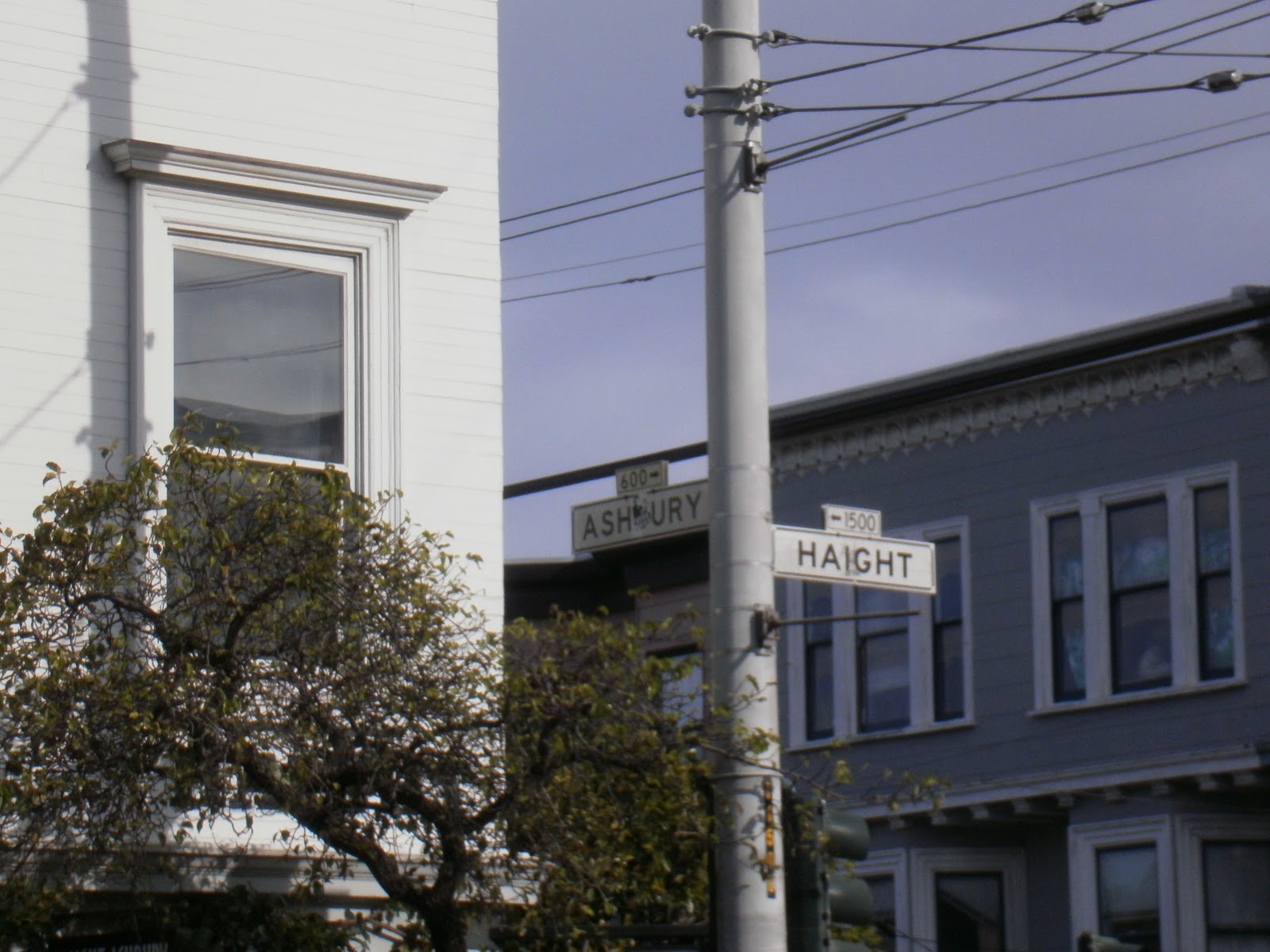
First stop though was a pilgrimage to Jerry Garcia's house at 710 Ashbury.  These days it is a beautiful and plaque free residential home.  And I don't blame the owners at all for gating the front steps to prevent the hordes of pilgrims like me having their photograph taken on Jerry's steps!

710 Ashbury -- Jerry's house.

Downtown San Francisco is quite a decent walking city.  We grabbed maps and headed for Chinatown and a nearby bar frequented by Jack Kerouac and other artsy people in the 1950's and 1960's called Vesuvio.  Jan had never eaten dim sum so it was something new for him to chow down on lots of little plates of things following which a cool cleansing ale or two at Vesuvio was quite an experience.  On the bar itself was an absinthe dispenser, you don't often see those so it was likely quite a serious drinking hole.

Chinatown
Jan in front of Vesuvio on Broadway.  Lots of pictures inside of SF bands of the 1960's including of course the Grateful Dead and Jefferson Airplane.

Viv had waxed lyrical about the joys of San Francisco crab and in particular crab in an omelette and so I had told Jan that the only other box I had to tick was Fisherman's Wharf and a crab omelette, so we took the rickety old street car (they are just wonderful) down to Pier 39 for a quick bite to eat prior to the show.  We just about had enough time, actually we hadn't.  We or rather I had forgotten just how touristy this would be and the crowds were immense so we had to rush around looking for a restaurant where the crab fix was resolved but then realised in horror that we and 100,000 others were looking at a 1930's renovated street car seating 35 to get back downtown to the show in time for a 7.30 start.

Fortunately a bus came by and for $2 each he dropped us pretty near to the auditorium and having collected the tickets for all 3 nights piled into the show.  Amazingly these 70+ year old geezers had started on time bang on 8 pm (they would be even earlier on the subsequent shows) and we missed the opening few bars to "The Golden Road" from their first album.  Great start and indeed a great show.  You can check out the set list and see photos on the website www.further.net.

They played until midnight just about with a short break and both of us agreed that not drinking throughout the show was a good idea, thereby avoiding the inevitable bathroom breaks.  One thing amazed me was the age of the audience.  I expected grey hairs like Jan and I but not the 20-something year olds and all ages up.  Why on earth would a 20 year old force fed on rap, hip hop and Beyonce want to watch a bunch of 70 year olds play really, really long songs?  Jan of couse said "Why wouldn't they?  The music is fantastic."  OK granted but really that's not an answer.  So I asked a 20 year old (it was his 20th birthday he told me).  Apparently it is the tribute bands that are on tour endlessly around the country and in particular the campuses that created the spark.  So when the originals decided to play, of course why wouldn't you want to see the masters at work?

One thing that bugged me is my camera.  I've carried it around with me for several years now and realise its OK for snaps and not much else.  I'd hoped for some nice shots with Jan and of the show and pretty much they are dire (sorry about that and the fact that that means I snagged some stock photos off the internet).  But there were people all around using their smartphones of all types to take photos and they looked great.  People were also recording the shows either in industrial means in the dedicated taper area or again from the smartphones and the quality looked amazing.  Given smartphone technology advances, who needs a camera any more just for snaps?

See what I mean?  Fantastic quality.

The following day was interesting.  The Red Victoria on Sundays hosts a "Peace Conversation".  The hosts grab a bunch of residents and sundry visitors to discuss peaceful issues and initiatives and included Jan and I, which came as something of a shock.  However everyone was really nice, earnest and suitably peaceful so it was a pleasant experience.  One thing made me chuckle though was a nice young couple who we ran into every day of the trip in various locations including this conversation.  The young man was a Marine aviator officer.  Part of the conversation was about what people bring to the world as their unique skill and this young man decided on his mentoring abilities for younger recruits (he was a mere 27, same as my son Indy).  Later on we ran into him and he'd forgotten his car keys (he'd actually left them at his parents' house in Oregon, one state away) and as he couldn't return to base in Florida via Oregon again, his parents made the sacrifice of driving umpteen hours down to SF to return his keys!  You never stop being a child to your parents even if you're a US Marine officer.

We of course managed a cable car experience -- why not?  And it was of course great.  I just love the way that many cities maintain their older public transport systems -- cable cars, street cars, etc.  In England we dug all that lot up years ago.  I wonder why.


And of course there was Neiman Marcus (or 'Needless Markups' as I have heard it described) with their high priced array of fancy stuff.  When Viv and I came to SF years ago we were enthralled with the biggest Christmas tree we'd ever seen.

2012 version of the Neiman Marcus tree
I took Jan to a steak house for lunch -- John's Steak House, apparently the best in SF.  Dashiel Hammett, the author, used to eat there frequently as did Sam Spade his detective in the Maltese Falcon book and movie.  It was great too and took us nicely up to showtime.


The second night's show surprised us even more as they started even earlier so we again missed the start of the show.  I bought the CD of the show by waiting half an hour after the show and checked -- we in fact didn't miss more than a few minutes.  What a great show though -- again!  These guys are amazing, playing for another 4+ hours with only a short break in the middle.  Highlight for me was the "Dark Star --> St Stephen --> The Eleven" combo.

We met Jan's friends on New Year's Eve at a bar in another part of town -- a guy called John being the organiser whose job it is to sell Grateful Dead merchandise.  We hung out with him after and got a ride to the show with some other friends of his that were taking an array of food and drink to the show as they'd organised upstairs seating -- which would be a change for us as we'd been downstairs in the auditorium thus far.

Did I say "organised"?  What was I thinking?  Chaos, more like.  The entire Dead follower fraternity don't take life too seriously and organisation and planning is never on any to do list.  They also have a traveling camp outside where you can buy Dead stuff (and whatever else you can imagine too) called 'Shakedown Street' -- there's a song about it too.  Mind you it all worked out and we took our balcony seats for the final hurrah.


Balloons at midnight!


And of course it was a great show -- on at 7.30 pm, finally off stage around 1.30 am!!  Just the 6 hours less brief breaks between sets.  The highlight for me was the "Dear Mr Fantasy --> The Wheel".

Straight to the airport afterwards and collapse on the plane!!  Thanks SF, I had a great time.


Saturday, December 8, 2012

World Heritage Sites

Up until now I've only written posts for countries I have visited outside Bermuda but tonight Viv, myself and Viv's mum Anna drove 40 minutes each way to Bermuda's very own Unesco World Heritage Site -- St. George's.

Bermuda -- divided into 8 parishes. From the top: St. George's, Hamilton Parish, Devonshire, Pembroke, Paget, Warwick, Southampton, Sandys.  Hamilton is in Pembroke Parish, Somerset is in Sandys Parish and St. George's is in ... well St. George's Parish.  

It takes that long of course as the speed limit is only 35 kph (aka 20 mph) and St. George's is just about 20 miles away from where we live in Warwick.  But why tonight of all nights?  Well it was the Bermuda National Trust's pre-Christmas Walkabout.


We've lived in Bermuda since 1985 and this is the first time we've ever attended this event.  This is what the National Trust says about the place:

St. George's is the oldest continually inhabited English town in the New World, and, after nearly four centuries, it continues its dual role as a lively town and a living museum.  In November of 2000, UNESCO designated St. George's a World Heritage Site.  It is where Bermuda's history all began and was Bermuda's capital from 1612, when the first settlers arrived, until 1815, when the new town of Hamilton became the capital.  In St. George's you are surrounded by history -- history that unfolds around each corner of the quaint narrow alleys and in buildings that have stood for centuries.

All well and true but at 35 kph, St. George's is about 10 minutes too far away as far as I'm concerned.  This is a shame as the city is really as advertised, just a step back into history.  You can visit Williamsburg in Virginia and do the full recreated time warp American-style but for the real thing, including bits that are downright shabby, St. George's is the place.

Sad to admit but I usually only visit St. George's every other year when Cup Match is held in St. George's at the Wellington Oval -- Cup Match is the annual East versus West cricket match in mid-summer and is a must visit event in anyone's calendar, by the way.  So I knew the parking which tonight with hordes of merry makers heading for the winding streets of St. George's was just as well.

Fortunately it was a beautiful clear night, not too muggy and a comfortable 70 degrees and our first stop was at the World Heritage Centre itself on Penno's Wharf -- St. George's is an enclosed harbour and has been an active port since the early days and remains so now, although the only ships that dock are the smaller cruise ships and the occasional warship on a goodwill stop.

The building itself is a converted warehouse and has been interestingly laid out with some history thrown in as well as the Sassy Saxes Quartet who were churning out some jolly Christmas tunes -- for this one night only apparently.

Turning up the hill, we turned right into Blacksmith Lane which leads into picturesque Water Street and strolled down towards the main square via the early 17th century Tucker House.  One good thing about such a small place as Bermuda (pop. 60,000) is that you keep running into people you know particularly if there are events going on and tonight was no exception.  Almost at every turn were people we knew, all of whom were in festive spirit and ready to have a good time.

The shops, bars and restaurants were open and every 50 yards or so was a band or orchestra playing cheery carols or something similarly appropriate.  It really was very nice and at the centre was King's Square really beautifully lit up.

Water Street towards King's Square, St. George's

The layout hasn't changed since the early 1600's and many of the buildings are of the same vintage -- very few of course performing the same duty as in the early days.  Walking down Water Street, straight ahead is the Town Hall; to the left is the bank building in front of which are the Stocks -- a place of punishment for wrong doers; to the right is the wharf and Ordnance Island, where boats moored and unloaded and of course the Ducking Stool -- the place where nagging wives are disciplined.  Tonight however the stocks were not in use but a stage was set up where song, dance, bands and speeches were all taking place.  But the Ducking Stool lurked just waiting for an opportunity...

Realising that with all the stopping, looking, chatting with friends and generally milling around time was moving on, we moved onto the State House, a real highlight.  Built in 1620 by Governor Nathaniel Butler, the State House is one of the oldest remaining stone English structures in the New World.  It was the earliest government building, has been a law court and in 1815 when the capital city was moved to Hamilton along with the important government buildings was rented out to a Scottish Freemason lodge (#200 if you're interested.  They meet on the 1st Tuesday after the full moon each month) for an annual rent of 1 Peppercorn.

The Old State House

The rent was set at this level on condition the lodge was left open to visitors, a unique circumstance as freemason lodges are usually kept strictly closed.  Each year the rent is paid in the Peppercorn Ceremony, an event where the Governor and all of Government turn up to receive the solemn peppercorn from the lodge's master and a host of other masons, many of whom fly in from overseas and parade around St. George's in their full regalia.  It is a ceremony unique to Bermuda and in particular St. George's.

Peppercorn Ceremony

We left St. Peter's Anglican church to last.  The church is the oldest continually used Anglican church in the Western hemisphere.  Replacing a 1612 structure constructed of wooden posts and palmetto leaves that was destroyed in a storm, the present church was built in 1615  and has been much extended in 1713 and again in the 19th century.  The first Bermuda Parliament met there in 1620, making it the 3rd oldest parliament in the world.


St. Peter's Anglican Church

History!  The entire place reeks of it.

Tonight was a magical night and has made me think twice about leaving it so long before visiting St. George's again.  This really is a special place.


Sunday, December 2, 2012

Welly's

It's been 7 months since I 'un-retired' and rejoined my company and it has been an interesting time.  We launched a new mutual fund (now we have 4) which I put together and in general have been trying to crank up the pace.  Having nearly 2 years off recharged the batteries a great deal and I do recommend a mid-career break to anyone who is lucky enough to have that luxury.  It certainly wasn't planned that way but that is how it seems to have turned out.

It has also meant I've started to come to Cayman again.

The Cayman Islands is a British colony like Bermuda but without the same constitution meaning far closer supervisory links than Bermuda.  Whether this is good or bad is a matter of opinion but in the wake of the Turks & Caicos Islands' spectacular financial collapse and take over by the FCO in Whitehall (my friend Mark from Bermuda playing a leading role), HMG and the mandarins are taking a far closer interest than before.

It's also nearing election time both in Bermuda (on 17th December) and in Cayman (some time in May 2013) so rhetoric of the highest level is being blown out in all directions.  I can't vote in either jurisdiction so am in the happy position of observer in both cases.

Bermuda has a new party contesting the election and as of last week Cayman had a 3rd grouping -- too early to call them a party -- meet the public to try to raise the notion that honest, transparent and fair government doesn't just have to be a pipe dream.  I know I've over simplified things somewhat but this lot are educated successful businessmen and women who've just had enough.  Were in their position I'd probably feel the same too.

I mention this for today I had lunch with my Caymanian friend Bryan who'd talked about this new 'movement', for want of a better word, in Cayman that hopefully presages changes for the better.  And during the same conversation last time we met we'd talked about the finest Cayman cuisine and where would he go.  "Simple", he said.  "Welly's".

Welly's
So we agreed to go to Welly's.

Welly's looked a bit of a shack when I arrived with my business partner, Robert, and went inside.  It was really small, about 10 foot square with a bar along the length of one side with a rasta and barman looking curiously at us.  The rasta had a beer and a big dark liquor based drink by the look of his ruby red bloodshot eyes and said "I think you two gentlemen are looking for the restaurant which is that building over there".

He was right and that first attempt corrected we had no trouble finding the restaurant where we found that the choices were fairly simple: either stewed or fried and stewed fish, goat, salt beef or beef with plain rice, peas and rice or rice and beans -- yes there is a difference.  Bryan said you had to also have the beef soup which is really something.  And he was dead right, it was something.  Just fantastic in fact.  As was the salt beef and beans with plain rice that I had (the others' choices also received a favourable report).  It was unlike me to actually eat the beans but they were too good even though it was likely to condemn me to an afternoon of intestinal discomfort.

I played tennis that evening and during the apres tennis beers I mentioned Welly's and everyone not only knew it but knew others that were waaaaay better too.

It only goes to show that quality sometimes comes in the most curious of shapes.

A few days ago I drove out to the deserted east end of Cayman as I periodically go through splurges of thinking about buying a small place in Cayman.  There's lots of space so no restrictions on who can buy or build like in Bermuda.  It also means that you're unlikely to make any money on real estate as there'll be space for years so it really is a lifestyle choice.  I'd found a real estate magazine and took a look at a place called Beach Bay and found, well, no beach really of any sort but a rather Californian looking home.

No beach in sight...


... but there was this modernistic looking house.

I also found the home of the new Shetty hospital, a fair step towards the east end.  The plan is to spend $250 million building a medical facility to enable operations to take place outside the hideously expensive USA, but close by.  15,000 new people in 10 years apparently plus all the trickle down benefits to the economy.  Cayman really is trying hard to make things happen.  Lets hope it actually happens.

At present not even a building site but who know in future?
One thing that I do find odd is the speed with which folks in Cayman put up their Christmas decorations.  Immediately US Thanksgiving was over and out came the trees etal.  Its not even December yet!  Mind you they go all out which is pretty neat.  I thought Bermuda went mad but these guys just take it to the next level.

It even makes me feel Christmassy already.

And then you walk onto Seven Mile Beach and all Christmassy feelings leave!

Mind you the reason I was in Cayman was business and in particular a conference where the keynote speaker was a guy called Erik Wahl.  He was an inspirational speaker but did his talk through the use of art.  I'd slipped into the session to watch and the organisers put on a U2 video of "Beautiful Day" which I watched for a bit as nothing much seemed to be happening on the podium other than some skinny bloke putting out water and setting up something presumably for the speaker.  The song went on all of a sudden it appeared that this bloke was doing something with crayons on a black board.  The song continued some more and as it hit the final notes, all of a sudden there was Bono.  Pretty impressive!