Tuesday, July 12, 2011

The Long Way Back

Rather sadly we turned left out of the hotel and left again at the lights and turned onto the autostrada heading north... WHAT!!!  Why didn't the road instructions give these details on the way in?  OK, moving on ... Ali and I decided we'd rather like to have a final pasta meal at lunchtime so chose Lake Como to be the location, or rather Cernobbio, a small town on the lake.

Pulling out we turned back on the wrong side of the motorway heading back to Milan and passed through all the tunnels, etc, that should have led us to Switzerland but in fact led us back towards Milan.  Those bloody road signs or this time lack thereof!  Anyway we managed to turn around and head north, the plan being to take the San Gotthard pass in Switzerland this time and then head through Zurich and overnight in Stuttgart.

This was a day for tunnels and bridges like no other.  I've enthused about roads and infrastructure but really the Swiss went way overboard.  The tunnel through San Gotthard is 17 kms -- the longest of the trip -- but that meant we hit Zurich at rush hour time where we got caught in traffic for nearly 3 hours.  This meant we made it to Stuttgart around 8.30 pm but on the way we'd experienced the 'thrill' of the German autobahn.

Lake Locarno from the car ... nice barrier
The Modus is a fine vehicle of course and maintaining 130-135 kms is a breeze (about 85-90 mph) however on those roads the big Audis, Mercedes and BMW's in the rear view mirror are pretty intimidating.  They all have big wide wheelbases and are low to the ground.  Plus the newer models have these little halogen light dots that highlight their headlights making them look like sinister snakes as they approach at near warp speed and then roar past.  Not so many sports cars though, just these big saloons driven very, very fast.

Stuttgart is a nice town though, what we saw of it.  90% destroyed in the war, it was not restored for some reason.  The town planners simply built whenever so its a 'new' town in the sense that there's not endless medieval buildings all over the place.

The main platz in Stuttgart.  The only place where any old buildings are standing.
Not sure why but Ali next wanted to stay in Eindhoven.  That was a long drive!  Not so many windmills in Holland any more.  There's quite a few of those big wind machines though as its so low lying -- and quite boring actually.  We'd not booked anywhere as we were not sure we could make that far but rolled into the Information office (the VVV) who found a place opposite a gay bar for us just out of town.  We had our usual bimble around town to get a grip of the place and found an Indonesian restaurant for one of their rice tables (rijstafels) which consisted of 17 different dishes and rice.  A stand out meal indeed.

The skyscrapers of Eindhoven in the distance

A modern day windmill, without the wind bit.  Or  the mill.
The final stop would be Brussels as we wanted to eat mussels again but this time I booked a place ahead of time in the Avenue Louise neighbourhood.  And where I was critical of Milan's road signs, they almost pale into insignificance behind Brussels.  It took about 1.5 hours to drive into the outskirts and the same again to find the hotel, no more than 2 kms away.  Just hopeless!  In the end we stopped and found a street map on the street next to a bike hire stand (that seem to be in every city these days, nice idea by the way).  Armed with this information and after only a relative few more side turnings and mini detours, we found the hotel and checked in.

I actually missed an important side bit in that en route and pre-traffic holdups and wrong turnings and bloody one-way streets and no sign posts and ... we delayed and headed for the Battle of Waterloo Champ de Bataille in Waterloo itself.  I've just finished reading a great book on Wellington on the Peninsular War and Waterloo campaigns so am full of this stuff right now and Ali in reasonable humour tagged along getting more interested along the way.  The battle of course redrew the map of Europe and established a new European order, the tour guide used the word 'hegemony', namely that of the main victors of the battle: England and Prussia.  Sure Austria and Russia were waiting their turn and Spain and Portugal were nosing in from the south but it was Wellington and Blucher who won the battle and very clearly the peace that followed.

The lion monument at Waterloo.  The English position was atop a range of ridges and small hills which were razed to make way for this memorial.  The lion is aimed at France supposedly keeping watch.  Wellington visited the battlefield 2 years after this was completed and complained "Where is my battlefield?"
At the top of the lion monument

For years after England had the veto on virtually every major foreign policy decision taken by any European nation and with Wellington first Ambassador to pretty much every country in Europe, then C-in-C, then Prime Minister (a really bad one incidentally) and then finally the crusty old warrior that nobody ever wanted to cross ever, England was able to roll above the everlasting 19th century continental European squabbles, revolutions, restorations, wars, and such and say "No, you can't do that" at various junctures and the various parties would say "Alright, sorry, didn't mean to do that.  Hope you don't mind" and everything would be hunky dory (for England that is -- Milan however as an example didn't do so well).  It only took 100 years for the Prussians to get sufficiently resentful that they felt like taking on England again in WWI but I suppose they'd been busy unifying Germany (at sword point) and thrashing every other upstart nation nearby (Austria 1865/66 and France 1870/71).

The Belgians rather nicely have legislated that the Waterloo battlefield will never ever be built upon as it such an important national as well as European icon.  Curious that they have leased the field itself out to lettuce and cabbage farmers who've put up "Properte Prive" signs everywhere.  But the tour was great although the farm at Hougoumont is under repair so we couldn't go inside.

Once ensconced in Brussels we headed into town on the Metro.  I have to say this is the way when driving around Europe.  Most cities have efficient public transport and with the city centres impassable to traffic and parking crazily expensive, why not stay near a Metro stop a little way out?  The city is lovely and the Grand Place spectacular of course and if I haven't waxed on enough about Belgian cooking, that is an oversight as realistically European cooking outside France, Italy, Spain and Belgium is bog standard meat and potatoes (Scandinavia is probably herring and potatoes) which after a couple of days is pretty uninteresting.  Belgians love to eat and drink.

Getting ready for the entertainment in the Grande Place
I've mentioned before the hundreds of different beers brewed in Belgium, most of high alcohol content and made with wheat, fruits, and in other fancy ways which I personally find undrinkable.  The standard beers though are just really nice though and Ali and I mosied into a couple of bars to taste test Brussels' finest.

The first place was recommended in the guidebook (Delirium Cafe) as having 2500+ beers in stock at any one time.  It was jammed and with only 2 barmen, nobody wanted to take the time to discuss beers so we left in a huff and found a small, street corner bar nearby where the barman greeted us with a cheery "Hello Boys".  We ordered a couple of beers and started chatting with the locals when I realised that they were all guys and that the only younger guys in there appeared to be ... well, the object of the older guys' attentions at which point we realised we were in a (unadorned) gay bar.  So we left and found this time a waffle bar where Ali had his first Belgian waffle of the campaign.

The 'evening snack' waffle -- chocolate sauce, vanilla ice cream and whipped cream

I did say that Belgians love to eat, didn't I?  In the streets around the Grand Place were restaurants of all kinds, coffee shops, waffle shops, ice cream stores, and chocolatiers galore.  Ali marched into one for a bar of dark chocolate which is when I fell from grace and broke the seal, as it were.  Being a lover of chocolate in all its forms, I know my limitations and weaknesses -- they are great.  If I start eating chocky I will continue until next year and the 5 individual pieces I bought from that shop lasted probably 30 seconds.  Some form of inner steel kicked in at that point for we marched on now looking for a dinner option.

The Grand Place was having some form of medieval ceremony with people of all ages dressed up in old clothes marching around to some stirring music waving flags which was a fun diversion but once finished we felt the need for dinner and found Leon's -- a 100+ year old mussel shop.  Ali didn't have mussels whilst I did (plus oysters) and they were very fine indeed.

The following morning was a 200 km dash to Calais to drop off the Modus and catch the ferry back to England so Ali and I decided to seek for more waffles and the elusive frites with satay sauce and headed back into town.  Both were satisfied (frites were a little disappointing as the shop had no satay sauce) so we headed off.

The 'breakfast' waffle -- strawberries ("to cut the sweetness"), chocolate sauce and whipped cream

I did mention about how in Brussels there's no helpful road signs, didn't I?  That works for going out as well as going in for we drove around the tunnel system for ages until we saw a road sign but when we did we were able to crack on.

I'd been a bit worried about the mechanics of dropping off the car and called the Renault number I had to negotiate a return time.  I said I could do it around 1 pm and the lady at the other end said that was lunchtime, could we make it at 2 pm?  Just as well as with all the messing around in Brussels we were behind even that return time and finally made it back to Calais harbour (drop off at the ticket office) around 2.30 pm to find nobody there.  So I called the number again and spoke to the lady who said she'd finished work for the day and could I just return the 2 keys, the car documents and any other relevant paperwork and leave the car anywhere in the car park?

So all in all very easy indeed.  We parted from the Modus -- now 7619 kms old -- bought ferry tickets and went back to Dover where Paw Paw awaited.

Farewell Modus and thanks!

Paw Paw of course had cooked up a storm and did Ali's washing as he planned to stay on in England another month.  We'd arranged to go up to London for a couple of days first before I flew home on Monday.  So it wasn't over just yet!

Monday, July 11, 2011

Forza Italia!!

So many factors determine what makes a successful country but sometimes its pretty easy to see at once what problems exist.  My Roman friend, Angelo, said in the past that when Italy got into troubles, it simply devalued the Lire again and immediately they were competitive again and became (temporarily) more successful.  Now its part of the Eurozone it has zero ability to do something similar again so its economy continues to slumber and drift but that isn't why I think Italy will never rise above where it is right now.  I think its down to road signs.

How can anywhere seriously look to grow if at no point in time does anyone not from the locale know where they are?  (Brussels is just as bad by the way but they have the excuse of trying to tell people where they are on their tunnel ring road ... which is gibberish to anyone not from Brussels).  I'd chosen a hotel in a business district -- on the subway but a couple of kms away from the centre.  However the road signs wherever they existed were pitiful.  I'd written down instructions given by the hotel themselves which were simply useless.  They may as well have been written by a 4-year old.  Ali called the hotel and tried to tell them where we were -- a tough thing in itself -- but the hotel said if he gave instructions, they'd be useless so refused to provide any.  So Ali asked a guy getting cigarettes from a shop who said "follow me" which we did which was how we found the hotel.

I cannot hammer Milan and Italy too much as all cities have traffic issues and have instituted mazy one way systems all around their city centres making driving a miserable task for any that do not have a GPS.  Next time I will get a GPS!

8 stops on the metro later and we walked out into the Piazza del Duomo and boy what a duomo it is.  My chum in York Minster had told me that the Minster was #2 in the duomo size rankings in the northern hemisphere after Milan and where York is all business (courtesy of the Reformation), Milan is all ostentation.  But what magnificent ostentation!


We took it in a bit and then bimbled on and around the inner part of the city centre finally settling on a restaurant for some risotto milanese and the result of Ali's internet research regarding the cotolette.

Both wiener schnitzel and the cotolette have only been around since the mid-1800's when Milan had fallen into the hands of the Austro-Hungarian Empire -- this was fairly recent as Boney (again) had rolled up all of Italy by 1803 and had himself crowned King of Italy.  Before this the Duchy of Milan was an independent city state, a position it had held under the Sforza family since medieval times.  Whether the cotolette beat the schnitzel into existence depends on your perspective -- whether you are Italian or Austrian.  The Italians of course believe that their Cotolette Milanese is pre-eminent while Austrians believe the wiener schnitzel came first.  The important thing is that Ali was able to chow down on both in order to make a definitive conclusion as to which was best.

He said they were both as nice as one another.


Next day we headed out on the hop on hop off bus tour which was good (they'd all been good, the only dodgy one being the tourist train in Ljubljana) and enabled us to have an early dinner before heading out to the Roger Waters' show.  More risotto milanese but this time no cotolette.

The show was held at Mediolanum Forum in an outskirt called Assago.  Mediolanum is the old Roman name for Milan.  But we'd had some interesting debate on its whereabouts with the receptionist at the hotel which went something like this:

"Can you let me know where the Mediolanum Forum is?  We are going to a show there tomorrow and would like to know how to get there."

"What?"

"Mediolanum Forum.  Its in a place called Assago."

"For-Uma-Sago.  Never heard of it."

Ah, so it DOES exist!
"You don't know where the stadium is?"

"What?  San Siro??"

"No, not San Siro.  Its another stadium where they have shows and that sort of thing."

"You want to buy some shoes?"

"No, no.  Shows.  Things like concerts, basketball games.  That sort of thing."

"You cannot get shoes there."

"No, I know.  Its the stadium at Assago."

"Aah, you mean Foro Assago?  Its not very close.  Very difficult to get to from here."

"OK, but you do know it then?"

"Of course.  Who doesn't know the Foro Assago?  Concerts and basketball matches happen there."

"Yes, yes and that is where we are going tomorrow."

"You want to go there tomorrow?"

"Yes, tomorrow evening.  We'd like to know how to get there."

"Its very difficult."

"Yes, so you said.  So how would we get there?"

"You could take the Metro to this stop and then get a bus."

"Great, so that's how.  How long will it take?"

"Ooh, long time.  Depends on traffic.  Maybe one hour."

"What if we got a taxi?  How long would that take and what would it cost?"

"You want a taxi now?"

"No, maybe for tomorrow.  To get to Foro Assago, how long would it take?"

"Depends on traffic.  Maybe 20, 25 minutes."

"OK and how much would it cost?  Just an estimate."

"Maybe 20 Euros".

Ali was having trouble not laughing out loud at this exchange but at least we had a plan.  We'd take a taxi there and wing it coming back by following the crowd.

And this is what we did and remarkably easy it was for to nobody's knowledge the Metro line had in fact been extended out to Foro Assago so getting back after was a breeze.


The show itself was great of course and I think RW had made a couple of small changes (for the better) since I last saw it in Antwerp.  The solo on 'Comfortably Numb' for example was extended, better and more showcased.  Our seats were good too, right next to the wall on the right hand side.  The stadium was full and audience enthusiastic.  Shame RW didn't do an encore.


Big come down tomorrow though as we were about to turn north and head for home.

Sunday, July 10, 2011

Northward Bound

How can anyone be annoyed about a place that calls itself Zadar?  It is something out of Star Trek, for goodness sake.  "Aliens from the planet Zadar are running amok in Kotor" -- just brilliant.  However when we left Mira's place we found a parking ticket on the Modus.  Other than outright amazement that someone could defile such a vehicle, we were amazed as we'd spoken to a cop the night before who'd assured us that we'd parked just right and shouldn't get a ticket.  Clearly he'd not spoken to his colleagues when he'd knocked off.

Putting this brief interlude behind us we headed for Slovenia, our target for the day being Ljubljana, its capital city.  We'd crossed Slovenia already and had noted that clearly no love was lost between Slovenia and Croatia as the motorway ran all the way to the Italian border where it changed to a single file road across 25 minutes of Slovenia before Croatia picked it up again with a motorway of its own.  This time though we headed inland and after a while picked up motorway and the remainder of the journey to the 280,000 person capital city was a breeze.  Even finding the hotel wasn't a major problem this time as somehow we drove up to it almost at once.

It was hot though and making an immediate mistake in having a beer in the sun compounded things to the point that torpor set in.  Ali decided he needed a nap while I took a look round, pretty sluggishly and was pleased to find that Ljubljana was in fact a lovely city set aside a little river running through it.  There was of course an old town but without walls as they'd been overrun more often than, well I can't think of anywhere right now actually but it had been an awful lot and they seemed pretty resigned about the whole thing.  There's only 900,000 of them in the whole country so they probably couldn't make much of a fuss anyway even though the country is pretty much 100% mountains.  The Austrians had been the overlords longest so their architecture seemed to be most dominant.

We found a place to eat specialising in suckling everything but it had been a busy night so they'd sold out but could help us with the local specialty -- horse or young horse (i.e. foal).  Gently declining the 'colt tartar (a house specialty)' we ate sparingly as the search for the real wiener schnitzel would take place the following day as we were headed for Vienna.

Colt Tartar anyone?
En route it began to rain for the first time in ages but we still made good time to Vienna where we had no chance finding the hotel so Ali headed for the central information office and found it.  The hotel was right next to Prater Park, famous in the 39 Steps movie, and a little out of town on the underground but was just fine for us.

The ferris wheel in Prater Park
I'd found reference to a biergarten in the park that served beer and schweinehaxe so we headed there first to chow down on some real pork.  My goodness, what a hunk of meat!  But just perfect when combined with Budvar pilsner.  It was mid-afternoon on a Friday and the place was jammed.  Next to us was a man with a haxe and a BIG glass of beer, some cabbage salad and some bread and he'd clearly made plans to stay the night as he was not going anywhere!

What a hunk!!!
We on the other hand headed for the centre of the city and as the hotel said we were only 20 minutes out of town decided to walk.  It wasn't 20 minutes out of town.  Anyway ultimately we made it and began to criss cross the city to try to make it to the Opera House where the hop on hop off tourist bus started from.  We found it and then also found Cafe Sacher nearby and decided to stop for a cafe and sacher torte (chocolate cake and whipped cream) which is their globally renowned piece de resistance.  Very nice it was too but by the time we'd finished, so had the tourist buses for the day.  So rather than do the tourist bus thing, we decided to head back to the hotel to change and really seriously look for some wiener schnitzel.

I'd found reference in the tourist book to a place where prominent locals ate.  It said that the ambience was interesting but don't expect fine dining.  It was a little out of the centre but on the subway so we headed out that way and tramped around for a bit before finding what looked like a church hall (forget the name, sorry).  Inside were cheery, red faced Viennese drinking all sorts of stuff and chowing down on large slabs of something that on closer examination seemed to be schnitzels.  A table at the back was found and we ordered beer and bog standard wiener schnitzel and looked around at the other patrons.

The place was jammed.  At one table were 8 young people all eating and drinking.  One young lady at the end started accumulating all the uneaten hunks of schnitzel looking stuff and with the waiter's assistance began wrapping it up -- and there was a lot of extras.  The 3 person table next to us clearly ordered the meat combo as the waiter brought in an enormous platter piled high with schnitzels, sausages and other meat like looking substances that they managed to finish less than half of.  As for us we'd already eaten schweinhaxe and sacher torte so were not really ready for an onslaught but it came anyway in the shape of plate size schnitzels (2 each) and a bucket full of fries.

Not sure how we managed but we did (not the fries though) and the whole thing was laughably inexpensive too.  However we weren't able to converse much for the rest of the evening and suffered a bit during the night too.  Not helping at all was heading back to Prater Park to go on the famous ferris wheel.  We were the only people there at the time so the show was all for us.  The operator stopped the wheel at odd places throughout the cycle but the longest was right at the very top.  Given that the wind was howling and the compartments were shaking and shimmering, this was not the most comfortable of experiences on a stomach in any state at all, but when said stomach was filled to the brim and beyond with haxe, sacher torte and schnitzel galore, well ...  This said, I wouldn't have missed it for the world.

"Don't ask how I am feeling right now"
However we did take the tourist bus the next day which was just great.  Vienna is a lovely city and has beautiful buildings all over the place.  The empire of old has gone but they certainly loved to bling the place up.  Summer Palace at Schonburg; the Duke of Marlborough's sidekick Prince Eugene' palace at Belvedere; just lovely and realistically a shame we had to leave after only 1 day.

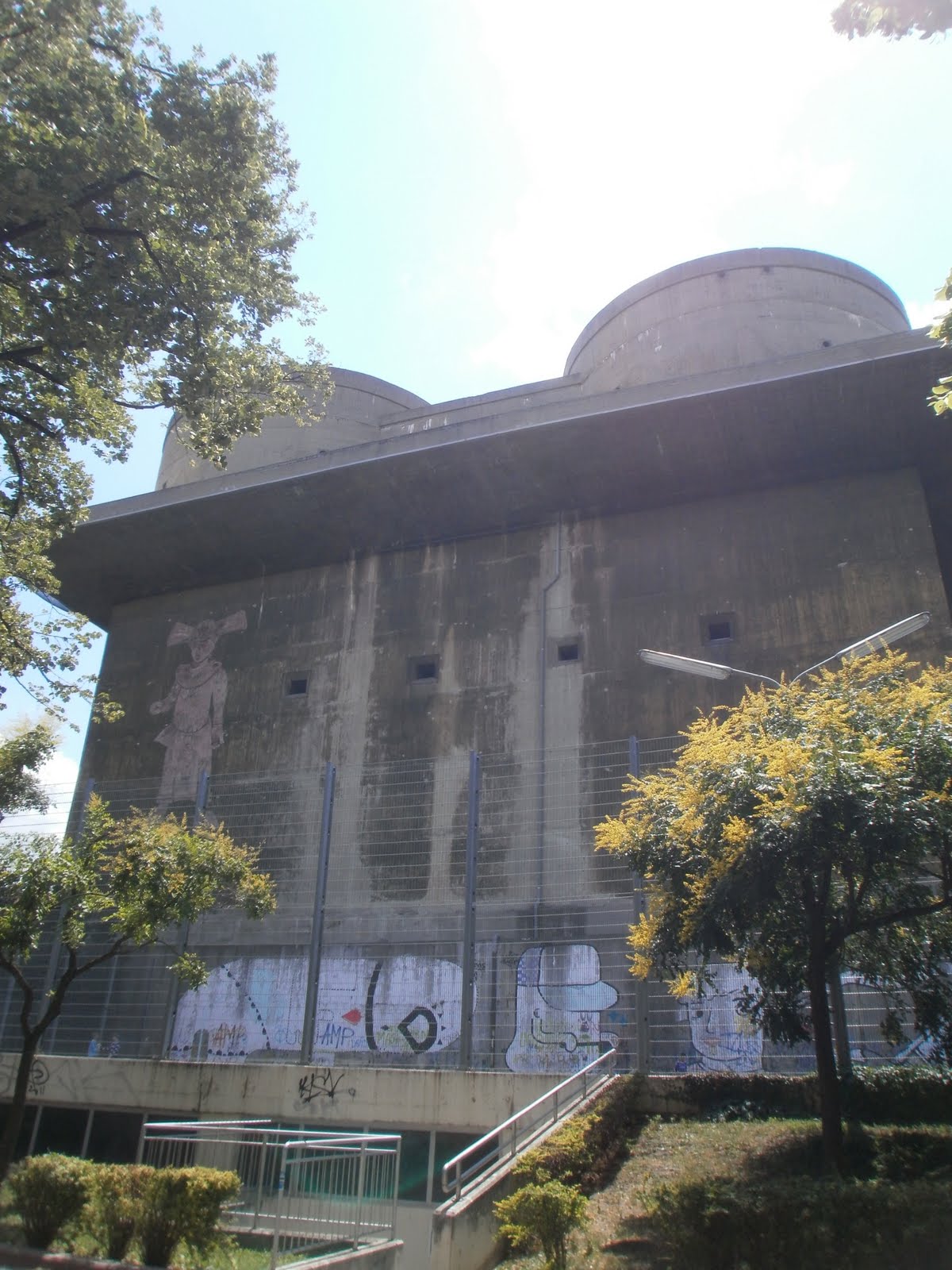
On the way out we drove by a WWII flak tower, one of 6 erected by the Nazis against bombers and which were so well built could not be torn down after as the damage it would cause to the nearby buildings would be absolute.  Some 30-40% of Vienna was flattened in the war.

Flak tower still standing
The drive to Munich was uneventful although finding our digs was again torture however having found the Regent Hotel only 100 metres away from the station as the guide said we were pretty much sorted. We'd planned to stay 2 nights as the first would take in the Hofbrauhaus where Hitler had started and which Viv and I had visited before.  I expected a slow morning after so suggested a lazy tourist day rather than 6 or 7 hours driving.  Great stuff!  We had a haxe just because we could and settled down to sing and chat with the locals.


The first bunch on our table were locals who'd been there for 3 hours and it showed.  One young chap said "you English make fun of us, you call us krauts.  After the cabbage."  Ali asked what the Germans called the English and he replied "you drink too much and it is always raining"... fine talk coming from him, we pointed out.  Also it was raining outside.  "OK" he said and we got on famously.  Next were a family from Emden ("the furthest top left in Chermany you can go.  It is 12 hours drive tomorrow") and finally a family of all things from Uruguay.  The oom pah band didn't play as much as we liked but after several more steins of beer, it was clearly time for bed and the headache that followed.


We did the tour bus and discovered that over 90% of Munich was flattened in WWII and what the town did with the rubble was scoop it up and make hills good enough to ski and sled on in the section of the city that hosted the 1972 Olympic Games -- the so-called 'Munich Hills' for other than this it is as flat as a pancake.  Great tour again and ideal for a lazy day.  Ali took over the navigating and marched us around Munich in the sun until we found it was time for a mid-afternoon haxe and beer in the English Biergarten preparatory to the last wiener schnitzel of the day and a reasonably early night.

A modest snack
Germans love to eat and drink.  All the stuff you read about the Europeans being more circumspect in their drinking habits and diet is simply nonsense.  There's just as many heavy drinkers and eaters around Europe as anywhere else.  The Germans I would say though rank #1 in that category though.


Next is Milan and the show!!!

Friday, July 8, 2011

What or where on earth is Kotor?

I'd burned 10 CD's with a mixture of music on them a few days back as the radio/iPod thing wasn't working right and one of the songs was to get us ready for Munich's Hofbrauhaus with a chorus of "Who the **** is Alice?" and you could say much the same about Kotor ... until you get there.

Welcome to Montenegro
The drive from Dubrovnic to the border along the coast was short and then we met the non-EU funded roads my brother Jan called "immediate death" of Montenegro.  Windy, switchbacks, deep gorges, you name it and with "immediate death" just a second's inattention away.  But then we entered a bay, or what seemed like a bay but turned out to be one of the largest fjords in the northern hemisphere.  Fjords are glacial and are to the sea what valleys are to the land.  Massive cliffs and very deep water and this one just kept going on and on.  Very impressive too seeing mountains all around as we drove further into the bowels of the fjord at the end of which was Kotor.

Never a fjord...
Kotor is yet another World Heritage Site as its old town again is in pretty darn good shape.  Apparently Kotor, like Dubrovnic, was a renowned trading location in the past as the caravans from the east ended nearby and Kotor (like Dubrovnic) had a huge trading fleet to take stuff further on.  Kotor survived pretty much unscathed as nobody knew it was there ... at the end of a darn great fjord, behind darned great walls.  However they built forts in them thar hills too which appear to have stood the test of time largely it must be said because nobody attacked them.  I suspect it was because nobody could possibly find them of they didn't know it was there for where Croatia's hinterland has rocks, trees, no roads and no people, Montenegro's is even more desolate than that (if possible).

Montenegro sided with Serbia pretty much all along and suffered the same WWI fate as them - i.e they were rolled up by the Austrians -- however that lasted only until 1918 when the victorious allies lobbed them in with Serbia and all the others to create a new Yugoslavia.  They also got a Serbian king too.  And that was pretty much it for Montenegro as anything other than a team that draws 0-0 with England at Wembley in various qualifying football matches ... at least until 2006 when the then president extracted them away from Serbia.  This must have been some feat as the Montenegro coast is/was Serbia's only water outlet and the Serbs are notoriously prone to invading other countries nearby if they don't like something.  But the Montenegrins themselves still consider themselves to be mainly Serb even though the tourist books say the language they share with Serbia should be called "the mother tongue".

Mother tongue and helpful translation
However the Serbs are pretty ever present in Montenegro.  They holiday there, they own second homes there, they are building a massive new development called Porte Montenegro just outside Kotor which is meant to rival Monte Carlo ... already some humongous boats are there, also cruise ships.  Remember this is a fjord.


The country is trying to build infrastructure but as they are non-EU have little access to cheap EU loans so building is slow going.  Driving at night is a death wish, according to Jan.  The WHS old town of Kotor is in pretty good nick still though as nobody bombed, strafed or attacked it but it is pretty run down and needs a billion or so to pretty up to say Dubrovnic's standard.  However it was where Jan chose to take two of his three children, Zofia and Gabriella, on holiday.  Rupert couldn't make it so as we were but one country away, decided we could make it instead.

Jan had rented a car and a yellow apartment building also housing a government department next to a Roman or medieval ruin ... nobody could be sure which.  It was a nice place to catch up too.  They had already met some crew of the monster boats whose sole pastime seemed to be vodka so were a little sluggish to start with.

Note the fort barely visible atop the 'hill' not mountain
Kotor was overrun by Russian billionaires and their trophy wives.  It was fun to see one particular TW pose theatrically by what looked like a drain in the old town whilst hubby snapped away.  One day we took a drive (Jan driving with Captain Beefheart, PJ Harvey or some other band screeching away at #11 on the dial) to Lake Skodor through the mountains on bad roads ("immediate death on both sides" according to Jan).  I've not seen so many lily pads in one place.

Lily pads all the way to Albania
This place is 2/3 in Montenegro and 1/3 in Albania ("I spit on Albania" said our boat driver) and on one side of the lake is a castle formerly Ottoman truly in the middle of nowhere (you must have done something really bad to get posted there) which was the border of the Ottoman Empire (and where they stopped probably not able to face the endless mountains between them and the sea).  The boat ride was fun but after the boat driver suggested a family restaurant where the local speciality called Krap (actually carp, the fresh water fish) was pretty darn good.  When we asked for a menu, mein host said "no menu, just feesh" so we said "fish please" and moments later started an Anthony Bourdain moment when for a change it was us who were taken to a place off the beaten track, taken into someone's home, and had them cook and cook and cook the local stuff for us.  OK we paid (not very much) at the end but the krap was startlingly good.  There was also local trout and sardines -- although not sure how sea water sardines could reach the lake.  Nobody much wanted to ask but they tasted great though.  All deep fried with frites and salad and the first time that Ali and I came across a new holiday favourite which was cabbage salad.

We'd had cooked cabbage already and were actively looking to dodge a repeat but the salad varietal was fantastic.  Some places wanted to add stuff so here are a few rules for cabbage salad:
1) fresh salad finely chopped
2) olive oil
3) salt and pepper
4) lemon juice
5) vinegar
This is a pretty good start and if you stopped there would be easily good enough but if you really must you can add stuff like:
6) caraway seeds
7) fennel seeds
8) coriander or parsley
But definitely stop there.  Trouble is that at times the keener chef would add horrors such as:
9) smoked bacon or ham
And this was where the trouble started as on the first night Ali and Gabs had done some shopping for snacks and acquired some cured ham, salami and what was termed "gouda style cheese" in a brick shaped block.  Even the sight of this stuff made me shudder but the others chowed down and Ali was "off" ham and cheese for the rest of the trip.

Note cheese brick next to Z together with mystery meats
But the fish (I gushed) could have been some of the best ever.

We also visited the beaches nearby which were enormous but narrow with people huddled together.  All within beach cabana type arrangements where on beach nosh and beer could be obtained.  The water was really clear and relatively warm too but the setting at the foot of enormous mountains was almost surreal.


Just in case somebody did find Kotor, the residents built a fort on top of a ridiculous hill ... not a mountain as it wasn't high enough.  Access was at times vertical so I got Jan and Gabs to join me up there to check out the view (Ali had discovered vodka and fresh lemon juice the night before so wasn't up to much) which was pretty darn impressive.  It was old but undamaged other than by age.


Parting was sad but Ali and I planned a great swing through Serbia and further north so had to get going whilst Jan, Zophia and Gabs all headed for home.  However we took a wrong turn almost immediately and gave up on that notion as we were barely able to follow a road, never mind keep a speed decent enough to enable us to actually reach Belgrade (our target) sometime that week.  So we ended up briefly (we think) in Serbia but for quite a lot longer in Bosnia again (nice uniforms) where their mountains we found were every bit as nice, rugged and unspoiled as those in Montenegro, Croatia, Slovenia and Serbia (we think).


We gave up on quite a lot of things that day including fooderies serving mystery meat en route but finally decided that we should stay at a place called Zadar (in Croatia again) not sure why now but I think because it was nearby around the time to stop.  Zadar is another old town on the coast somewhat north of Split and south of Rijetka and apparently has the most clubs of any Croatian town in a place the size of Hamilton.  For accommodation we rocked up to the tourist office and asked for a B&B and Mira appeared less than 60 seconds later saying "this way".

Mira's place was a very clean, double room with wireless internet.  Our neighbours were all back packers or clubbers just over for a couple of days Jack Daniels-ing.

Access to internet is simply THE most important thing in creating a new future.  Young people have a real need to stay connected and internet is how they do it.  On their phones, PDA's, whatever.  Give them wireless and they are in touch.  Greater communications = greater growth potential.  Some large firms see this, most don't.  Step up Mac Donalds, Starbucks, Burger King and ... Mira.

Heading north again tomorrow.

Wednesday, July 6, 2011

Balkan Adventure

Hitler had to postpone Operation Barbarossa for 6 weeks in 1941 as his Italian allies were not just pushed back from Greece, but were driven back through Albania and back in some disarray into what was then the kingdom of Yugoslavia.  So he turned his troops right and pounded through Yugoslavia into Greece and in so doing turned up the gas under the already bubbling melting pot that was the Balkans.

Yugoslavia had come into existence at the end of WWI in 1918 with the dissolution of the Austrian Hapsburg empire when several of its southern provinces were bundled together into a new Kingdom combining pre-WWI greater Serbia as well who had had the temerity of being forced to capitulate to the Central Powers in 1917.  The 6 provinces were Slovenia, Croatia, Serbia, Bosnia (where it all started -- that'll teach them), Montenegro and Macedonia and it would prove to be only Macedonia that our tour didn't reach.

Post WWII, Croatian communist partisan leader Joseph Tito kicked out the king who had sat on the fence throughout the war and re-established pre-war Yugoslavia under tight control.  However there's precious little evidence he was as strict as the Soviets in their other conquered territories as western tourism quickly bounced back and after the various Soviet repressions in Prague and Budapest, Tito distanced himself from the Soviets and essentially suggested they just 'try it' with him.  Having seen the topography of the country and read a little of the military endeavours throughout the region, Tito was pretty confident that he could sit out any threat because boy are there a lot of mountains, precious few roads and virtually no people.

The mountains start pretty well immediately from Italy as the Alps morph into the Julian Alps and then the Dalmation coastline which was called Illyria in Roman times.  These days transport is possible but at any time in the past, it is difficult to see how any serious overland movement could be conducted.  In Italy and Switzerland there are villages all over the hills and in the valleys.  In the Balkans there are trees and of course rocks of any size you care to chose.

I don't know if it has been the multiple past wars in the region that has depopulated the entire region but relatively speaking there's simply nobody there.  Slovenia has 900,000 people.  Croatia 4.4 million (mostly inland) and Montenegro 2 million.  Plus a load of mountains and trees.  This said the entire region is hell bent on catching up with the west and thankfully for Slovenia and Croatia, they were both the nearest to Italy (the west), the furthest away from Serbia and had the most mountains.  Indeed Slovenia is pretty well all mountain.  Slovenia managed to extricate themselves from the post-Yugoslavia/Greater Serbia mess in the first 2 weeks (they had a 10-day war in 1991) while Croatia had to battle it out to 1995 before shedding the Serbs (and Montenegrins).  Slovenia therefore joined the EU ASAP, adopted the Euro and borrowed shedloads more at cheap rates to build roads and bridges.  Croatia took a while longer (currency is the Krun) but managed to borrow the shedloads of cheap Euros on offer and built their roads, bridges, tunnels and infrastructure.  And they are magnificent.

Bridge pillars during construction ... still building roads
I think it was the Top Gear people who said that the finest highway in the world is the Autoroute du Sud from Nice to Genoa -- which we travelled and there were dozens of huge bridges and amazing tunnels -- but they are not a patch on the new Croatian roads.

View from coast road of one of the dozens of islands
People rave about driving along Big Sur in California with the winding roads atop and alongside cliffs above the surging Pacific Ocean.  Well the Adriatic is nowhere near as rough as the Pacific but having driven Big Sur and now Croatia's equivalent coast road that stretches all the way down the coast past Dubrovnic in the far south, Croatia has it on that count too.  That is just fantastic big biking country and there were loads of them from the north just enjoying the winding roads and fabulous views.

More roads and islands ... 
Our Balkan tour first took in Rijetka which is at the top of Croatia's riviera and the start of the motorway system.  It is a port town and we stayed overlooking the container docks but everyone (under 40 that is) speaks English ("if we don't spik Eenglish, we are nothing") and more than helpful.  Ali and I pigged out on home made pasta/gnocchi washed down with a 1.4kg T-bone steak Ali said was for tour bonding purposes.

The next port of call was Split (home of the biggest football team in the country) which is towards the bottom of the first part of Croatia.  I don't know how they did it actually.  First Bosnia and then Serbia comes down to within 15km of the Adriatic at times yet even with a war, Croatia was able to (a) hold on and (b) convince whomever drew up the boundaries that these regions were mainly ethnically Croat.  The southern part is even more extreme in this regard.  But Split is wonderful.

The entire old town is built on top of the Roman emperor Diocletian's palace (3rd century AD).  Diocletian is the ONLY Roman emperor to voluntarily step down after an extraordinarily successful career that saw him expand the empire to its all time greatest point and then divide it into two parts ruled from Byzantium (later Constantinople and now Istanbul) and from somewhere down the coast in Greece.  Diocletian based himself there and not Rome because he was a historian and spotted a trend -- i.e. emperors based in Rome tended to be assassinated.  Once he stepped down after appointing twin successors and assistant emperors (4 in all to rule the combined empire, all his mates), he retired to Split and became the Jimmy Carter of the 3rd century: visiting, giving advice and hosting friends.  Happily according to our tour guide, Ivo, he died of natural causes, rumour has it by being starved to death by one of his disgruntled 'mates' -- couldn't work out where the natural causes bit came in.  Anyway in the 7th century, the place was overrun by barbarians and everybody fled only trickling back after the bad guys left to set up in the palace itself.  And that is how Split restarted and how it has become today.  It is a World Heritage Site of course and the centre of everything going on there.

First glimpse of Split's old town
We also had our first outing of Croatian food and 'mystery meat'.

We were recommended a real Croatian restaurant near the harbour (everything is near the harbour) and had the non-fish option which was 'beef' in a rich dark sauce with home made gnocchi.  Interesting.

Next we had 2 days in Dubrovnic to do laundry (it was a weekday) so drove to start with along the coast road south and then into Bosnia for 15 minutes and then back into Croatia.  This is where it gets weird as the southern part of Croatia is about 150 kms along the coast and 10-15 kms maximum inland.  Inland is first Bosnia, then Serbia (boo!) and finally Montenegro (formerly boo! but now OK just about).  During the 1990's war Croatia's army was all in the north and Serbia/Montenegro sent their 10,000 troops against Dubrovnic but forgot all about Napoleon Bonaparte.

The furthest south Old Boney had made it was Dubrovnic which then was surrounded on all sides by the Ottomans that he had pummeled to bits in Egypt and Palestine 10 years earlier.  Well they weren't exactly there as there was/is nothing there other than endless ridges and mountain ranges.  He chose the highest one above Dubrovnic to site a fort as the defence line for the city and region and just like everything related to stuff like this, he chose well.  Scroll forward to 1991 with 10,000 Serbs etc coming up and down over the ridges and mountains, with artillery and air support and the tiny militia garrison sitting in this fort held them off throughout the winter offensive.  In this day and age I don't know why this could happen as the fort is isolated and they had few weapons.  Ivo said it was because the Serbs wanted to make a point that they "could" take Dubrovnic if they really wanted to, but ...

Boney's fort
The Croats don't much care for the Serbs (nor the Bosnians and Montenegrins for that matter, we didn't ask about the Macedonians even further south).  Ivo nearly spit when Ali told him we were off to Montenegro afterwards.  "There's nothing there", he said.

We stayed out of town and with Ali's football played some one on one, swam and generally gloried in Dubrovnic.  We did a bus tour, cable car (up to the fort and museum) and walking tour around the amazing walls.  Great, just great.

Dubrovnic old town from Boney's port... pretty darn strategic, I'd say
Our laundry just about got done too as even though it was a week day, we arrived at the start of their 5 day national holiday celebrating liberation and nationhood.  It really does pay to look at the calendar some times!

Next stop Montenegro (spit, "what do you want to go there for?") and part of the UK Melvin clan.

Saturday, July 2, 2011

It Pays to Remember What Day It Is

I'd relearned a forgotten lesson regarding how good an idea it is to have accommodation sorted out before you rock up to a new town you don't know so had booked a Best Western hotel in the 'business district' of Marseilles before we set out on what was a pretty long drive along the Pyrenees (right hand side) and then the Med (also on the right hand side) but arrive we did and Ali did an amazing job of actually finding where the hotel was.

'Business District' -- ha!  That would imply office buildings and some sort of business appearance.  But that's not Marseilles.  The guide book said it is a dump in a round about way but (it said) it has done a lot trying to improve its rep turning itself into a sophisticated holiday location in the process.  It hasn't made it yet but you can see it is trying hard.  However one stumbling block is the Marseilles folk themselves.  They have what you might call an 'edge' to them.

In Bermuda people suck their teeth and roll their eyes.  The Marseille folk aren't even that surreptitious in expressing their opinion/disdain.  The attitude is 'that is who we are, you live with it'.  And if you do, Marseilles turns out to be a great place.

First thing though was that we planned a 2 day layover to get laundry done and discovered it was Sunday and therefore everything was closed so tough luck!  As we were collectively down to 2 pairs of clean underwear and not even that for other clothes, this was not good news.  Fortunately it was hot so we were able to get away with wearing not many clothes however those that were worn became pongier somewhat more quickly.

Marseilles is home to real bouillabaisse so that was the trek for the evening. Everywhere had real bouillabaisse and said all other places' versions were little better than spit so it was difficult to pick a winner.  When we did the staff were of course surly and the bouillabaisse was no different to the fish soup we'd enjoyed in St Jean de Luz, La Rochelle and Le Touquet.

The Vieux Port all decked out
There was what appeared to be a Med wide sailing competition going on as the Vieux Port (the centre of action) was decked out in bunting and loads of sunburned young people in docksiders or boat flip-flops were all over the place.  It was also the night for the various fishing guilds to have their fish grill night on the harbour side so if you weren't prepared for endless grilled sardines, you were out of luck.

Sardines fresh from the sea... where's the steak?
The following day we set out to explore all that was good to explore and as Chateau d'If wasn't OK to visit due to the weather we found a tourist train (like Bermuda except waaaay better) that went all over and most importantly up to a really neat church on top of a hill overlooking the port.  That night as we'd got over fish in a big way we found a North African restaurant where we ate a really excellent cous cous followed by sweet mint tea which was just lovely.

Next day was a really long day of driving but this time I did not pre-book a hotel as we did not know how far we would make it.  We were thinking Venice or even Trieste but it soon became clear that wouldn't happen so just looked at the time which ended up as being Verona, just 100 kms short of Venice.  The drive along the French Riviera was simple but the autoroute from Nice to nearly Genoa in Italy was just spectacular with the sea vistas and the endless bridges and tunnels.  Building them must have been some technical achievement.  Ali was team photographer for the day and took endless photos from the car as we whizzed along.

Nice road barrier... and the vista
Verona is yet another World Heritage City due to its Roman arena and the medieval town centre and boy were we lucky to find another Best Western just outside the city walls as it was so late.  Again free wifi which I think is becoming a must have for all hotels these days.  Young people just need an open wifi zone for their PDAs to enable email, facebook, etc.  Anyone who doesn't realise these young people are living how life will be in the future clearly hasn't got the message about free wifi.  Mac Donalds and Starbucks have and as a result are jammed with customers.  Paying for hotel wifi is something I am no longer willing to do.

Ali pointed out that Shakespeare clearly had an Italian thing particularly Verona as it hosted The Two Gentlemen of Verona as well as Romeo and Juliette.  I forced Ali to tag along to visit Juliette's house and the balcony where she did the "Romeo, Romeo, wherefore art thou, Romeo" speech.  It was closed but I took a picture of a balcony on the house and clearly Romeo had no chance of shinning up for a snog for it was miles up in the air.  The street also is really narrow so unless you (i.e. Romeo) are jumping up and down waving your arms and calling out, the seeker (i.e. Juliette) wouldn't be able to see a thing.

Balcony at the top
We rambled around the old town and found an old osteria which was jammed and where you shared tables.  No menu so we ate what they had which was home made lasagna and drank house red.  Very nice too.  But the best part was our table mates who turned out to be Thais on holiday in Europe searching for the world's finest (wait for it)... lavendar (pronounced LAV-ENNNN-DAR).  They'd heard it was nice in Italy.  We were able to show them Ali's photos of lavendar from La Rochelle and our new friends ooh'd and aah'd appreciatively clearing wishing they hadn't bothered with rubbishy old Italy but should have headed straight for France.


Ali and I stayed out and ate our ice creams with limoncello.  Apparently the chocolate was the best anywhere.

Tomorrow we head east and into the new world of the Balkans.

Wednesday, June 29, 2011

World Heritage Sites

The next step was a short step for the Modus under full power.  Ali had been in contact with his friend Micky who was at uni there and was looking for us to meet.  Micky organised a hotel for us and we were rolling.

In full tourist mode
Bordeaux is a Unesco World Heritage Site, our first for the trip, and by some miracle Micky was waving to us from the side of a road into the city centre when we spotted him so the drive in was easy.  He had booked us into a Quality Inn right in the city centre which was very convenient and then proceeded to give us the tourist visit of Bordeaux.  Lovely city too.  More mussels for dinner followed by cigars and brandy ended things nicely.

Next up was a drive down the coast to St Jean de Luz, the first place in France that Wellington stayed in 1814 after expelling the French from Spain/Portugal.  But first to an extraordinary natural phenomenon that is the Dunes de Pyla.  I had been to see them 10+ years ago but thought Ali would be interested too.  They are simply huge sand dunes that have been piled up on the sea shore over the last million or so years by the endless swell from the Atlantic Ocean and currently stand some 100+ metres high and 8 kms long.

We walked to the bottom on the other side... which was far easier than walking back up again!
Below the Dunes is a fairly desolate area of SW France known as Aquitaine that has sand and pine trees and the occasional village.  Miles and miles of it and we drove all of it on secondary roads away from the autoroutes.  This part of France was owned by England in the days of Henry II and you can see why the French didn't really care much at the time.  However these days the intrepid view the endless sandy beaches on the Atlantic as summer beach resorts and surfers just love it with the continuous big swells and no rocky sand to land on.  Pretty breezy though.

I had convinced Ali of the need to not stay in Biarritz and push on another 17 kms to St Jean but we did visit Biarritz to see why the jet set like it.  Pretty posh it is but the day we chose to be there was grim and windy.  The hotels, casinos and beach front were all there though as were a good bunch of people just looking (like us).

Note the fine summer weather!
St Jean on the other hand is small and cute.  We adopted a new (successful and subsequently adopted) tactic of heading for the town centre and finding the tourist information office (which everyone had these days).  This found us digs for the night in the middle of this charming little fishing village.  We couldn't find where Wellington stayed and nobody would tell us.  I guess he wasn't that popular here.  However the people are French Basques who are resolutely different from the French (and Spanish on the other side too) and most things are distinctly un-French.  However seafood remains the order of the day and fish soup and paella made an appearance at the dinner table.

Our next stop was intended to be San Sebastian (or Donostia as the Spanish Basques and road signs confusingly call it) but first we had to contend with the peages.  Tech isn't a strong point but really getting through a peage is like taking an intelligence test.  Symbols all over the place and with nobody around if you mess up, simply getting through one of these things is more stress than you need on a holiday.  But first we decided to head into the Pyrenees and see what the fuss about them is all about.  They are BIG.

If you are a student of Wellington's campaigns in the Peninsular War you will know it took him 4 years to wend his way from the lines of Torres Vedras outside Lisbon to the French border and beyond.  You probably think that it meant simply tramping up roads and thrashing the French periodically.  It wasn't (other than the 'thrashing the French' bit).  The terrain is mountainy and virtually impassable these days in a car, on roads and without nasties shooting at you.  One late-ish affray in early 1814 took place atop La Rhune just outside (actually 9,000 feet above) St Jean de Luz.  The French were on high ground and Wellington's sharp shooters and irregulars pushed them off.  How on earth did they manage that?  These days you take a cog railway train that huffs and puffs and heads up to the top.  Good view though.

St Jean to the left and Biarritz off to the right
San Sebastian is a nice town although they don't really care for Wellington much.  It was the scene of the last battle in Spain in 1813 and when the British troops who had suffered mightily in the storming of the town actually broke in, they spent 2 days pillaging the place and burned it flat.  So no buildings predate 1813.  The tourist information is really rather upset by all this and keep on repeating it however we managed our head in/tourist information office combo again and found the Hotel de la Playa conveniently located nowhere near a 'playa' but more handily located on the edge of the old town.

Very nice place too is San Sebastian these days.  Surfing beach nearby if you want it, thousands of bars, cafes and restaurants in the old town when you've finished.  And with this being Spain (even Basque country), suckling pig or goat is always on the menu -- this time goat.

And did I talk about the tapas?  My experience with tapas formerly was a few plates of small food scrapings you poked around at and said 'very nice' and then went off to dinner.  This was nothing like.  Simply amazing.  Endless platters of small things that you simply wandered around to and grazed at.  The barman would tick off one of this, two of that, and so on, and at the end you give him 10 euros and get change.  AND if things couldn't get any better than this, in the morning you went back for your breakfast tapas.  The little bacon and eggs things were fantastic as was the coffee, as was.... well San Sebastian.

Egg and bacon things on the right... yummy!
Sadly only 1 night as we were next headed for Marseilles where we needed to do some laundry and planned to stay 2 nights.