Sunday, October 14, 2012

We're Doomed!

During the last three weeks I have been traveling on business and at the same time finished a fantastic book called "The Lords of Finance" by a hedge fund manager, Liaquat Ahamed.  This is a book about the four heads of the main central banks at the time of the great 1929 crash but really is about the economic consequences of World War I and how these worthies, each trying their best, made a right royal hash of things triggering a global depression that only rampant nationalism and global conflict even worse than first time around brought to an end.


Taking a look at today and adding everything up, I can't see much difference. There's no escaping the fact that the world is in economic turmoil of such momentous size that it is difficult to see a way out.  Or as Private Fraser of Dad's Army would say: "We're doomed".

Private Fraser of Dad's Army
Back to the book, this is the situation.  WWI was largely funded by the British Empire and then when they/we ran out of money by the US.  At the end of the conflict France owed Britain $11 billion and Italy $6 billion (round numbers).  Britain owed the US around $8 billion.  Converting those 1918 numbers to 2012 numbers: France owed Britain $3-4 trillion, Italy owed Britain $2 trillion and Britain owed the US $4-5 trillion.  France and Italy also owed the US money directly.

Because the Germans had demanded the French pay for losing the 1870-71 war so catastrophically to them, they took Alsace and Lorraine as well, the French demanded and the 1919 Treaty of Versailles so disastrously embodied reparations from Germany in the amount of $31 billion which in 2012 terms was ... wait for it ... $12 trillion.

Germany unsurprisingly said from the get go that they couldn't pay.  France said they didn't care and promptly marched into the Rhineland and took over Germany's entire industrial capacity ensuring that Germany now couldn't earn enough to even cover the interest on this debt ... Oh yes, there was interest as well!  Britain told the US that if the French and Italians couldn't pay them then we couldn't pay the US and asked whether the US would agree to offset the French/Italian debt portion so therefore the US could simply go after them.  Realising that only Britain had never reneged on any debt, the US said no.

Factor in the straight jacket that was the gold standard to which Britain wanted to cling at pre-WWI levels making Sterling massively over valued and consequently Britain's exports massively expensive and Britain wasn't able to make ends meet.

German hyperinflation ensued wiping out the middle class's savings and any debtor setting the scene for the Nazis.

The French managed to devalue their currency in 1920 sparking an economic boom which resulted in a massive influx of gold so that by 1930 the vast bulk of the world's gold was in only the US and France.  Add to this the fact that the French resolutely refused to budge on any concession to Germany and you now had political impasse as well as financial mess.

Ultimately the US agreed to take a haircut on their debt from Britain (80% -- they were the first to agree), France (40% in 1926) and Italy (26% just after France) and then promptly turned their backs on Europe and the interminable squabbling.  Germany ultimately settled for 20% too, but that was years later.

Anyway, read the book.  It's better than my brief synopsis.  However there are parallels between then and now: massive government debt, economic fragility, banking sector crisis.  What happened then could happen now.

Debt forgiveness has already started with the Greeks forcing a big haircut on their debt.  The reality is that Greece today like Germany post-WWI cannot repay their debt.  Nor for that matter can Spain, Portugal, Ireland, Italy and many others.  Eurozone actions currently are simple band aid measures kicking the can down the road for someone else to fix later on.

Inflation is happening now, its just not being fully described in official statistics.  Official statistics in the US and many other nations quote CPI two ways -- core and headline. CPI means the Consumer Price Index and is calculated by taking a basket of items in current use and comparing price levels at different time periods.  'Core' excludes food and energy -- two of the main items that the consumer actually uses the most (remember the consumer accounts for 70% of GDP).  This is the number that governments use for their 'official' inflation index.  In the UK there is an older measure called the Retail Price Index (RPI) that is an even broader basket of items that in actuality better reflects what the consumer spends than either of the CPI measures.  Currently RPI is 5.5%, headline CPI is around 2% and core CPI is lower still.  Pick a number.

Now I don't feel that inflation is non-existent.  Last year my power bill was $300 per month.  This year it is $400.  I use no more and the price of oil has been pretty much flat year on year.  Yet that rise is excluded from official statistics.  The fact that I can buy an iPod for less than last year DOES reflect in the CPI numbers.  What do 'they' say about statistics, statistics and damn lies?

I worked in Brazil and Argentina in the last 1980's during their hyperinflation periods.  The first time I was in Argentina it was for a week.  When I arrived the exchange rate was 600 pesos to $1.  When I left a week later it was 1200 to $1.  In Brazil, the company I worked for had an accounting difference in local currency terms that was considered 'material' by the auditors.  At the end of the week, it became a rounding error.  The result there was the extinction of the middle classes and the destruction of their savings.  In both countries a tragedy that has taken years to fix.

The third thing is currency depreciation.

Consider the level of US government debt and the fact that wealth is being sucked out of the West (OECD nations) towards the East and you realize that at some point there must be a drastic change in the level of currencies.  20 years ago there were virtually no Emerging Markets (EM) nations whose government debt was considered to be Investment Grade.  Today more than 65% of EM nations are investment grade.  In fact overall EM aren't doing that badly at all right now.

Going back to the comparisons of then and now, there was one thing that really helped when all the dust settled and all of the nasty stuff had been scraped off the global fans and that was population growth.  After WWII, there was a huge surge in births in the West, the age of the Baby Boomer like myself.  Our parents had come through the rigors of war and wanted to get on with life and a better life than before.  Innovation helped of course and with it the drive for personal economic prosperity fostered by capitalism.  This also allowed that generation to save, the first generation to do it on a broad level.

Take a look at today's demographics in the West and you see that there's no such demographic boom on the horizon.  In fact countries in the West are actively seeking ways to limit immigration at the same time as birth rates are declining.  Any positive demographic trends that are going are in EM.

So in summary, we have broadly the same economic mess as before (but thankfully no gold standard but floating currencies) but the demographics aren't with us.  I'm concerned about this and hope that policy makers are as well and that the heads of the major central banks do better than last time around.

History brings great perspective.  Ben Bernanke of the Fed is supposed to be a keen student of the Depression and to this point has done the full Keynesian solution of throwing money at the problem hoping that fixes it.  In my estimation this is way better than nothing but the jury's still out on the unforeseen effects coming along in the future, whatever they may be.

When I was young there was a journalist in the UK that wrote under the name "Cassandra" for one of the dailies.  His voice was opinionated and always to the point.  Hitler had him on his death list had Germany won WWII.  He took his pen name from a Trojan lady, a great beauty who having spurned Apollo's affections was condemned to have perfect foresight but to have nobody believe her in eternity.  I can't imagine many worse things than that.  I hope people are looking at the same things I am and paying attention.  That's the only way I can see a way out of this mess.

Cassandra, daughter of King Priam of Troy.  They should have listened.

Listen to the Music

I've loved music for years. I think it all started with the Beatles or maybe sooner but I can't believe I'd like the musak from the 1950's and early-60's that passed for pop music.  Knowing for example that the winner of the Eurovision Song Contest in 1959 was Pearl Carr and Teddy Johnson with their "Sing Little Birdie" only came about as a result of watching Monty Python's Communist Quiz when that toughie was correctly answered by Mao Tse Tung.  It certainly didn't come from me.

The Beatles really did redefine a generation, certainly in England.  I wasn't old enough for the teddy boy rock n' roll but definitely made it in time for the Fab Four.  Moving on a few years I began going to concerts, my first being Uriah Heep at the old Classic Theatre in Southend, and through my brother Jan discovered US bands too starting with the Grateful Dead of all things and generally broadening out from there.  Any band with at least one guitarist, preferably two was fine by me.

Not being able to afford much in the way of records my only real outlet was the pirate radio ships, Radio Caroline being my all time favorite.  It played every out there band you can think of with John Peel's late night shows a particular treat as he played anything and everything you'd never heard before.  And he was funny too in his dry understated 'this is John Peel' kind of way.  BBC Radio 1 was just about bearable because John Peel made the transition for his 'Sunday repeated on Wednesday' In Concert series.  I dutifully recorded everything I could on a really bad quality cassette recorder that made truly dreadful recordings -- sorry, no gems there I'm afraid.  30+ years on they sound like static with the occasional John Peel intro saying that was 'Thunder Perfect Mind from their last LP.  The next song is a new one called Mount Vernon's Moustache'.

And then there was Whispering Bob Harris on the "Old Grey Whistle Test".  In addition to the music he also showed the occasional concert outtake or US TV show where a band was playing some tune live -- that was where I first saw the Doobie Brothers doing "Jesus is Just Alright'.  In truth the Doobie's weren't a first rank band nor were in they my first rank of favorite bands.  To me they were OK and did  some decent tunes.  They were on my "If they played in a town where I was, I'd try to see them" list.  On Friday we were both in Toronto.

The Doobie Brothers in the 1970's.

Now I know 40 years pretty much have come in between during which we both have had some success and some not so great times but here we both were and courtesy of the internet I was able to buy two tickets for myself and Viv at Massey Hall in Toronto.


This is a nice venue.  I'd seen a couple of bands there over the years I'd been traveling to TO and its a classy old venue built in 1896 so of the dark red velvet, gilt everywhere genre.

Now Viv had been on a 'no music with Melv' embargo since that last Pink Floyd tribute band show I'd taken her to a couple of years back -- I'd been able to slip in a Deep Purple in Taormina, Sicily show largely because it was being held in a 2,000 year old Greek amphitheater so the event doubled as a historical adventure as well -- so I was pleased she agreed to come along with me and therefore played the only Doobies album I have (Toulouse Street) several times to get us both in the mood before hand.  Imagine my pleasure therefore when they ambled on and first up played the first song I'd ever heard of theirs -- 'Jesus is Just Alright'.

One of the original Doobie's -- Patrick Simmons -- still churning it out after 40 years.

Anyway it was a great show and you can read all about it from the Toronto Star.


A neat highlight was Randy Bachman from BTO fame, an aged Canadian guitarist, coming on to jam with them in the middle of the show through another 'Toulouse Street' have called "Don't Stop Me Talking" where each of the guitarists in turn had a crack and then they lined up and traded off one another.  It was common years ago but I'd not this at a concert in years.  People these days don't want to see endless guitar solos.  With our ADD-fueled ways these days, anything 4 minutes is considered "BORING", one expression I'd heard being 'dinosaur rock'.  Well, I thought it was great!

This wasn't the only reason for being in TO this weekend but it turned out to be not a bad one!

This wasn't the reason for being in Toronto either although a compelling alternative.

I'd been in New York for a meeting where Viv joined after visiting her friend Dee in Boston.  We stayed in a gilded palace -- actually the New York Palace.  I'd stayed there 25 years ago when visiting the New York office (just around the corner actually) of my previous company and it doesn't feel like its changed one bit.  Its still gilt and ormolu.

Rather nice view from our room's window.

We'd flown in from La Guardia in New York, one of the only times we'd ever flown through that airport and I'd had an issue checking in during which one of the baggage handlers checking us in curbside (it's back again after many years absence -- Yay!) during which we'd been debating the issue of the finest hamburger.  Viv had a few days before enjoyed a Wendy's 'Baconator' which this worthy dismissed with usual New York disdain suggesting that the Five Guys equivalent burger actually in the departure hall was better.  "Have one with de woks", quoth this worthy.  We did and most delicious they are too.


"De Woiks". There was nobody in any line for any other concession at the airport so they must be good. 
I'd never seen this name before so thought it was a family joint but amazingly found one on Yonge Street in Toronto -- where the Chipotle Grill used to be.  I'll be back!

A new outlet on Yonge Street, Toronto.

Update on the big condo next door: we were shocked and rather dismayed when right next door an even taller condo was mooted a few years back -- at 71 storeys the tallest residential building in North America!  It blocks our view -- actually not as badly as I thought but we've been following it with interest over the years and now its higher than we are on the 44th floor!  Aaagh!!


Sunday, September 9, 2012

I wish to register a complaint!

Most people my age will remember the classic 'Dead Parrot' sketch from the first Monty Python series in I think 1969.  It starts off with the immortal words from John Cleese to Michael Palin in full pet shop owner mode: "I wish to register a complaint".

 "Now I know a dead parrot when I see one and this one is dead." "No its not, its resting..."
It is a favorite of mine but sometimes like John Cleese you have to pull out all the stops.

We'd been to the Toronto Rogers Cup a month or so back and the weather was spasmodically awful, rather like the US Open that's currently on.  So a couple of days were rain affected and that means getting your money back.  Not of course what the organizers want to do, they want to give credits against future tickets.  

I don't believe they have the interests of the paying public first and foremost, which is what it should be as it is us, the public, that keeps these events going, sponsors interested and the players very well paid indeed for hitting a little ball over a net to actually very little purpose other than fun.  By my back of the envelope calculations given the $215 ticket price on final's day, they are looking at 15,000 times $200 = $3 million per day in ticket sales (earlier days have more tickets sold as there are more courts in use albeit at lower prices but this is just my guess, it could be inflated though).  $3 million times 7 days = lots and lots of money in takings from punters like me.  OK sponsors pay up for the privilege of being seen and heard on top of that but absent we, the public, events like this would fold.  So would sport in general in fact.  Organisers should remember this.

I think that the paying public come pretty much at the end of the list of priorities.  TV scheduling is all important so the prime time evening slots are sacrosanct.  This meant that the daytime sessions (which was what we had) would always be interrupted if there was even the slightest chance of matches spilling over to the 7pm start time slot for the evening -- and they were unerringly.  Next come the sponsors and players before finally poor old Joe Public who stumps up the most cash of all.

Rogers Cup Toronto 2012 was pretty well attended even though there were empty seats aplenty on all days.  Even with Canada doing pretty well economically, people aren't spending crazily on discretionary events like this.  Also the Olympics the previous week saw off Federer and Monfils, Murray found a mystery injury after his first match (he's in the final of the US Open, by the way completely recovered now you'll all be pleased to know), Tsonga, Dolgopolov and del Potro basically gave up in their first round matches and Nadal is in the middle of a long term injury which cut down on the number of stars unfortunately.  I can't think the organizers were that happy about things and were probably praying for good weather but even that went all blooey.

Organising a major event like this is a tough thing to do, I realize, but I don't think they covered themselves in glory as on the first major rain day, there wasn't a single PA announcement about what was going on and the poor guy in the Information Booth I kept going back to told me he hadn't heard a thing from the organizers so couldn't tell me what was going on.  He was a volunteer like many others just trying to do his best which was hindered by being kept in the dark.  We only found out what was going on by seeing a steady stream of others leaving and lining up outside the ticket booths for replacement tickets which didn't work for us as we had bought tickets pretty much for all the sessions up to and including the final.  In fact, Jordan (an employee who had helped us get tickets both by email and phone) suggested we could have been one of the best customers at this year's event given the fact that on several of the days there were 7 of us attending.

Anyway, this was my chance to do the full John Cleese and complain to my utmost extent.  Where John Cleese did it face to face, I have to do it by letter:


Dear Sir or Madam:

Rogers Cup Toronto 2012

I am writing as requested in the official rain day policy note to seek redress for the 2 days materially affected by rain for which I and my party had tickets, namely Thursday 9th August and Saturday 11th August 2012.

I have included the tickets for the two days as requested.

At the same time as I do this I wish to register complaints about how the tournament was run, or at least how I perceived it to have been run particularly with respect to events on the Thursday that was finally abandoned altogether.

Rains came early and stayed throughout the day yet there was not one single announcement over the PA systems.  The only way that I was able to determine around 6pm that play had been officially abandoned was from other patrons leaving the stadium.  I had asked the official Information booths (in three different places on multiple occasions) whether they knew anything about play and on each and every occasion, and it must be said in good spirit but increasingly frustrated, that they had had no word from organisers, referee or any other person able to dispense information about play that they could then pass onto the patrons.

I have attended tennis tournaments the world over, including all four majors, and understand that weather and unforeseen events happen.  However in each case there is always a Plan B and more importantly as someone who spent $4,249 on tickets for myself and my party of 5, organisers make official statements.  

We would have left the Rexall Centre far earlier and made something more of our holiday in Toronto which wasn’t affected by rain as it was clear to me that there was little chance of play even if the rain stopped as from experience in running tournaments elsewhere I know that it always takes a while to squeegee the courts, dry the lines and wait for the surrounds to dry.  One of the people at the official information stand said it would take an hour to get the courts ready, which I believe.

Incidentally, Novak Djokovic made a comment a couple of days back at the US Open about rain at the Rogers Cup which I thought most appropriate (from the US Open website):

Q.  When you have asked about these covers, you said they have said it's a good idea.  Have they given you any explanation why they haven't done it?

NOVAK DJOKOVIC:  The explanation back in Toronto I remember couple weeks ago where we had really terrible weather conditions ‑ we had to stay two days to play two matches in a row in one day ‑ so the explanation there was the humidity is a concern for those hard courts.  If you put the covers down and then it's too humid and, you know, it's not good for the surface itself.  But then, you know, I said, Okay, so why don't you just inflate it like they do in Wimbledon?  Oh, it's a good idea.  Okay.  (Laughter.)  So that's all I got.  I really hope they will seriously do something about it.  There is no reason not to.  I mean, not just here but in Toronto, big hard court tournaments, Washington.  Everywhere, they have the rain at this time of the year.  So, you know, you have to try to change something in order to benefit from it.  I mean, it's definitely frustrating not just for players but for the tournament that they are losing people coming to the courts, you know, they have to refund the tickets.  There's a lot of different angles that you have to, you know, try to cover after the rain.
  
So even the players aren’t that happy about the way the tournament is run in respect to the rain issue.

The other issue that I take exception to is the treatment of the daytime session patrons.  It seemed to me that priority always was with the night session and presumably the TV prime time session.  

On the Thursday, it was clear that every effort was made not necessarily to get the court ready for afternoon play (as for decent periods the rain did stop but no effort was made to clear the courts) for as the afternoon wore on beyond 3pm, a long match would have encroached on the evening session and therefore the TV coverage.  So it seemed to me that little to no effort was placed on readying the court once this situation became a possibility.

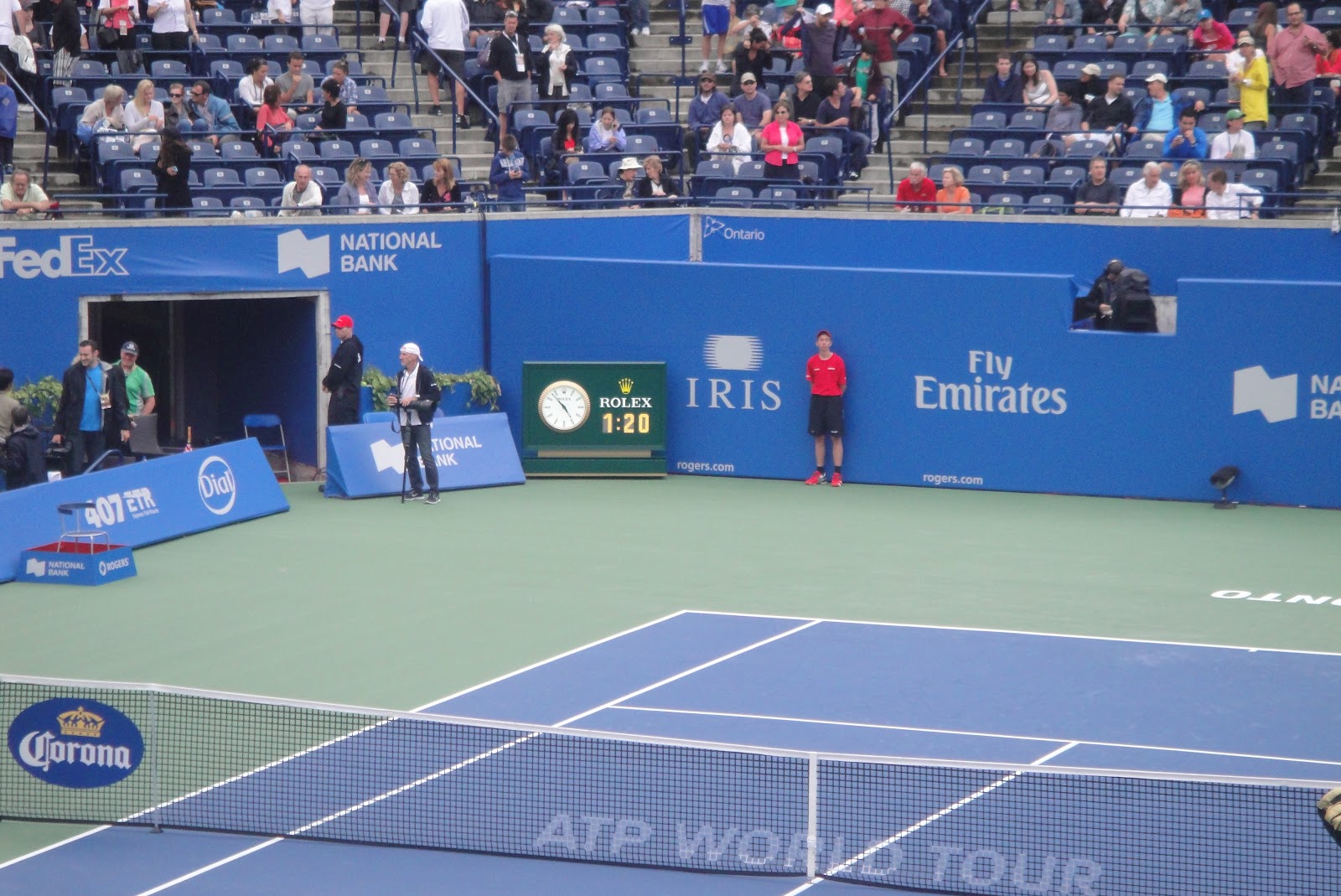
This was underscored on the Saturday when there was early day rain and the first of the only two matches scheduled for that day on the stadium court was rearranged to another court, ironically at the same time as the winner of that match would have had to play their 2nd match of the day, so that when the singles game between Gasquet and Isner took place and was over in 1 hour 20 minutes (see photo below), there was no other game scheduled and the session costing $140 per ticket for my party of 5 was over by 4pm.


Gasquet beat Isner very easily so having read the 90-minute rain policy thought it sensible to take a picture to record the event just in case there was some argument later.  The match clock clearly shows 1 hour 20 minutes.

Again I understand that you cannot legislate for quick matches but there was plenty of time for a doubles match as given the current scoring structure of 2 no-ad sets plus super tie-break for the 3rd set, no doubles match goes beyond 90 minutes.  Plenty of time in fact before the night session was due to start.  Plenty of time to give your patrons value for money.  And you would have even exceeded the minimum 90-minute requirement on your official rain policy for play, meaning you would not have to make refunds on tickets.

My exasperation comes from the lack of consideration for patrons who, certainly in our case, had traveled thousands of miles, spent thousands of dollars and took time out from work to visit Toronto and the Rogers Cup because we considered it to be a well run event.  In actual fact we encouraged two other friends to drive up from Boston at the last moment on our recommendation to join us but they bought their own tickets at the last moment, so in fact our party amounted to 7 of us whose sole reason for being in Toronto was the Rogers Cup.  

Being treated with such disregard is really disappointing.  I really did expect better.

I see the rain policy is either replacement tickets or a credit against 2013 tickets.  This really doesn’t help very much as given our experience this year, we have little enthusiasm to return again next year.  In addition, the men’s event is being held in Montreal which for us is even further away and more difficult to get to.  And finally, at the present time we have very little enthusiasm for watching the women’s event in Toronto.

Accordingly I would ask that you issue a refund of the ticket prices for the days in question; namely $480 for the Thursday and $700 for the Saturday, plus associated taxes and the service charges incurred.  

We will make our decision about returning to the Rogers Cup when we are less upset and disappointed than now.


I think the thing that makes the least sense is the decision to move away a match from the stadium court on the Saturday thereby falling foul of the 90-minute rain policy rule (printed on the back of all tickets).  Had they not done this, we the punters would have had some value and been content AND they would not have to pay out under their own rain delay policy.  Now let's see that is 15,000 people at $100 a head on average -- that's more than $1 million needlessly lost.

How can that be smart?


 Anyway the ball is now firmly in their court! Let's see what happens next.

Saturday, August 25, 2012

Cottages, boats and paint balling

The journey from Guha's to my friend Byron, another Strategic Coach escapee, was pretty short, less than an hour in fact but along the way we found quite a lot of things to delay us so that we arrived Chez Byron and Daina in Baysville around 5pm-ish, just in time to find Byron tinkering in his insanely tidy man cave (garage) and thirsting for Martinis.  (In addition to being Coach alumni Byron and I share a passion for martinis of all types so our occasional meetings usually have this theme running strongly through them with hell to pay the following morning!).

Byron is something in software so connectivity for him is paramount.  I had wondered quite how he'd manage in the middle of nowhere on a smallish lake (called Dickie Lake which was only about the size of Bermuda) but of course when we entered the house I counted easily a dozen internet related devices whirring, buzzing and chirping away all at the same time.  Byron says as he's in software he has to buy everything to see how it works and it sure looks like he'd bought everything Apple puts out, mind you he has 3 children who get the cast offs (if you can call 3 month old stuff cast offs that is).  I think he's tuned out that Apple ching sound that you hear when anything happens on an Apple device as it was constant.  He told me that the reception was 'pretty lousy' and he'd nearly killed himself climbing trees, putting in satellite dishes and various other arrays but I am also pretty sure only NASA or maybe his main office in Toronto has better internet reception.

From the back garden
As it was a lovely evening again (we really lucked out on this trip in a big way for after the tennis when it rained cats and dogs, the weather has been magnificent), we went out for a tour around the local lake and again it struck me that how you define 'cottages' depends very much where you are.  Some of the lake homes were simply enormous but both Daina and Byron said wait until we get onto the Lake of Bays and you'll see some really big places.


Dickie Lake cottages

I am really impressed by how Byron has managed his life.  He is CEO of a disparate software company that has no office but 20-30 staff (he's a bit vague about numbers) located anywhere there's a good internet connection.  The only proviso is that they meet for lunch or dinner in Toronto once a month so they remember what they all look like.

And meet at Byron's cottage for a company paint ball competition a couple of times a year for some real honest team building!

The Lake of Bays is huge, I'd put it around the size of a medium size English county.  Sussex probably.  While Byron had been vice president of the 300-strong Dickie Lake Association (of cottage owners), I could not begin to think how many cottages were around the Lake of Bays which as the name suggests is pretty big and is composed mainly of various shaped bays.  The lake (and indeed all of the Muskoka and indeed Great Lakes) was fed by the Canadian Shelf, basically the entire northern part of this huge country which is under snow and ice for months each year, and was of various depths.  Mind you the size of the lake equated with the size of some of the cottages there.


A rather nice way of coming to the cottage and avoiding the car crush


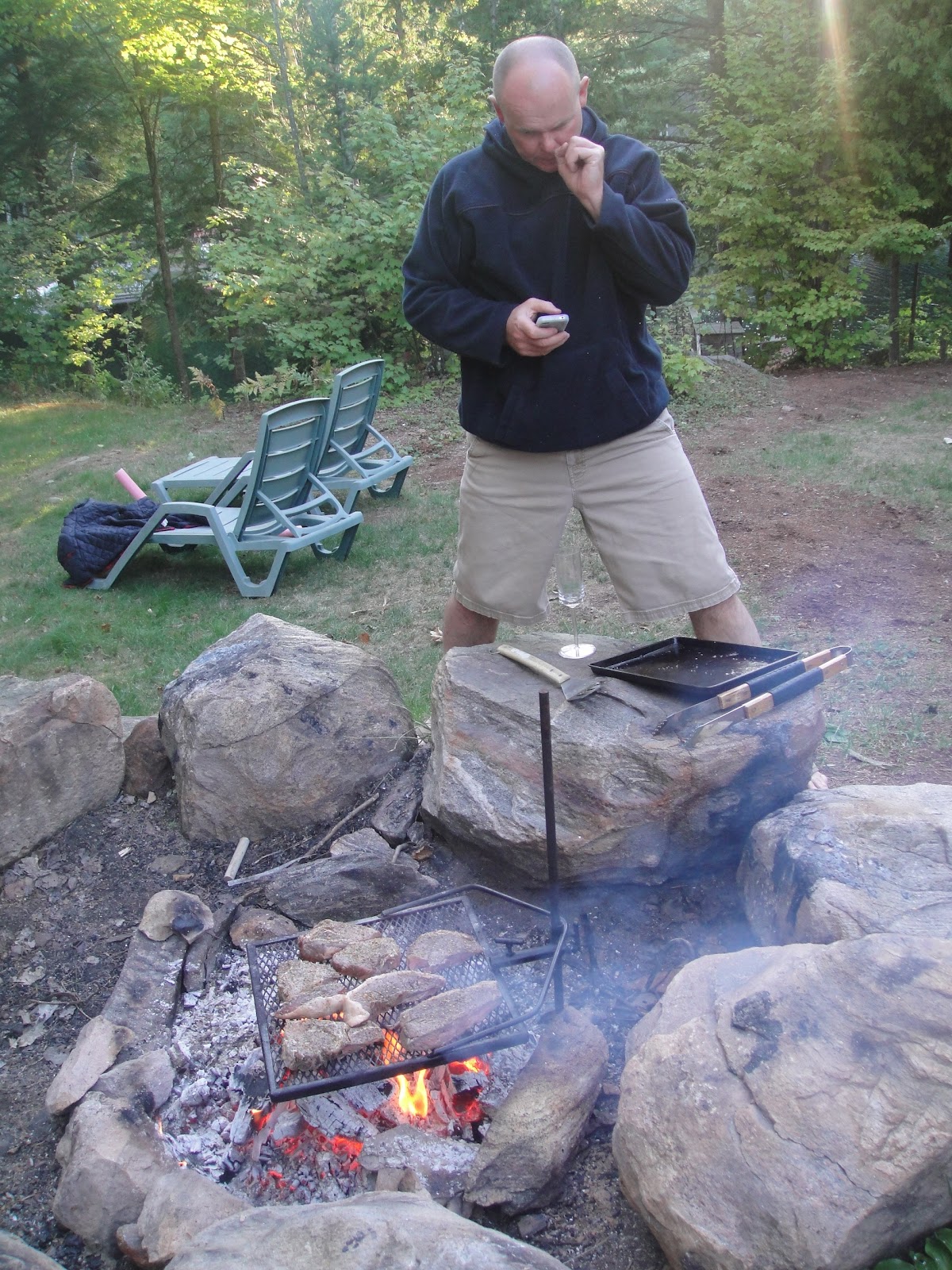
When they bought the cottage Byron put in a fire pit where he could do the rugged outdoors bit in full and cook steaks over an open fire.  And that was the plan for the evening but while the fire was getting going in earnest we had plenty of time to check out Byron's paint balling arsenal of weapons and play ourselves.  Byron showed me some of his bruises and I can believe that they hurt particularly when the gun itself was in semi-automatic mode.  Mind you it was good fun though.

I'd never done a campfire cookout before outside of a couple of outdoor barbecues so had never experienced the delight of eating smores.  These things are marshmallows toasted on the open fire between 2 Graham crackers with a couple of slices of chocolate thrown in for good measure.  Massively sweet, calorific and definitely not that good for you but really quite scrummy.  Byron's daughter Rowan showed me how to get the outside part of the marshmallow off so you had access to the really gooey middle bit.

Traditional caveman cooking steaks over an open fire -- except for using the Apple 4S iPhone as a timer that is!

And that was it.  The road trip was over.  Many thanks to Byron, Daina, Shea, Sonia, Rowan and Stanley the dog for a really pleasant stay.  Our first cottaging experience was great.

Next stop Bermuda and home.


Guha's Babies


Leaving Ontario’s west coast on a Sunday meant we drove against the cottager traffic most of the time.  This was the day they’d rush back to the City ready for the work week.  Friday by contrast was the day the reverse happened.  I had never seen a Canadian ‘cottage’ before so was keen to experience it.

In Bermuda a cottage is thought of as being a stand alone single storey house.  What we’d call a bungalow in England in fact.  However over the years, Bermuda cottages had been built on and extended in all directions so quite often they sprawl.  When we’d first arrived in Bermuda it was to a 2 bed, 1 bath bungalow – a cottage indeed, and we lived 12 happy years there.

Because we were bimbling still, we aimed north to go through Collingwood, a resort town on Georgian Bay.  They have a ski mountain there, the closest to Toronto, which is very popular to the point of exclusivity.

I’d found a B&B on a lake called Rosseau in Muskoka, the district which is considered to be prime cottage country because of the massive preponderance of both lakes and of course cottages.  Lakes Rosseau and Muskoka are very large indeed, not quite Great Lake size (Huron is as big as England) rather the size of, say, Yorkshire.  It was near Port Carling, a very small speck on the map that in summer time grew in size from 300 to more than 3,000 with the summer cottagers.


Not exactly what I'd call a cottage!  Very swish.

The B&B was very pleasant on the lake and Viv and I were most comfortable there.  We headed off to a big resort called Windermere for dinner (another golf resort) and settled down for a cottage night, our first.  At breakfast, mine host told us off a place only 5 minutes away (Ha!  Never believe people that live in the country.  Maybe to them it seemed like only 5 minutes away but it took us nearly 40!) where an Indian guy raised lions and tigers. 


Now I’m a skeptic at heart so the likelihood of there being an Indian actually training lions and tigers simply miles out in the bush where in the winter the temperature fell to minus a hell of a lot for simply months was highly unlikely so we just had to take a look. 

Apparently this Indian had trained Elsa the lion in that early animal movie, Born Free.  This was too much and when we finally found the drive and turned in all we saw was a ramshackle house and what looked like a bunch of poorly tacked together cages with all the brush overgrown.  Like a trailer park in fact. 

And then the dogs started barking… and pretty soon after that an elderly guy with a floppy hat wandered out and looked around wondering no doubt what on earth was happening to destroy his peace and quiet.  That’s when we saw one another and I explained what we were about and he genially welcomed us in.

Guha with Mum and Dad. When the weather gets too bad, he still takes them all indoors out of the cold but they still get their daily walk in the woods.
This was Guha and he told us pretty quick that he’d chosen this remote location because he wanted to lie low beneath the radar as he was much in demand for what he did.  Guha was a 13th generation animal trainer and for as long as he remembered he always had lions and tigers, Indian lions and tigers that is.  Bigger and more rare than their African counterparts.  He told us his 110 year old mother who lives in Darjeeling still keeps Guha’s elephant for him and rides him every day just to remind him who’s boss.  Apparently the elephant DOES remember who Guha is when he visits.

First was mum and dad – the big lion and lioness.  Guha told us that lions are pretty frisky for the first 7 years of their life but once they hit fully grown up age (7 years old) they become very lazy.  And these guys barely moved a muscle the whole time that Guha talked to them.  He’d brought these 2 lions up himself from the age of 6 days (poachers took their parents) and they’d lived with him and his wife until they were 7 years old.  Each day Guha would go into their cage with their food (they are 800 pounds in weight and eat 250 pounds of meat each week apparently), talk to them and have a cuddle.  They were in fact quite loving lions and certainly when he spoke they listened intently.  Eating that lot would make you pretty sleepy though and as it was nice and sunny they certainly took advantage of that.

There’s only 200 Indian lions left in the wild and in all the world’s zoos and Guha has 6 of them.  His lions are much in demand for stud purposes; there are 3 boys with Guha, all 4 years old so still adolescent but their older siblings are in several zoos around the world busily doing what needs to be done to prolong their line. 

Guha’s Siberian tiger is currently with Cincinnati zoo on the same mission.  There are fewer Siberian tigers than Indian lions courtesy of the poachers, so the issue is more critical.  Guha frequently takes in females for mating purposes but the big problem with this for the tigers is that prior to mating, the female needs to have selected a secure place to bring up the cubs so staying for a month at a time with him doesn’t work.  Guha wanted to carve off a decent area within his 100 acre holding that he would enclose safely and simply kick the 2 tigers out there for a while but apparently the local authorities couldn’t get their heads around a couple of 12 foot long 1,000 pound tigers roaming around in the wilderness so baulked at the notion.  Guha seemed bemused about this ‘ridiculous’ decision as quite often he’d have the tiger in to watch TV with him and his wife so really how could they be considered dangerous?

So as a result the tiger is elsewhere doing the business and so successful has he been that there are now 32 young Siberian tigers that are being reintroduced into the wild in Siberia some time in the next few weeks.  Guha will be attending to advise on the details however his tiger will not be going to Siberia.  He’s coming home presumably for some nice home cooking and TLC from Guha and his wife.

Guha also has 1 black panther and 2 cougars (father and son) plus the other 4 lions all of whom responded amazingly to his voice.  The elder cougar (who’d just lost his wife and unborn cubs in childbirth) in fact had a conversation with Guha going back and forth like a human would.  Guha had had all these big cats since they were only a few days old so was a father to them all.  The cougars liked to watch TV even more than the tiger but while the tiger knew its place and wouldn’t climb on the furniture, the younger cougar would try when Guha’s wife wasn’t looking.  However she was very firm with them and wouldn’t let them get away with much.

One of the last 12 black panthers left in the world

The talkative cougar that likes to watch TV and climb onto the furniture -- much to the lady of the house's displeasure

Two 'babies' -- aged 4 and only 400 pounds.  These are the active ones.

Amazing story but when we spoke more, the rest of the story was equally so.  Guha has a PHD in economics from LSE and was offered the chance to do another, in German, at Heidelburg when he was only 21.  That was where he met his German wife who didn’t believe it when he told her that his girlfriends were the big cats at Frankfurt Zoo where he volunteered.  Clearly Guha is a romantic as well.

He’d come to Canada to teach and somehow ended up in North Bay teaching Economics to students who didn’t want to learn, only argue with him so he quit and moved to Muskoka with his big cats.

We asked if he ever sold any of his ‘babies’ (he has 3 sons dotted around Canada as well all who help out when they are around – they used to go swimming with the tigers when they were younger so are clearly as comfortable around the big cats as mum and dad).  Guha told us Disney are always trying to buy some of the cats – and he has relented but never took money for them, only ensuring that they are treated ‘royally’ (which means 3 personal attendants each).  But there was one occasion when the children of the Emperor of Japan visited and took a liking to a couple of the black panther's babies – there are only 12 left in the world, Guha has 1 and now the Japanese royal family have 2.  Guha insisted that the Emperor's children spend time with them prior to taking them to Japan (they spent a month) and Guha went over for 6 weeks to make sure they are OK.  They are truly being treated ‘royally’ now!

As these are huge cats and the cages while comfy are pretty small, we wondered about exercise.  Guha said he takes them out for a 2 hour walk every day. I wondered if they acted like dogs when taken off the leash who ran around crazily, Guha said what leash?  He treated his babies with respect and they did the same for him.  They would accompany him quite happily and placidly in the forest to the point where if they ever saw or heard a moose or deer, they’d be the ones that were afraid more than the others.

Having a conversation, going for a walk, watching TV together -- this was an extraordinary visit and one that quite frankly when I drove into the driveway I wanted to turn around and drive straight back out again.  It was a privilege to spend an hour with Guha and his amazing cats.  Long may that happen. Thank you very much, Guha.


Monday, August 20, 2012

Huron Country


I’d been talking to my friend Brian for at least 3 or 4 years about visiting him in his new home on the shores of Lake Huron.  Brian was a long time friend from Strategic Coach, the entrepreneurs course I’d been taking for more than 10 years in Toronto.  We’d both given the course up a couple of years ago (mind you I just restarted last week) but had kept in touch and had finally agreed a date.

I’d organized a car hire – a car I’d been wanting to try out for ages in fact, a Chrysler 300 gas guzzler. 

I don’t know if its just me but I have hired 2 fantastic German cars in the UK in the past year – a VW Golf and an Audi A4, both diesels, both managed 50+ mpg in town driving. In fact I’d driven the VW from York to London, spent 3 days driving all over London, down to Southend in Essex and Canterbury in Kent and still drove it down to Dover all on half a tank of diesel.  That is simply ridiculous so I struggle to get excited when I see US adverts for cars that proudly announce energy efficiency at 31 mpg for motorway driving.  Why can’t US manufacturers simply licence the technology the German car manufacturers have and save 50% on their gas costs?  

The car is great though.  Big, comfy and filled with neat gadgets designed to make me feel comfortable.  I’d also bought a GPS as after my struggle with maps on the European road trip from last year, I have given up on the map versus GPS struggle.  GPS wins hands down.  But when there’s road works you still need a map to give you a broad idea of where you’re going.

I’d never driven in Toronto so leaving was a bit of a challenge particularly when we hit the airport region near Mississauga.  Viv had specified no motorways, toll roads or unmade roads so we went almost the entire length (seemingly) of Bloor Street and hit a traffic light at the airport where we had a left turn to make without assistance from the lights amidst mayhem, manic traffic.  We survived somehow though.

Once clear of that we were in endless farmlands with the intent being to target St. Jacob’s, a pretty village somewhere in the west.  Viv had also booked us into a motel in Stratford and a play at the Festival Theatre – Henry V, part of the annual Shakespeare Festival – so we had a time constraint looming in the background particularly so as our speed of travel was distinctly in the bimbling mode.

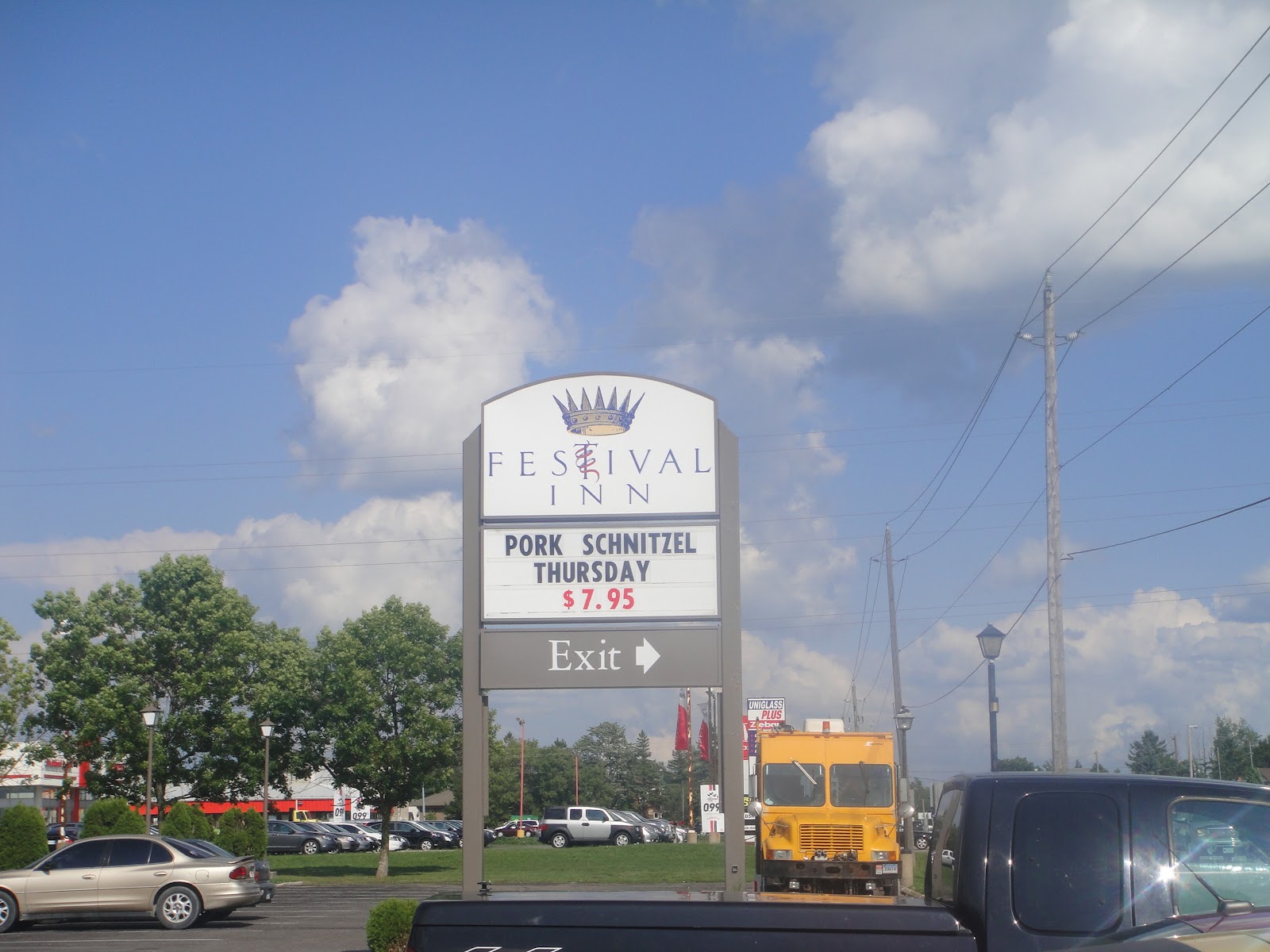
This is pig country.  The bacon, ham and pork is just fantastic.  Clearly Thursday is a real banner day.

But the country is reaaaaaally big.  The land is laid out in vast chunks all surrounded by what are called “Line” roads.  Brian later told me in the early days farmers were assigned 100 acre square parcels, around which were laid out roads in straight ‘lines’, hence the name “Line” roads.  So out somewhere in the middle of wherever we changed from Line Road 119 to Line Road 111, which somehow doesn’t quite give the trip much romantic sparkle.  Some counties have climbed down off their perch and permitted more interesting names to be used but others are more puritan.  Speaking of whom let’s talk about the Menonites.

Menonites are protestant extremists that sprang up just after Martin Luther nailed his objections to that church in the 16th century and took his opposition to orthodox church a few steps further to the left (or right even, depending on your own politics).  To give you an idea, they thought Luther’s articles were a few hundred too few so they added on a whole bunch more, all radical, which alienated not only the Catholics but also the newly self-proclaimed Protestants as well so everyone, and I do mean everyone, persecuted them.  The Jews must have been relieved to have been given some time off, I would think.  So given the fact that there were so few of them, they fled in all directions. The Dutch went east to Russia where Catherine the Great welcomed them and sent them to Siberia, far enough away but in the knowledge they'd get things going there, whilst the German and Swiss went west, ultimately to the US mainly Pennsylvania where many protestant religious groups settled.

After US independence, large numbers left in their wagons for western Ontario as they had been treated well under the British (i.e. pretty much left alone and not been asked to join in any imperial wars) and feared that the new USA would conscript their young men into the US Army.  The Amish and other similar groups remain in Pennsylvania still but large numbers now control large tracts of farming in rural western Ontario. 

The Menonites are split into various strata as over the years many gave up orthodoxy and embraced many of the ‘new’ ways while still holding to their religious beliefs.  But some of the ‘Old Order’ remain and you can see them in their traditional garb driving their coach and horses along the highways and byways.  But they are good businessmen and have prospered over the years.  Most of the old order drive cars now (except on Sundays), the proviso being that they are black in colour to match the men’s attire.  I met a retired government property assayer who told me that he’d visited all over the region and found that the Menonites were very far advanced in their usage of modern technology even the old order so while you may consider them curiosities because of their garb, their accents and their ‘ways’, they know what they are doing and they do it really well.


A Menonite convoy.  Mind you this was Sunday so the cars were likely in the garage at home whilst they went to church in the old ways.

St. Jacob’s is a largely Menonite enclave and that was why we were heading in that direction but as the day wore on it became clear we (a) couldn’t find the damn place and (b) even when the GPS had got its act together, we’d have no time to do anything other than leave so we redirected our efforts towards Stratford and Henry V.

Stratford is really a lovely little town.  Settled like everywhere in the region in the mid 1850’s it has no big or new buildings to speak of other than a couple of theatres and retains a really nice olde worlde feel to it.  Once an industrial town doing I’m not sure what, now Stratford is solely tourism and pretty much solely Shakespeare.  Even the river running through it is called the Avon (there are some similarities with the Avon River in Christchurch, New Zealand, but not many). 

Avon River walk in Stratford, Ontario.

Once we settled ourselves at the Festival Inn on the outskirts and found the theatre we walked into town along the riverbank which was really lovely, circumnavigated the town in really quite short time and settled ourselves into the Mercer Inn for dinner, a nice boutique Inn that had declined to house us for the night but fed and watered us really well.

The Festival Theatre was nice, set out in a horseshoe pattern with the stage jutting out into the middle so the actors could easily move around in the auditorium.  We were on the left hand side but really close so felt ourselves in things. 

They kept fairly closely to the original script including all the potentially edgy bits about the English massacring the French prisoners that both Lawrence Olivier and Kenneth Branagh had omitted from their films.  All the ‘English’ accents were decent too.  And of course who wouldn’t catch a breath when Henry went into his “Once more into the breach, dear friends” and “We happy few, we band of brothers” speeches?  Shakespeare wrote some fabulous lines but he also integrated some humour and political satire as well that stands the test of time very well.

By contrast to the previous day, the next day was a breeze.  I put it down to it being Viv’s birthday of course!  We found St. Jacob’s and went through the Menonite Museum (most interesting) and the Menonite bakery next door where the cherry tarts were fanstastic.  And the drive to Grand Bend was a breeze too for the GPS had got its act together and had we not taken some deliberate detours, we would surely have arrived at Brian’s house somewhat sooner than we did.  However all’s well that ended well and we did arrive at Brian’s house (now 3 years old) which overlooks Lake Huron in very good time.

I hadn't expected to find a broom maker making brooms in the old fashioned way but here in St. Jacob's we did.
It tells you something where another protestant church (above) has been sold and turned into a toy shop and day care centre in St. Jacob's high street.  

Lake Huron as all know is one of the Great Lakes – the others being Ontario, Erie, Michigan and the largest of all by a factor of an awful lot Superior.  They are all connected by rivers, canals and other waterways, so you can get through to about half way across the continent by water provided you follow the connections properly.  Huron is 3rd one over from the Atlantic.  Michigan is just about below Huron with Superior, the monster, to the west.  Brian overlooks Huron and the view is simply sensational.

Rum Swizzle overlooking Lake Huron.  It wasn't hard to drink it!

That part of the coastline also has a real beach.  Well, real if you classify ‘beach’ in its proper way as being the stuff churned up from the sea floor by wave action but not a real beach if you classify it as being either sandy or pink like Bermuda’s.  But as Huron only has silt and mud at the bottom and not rocks and coral like Bermuda, you can’t blame it.  The texture actually reminds me of the mud flats at my home town, Southend, when the tide’s out.

Ultimately we went for a swim and it wasn’t as cold as I expected and was in fact very pleasant.  I’d never swum in a lake before or in real fresh water, so this was a new experience for me.  Huron even had waves and something of a current and undertow to make it familiar.

The hot tub on the upper balcony was pretty darn nice!

Grand Bend is interesting.  Staying with Brian enabled me to see the town in two completely distinct but parallel lights: the summer resort catering to wild young party goers and the all year round town where normal people lived normal lives.  The main street was a cut down version of Key West with fewer seedier aspects and looking back on the trip I did there last year with Viv, there must have been another side to it.  We just never saw it.  In Grand Bend we saw that through Brian’s eyes.

Brian is part of the Rotary Club who recently began a series of projects providing aid to primarily southern Africa.  Apparently in the past, each small rural township in the Huron area had had local schools and in fact a complete local infrastructure at each town. With a declining birth rate, school numbers have declined as has the population generally so the county decided to amalgamate several smaller townships’ infrastructure into larger more economically efficient structures from schools to hospitals and local administration.  At the school level this means school closures with new larger schools being built and the children being bussed in from outlying areas.  But what happens to the old schools?

Well, first the stuff in them goes into the dumpster and then the buildings get offered first to the local community and then get put up for auction.  That’s where Rotary stepped in.  They asked if they could simply take the stuff that would be thrown out and give it away to poorer places.  The answer was a qualified ‘yes’.  Qualified because the authorities didn’t want stuff given away and then being resold at a profit so they specified it had to be given away.  As Rotary had found in South Africa another Rotarian with the capability to give this stuff away, this was no problem.  So up to now they’ve filled 19 forty-foot containers (5 this year) at a cost of $5,000 a pop which Rotary themselves raise.

Anyway Brian’s group had organized to empty a school in near by Zurich and pack a container and promptly volunteered me to hump and carry as well. 


The school was jam packed full of stuff including 100 desks, 200+ chairs, teacher’s desks (that weighed a ton), blackboards (the proper slate ones weigh 10 times as much as you’d think) and I felt that there was no chance that lot would go into one container.  However 3 hours later the container was 2/3 full and I take my hat off to those guys who packed it.  I also take my hat off to the association who came up with the very creative idea and the authority who backed it.  The children in Africa will certainly benefit from this what would have been garbage.


The seedier (or parallel) side of Grand Bend, Viv and I saw as Brian and his wife Irene went off to a wedding, leaving us to fend for ourselves.  I dragged Viv into what I thought from a simple drive by to be the party place in town (called Coco’s) to have a beer.  For some reason some guys were setting up cameras and another older guy and his wife were talking away at them so I asked what was happening.  

The cameraman told me that they were videoing a documentary of the people who work and play in Grand Bend (take a look at www.grandbenders.com) and how they interact.  The older guy whose name was Mickey and who was the owner of Coco’s gave me a card and said the documentary was at that moment shooting. After this random people came up and started talking to/at him very loudly and the cameras sprang into action vigorously.  It all reminded me of a TV programme my son Ali watches called Jersey Shore.  I checked it out later online with Brian and I had my suspicions fulfilled whilst he was more than a little surprised to find out about it.  

Mickey is the grey haired guy next to the blond (his wife) in profile.   A few minutes after the girl in yellow joined them and began a lengthy, loud conversation that will surely make it to the next episode and should not be missed.

I’ll go back in a while and take a look at some more recent episodes to see if Viv and I have made it onto an edition.

Sunset over Lake Huron
I’d also seen what looked like a broken down old pub (called Paddington’s) so Viv and I went off there only to find not only very nice beer, very nice fresh lake fish (called pickerel) and a charming young waiter from Cayman (named Lee) who gave us a bottle of his own very hot sauce.

On our final morning Brian got up at a hideous hour to make us his legendary waffles which promised to provide enough fuel for the remainder of the day during which we’d make our way up to Muskoka, providing that the GPS allows it of course!


Thanks Grand Bend and of course Brian and Irene, it was a blast.