Showing posts with label lemons. Show all posts

Sunday, June 19, 2016

Lemons, lemons and more lemons... oh yes, and paper as well

Like a previous trip I have been extremely remiss in not staying current on these posts.  However I did use that wonder App called Track My Tour (please tell Chris that I sent you if you check it out) which did a much better job.  Here is the link to this part of the trip -- Click here.

**

You really cannot talk about this part of the world without talking about lemons... and of course the Romans and the Egyptians from whom they 'acquired' the plants and knowledge of how to grow them to this wondrous size and taste.  For you can eat the whole thing, including pith and skin which actually to me tasted rather like delicious lemony biscuits.  The pulp isn't too sour either, nor is it sweet.  Just that happy mid-point between sweet and sour.  Locals here eat them with salt.  Absolutely delicious!


In our stay we had quite a bit of spare time to bimble in between the tours organised for us by Daniele and as much of the time after Paestum was dry and sunny, it was really nice to just bimble up and down the valley in Amalfi.


The town itself is probably no more than 50 metres wide either side of the river floor up the sides of the mountains and the streets are of course very narrow.  Once you pass 1/2 mile or so up from the sea front, the houses start to come to an end and the path, or rather steps, start to get steeper... and steeper.


This is the path that the townspeople used to use when they were running away from the pirates to the little town on top of the mountain -- which may be Ravello or some other little village.


Today of course it is peace personified.

Amalfi was/is famous for paper as well as lemons.  Well they do have that river and ravine after all.  The technique for paper making was brought in from the Muslims in the 12th century (who'd learned it from the Chinese) and with trees and river, you'd have thought everything was perfect... except that it wasn't/isn't made from trees at all.  Rather other plants.  Well actually old clothes which were made out of flax and other plant material.  First of all bleach white with urine and then...
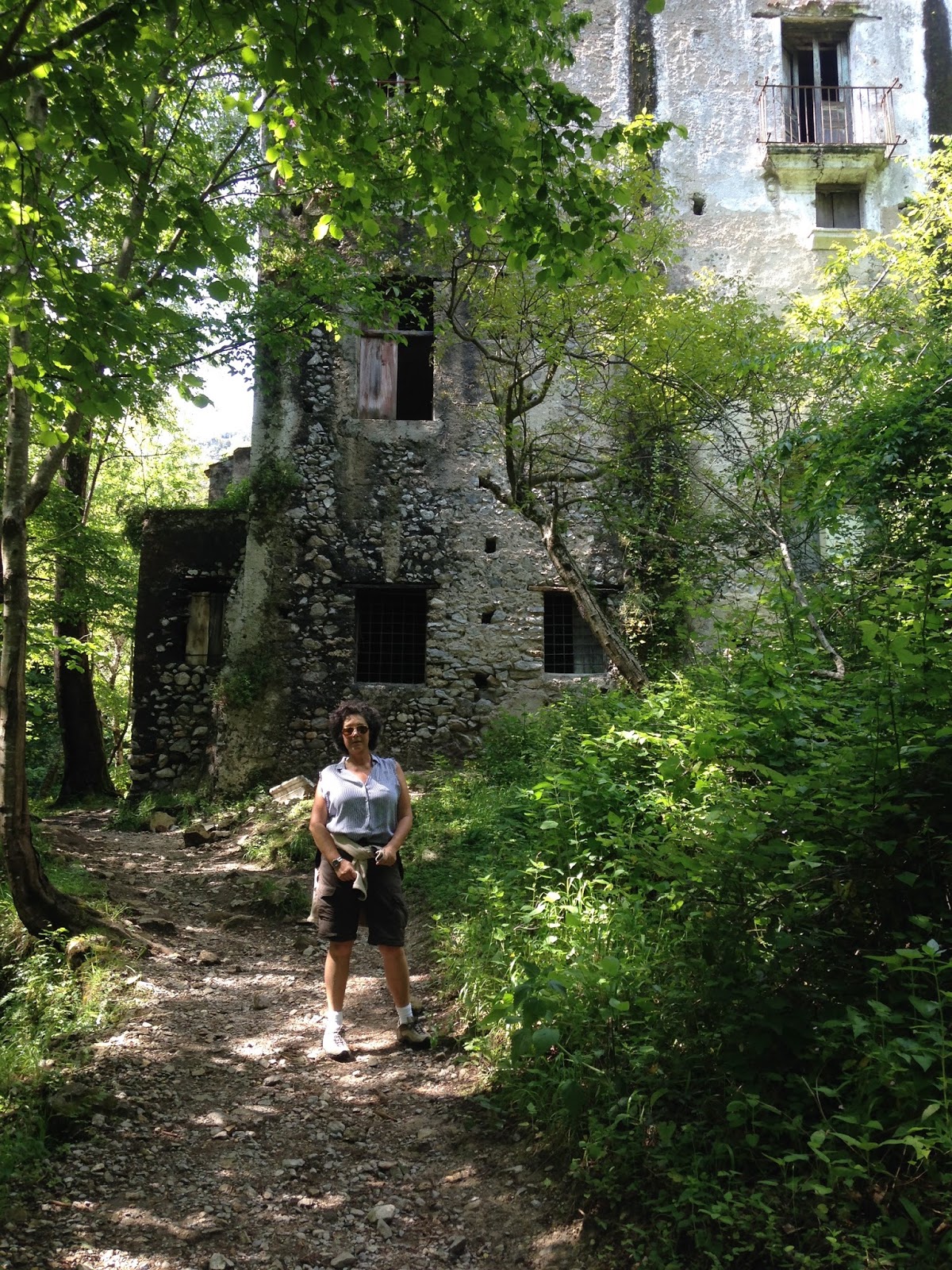


There's a paper museum in the town that I thought would be awful but it was actually fantastic.  They showed us how in this mill (right on the outskirts of town) that they diverted the river to aid the process, the stretching and drying racks and all the rest of it.  The Pope's writing paper is still from these parts.

There used to be 70 paper mills on this river, none today but the plants still remain dotting the landscape up the side of the mountains on the little footpaths into the hills.  They are now fully integrated into the landscape like the lemon plantations stepped up the valley from Amalfi proper.


Pretty amazing sight to see the steps all the way up like that.  The covers are to protect the lemon trees from both sun and frost but as we discovered not everything is well in the land of the lemon.

Daniele had organised a lemon tour for us and so we met Salvatore, an ex-tax guy from Positano who took the business over from his 82 year old dad 3 years ago.  Jam packed full of anecdotes and information, he was withering about the EU primarily and how regulations favoured large companies and hindered small ones to the point where most farmers in the area no longer bothered farming properly so a lot of those covers you see over lemon trees could have been there 5 years or more.  The plants underneath would be rotten by now (his farm is the biggest locally and was in the process of taking the screens off to give better access to nice warm air vital in this stage of cultivation).


Furthermore...

Anyway I could go on endlessly about the EU's malign influence here but take away just a couple of things that he told us.  First is about sheep.  Why sheep?  Well the lemon trees are farmed on steps and create a lovely shady screen.  Under the screen the grass and weeds have to be kept down so the old way was to let sheep roam at will.  They couldn't use goats as they eat down to the roots whilst sheep crop the top.  Goats would turn the place into a desert as they have in many parts of Africa, for example.  The sheep would keep everything down and fertilize the soil naturally.  Eating like that would make their flesh slightly lemony itself so it was all a win-win.  The EU forbid keeping sheep without pens which farms don't have.  Futhermore they also forbid sheep fertilizer being used on lemon trees (regulation 1223768, sub paragraph 132456, footnote 19886 or something).  So now farms have to employ someone to keep the grass down and buy fertilizer for the plants.  Many have given up the ghost so lots of the farms aren't looked after at all.

Sheep used to roam here, no longer thanks to the EU
Second is about the steps themselves.  They fall down, not all the time but certainly from time to time.  When they collapse, they cost 10,000 euros to replace or repair.  Salvatore said this farm had 3 such occurrences in the previous year which was about normal.  He repairs them but others do not so the valley walls are gradually disappearing which causes soil erosion and threatens the entire eco-fabric of the region.  We met a journalist and his cameraman who are the Daily Telegraph Paris correspondents down in this region just to write an article about this. Both fascinating and disturbing.

One of the main uses of local lemons is limoncello as the cost to produce and sell is uncompetitive with other locations, so they have to do something creative and of course delicious!

And lemon risotto... just fantastic!
If you don't believe me, check out the article here.  Nice picture of Salvatore in the family museum too.


Thursday, June 9, 2016

Lemons, Steps and Pirates

Like a previous trip I have been extremely remiss in not staying current on these posts.  However I did use that wonder App called Track My Tour (please tell Chris that I sent you if you check it out) which did a much better job.  Here is the link to this part of the trip -- Click here.

**

Quite why we decided to go to the Amalfi Coast is unclear at the moment.  I cannot quite remember why we chose to do this but boy am I glad we did.  It is lovely.  Very difficult in fact to take a bad photo or see a crummy vista.

We decided to split the week up into several sections: first the Greeks and buffalo mozzarella cheese. Next the coastal villages and finally lemons and a cooking class.  We had a day in between so in those days we were able to bimble in the Amalfi area itself and the little villages around.

Amalfi was the centre of a 100,000 person plus 'empire' that was a seafaring empire that essentially took over the sea faring of the Roman Empire.  It was a great trading empire that competed on favourable terms with Genoa, Pisa and Venice in the early days pre-1100 but sadly those bloody Normans again spoiled the show and sacked Amalfi and essentially killed everyone over the next generation leaving each village with 2-3,000 persons each and subsequently irrelevant.

Just a brief aside about the Normans, this is pretty typical of how they 'colonised' places.  Slide in through the back door on the pretext of helping out against some external danger and then simply killing all your former allies and taking over.  Architecture in this region is largely Norman and bears testament not only to their presence and control, but rather more sinisterly, their utter ruthlessness in taking over.  Witness the Harrowing of the North in the years after 1066 in Great Britain for how effective this strategy was.

The duomo in Amalfi is Norman dating from the 1200s but with the usual Baroque add ons
The Normans did build a series of watch towers along the coast as Barbary pirates often came calling.  The 9 coastal villages did a very sensible thing and built 9 villages up the side of the mountains that drop straight into the sea.  When the pirates came, the villagers decamped up the tiny mountain paths ... that we walked ... to their high villages.  Sensible precaution.

Food is mainly seafood oriented with my favourite anchovies everywhere!


The drive over the mountains from Naples was interesting.  The rain stopped over there while the sun was over this side... sorry, the Amalfi side.  Just as it should be in fact!

The divide between Naples and the Amalfi Coast
As for the lemons, well the land here is so steep that the only way to farm (and incidentally stop soil erosion) is to create terraces up the side of the hills which are then cultivated.  Quite why lemons are so popular here is a mystery but not so their original source.  Egypt.

Our first view of the Amalfi Coast was definitely not shabby!
Back in the Roman era, Egypt was quite possibly the most cultivated part of the known world, specifically in the vast Nile delta.  Pre-Caesar, Egypt worked with Rome as its exclusive customer to provide all manner of foodstuffs.  Post-Caesar (and particularly post-Cleopatra) the province was decimated and taken over lock stock and barrel.  As a result of this trade, Amalfi got seeds, cuttings, plants and know how and simply made wonderful lemons.

One fine use for the local product!!
They still do.

And the views, well you cannot find a bad one.

Our balcony


Thursday, June 2, 2016

See Naples and...

Like a previous trip I have been extremely remiss in not staying current on these posts.  However I did use that wonder App called Track My Tour (please tell Chris that I sent you if you check it out) which did a much better job.  Here is the link to this part of the trip -- Click here.

**

We'd talked about it for quite some time or rather I'd droned on about it, that we wanted to follow the European red clay tournaments from Monte Carlo in mid-April through to the French Open in the last week of May and first week of June.  However life does get in the way some times so we finally agreed on a cut down version which looks something like this:


  • 2 days in Naples
  • 6 days in Amalfy
  • 8 days in Rome for the Italian Open with a group of tennis guys from Bermuda and Canada
  • 7 days in Portugal, bottom left part on the western Amalfi Coast
  • 6 days in Paris for the French Open (just Viv and I)
  • 5 days in England
That's about 5 weeks.  Fantastic!

I confess to being a little anal in that I really do like to know the whats, wheres and hows of the places that we are going to visit but what the heck!!
I'd never been to Naples.  Viv had but on a cruise ship years ago so our collective knowledge was rather light however I'd started to read the book called Pompeii by Robert Harris and a book about the fall of the Roman Republic so was in the right mindset for Naples despite its more recent history (and there is a lot of it) is really, really old.

The route in took us over the Alps!! Just beautiful.

Naples or Napoli for the Italians was Neapolis for the 7th century BC Greeks who founded the city and Napule for the Romans who used the region as a holiday resort as well as enormous port city (according to Wikipedia anyway).  Home to 3 million people these days, Naples is quite simply a mess and mass of steaming humanity... crammed pack full of wonderful old stuff and really tiny roads.

This of course means road congestion.  

Of course there can be no reference to Naples without reference to Vesuvius which is right next door. It dominates all landscapes being so huge a double mountain, these days.  Formerly it was a single peak before that famous explosion in 79 AD blew it apart and submerged Pompeii, Herculaneum and I am sure a host of other unnamed and unremembered places.

Our first view of Vesuvius

We'd organised as much as possible a driver for all occasions as there had been so many of those warnings about tourists being stiffed over everything.  I found Daniele on the internet, Trip Advisor and the various online tourist guides.  His company could provide transport and tours of the entire region but also he was a sommelier and provided culinary events as well!  Simple choice really. Daniele's website is here.  Do check him out.  He is great.

It was one of Daniele's drivers who collected us from Naples Airport and took us to our downtown hotel.  It was in a maze of little side streets but importantly just up the hill from the central square and the old castle that was the feature of this part of the city.  Not Roman but still 600 years old!  Just a snip in time in fact.

The day we arrived was cloudless.  This is the view from the hotel terrace with of course Vesuvius in the background and the castle in the foreground.  Naples has always been a significant port town.

There really wasn't much time to do anything more than have dinner so we took a recommendation of a place called Il Garum from the check in guy and strolled down the street to enjoy it.

Different cities and countries have dinner at different times.  Spain before 10 pm is unheard of.  Here in Naples, it was 9.30 pm so as we arrived an hour earlier we had the place pretty much to ourselves.  And of course it showed us to be tourists as well.

Dinner was spectacular and looking back on it one of the top 3 meals of the entire trip.

Linguine alla colatura d'alici
Local fare is seafood even though pork, boar and porcini mushrooms are popular local dishes too.  But this one is the #1 -- anchovy juice cooked into home made pasta with olive oil and garlic.  This one was sensational!  It is also very traditional dating back at least to the Romans.  They called this sauce... wait for it... Garum.  Coincidence, eh?  I think not.

I just love the local in season little strawberries called Fragolini served with lemon juice, local of course, and a little sugar which is mostly unnecessary but when in Naples... 

I'd really missed the end of day Gelato and was not going to get off on the wrong foot!
And the night time view over the city ...