I just found this post that I wrote back in 2012 when the global economy was in tatters following the Great Recession and I was trying to make sense (to myself) of some of the why's and wherefore's as to why Bermuda was struggling while Cayman was booming. Why should I care? Well my company has offices in both locations so clearly from a business perspective it is absolutely essential to figure out where to use your precious and limited resources. Why do I do it this way? Well some people are able to talk about things. I am not one of those people. I have to write things out in full to make sense of things. This is what I did. Does it make sense today? Is it even relevant today? Well not entirely relevant as there have been 2 elections in Bermuda and at least one in Cayman so what was envisaged back then has actually happened/or not and other things have moved into prominence.
I read only today some 6 years after I drafted this post that 99.7% of all businesses in the US are small businesses and employ 90% of the total workforce. That means that what goes on at Apple or General Electric, say, is irrelevant to the greater population hard as it is to imagine that in all the hype that accompanies their every movement. Of much greater import is the small business. Where small business goes, so goes the national economy.
In a Bermuda/Cayman context it is difficult to see this is the same thing but I would think that a far larger than 50% amount of the local workforces work for smaller companies. Like ours. So despite the fact that small business is largely ignored by both media and decision makers in government, it really it us that still makes it all happen. As a small business owner we knew this and were perennially aggrieved that decision makers didn't really care about our needs despite our relative importance to the economy. Amazing as it is to hear, government actually said that the trickle down effect well known in economic theory does not apply.
I never posted this note as at the time I thought it was potentially inflammatory in the same way as my note on a Bermuda bank (that I prepared for my business' clients) was inflammatory. This bank had fallen foul big time of sub-prime mortgages in its investment book to the point that it was realistically insolvent (the CFO tried really hard to tell me it was all a question of timing... but it wasn't). I spent a lot of time reviewing this and talking openly to the CFO who very generously gave of his time and I just knew they'd need to get massive outside assistance (which did happen). However I was left with a very tough decision. Do I make public my findings and create the self fulfilling prophecy in which there very may well have been a run on the bank, or do I not do this and make a decision based on what was best for the public who had no idea this was the case (just read a 10k issued by a listed company and tell me if you undertsand any of it. I do because that was my job but it takes a heck of a lot of training and then work). The bank took the bail out and has survived with no depositor losing any money as opposed to the Greek and Italian banks whose depositors took a haircut when they had to seek support from their 'friends' in the EU and the IMF. So, happy ending there.
However time is a great healer and what was inflammatory back in 2012 is today merely history. And history as the name suggests is merely a story about what transpired at a certain time according to the person who followed it -- that's me. So please bear this in mind when/if you read the following. It is how I saw things at the time.
***
25 years ago when I was working at the Bermuda Monetary Authority in my first Bermuda role as sole regulator -- essentially the only Banking Supervisor pre-these Basel I, II or III days, collator of Balance of Payments, Controller of the Currency and the then in situ Interest Rate controls as well as the supervisor of the Bermuda Stock Exchange -- I had a staff issue where I wanted to hire another person and needed both budget approval from the Ministry of Finance and permission from some obscure government department whose name I forget. It couldn't happen until a Board agreed and the MofF signed off -- quite why is beyond me as the BMA was and remains a quango responsible for setting its own budget. I was assigned a member of this department who would plead my case in front of the board -- I was not permitted to talk at all although I could observe. I briefed this person in detail and agreed a strategy that he totally ignored starting his presentation with the immortal words: "I know comparisons are odious but..."
Our case was thrown out and ever since I've always tried to never, ever use that ridiculous statement in any way shape of form however with this post I simply cannot think of another way to head it. My intent is to try to compare some key elements of Bermuda and Cayman, their politics, economy, etc. -- similarities there are but also differences, both cultural and economic.
I care because I have spent considerable time in both countries and my firm has an office in both jurisdictions. I simply don't want either to fail.
The first similarity is the airport. Both are aging and in need of a spruce up for sure and both don't have those pod things that slide out at door level to allow passengers easy access straight into the arrivals area -- the old fashioned ways rule. You climb up or down stairs and walk along the tarmac (see note at the end of this post for an update).
Another and probably more relevant comparison is the fact that both are offshore financial centers; Bermuda primarily insurance related while Cayman is big in banks and funds.
Both too have UK common law systems but this is where things are a little different for Bermuda is self-governing whilst Cayman is still just a colony. This means that Bermuda charts its own course even though it has a UK appointed Governor who has titular responsibility over the Police and certain government functions such as the office of the Auditor General. Bermuda also has responsibility for its own budget. Cayman's UK appointed Governor is still the head of government although there are elected officials as well, the leader of whom carries the unofficial title of 'Premier' is actually legally titled 'Head of Government Business'. Cayman does not have responsibility for its own budget and must seek approval from the UK each year.
And herein lies the rub. Bermuda has been able to finance its ongoing deficits with increasingly large amounts of borrowing that they drive whilst Cayman has been denied that privilege by the mandarins in Whitehall. On the day I arrived in Cayman, the front page of a local newspaper carried a story in which the Premier was triumphantly announcing the final agreement of the 2013 expenditure budget with the UK in the amount of $575 million.
I'm not as close to Cayman's budget issues as I am to Bermuda's (I used to compile the BMA's own contribution to the Bermuda budget so retain a keen interest still) but this seems either an awful lot or an awful little... and I cannot figure out which it is.
The reason for my being in Cayman is business development which means visiting as many local businessmen as I can in my allotted time here. In practice, you don't talk about the real thing that you want to talk about, you edge into it. You chat. My 30 or so meetings in 10 days therefore have taken me to talk to a number of highly placed business people who have opinions extending beyond their business and like me want to see their jurisdiction succeed. Many have very strong opinions and some even have specific knowledge -- Cayman like Bermuda is small so people tend to know other people's business in far greater detail than they may in a larger jurisdiction.
Distilling it all down for Cayman is the over spend on 2 new schools for Caymanians. In itself a laudable project of course for raising education levels across all classes is a vital way for a country to stay ahead of the competition. It was the cost apparently that was the issue: I heard figures of $80 to $100 million for each of the schools from different people. Now I haven't a clue what a true cost should be but know that the Berkley project in Bermuda a few years back was budgeted around $60 million and came in around $150 million so government overspend isn't that unlikely an outcome. Its just the size that is the variable. Again the same people suggested that these Caymanian schools could have been built at half the cost which suggests to me that government overspend on these projects could be around $100 million.
That's a lot of money for a population of 55,000.
But is it? Well, it sure sounds it of course but when you consider that Cayman's population is just about the same as Bermuda's and its land mass is somewhere between 4 and 5 times larger but Bermuda's expenditure budget is around $1.2 billion -- doesn't that make Cayman sound fiscally prudent? Or putting it another way, how on earth can Bermuda spend twice as much as Cayman?
It sure beats me but I suspect much of it comes down to economics. Everything ultimately does. I've just finished reading a great book entitled "The Lords of Finance" -- a book about the 4 leading central bank heads just after World War I faced with a world in recession, then depression, war debts of such enormity that even today look to be completely unrealistic (way worse than what the bankers have done to the world), reparations that the victorious nations imposed upon the losers and the inflexible, outdated gold standard. Essentially this is a book that Ben Bernanke of the Fed must know inside and out for those 4 men (heads of the Bank of England, New York Fed, Banque de France, Central Bank of Germany) did everything that could be done to fix things but using solutions that were outmoded and not of a size able to dent the problems facing them, everything they did made things much, much worse. But do read the book. Just wonderful if you like that sort of thing.
The point I was coming round to was that the root cause of WWI was actually not the inherent distrust of the French for the Germans, or the desire for territorial gains but simply economic: Germany resented Great Britain's economic dominance of the world, the French were trying to get back the reparations they were forced to pay in the 1870/71 war with Germany that they cataclysmically lost, the Brits wanted to keep every foreigners hands off their foreign possessions and trade routes and the Russians ... well they were different and nobody really knew why they fought the war. Every one of these countries was warned categorically by their advisors in the years leading up to the conflict that going to war with another great power was economic suicide. That was why the French and Germans didn't go to war in 1911/12 -- both backed away as their advisors told them they couldn't afford it. So sadly both nations went away and built up their gold reserves to the point where the rulers felt that they could ignore the accountants -- they were wrong! Accountants are always right.
I don't believe that in either Cayman of Bermuda governments really comprehend the basic GDP equation: GDP = C + I + (X - M) + G. By far the largest component of GDP is C -- which is we the consumer. C is all the stuff we buy, eat, wear and generally consume. Typically in advanced economies this is around 65-70% of the total. I represents business investment, typically 15-20% depending on the business cycle. X is exports and M of course imports -- which offset one another typically. G is government, and in developed economies comes in at around 15%.
When times are tough, governments step in with 'stimulus' raising G in the equation. By far the most important part is the consumer and then businesses. Business will not invest in uncertainty and consumers won't spend if they don't have a job or are concerned that they may not. But when G is already more than 30% (as it is in Bermuda, I don't know about Cayman) how on earth do things turn around?
Cayman is lucky in that there is the Dart family willing and able to throw billions of dollars into infrastructure -- Camana Bay is the highest profile example of the ultimate "Field of Dreams". This is a billion dollar new city built on swamp to a very high standard where it is almost impossible to consider that there will be a return on capital any time soon. Stunning place, simply wonderful. Other projects including re-siting the dump and building another near billion dollar new resort on Seven Mile Beach including the redirection of the by-pass roads, which under Dart supervision is nearly complete already. I wish there was someone like him willing to take that sort of chance in Bermuda!
That is the I part of the GDP equation and thanks to the Dart family, Cayman's GDP is somewhat bolstered during a tough time for both the banking and fund business, their financial services staple.
Obviously there is a quid pro quo for a couple of billion dollars of speculative investment and the Cayman government has made significant concessions (tax and work permit) apparently in the greater good. I wish it would be so in Bermuda where government seems resistant at almost every opportunity to make concessions other than the most minor kind. For example, waiving the 60/40 rule only for Bermuda listed entities means that only 4 or 5 of the larger companies will seek this waiver and while it is nice to think that foreign capital would flow in via this source, the question has to be: into what? More likely the waiver is being sought to provide greater liquidity to the individual company's shares as chances are step 2 will be a listing on NASDAQ, TSX or FTSE. Why not make it a blanket 60/40 waiver for all companies? There's far greater chance that new capital (or I) will come into Bermuda if you actually enable it.
Both Bermuda and Cayman face impending elections at some point in the next 6 months so politicking is growing and the hot air of rhetoric is blowing from all corners. Bermuda has constituencies and a 1 man, 1 vote system based on the UK's first past the post system so pretty straight forward ignoring the perennial boundary changes every government does seemingly all the time.
Cayman's system to the outsider (well this outsider at least) is unfathomable. There are constituencies but for some reason they are grouped so in West Bay, for example, there are 4 seats. In Georgetown 6 and in Bodden Town 4 more. The East End and North Side have 1 each and the outlying islands a further 2. If you live in Georgetown, you get 6 votes and so on, so technically speaking someone from Georgetown could be seen to have 6 times as much political say as someone from the East End (actually not so as you cannot vote for the same person 6 times). Cayman's 1 man, 1 vote referendum to change to the individual constituency vote system was defeated earlier this year not necessarily because it wasn't wanted (it was) but because neither of the parties gave official and vocal sanction to it so the turnout was of a level whereby the required majority simply couldn't be achieved. I can't say I understand why this would be so for as someone explained to me the opposition party strongholds are in Georgetown and Bodden Town so the possibility for them to lose the vote at the next election is actually very high.
Both countries have party politics, Cayman's being the more recent. Personally speaking I am an opposer of party politics as all that does is generate a divide between the parties making consensus for the good of the country being impossible on occasion. The US is a prime example of this at the moment. The entire world (well certainly my financial services world) is watching and hoping like hell that the politicos climb down off their high horses (actually there are pretty low in my estimation) and agree on something, anything really that moves the country away from falling over their fiscal cliff. Not doing so is irresponsible. Doing what's right in this day and age though seems to be going out of fashion.
Party politics also stifles debate. There's no debate really any more as on the one side, you have one opinion and one party line and on the other, there's the other one. The ruling party wins because everyone votes the party line for to not do so means the potential end of their comfortable sinecures, which is the lot of today's professional politician. The 'good of the country' therefore becomes whatever the ruling party says it is. How is that democratic? History has shown us that governments get it wrong all the time. Human nature doesn't change. But because we say so, it is so. No wonder politicians the world over are increasingly detested by the voters.
And finally back to the present day (2018) for the moment. The following comment is truly timeless...
And then there's the beaches and OK here I am truly biased. Bermuda's pink coral sand beaches are the most beautiful beaches I have ever seen anywhere. Grand Cayman has Seven Mile Beach which while lovely white sand and mainly very calm water simply cannot compete.
***
Note: Since writing this in 2012, Bermuda has committed to building a new airport as has Cayman but utilising very different means. Cayman has also stated that they have the intention of growing their population to 100,000. Bermuda has not made any announcement of any sort related to this. Infrastructure building in Cayman is still massively ongoing. Go visit both places and enjoy them for what they are.
Showing posts with label Cayman Islands. Show all posts
Showing posts with label Cayman Islands. Show all posts
Wednesday, November 21, 2018

Friday, June 30, 2017
The System
It has been a while since I made my last post but I have just been a bit lazy. So apologies to any readers that follow my meanderings. I'll try to do better in future, as Warren Buffet says after he's made a bit of a horlicks about something -- not that he makes many of those. Witness just today when he exercised his Bank of America options and made $12 billion! He deserves the afternoon off on a day like that.
But this post isn't about any of that, it is about the mindlessness of how business has become when it touches the small person, that is you and I, or in tech speak 'the user'. Time was (and I know I sound like my parents now but then again I am grey so what do you expect?) when you wanted something like a bank loan, for example, you went into your local branch and asked to see the bank manager. You'd meet him (most likely in those days) and discuss what you needed and he'd make a decision on whether you were a fair risk or not. Scroll forward to the times of the robo-lenders and there's no human touch involved at all. Just credit scores and a few computer chips with an embedded algorithm that give you an answer in a nano second. It is called 'efficient' and the world is striving for 'efficiency' so that we may increase our 'productivity', another quite innocent word that has taken on horrible connotations in recent times.
Now if you want a loan from a bank you cannot go into a branch and see a manager because there isn't one, a manager that is, and quite often there isn't a branch either. I went into a branch of my bank in England in a city high street and lined up dutifully for a 'customer services assistant' who it turned out could not assist me at all even though I was there in the bank. I had to call their call centre (which I did from a bank of phones from the bank branch) for this type of thing which was in another city (and could have well been in another country for all I know) and speak to another but this time disembodied 'customer service assistant'. These days I don't bother going into banks but simply make the call to the call centre instead. Its not that it saves much time (it doesn't) rather I just skip the first bit where someone tells me in person that they cannot help and suggest that I speak to someone in the call centre.
Almost always you are met with "Good day, this is XXX customer service centre where your call is very important to us. Unfortunately there are other customers on the phone and the waiting time will be ..." or some such variation. I tried British Airways for some insane reason the day after their recent computer crash and the wait time even at night was a day and a half! But if you're lucky the line goes click and somebody picks up.
At that point you encounter the first stage which immediately follows the pleasantries which are "How can I help you?" and then immediately jump into the remote identification process which starts off with invariably the same: "what is your date of birth?" and "what is your mother's maiden name?"
So on the one occasion recently that made me write this blog piece (it was a bank but could easily have been a phone company or almost anyone else) upon providing the details, I was met with the answer: "that's wrong". "What do you mean that's wrong?" I said back. "The system says its wrong" comes back the answer.
So there you have it, the 'System' knows everything about everything and everyone and that 'System' knows my date of birth and mother's maiden name... and I don't! But here's the wrinkle, I have had that account since 1980 or 1981, don't remember which, and that... wait for it... predates computers and goes back to the time of branches and bank managers. At no point in between then and now have they ever asked for my mother's maiden name (they update passport details every so often) so how does it know?
We have a friend who is more nomadic than we are and she is part of the global data entry team that enters masses of data on people for a website that specialises in genealogy. She is provided with reams of paper with various bits of information and simply enters data from that paper into a 'System' and gets paid something for it. So human interference gets involved right at the beginning. One thing I remember from my college classes in DP (Data Processing as it was called back in the 1970's!) is garbage in, garbage out. Fat fingers is another way of putting it. Or human error. Not saying it is, not saying it isn't. Just saying.
Going back to my call centre conversation, I realise that its not that person's fault. All they do is react to prompts provided by 'The System'. They don't know me or my details, they have common sense probably but 'The System' does not. They just respond to queries from 'The System' -- by the way I thought this is what computers should do for us, not the other way around -- and 'The System' asks them random questions for which the first two always seem to be the same. Once through them there are of course many others to choose from as well before you can actually start to do whatever it is you want to do.
In the past month or so I have had many such conversations with call centres on various matters and all of them last an hour or thereabouts. Just this week I tried to close a bank account and went through two call centre levels; the first was the low level person who didn't know a thing and at the first sign of anything complex immediately referred me to someone else who knew a bit more with the upshot being that the lady suggested that I should go into my local branch. Fortunately for this account at least I was in the same place so did just that, met a lovely lady named Ms. Bell and she resolved things in less than 5 minutes leaving me with a warm glow.
Now isn't that what customer service should be?
But this post isn't about any of that, it is about the mindlessness of how business has become when it touches the small person, that is you and I, or in tech speak 'the user'. Time was (and I know I sound like my parents now but then again I am grey so what do you expect?) when you wanted something like a bank loan, for example, you went into your local branch and asked to see the bank manager. You'd meet him (most likely in those days) and discuss what you needed and he'd make a decision on whether you were a fair risk or not. Scroll forward to the times of the robo-lenders and there's no human touch involved at all. Just credit scores and a few computer chips with an embedded algorithm that give you an answer in a nano second. It is called 'efficient' and the world is striving for 'efficiency' so that we may increase our 'productivity', another quite innocent word that has taken on horrible connotations in recent times.
Now if you want a loan from a bank you cannot go into a branch and see a manager because there isn't one, a manager that is, and quite often there isn't a branch either. I went into a branch of my bank in England in a city high street and lined up dutifully for a 'customer services assistant' who it turned out could not assist me at all even though I was there in the bank. I had to call their call centre (which I did from a bank of phones from the bank branch) for this type of thing which was in another city (and could have well been in another country for all I know) and speak to another but this time disembodied 'customer service assistant'. These days I don't bother going into banks but simply make the call to the call centre instead. Its not that it saves much time (it doesn't) rather I just skip the first bit where someone tells me in person that they cannot help and suggest that I speak to someone in the call centre.
Almost always you are met with "Good day, this is XXX customer service centre where your call is very important to us. Unfortunately there are other customers on the phone and the waiting time will be ..." or some such variation. I tried British Airways for some insane reason the day after their recent computer crash and the wait time even at night was a day and a half! But if you're lucky the line goes click and somebody picks up.
At that point you encounter the first stage which immediately follows the pleasantries which are "How can I help you?" and then immediately jump into the remote identification process which starts off with invariably the same: "what is your date of birth?" and "what is your mother's maiden name?"
So on the one occasion recently that made me write this blog piece (it was a bank but could easily have been a phone company or almost anyone else) upon providing the details, I was met with the answer: "that's wrong". "What do you mean that's wrong?" I said back. "The system says its wrong" comes back the answer.
So there you have it, the 'System' knows everything about everything and everyone and that 'System' knows my date of birth and mother's maiden name... and I don't! But here's the wrinkle, I have had that account since 1980 or 1981, don't remember which, and that... wait for it... predates computers and goes back to the time of branches and bank managers. At no point in between then and now have they ever asked for my mother's maiden name (they update passport details every so often) so how does it know?
We have a friend who is more nomadic than we are and she is part of the global data entry team that enters masses of data on people for a website that specialises in genealogy. She is provided with reams of paper with various bits of information and simply enters data from that paper into a 'System' and gets paid something for it. So human interference gets involved right at the beginning. One thing I remember from my college classes in DP (Data Processing as it was called back in the 1970's!) is garbage in, garbage out. Fat fingers is another way of putting it. Or human error. Not saying it is, not saying it isn't. Just saying.
Going back to my call centre conversation, I realise that its not that person's fault. All they do is react to prompts provided by 'The System'. They don't know me or my details, they have common sense probably but 'The System' does not. They just respond to queries from 'The System' -- by the way I thought this is what computers should do for us, not the other way around -- and 'The System' asks them random questions for which the first two always seem to be the same. Once through them there are of course many others to choose from as well before you can actually start to do whatever it is you want to do.
In the past month or so I have had many such conversations with call centres on various matters and all of them last an hour or thereabouts. Just this week I tried to close a bank account and went through two call centre levels; the first was the low level person who didn't know a thing and at the first sign of anything complex immediately referred me to someone else who knew a bit more with the upshot being that the lady suggested that I should go into my local branch. Fortunately for this account at least I was in the same place so did just that, met a lovely lady named Ms. Bell and she resolved things in less than 5 minutes leaving me with a warm glow.
Now isn't that what customer service should be?
Friday, July 3, 2015
Vive la Difference!
I've been traveling to Cayman since 2003, just before the big Hurricane (Ivan) that swamped the island and washed away our first office there. Each time I return I mentally compare the situation there with that of Bermuda where I spend most time. This isn't planned but seems to happen naturally when I am there. They should be very alike: they are both specks in the ocean, both Crown Colonies (one of the few remaining), they are both sunny and tourist oriented (or rather should be) and both are serious offshore financial centres.
Another way they are alike is in the dislike directed in their direction by larger onshore jurisdictions that really should know better. Only two weeks ago, both were put on an EU black list for being involved in nefarious activities and abetting tax evasion. Where did that come from? Both places have spent the last 20 years bending over backwards to share information and stamp out any such activity -- which didn't actually exist in the first place. It has always been a figment of the larger jurisdictions' imaginations. Trouble is both are tiny and have no voice in the world compared to the larger countries.
This means both countries therefore have to take time out of turning their respective economies around to convince these other countries for the umpteenth time that they are wrong. Bermuda has 40-something tax sharing treaties and Cayman a couple fewer -- but in Bermuda's case it seems that we missed out Estonia and probably Latvia from our TIEA list and in that process incurred the black list wrath of the EU!
We don't do business with either country, never have, so why do we need to go to that extra trouble and of course expense?
None of this seems to matter when politicians are involved for the latest survey took the opinions of half a dozen senior policy makers in each EU country asking which nations are the busiest in helping people hide money and evade tax.
Several European countries starting with Poland (thank you) subsequently distanced themselves from this ridiculously ill informed survey but it doesn't matter now. The initial front page announcement has been made (yet again) that tarnishes our reputations. That's what people will remember particularly as the apology and retraction will likely be published (if at all) on page 7, under the obituaries.
With this rumbling along I did a mental comparison between how Cayman and Bermuda are emerging from the financial crash in 2007/8 that decimated our economies. Both realized that the single largest leg (international business) was not as previously supposed untouchable by world events for when Lehman went down, so did the hedge fund industry and the administrators that supported it -- based in Cayman particularly and Bermuda.
Both noted that it was important to create better diversification in the respective economies so that IB isn't as all dominant. Both jurisdictions lost thousands of jobs mainly expatriates who worked in IB and whose impact on the economy was massive -- the trickle down effect in Bermuda is estimated at least at one to one, namely 1 expat job means another local job is created in a service industry. I am presuming it is the same in Cayman. With a 60,000 population in each country, this meant that the impact was/is greater than 10% of GDP.
That's a crash.
What Cayman did was to try to ditch the two-party system that led the country into that mess (recently that is) and which created gridlock. It didn't work completely but there has been an injection of new, business savvy former non-politicians into government. In Bermuda one of the previous incumbent parties in their two-party system vaporized but found rebirth in a fashion within a new more inclusive party that took power at the last election (at about the same time as the Cayman changeover, in fact). Both countries now had systems and the possibility to turn the tide on economic malaise.
One major difference is that Cayman has a multi-billionaire benefactor who has pumped over a billion dollars into the island in various building programs that to my mind haven't a hope of making a return for years still. But they are working and so long as he has the patience to deal with some of the small island stuff in Cayman, he will keep on. His new Kimpton Hotel is half built and he plans another Four Seasons Resort on Seven Mile Beach to follow close behind. The new Kimpton Hotel will be 500+ bedrooms and will need 800+ new employees to man it. This is a massive boost to Cayman simply in these terms without considering the impact on the wider economy, need for housing, etc.
As a result the need for increased airlift to bring the hotel stay tourists to Cayman is intense. Ground breaking on the expansion of the airport is due to start in August.
The new dock is also at an advanced negotiation stage -- Cayman sure needs it with 4-6 cruise ships daily staying between 7 am and 6 pm. This could start in the next year and be a multi-year project.
The Shetty Hospital that currently brings medical tourists to the island recently partnered with several US health insurers so that US patients can receive treatment at a lower cost in Cayman and be covered with their insurance -- the critical element previously missing. Phase I has 200 beds, Phase II will break ground before the end of the year and add a further large number of beds.
In sum, the new Cayman government has managed a shift away from IB to a more diversified economy than before the financial crisis and have achieved a primary surplus on the economy (i.e. before debt service and capital spending) to boot.
By contrast, in Bermuda the new government is faced with opposition on every issue from a seemingly ever more divided parliament. It almost seems to not matter what the issue is, there is very rarely bi-partisan agreement on anything. This makes it difficult for Bermuda to take the sometimes politically sensitive hard medicine it needs to cauterize the wounds still left from the financial crisis.
The deficit has narrowed from $330 million to $260 million to be sure, but that still means new borrowing on the open market is required each year simply to keep the lights on.
If global regulation and downright opposition for financial centers tightens ever further in the future, it makes you wonder where the benefit will ultimately lay for companies to continue to do business through offshore centres like Cayman and Bermuda.
If that happens, Cayman will be in far better position to weather that particular storm. Bermuda should take note and move in a similar direction. America's Cup 2017 will help, but more needs to be done.
Another way they are alike is in the dislike directed in their direction by larger onshore jurisdictions that really should know better. Only two weeks ago, both were put on an EU black list for being involved in nefarious activities and abetting tax evasion. Where did that come from? Both places have spent the last 20 years bending over backwards to share information and stamp out any such activity -- which didn't actually exist in the first place. It has always been a figment of the larger jurisdictions' imaginations. Trouble is both are tiny and have no voice in the world compared to the larger countries.
This means both countries therefore have to take time out of turning their respective economies around to convince these other countries for the umpteenth time that they are wrong. Bermuda has 40-something tax sharing treaties and Cayman a couple fewer -- but in Bermuda's case it seems that we missed out Estonia and probably Latvia from our TIEA list and in that process incurred the black list wrath of the EU!
We don't do business with either country, never have, so why do we need to go to that extra trouble and of course expense?
None of this seems to matter when politicians are involved for the latest survey took the opinions of half a dozen senior policy makers in each EU country asking which nations are the busiest in helping people hide money and evade tax.
Several European countries starting with Poland (thank you) subsequently distanced themselves from this ridiculously ill informed survey but it doesn't matter now. The initial front page announcement has been made (yet again) that tarnishes our reputations. That's what people will remember particularly as the apology and retraction will likely be published (if at all) on page 7, under the obituaries.
With this rumbling along I did a mental comparison between how Cayman and Bermuda are emerging from the financial crash in 2007/8 that decimated our economies. Both realized that the single largest leg (international business) was not as previously supposed untouchable by world events for when Lehman went down, so did the hedge fund industry and the administrators that supported it -- based in Cayman particularly and Bermuda.
Both noted that it was important to create better diversification in the respective economies so that IB isn't as all dominant. Both jurisdictions lost thousands of jobs mainly expatriates who worked in IB and whose impact on the economy was massive -- the trickle down effect in Bermuda is estimated at least at one to one, namely 1 expat job means another local job is created in a service industry. I am presuming it is the same in Cayman. With a 60,000 population in each country, this meant that the impact was/is greater than 10% of GDP.
That's a crash.
What Cayman did was to try to ditch the two-party system that led the country into that mess (recently that is) and which created gridlock. It didn't work completely but there has been an injection of new, business savvy former non-politicians into government. In Bermuda one of the previous incumbent parties in their two-party system vaporized but found rebirth in a fashion within a new more inclusive party that took power at the last election (at about the same time as the Cayman changeover, in fact). Both countries now had systems and the possibility to turn the tide on economic malaise.
One major difference is that Cayman has a multi-billionaire benefactor who has pumped over a billion dollars into the island in various building programs that to my mind haven't a hope of making a return for years still. But they are working and so long as he has the patience to deal with some of the small island stuff in Cayman, he will keep on. His new Kimpton Hotel is half built and he plans another Four Seasons Resort on Seven Mile Beach to follow close behind. The new Kimpton Hotel will be 500+ bedrooms and will need 800+ new employees to man it. This is a massive boost to Cayman simply in these terms without considering the impact on the wider economy, need for housing, etc.
 |
| Progress on the new Kimpton |
As a result the need for increased airlift to bring the hotel stay tourists to Cayman is intense. Ground breaking on the expansion of the airport is due to start in August.
The new dock is also at an advanced negotiation stage -- Cayman sure needs it with 4-6 cruise ships daily staying between 7 am and 6 pm. This could start in the next year and be a multi-year project.
The Shetty Hospital that currently brings medical tourists to the island recently partnered with several US health insurers so that US patients can receive treatment at a lower cost in Cayman and be covered with their insurance -- the critical element previously missing. Phase I has 200 beds, Phase II will break ground before the end of the year and add a further large number of beds.
 |
| Soon to be progress at the Shetty Hospital |
In sum, the new Cayman government has managed a shift away from IB to a more diversified economy than before the financial crisis and have achieved a primary surplus on the economy (i.e. before debt service and capital spending) to boot.
By contrast, in Bermuda the new government is faced with opposition on every issue from a seemingly ever more divided parliament. It almost seems to not matter what the issue is, there is very rarely bi-partisan agreement on anything. This makes it difficult for Bermuda to take the sometimes politically sensitive hard medicine it needs to cauterize the wounds still left from the financial crisis.
The deficit has narrowed from $330 million to $260 million to be sure, but that still means new borrowing on the open market is required each year simply to keep the lights on.
If global regulation and downright opposition for financial centers tightens ever further in the future, it makes you wonder where the benefit will ultimately lay for companies to continue to do business through offshore centres like Cayman and Bermuda.
If that happens, Cayman will be in far better position to weather that particular storm. Bermuda should take note and move in a similar direction. America's Cup 2017 will help, but more needs to be done.
 |
| The beaches and sunsets are still beautiful! |
Saturday, March 29, 2014
Tweeners
You can't always have action packed days like the last few in Saddlebrook. There are always in between times like the last few. We had to get to Miami in time to watch the Sony Ericsson tournament taking place in Crandon Park on Key Biscayne, one of the bigger islands off the Florida coast near Miami but we had a couple of days in which to cover the 500 or so miles. So we stopped off in Naples for the night.
The drive down I75 is pretty dull it has to be said only livened up by annoyingly not picking up all the articles we'd bought in Dick's Sporting Goods and having to turn around and get them when we realized what had happened. (Memo to self: Always check what's in your shopping bag before leaving the store!). But the GPS worked just fine and enabled us to reach the Ritz in Naples without much difficulty.
What a nice hotel and what an efficient bunch of people that run it.
We'd stayed in the Ritz on 7-Mile Beach on Cayman before so were looking forward to a pleasant if brief stay. I'd been keen to stay somewhere on the Gulf Coast as I'd never put foot in it before so as soon as we dumped our things we went for a swim (reluctant on my part as the sea was cold!) and walk along the beach.
First thing to say is that the sea was quite wavy. The staff said this was unusual but it was also a little windy which didn't help much either. Mind you the beach was enormously long in both directions towards who know where. It sort of reminded me of 7-Mile Beach except that the sand whilst white was also grubby in parts and the architecture of the buildings was very similar to that on 7-Mile Beach except surprisingly there was not so much of it.
Now under-developing isn't a trait I usually attach to Americans. Normally I would have said if they start building something, they build a lot of it. And there was certainly no shortage of available land along the gulf coast there. I suspect it must have been the protected mangrove habitat along the shoreline that stopped them.
In Cayman, the planners had allowed building right down to the beach. I don't know if there were mangroves before but there are none now. The result of this is that there is constant beach erosion along 7-Mile Beach. In Naples there was a mangrove line that I think prevented some if not all of this. Wise move although it does mean that there is wetland between the hotel or other buildings along the beach that I am sure houses bugs a-plenty in the humid summer months.
Another great trait of the Ritz is that they have great beds! Just what the doctor ordered after a few days exertion!
It's only a 2 hour drive to Miami from Naples along the part of I75 that borders the Everglades to the north. Every so often there were lay-bys where people put their boats into the water and presumably head off into the 'glades to go gator hunting or whatever.

We stopped at one and actually ran into at least one gator that was both awake and interested in what we were doing enough to swim over and greet us. Reminded me a little of Alice in Wonderland.

How Doth The Little Crocodile
Lewis Carroll
How doth the little crocodile
Improve his shining tail,
And pour the waters of the Nile
On every golden scale!
How cheerfully he seems to grin,
How neatly spread his claws,
And welcome little fishes in
With gently smiling jaws!
After dropping the car off in Miami and dumping our gear at the apartment Viv had organized for us right downtown off Brickell, we went for a stroll to remind ourselves of the layout of the city and came across a group of Peruvian street vendors serving stone crabs and ceviche and chowed down immediately.
Very lovely but very fishy so we had to immediately change flavors at our favorite Japanese ramen noodle shop, Moni Ramen (see website here), where mine host offered us a new sake he was looking to import from Japan. Unusually it comes in a can (he said it is sold in dispensers like Coke here!) and is served cold as opposed to warmed to a temperature of 98.4 degrees fahrenheit as James Bond states in You Only Live Twice -- see here.
Tennis starts tomorrow but this time we are watchers not players.
The drive down I75 is pretty dull it has to be said only livened up by annoyingly not picking up all the articles we'd bought in Dick's Sporting Goods and having to turn around and get them when we realized what had happened. (Memo to self: Always check what's in your shopping bag before leaving the store!). But the GPS worked just fine and enabled us to reach the Ritz in Naples without much difficulty.
What a nice hotel and what an efficient bunch of people that run it.
We'd stayed in the Ritz on 7-Mile Beach on Cayman before so were looking forward to a pleasant if brief stay. I'd been keen to stay somewhere on the Gulf Coast as I'd never put foot in it before so as soon as we dumped our things we went for a swim (reluctant on my part as the sea was cold!) and walk along the beach.
 |
| The Gulf Coast |
First thing to say is that the sea was quite wavy. The staff said this was unusual but it was also a little windy which didn't help much either. Mind you the beach was enormously long in both directions towards who know where. It sort of reminded me of 7-Mile Beach except that the sand whilst white was also grubby in parts and the architecture of the buildings was very similar to that on 7-Mile Beach except surprisingly there was not so much of it.
 |
| Quite some beach! This is headed north. South is just the same. |
Now under-developing isn't a trait I usually attach to Americans. Normally I would have said if they start building something, they build a lot of it. And there was certainly no shortage of available land along the gulf coast there. I suspect it must have been the protected mangrove habitat along the shoreline that stopped them.
 |
| Isolated clumps of development along the gulf coast waterline |
In Cayman, the planners had allowed building right down to the beach. I don't know if there were mangroves before but there are none now. The result of this is that there is constant beach erosion along 7-Mile Beach. In Naples there was a mangrove line that I think prevented some if not all of this. Wise move although it does mean that there is wetland between the hotel or other buildings along the beach that I am sure houses bugs a-plenty in the humid summer months.
Another great trait of the Ritz is that they have great beds! Just what the doctor ordered after a few days exertion!
It's only a 2 hour drive to Miami from Naples along the part of I75 that borders the Everglades to the north. Every so often there were lay-bys where people put their boats into the water and presumably head off into the 'glades to go gator hunting or whatever.
We stopped at one and actually ran into at least one gator that was both awake and interested in what we were doing enough to swim over and greet us. Reminded me a little of Alice in Wonderland.
How Doth The Little Crocodile
Lewis Carroll
How doth the little crocodile
Improve his shining tail,
And pour the waters of the Nile
On every golden scale!
How cheerfully he seems to grin,
How neatly spread his claws,
And welcome little fishes in
With gently smiling jaws!
After dropping the car off in Miami and dumping our gear at the apartment Viv had organized for us right downtown off Brickell, we went for a stroll to remind ourselves of the layout of the city and came across a group of Peruvian street vendors serving stone crabs and ceviche and chowed down immediately.
 |
 |
| 007 would NOT have approved! |
 |
| The view from our apartment! Not too shabby. |
 |
Tuesday, December 3, 2013
Undiscovered Cayman
When people come to Cayman they think golden sands and Seven Mile Beach. Well OK, that's a fair comment as both are pretty nice on SMB but really there is more to Cayman than just this. Thankfully.
The Seven Mile Beach corridor with its condo on the beach developments and attractions is admittedly the big draw, but there is more out east where the swamps and mosquitos and the deadly diseases used to be... but that was years ago. Things have moved on and with regular aerial spraying, the bugs have largely gone. Well at least those with deadly diseases have. So that leaves the largest chunk of the island available for use.
Topographically Cayman is or are the 3 tips of a huge undersea mountain so there are massive trenches just offshore which make it a fabulous diving location. But onshore realistically the largely undeveloped east end is what is called here 'iron shore' except that it's inland dividing large areas of mangrove swamp, small lakes and the odd fertile field where crops are grown and livestock raised. To develop this area, you have to both want to and have to know what you're doing.
So it was really nice to see that something that had long been talked about was actually happening and actually happening really soon. This is the new Health City or to be precise the Shetty Hospital complex out in the east end.

I'd been here before and seen the signs -- the ones that say "Site of the Future Health City" -- and rolled my eyes. So much talk, so little action but this time on the advice of a government surveyor I'd played tennis with I drove off the beaten track, up the hill and over the top and there it was in almost its complete glory -- the new Shetty Hospital.

And very impressive it was.

I was stopped at the gate by 'Panama' the security guard who said I couldn't go further but was happy to chat and tell me the story. The hospital is 170 beds and is phase 1 of the development (apparently phase 2 won't be built until government lengthens the runway and upgrades the airport) and is built of cork with poured concrete supporting it. As the building is on top of a small hill I suppose it's clear of storm surge like the island suffered during Hurricane Ivan in 2004.
Panama waxed lyrical about the fact that the workers on the site were mainly ex-cons who couldn't otherwise find work and that the entire crew plus contractors and sub-contractors had been hired by the Imperato family who were going to build a 10-story hotel on top of the hill just outside the hospital for patients' families. He showed me the dividing line of the property between hospital land (owned by the Thompson family) and the Imperato land. Apparently on February 14th 2014 once the hospital opened for business the crews would be working full time on the new hotel project. Certainly a lot of land had been cleared and graded ready for work proper to start.

This is an amazing positive for the island's economy. Better known for its financial services background, what the island needs (as does Bermuda) are big infrastructure projects that employ hundreds of non-financial people and with this they have them.
Seeing projects like this (and of course the many Dart family projects that are ongoing in the SMB corridor) convinces me that Cayman has seen the toughest of its days post Ivan and the follow-up Great Recession which decimated the funds industry, a cornerstone of the Cayman economy. Brighter things lay ahead.
***
I really like the north shore.

OK its a bit cheesy but anyone that calls the road the 'Queen's Highway' has me won over. What I like about it is that it isn't anything like the SMB corridor.

The road is empty, the beaches lead onto iron shore for the most part, swimming is all reef and rock and there's pretty much nothing there on the other side of the street except well ... nothing.

The heritage people have done a fine job since I've been coming to Cayman by putting up information signs all over the place. Great idea. They add loads of local color to what could be thought of as boring swamp or endless iron shore and scrub. The Mastic Trail sign for example is fascinating.

There's no fields like you understand fields. Just swamp and scrub. But between them are bits, small bits admittedly of fertile ground that can be cultivated. And the farmers of old got there by cutting down trees and laying them laterally across the swamp/scrub to make a footpath they could then take into and out of the fields.
What the sign doesn't say of course is how hard this must have all been and how little they could actually produce from inefficient scraps of land. But still an eye into the past and a fascinating one at that.
This said though walking along Seven Mile Beach doesn't make you a bad person!

The Seven Mile Beach corridor with its condo on the beach developments and attractions is admittedly the big draw, but there is more out east where the swamps and mosquitos and the deadly diseases used to be... but that was years ago. Things have moved on and with regular aerial spraying, the bugs have largely gone. Well at least those with deadly diseases have. So that leaves the largest chunk of the island available for use.
 |
| Grand Cayman. To the left is the Seven Mile Beach Corridor. To the right the large chunk of land is the formerly malarial east end -- now site of the Shetty Hospital. At the top right is the magnificent Queens Highway. |
So it was really nice to see that something that had long been talked about was actually happening and actually happening really soon. This is the new Health City or to be precise the Shetty Hospital complex out in the east end.

I'd been here before and seen the signs -- the ones that say "Site of the Future Health City" -- and rolled my eyes. So much talk, so little action but this time on the advice of a government surveyor I'd played tennis with I drove off the beaten track, up the hill and over the top and there it was in almost its complete glory -- the new Shetty Hospital.

And very impressive it was.

I was stopped at the gate by 'Panama' the security guard who said I couldn't go further but was happy to chat and tell me the story. The hospital is 170 beds and is phase 1 of the development (apparently phase 2 won't be built until government lengthens the runway and upgrades the airport) and is built of cork with poured concrete supporting it. As the building is on top of a small hill I suppose it's clear of storm surge like the island suffered during Hurricane Ivan in 2004.
 |
| Panama waxing lyrical |
Panama waxed lyrical about the fact that the workers on the site were mainly ex-cons who couldn't otherwise find work and that the entire crew plus contractors and sub-contractors had been hired by the Imperato family who were going to build a 10-story hotel on top of the hill just outside the hospital for patients' families. He showed me the dividing line of the property between hospital land (owned by the Thompson family) and the Imperato land. Apparently on February 14th 2014 once the hospital opened for business the crews would be working full time on the new hotel project. Certainly a lot of land had been cleared and graded ready for work proper to start.

This is an amazing positive for the island's economy. Better known for its financial services background, what the island needs (as does Bermuda) are big infrastructure projects that employ hundreds of non-financial people and with this they have them.
Seeing projects like this (and of course the many Dart family projects that are ongoing in the SMB corridor) convinces me that Cayman has seen the toughest of its days post Ivan and the follow-up Great Recession which decimated the funds industry, a cornerstone of the Cayman economy. Brighter things lay ahead.
***
I really like the north shore.

OK its a bit cheesy but anyone that calls the road the 'Queen's Highway' has me won over. What I like about it is that it isn't anything like the SMB corridor.

The road is empty, the beaches lead onto iron shore for the most part, swimming is all reef and rock and there's pretty much nothing there on the other side of the street except well ... nothing.

The heritage people have done a fine job since I've been coming to Cayman by putting up information signs all over the place. Great idea. They add loads of local color to what could be thought of as boring swamp or endless iron shore and scrub. The Mastic Trail sign for example is fascinating.

There's no fields like you understand fields. Just swamp and scrub. But between them are bits, small bits admittedly of fertile ground that can be cultivated. And the farmers of old got there by cutting down trees and laying them laterally across the swamp/scrub to make a footpath they could then take into and out of the fields.
What the sign doesn't say of course is how hard this must have all been and how little they could actually produce from inefficient scraps of land. But still an eye into the past and a fascinating one at that.
This said though walking along Seven Mile Beach doesn't make you a bad person!

Sunday, May 12, 2013
Location, Location, Location
Had the Cayman Islands been on the other side of Cuba, chances are they would be Spanish and very poor. However that's not where the Cayman Trench is. Its this side -- sorry, the south side of Cuba.
The Trench is essentially an 8000 metre high mountain under water and its three peaks are Grand Cayman, Little Cayman and Cayman Brac. I thought they were volcanic but I was disabused of this notion by the marine guru at the Cayman National Museum at a talk earlier this week as she revealed the Cayman Island Maritime Heritage Trail to the world.
Cayman is also swamped by ship wrecked vessels for the simple reason that the wind/current combination for sail bound vessels in the past was in through the southern part and out in the channel between Cuba (and of course Cayman) and the Central American coast. In dodgy weather this meant that many ships ploughed into Cayman's reefs (all of which are amazingly close in to shore) and were wrecked... then ransacked and then finally salvaged. Like Bermuda, one of Cayman's early industries was that of wrecking.
So having been fired up by the announcement of this trail I decided to go and follow it today. First up, the map of the trail is really small scale so tricky to follow if you don't have a fair grasp of the road layouts in Cayman which fortunately I do so I decided to start with the eastern part of the trail, starting in a place called Prospect Point. It's also a nice way to discover the island as I'd not been to many of the parts I covered today and I discovered that Prospect Point was a really nice residential location indeed. But I was here for the trail and found it.
There is a small channel in the reef line here so the early settlers decided to build a fort, as protection from pirates as much as anything else for the great colonial powers really didn't have any time for Cayman being small, waterless, no natural resources and with a landscape not set up for plantation farming like nearby Jamaica. So Cayman was largely ignored. Several schooners were lost on the reefs nearby in the 1800's.
Next stop was Pedro St. James, the oldest building in Cayman dating back to 1780.

It's government run these days and well worth a visit as a kindly old gentleman who turned out to be part of the original Eden family that built it was the tour guide. The building was a ruin for many years until the government stepped in and bought and painstakingly renovated back to its original condition. And it's a lovely old colonial style building indeed.
The first William Eden arrived in Cayman in the 1770's from Devizes in Devon and almost immediately met the governor's daughter, a Miss Bodden -- a very Caymanian name. They married and started having babies so needed a home, this one. Sadly Mrs. Eden died in childbirth with #4 so William married another lady with whom he had 6 more children. The new Mrs. Eden was reportedly a bit of a shrew so he upped and left for Honduras to log mahogany (for home and boat building) and sadly for him, that is where he then died leaving Mrs. Eden with 10 children and this house named St. James on Pedro Point (hence the name).
William Eden II was a very prominent businessman and inevitably with the biggest house that is where many of the business and governmental decisions were made in Cayman as Bodden Town, nearby, was the island's first capital. In the early days there were few local laws only those brought in from Jamaica (Cayman was a dependency back then) few of which had any relevance and so were largely ignored. That worked until the population grew larger when the old ways (essentially any problems were put out for arbitration with the neighbors but if you didn't like the result, you used fists) were found to be chaotic bordering on anarchy. So in 1831 the bigwigs sat down and drafted a 'proposal' for the Governor of Jamaica essentially creating a democratic society. Ultimately somebody read the proposal and in the 1850's it was accepted. This enabled local laws to be made and the anarchy stopped.
Pedro St. James was also the place where the proclamation outlawing slavery and freeing all slaves was made in 1835. The Act was actually passed in 1833. News traveled slowly in those days.
There's also a nice display of near contemporary news from the 1940-1960 times when the island went from being a mosquito ridden swamp fringed by isolated settlements (this is pre-roads) to what we know it is today. One section described the fact that personal incomes had actually gone down since the first settlement as truly Cayman had nothing, not even for Caymanians many of whom left to seek work. In the late 1940's Government revenues totaled 12,500 pounds sterling, three-quarters of which came from the sale of stamps! There were 3 civil servants back then as opposed to 4,000 today! The 1950's saw roads, an airport and the first hotel on 7 Mile Beach. There's no bush on 7 Mile Beach these days but 60 years ago there was no road and bush, bush and more bush. And no tourists either!
After this I was on the road again out east -- there's only one road so difficult to get lost. However the east road is all by the coast with reefs and beaches so it was difficult to know where the trail points were other than with the microscopic trail signs often hidden away behind things. This meant annoying everyone on the road traveling east as I couldn't go more than 20 mph otherwise I'd miss the signs.
The first was The Iphigenia, a Welsh barque that was stranded on the Bodden Town reefs in 1874 -- reckless navigation not weather being the reason. The ship was overrun by local salvagers, something the local authorities found difficult to control there being 2 magistrates who tried to keep the peace whilst the 3rd was joining in. The captain was reprimanded and told 'to be more careful next time'.

Next was The Juga, a Norwegian ship wrecked on reefs at Old Isaac in 1888. Part of it is still there above the water line. As it's really close into shore local wreckers were on board within 5 minutes, first helping the crew away, next negotiating salvage rights with the captain before finally dipping in.
Then came the East End Lighthouse -- on the other side of the road on top of a small bluff. The lighthouse was first erected in 1906/07 and was replaced in 1957 with a newer model. Before this a lantern was put on top of a 60 foot mast each night. Progress indeed. Today's model is driven by solar power.

Finally came the Wreck of the Ten Sail right out at the far eastern end. In 1794 during the Revolutionary War with France, the Royal Navy had captured a French frigate nearby and was sending it back to England for refit under the name HMS Convert. She was also acting as security for a convoy of 58 merchant ships also sailing back to various parts of Europe -- I thought the convoy system was only introduced in WW1 but clearly it was in operation before this. The convoy was setting sail from Jamaica on the morning tide but the night before 6 or 7 vessels left harbour so HMS Convert and the rest of the convoy had to leave pretty quickly. News came back that those turkeys who'd left before the others had all ploughed into some unknown reefs somewhere so the chase was on and HMS Convert was in the van. A lookout in the night called out a warning about reefs just off to one side and as HMS Convert turned away another merchant vessel who'd clearly been dreaming ploughed into her side and both ended up on the reefs as well. What didn't help was the fact that there was quite a strong breeze driving the convoy onto the reefs so in the end 10 ships, HMS Convert and 9 other merchantmen, ended up on the reefs hence the name of the site. The rest of the convoy managed to get back to their home jurisdictions unscathed. Convert's captain faced customary court marshal and was acquitted and went on to greater things in the Royal Navy.

On the way back to West Bay, I drove through South Sound and came across Pallas and Pull and Be Damned Point. This is pretty much the south eastern most point of the island and the place where all the bad weather comes in from -- plus it's the part where most ships pile up. The Pallas was another Norwegian ship in ballast from Scotland that piled into the reef in 1875. Part can still be seen on the reefs.
Now this is interesting. This was the time when the shipping world was making the great transition from sail to steam. So what happened to all the older sailing vessels? I'd never really thought about it but the Norwegians had. They bought them, or certainly a large number of them, and continued to operate them under sail. Some of course foundered and some on Cayman. The steam vessels didn't have to use the wind/current channels of old, they could now go when and where they pleased so largely avoided Cayman.
This site was right next to yet another cemetery. I've not mentioned this before but there are cemeteries everywhere. They are really ornate and this one was no different. In addition there appeared to be a digging party in the cemetery as a load of people were there, many digging away and seemingly having a party at the same time.
But the beach itself on this part of South Sound was actually lovely. Not the calm and quiet waters of 7 Mile Beach, but roiled by the endless ocean swell and currents coming up from the south. Today being calm and quiet, everything looked beautiful but I can imagine it being nasty when the wind picks up.
All in all, a great day!
The Trench is essentially an 8000 metre high mountain under water and its three peaks are Grand Cayman, Little Cayman and Cayman Brac. I thought they were volcanic but I was disabused of this notion by the marine guru at the Cayman National Museum at a talk earlier this week as she revealed the Cayman Island Maritime Heritage Trail to the world.
Cayman is also swamped by ship wrecked vessels for the simple reason that the wind/current combination for sail bound vessels in the past was in through the southern part and out in the channel between Cuba (and of course Cayman) and the Central American coast. In dodgy weather this meant that many ships ploughed into Cayman's reefs (all of which are amazingly close in to shore) and were wrecked... then ransacked and then finally salvaged. Like Bermuda, one of Cayman's early industries was that of wrecking.
 |
| In through the southern routes and Out through the channel between Cayman, Central America and Florida |
 |
| The fort used to be nearby but is now long gone |
There is a small channel in the reef line here so the early settlers decided to build a fort, as protection from pirates as much as anything else for the great colonial powers really didn't have any time for Cayman being small, waterless, no natural resources and with a landscape not set up for plantation farming like nearby Jamaica. So Cayman was largely ignored. Several schooners were lost on the reefs nearby in the 1800's.
Next stop was Pedro St. James, the oldest building in Cayman dating back to 1780.

It's government run these days and well worth a visit as a kindly old gentleman who turned out to be part of the original Eden family that built it was the tour guide. The building was a ruin for many years until the government stepped in and bought and painstakingly renovated back to its original condition. And it's a lovely old colonial style building indeed.
 |
| Pre-Renovation |
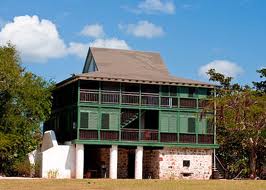 |
| Today fully Renovated |
 |
| This is in the outdoor non-attached kitchen (fire hazard and heat dispersement). and the restored old stove top. Wood frame filled with sand, then coals on top rather like today's BBQ |
The first William Eden arrived in Cayman in the 1770's from Devizes in Devon and almost immediately met the governor's daughter, a Miss Bodden -- a very Caymanian name. They married and started having babies so needed a home, this one. Sadly Mrs. Eden died in childbirth with #4 so William married another lady with whom he had 6 more children. The new Mrs. Eden was reportedly a bit of a shrew so he upped and left for Honduras to log mahogany (for home and boat building) and sadly for him, that is where he then died leaving Mrs. Eden with 10 children and this house named St. James on Pedro Point (hence the name).
William Eden II was a very prominent businessman and inevitably with the biggest house that is where many of the business and governmental decisions were made in Cayman as Bodden Town, nearby, was the island's first capital. In the early days there were few local laws only those brought in from Jamaica (Cayman was a dependency back then) few of which had any relevance and so were largely ignored. That worked until the population grew larger when the old ways (essentially any problems were put out for arbitration with the neighbors but if you didn't like the result, you used fists) were found to be chaotic bordering on anarchy. So in 1831 the bigwigs sat down and drafted a 'proposal' for the Governor of Jamaica essentially creating a democratic society. Ultimately somebody read the proposal and in the 1850's it was accepted. This enabled local laws to be made and the anarchy stopped.
Pedro St. James was also the place where the proclamation outlawing slavery and freeing all slaves was made in 1835. The Act was actually passed in 1833. News traveled slowly in those days.
There's also a nice display of near contemporary news from the 1940-1960 times when the island went from being a mosquito ridden swamp fringed by isolated settlements (this is pre-roads) to what we know it is today. One section described the fact that personal incomes had actually gone down since the first settlement as truly Cayman had nothing, not even for Caymanians many of whom left to seek work. In the late 1940's Government revenues totaled 12,500 pounds sterling, three-quarters of which came from the sale of stamps! There were 3 civil servants back then as opposed to 4,000 today! The 1950's saw roads, an airport and the first hotel on 7 Mile Beach. There's no bush on 7 Mile Beach these days but 60 years ago there was no road and bush, bush and more bush. And no tourists either!
After this I was on the road again out east -- there's only one road so difficult to get lost. However the east road is all by the coast with reefs and beaches so it was difficult to know where the trail points were other than with the microscopic trail signs often hidden away behind things. This meant annoying everyone on the road traveling east as I couldn't go more than 20 mph otherwise I'd miss the signs.
The first was The Iphigenia, a Welsh barque that was stranded on the Bodden Town reefs in 1874 -- reckless navigation not weather being the reason. The ship was overrun by local salvagers, something the local authorities found difficult to control there being 2 magistrates who tried to keep the peace whilst the 3rd was joining in. The captain was reprimanded and told 'to be more careful next time'.

 |
| Difficult to imagine conditions where a ship would founder on a day like today! |
Next was The Juga, a Norwegian ship wrecked on reefs at Old Isaac in 1888. Part of it is still there above the water line. As it's really close into shore local wreckers were on board within 5 minutes, first helping the crew away, next negotiating salvage rights with the captain before finally dipping in.
 |
| Don't expect to see this on the water side of the road. It is on the other side almost hidden by foliage. I missed it first time around. |

 |
| The old and the new ... old at the back. They don't like throwing things away in Cayman! |
Finally came the Wreck of the Ten Sail right out at the far eastern end. In 1794 during the Revolutionary War with France, the Royal Navy had captured a French frigate nearby and was sending it back to England for refit under the name HMS Convert. She was also acting as security for a convoy of 58 merchant ships also sailing back to various parts of Europe -- I thought the convoy system was only introduced in WW1 but clearly it was in operation before this. The convoy was setting sail from Jamaica on the morning tide but the night before 6 or 7 vessels left harbour so HMS Convert and the rest of the convoy had to leave pretty quickly. News came back that those turkeys who'd left before the others had all ploughed into some unknown reefs somewhere so the chase was on and HMS Convert was in the van. A lookout in the night called out a warning about reefs just off to one side and as HMS Convert turned away another merchant vessel who'd clearly been dreaming ploughed into her side and both ended up on the reefs as well. What didn't help was the fact that there was quite a strong breeze driving the convoy onto the reefs so in the end 10 ships, HMS Convert and 9 other merchantmen, ended up on the reefs hence the name of the site. The rest of the convoy managed to get back to their home jurisdictions unscathed. Convert's captain faced customary court marshal and was acquitted and went on to greater things in the Royal Navy.

 |
| This ship foundered in 1963. |
 |
| 200 year anniversary memorial of the Ten Sails |
 |
| Cemetery in the background |
 |
| The remains of the Pallas |
This site was right next to yet another cemetery. I've not mentioned this before but there are cemeteries everywhere. They are really ornate and this one was no different. In addition there appeared to be a digging party in the cemetery as a load of people were there, many digging away and seemingly having a party at the same time.
 |
| A private cemetery at Prospect Point |
But the beach itself on this part of South Sound was actually lovely. Not the calm and quiet waters of 7 Mile Beach, but roiled by the endless ocean swell and currents coming up from the south. Today being calm and quiet, everything looked beautiful but I can imagine it being nasty when the wind picks up.
 |
| A more recent ship wreck on South Sound |
Subscribe to:
Posts (Atom)