I had a day on my own in New York before the board meetings so wanted to make the most of it. The concierge in the hotel suggested I take in the High Line Park and Chelsea Market in the Meatpackers District. I'd seen it on Anthony Bourdain's TV programme too so thought I'd do just that.
I'd also made up my mind that as I was staying in the Big Apple I'd do something I'd never been able to do by now, namely understand the subway system and only use that mode of transport during my stay. So I bought a 7-day pass at the 5th Avenue/53rd Street subway station for $31 and headed off on the E train to the 8th Avenue/14th Street station.
The NY subway is messy. I like public transport but most other countries' subway stations I've traveled on are cleaner and with more advertisements, trash bins, signs and generally aesthetically pleasing stuff. In addition there were usually helpful maps around advising where you should be aiming. However the NY subway has a buzz all of its own too.
I found Chelsea Market on 9th Avenue and expected something along the lines of St. Lawrence Market in Toronto or Granville Island in Vancouver -- which really are havens for foodies. For sure there were food shops but also others as well and as it was near Halloween most was covered in fake cobwebs, funny masks and those yellow pumpkins so beloved over here -- I don't understand that really, but folks in the US go crazy about the day and the pumpkin.
However I did find a lovely place called the Lobster Place and found all manner of wonderful things. A helpful young man busy shucking oysters suggested I take a bimble around before ordering anything which is how I found the lobster shack and the steaming fresh lobsters themselves.
It was now 2 pm and I'd made up my mind I intended to have a decent dinner so felt I couldn't go totally over the top but wisely settled on a lobster roll and a dozen oysters which were just terrific.
I took the lobster roll up to the High Line Park nearby -- which is an old elevated railway system of some sort that some clever people thought they'd turn into a park -- i.e. just let the plants grow, I think they were all wild flowers, grasses and weeds actually -- dump in a few benches and leave alone.
Nice job too. It has certainly become a focus for tourists too as there were lots of people like me strolling about (on a Tuesday afternoon) taking photos.
I wanted to take in a movie so promised I'd return in a day or so and headed on the subway again to Times Square where the movie theatre was. I like Times Square. Gaudy certainly. Chic, elegant, sophisticated … not really!
As I was walking over to look at the half price ticket booth, I saw the Lyceum Theatre had "A Night with Janis Joplin" playing that night. Well, I like Janis so this was a no brainer.
This left just enough time to head down to the movie theatre to see "The Fifth Estate" -- the Wikileaks movie -- and head back to Times Square to a restaurant across the street from the theatre that I'd seen before called Bond 45. It was a big Italian restaurant and was pretty darned good too.
The Janis play was pretty good too. It didn't cover some of the yuckier parts of her life, glossed over the fact that one of the songs she'd 'covered' -- supposedly an Etta James song -- was actually Janis' own composition, and generally gave us the Hollywood sanitised version, but in the absence of the real thing it was pretty good to hear 'Ball and Chain' played live.
The actress playing Janis was really good -- but check out the real thing here. This is the incandescent version from Monterey 1967. The one that introduced Janis to the world!
This was a really good day!
Monday, October 28, 2013
Does it really have to be THAT big?
But there was no ill feeling in that parting. Noo Yawkers always simply have somewhere to go, something to do and "NOW, so get the lead out buddy!!"
And I also love the big buildings. But really, do they have to be that big?
Let's look back and see what was happening when they were all built and take a look at some of the things that were going on at the time: 1920's boom and then 1930's catastrophic bust in the main.
So labour was cheap and plentiful which helped but really did they need to be that high? New York was a big city, for sure, but it wasn't bigger than other major cities with lower rise buildings -- London for example had a far bigger population at the time. Also space wasn't really at a premium either. Manhattan may be an island but it's a really big island. So really why do they need such a big post office? And it's one of many.
| Left hand side… |
| … Right hand side … |
| … and round the corner too! |
The answer is quite simple. They did it because they could.
And what a job they made of it too. Some, no much of the craftwork is just lovely. It's not something you pick up at Home Depot either.
![]() |
| The original big guy … but really take a look at the building next door. The work is magnificent. |
![]() |
| The new big guy … #1 World Trade Centre, 1776 feet high and the tallest building in North America. And yes I bet you can guess why they made it 1776 feet tall! |
![]() |
| And my favorite, the Chrysler Building on 41st and Lexington |
Thursday, October 3, 2013
"Are they always this bad?"
It was a lovely sunny late summer day in Toronto last Saturday when I decided to go to a FC Toronto football match at BMO Field but after an hour I turned to my neighbour, an English guy called Jamie as it turned out, and posed this question for the preceding 60 minutes had been full of the most complete footballing dross that I can remember seeing.
Jamie said this was entirely normal this season and went on to give me a complete run down of the reasons why and the machinations in general of the MLS and of course FC Toronto.
Its all about money naturally.
The MLS has a salary cap which the game programme said was around $350,000 per year per player. The cap is set in aggregate per team so its up to each team how much they pay each player. This effectively means that no big name is likely to turn up to play MLS in their prime.
Well not exactly because in 2008 things changed to enable MLS teams to attract big names so long as they didn't form part of the salary cap. This meant teams could buy 1 non-salary capped player which is how the LA Galaxy team managed to hire David Beckham. They kept other stars like Landon Donovan by paying them most of the salary cap which is why LA didn't win anything for years.
The MLS has a draft mechanism like other US major league sports but everything is tightly controlled by the MLS themselves down to setting player salaries, transfers, everything. My new friend Jamie told me that Toronto had agreed to transfer a well known player, organised everything within the salary cap, but MLS HQ just said "No" after which he went to another MLS club whence they said "Yes". It all sounds rather sinister to me!
As for FC Toronto, they are owned by a media group called MLSE -- Major League Sports Enterprises -- which also owns all the other Toronto sports teams: The Raptors, The Blue Jays, The Maple Leafs and the Marlies. Jamie told me all the teams are pretty much despised locally as they have the highest ticket prices in the North American sporting firmament yet the teams are all rubbish and never make any play-offs.
I'm pretty sure its not quite as drastic as all that as getting a ticket is pretty difficult usually. I'd been lucky as it was the end of the season and the teams on display were 2nd last and last respectively, by quite a wide margin too (the other team was DC United who'd left most of their best players at home for the match apparently).
Jamie was optimistic though as in the past year ownership of MLSE had changed from the Ontario Teachers Pension Plan who didn't care much about sports or results, only their ongoing dividend, to a joint venture between Rogers and Bell Canada, the 2 big telephone companies in Canada. This he hoped meant a change in attitude towards the teams, hopefully more money to buy talent and a far more professional approach.
The programme itself mentioned the hiring of a 31 year old GM for the football team who looked insanely young and whose talent apparently was his ability to understand how the salary cap worked. He'd previously worked for a Baseball team in the US. I immediately thought of Jonah Hill in the Moneyball movie with Brad Pitt in it.
Ironically as soon as I started the conversation with Jamie the game perked right up and Toronto hammered in 3 more goals, good ones too, to end up 4-1 winners by the end.
Maybe I'd been a bit harsh in my earlier assessment!
Jamie said this was entirely normal this season and went on to give me a complete run down of the reasons why and the machinations in general of the MLS and of course FC Toronto.
Its all about money naturally.
| The pre-game show with national anthems respectfully sung |
The MLS has a salary cap which the game programme said was around $350,000 per year per player. The cap is set in aggregate per team so its up to each team how much they pay each player. This effectively means that no big name is likely to turn up to play MLS in their prime.
Well not exactly because in 2008 things changed to enable MLS teams to attract big names so long as they didn't form part of the salary cap. This meant teams could buy 1 non-salary capped player which is how the LA Galaxy team managed to hire David Beckham. They kept other stars like Landon Donovan by paying them most of the salary cap which is why LA didn't win anything for years.
The MLS has a draft mechanism like other US major league sports but everything is tightly controlled by the MLS themselves down to setting player salaries, transfers, everything. My new friend Jamie told me that Toronto had agreed to transfer a well known player, organised everything within the salary cap, but MLS HQ just said "No" after which he went to another MLS club whence they said "Yes". It all sounds rather sinister to me!
As for FC Toronto, they are owned by a media group called MLSE -- Major League Sports Enterprises -- which also owns all the other Toronto sports teams: The Raptors, The Blue Jays, The Maple Leafs and the Marlies. Jamie told me all the teams are pretty much despised locally as they have the highest ticket prices in the North American sporting firmament yet the teams are all rubbish and never make any play-offs.
I'm pretty sure its not quite as drastic as all that as getting a ticket is pretty difficult usually. I'd been lucky as it was the end of the season and the teams on display were 2nd last and last respectively, by quite a wide margin too (the other team was DC United who'd left most of their best players at home for the match apparently).
Jamie was optimistic though as in the past year ownership of MLSE had changed from the Ontario Teachers Pension Plan who didn't care much about sports or results, only their ongoing dividend, to a joint venture between Rogers and Bell Canada, the 2 big telephone companies in Canada. This he hoped meant a change in attitude towards the teams, hopefully more money to buy talent and a far more professional approach.
The programme itself mentioned the hiring of a 31 year old GM for the football team who looked insanely young and whose talent apparently was his ability to understand how the salary cap worked. He'd previously worked for a Baseball team in the US. I immediately thought of Jonah Hill in the Moneyball movie with Brad Pitt in it.
Ironically as soon as I started the conversation with Jamie the game perked right up and Toronto hammered in 3 more goals, good ones too, to end up 4-1 winners by the end.
| Pretty impressive view from my seat above the Directors' Box |
Maybe I'd been a bit harsh in my earlier assessment!
| You can just see the tallest residential building in North America in the distance to the left of the Canadian flag |
![]() |
| And here it is a bit closer. 71 storeys in all their glory. |
Sunday, September 29, 2013
"You should have been here in the summer.."
I've just returned from nearly 3 weeks in England when it rained pretty much each day except for the last couple and the stock response was to mention the glorious Indian summer when everything turned brown. Well suffice to say I saw none of it but as usual there was a hosepipe ban in force!
That's something I really don't get. England has to be one of the wettest countries in the world yet always it is caught out by an insufficiency of water ... apparently ... meaning you cannot run hosepipes to maintain the garden or even wash your car. I realise that a large part of the basic infrastructure of the country was built in the Victorian era of fewer people, homes, etc., and much of it is in need of update and in some cases repair. But really it rained cats and dogs for weeks. In Bermuda we catch rain on our roofs and a few days of heavy rain is enough to refill our tanks and turn everything green. And we don't get anywhere near the amount of rain.
It was nice though to spend some time in both Canterbury and Southend (our respective home towns) but a couple of highlights stand out: Beachy Head and Arundel Castle. Both are in Sussex and definitely worth a visit.
Beachy Head is a chalk headland near Eastbourne (a corruption of Beau Chef or Beautiful Headland in French), the highest chalk cliff in the country actually at 531 feet. It is also a place where 20 people a year go to commit suicide and is quite possibly the reason why the Industrial Revolution happened.
Back in 1653 the English fought the Dutch at the Battle of Portland over 4 days exhausting and finally demolishing the Dutch Navy who had big global trade aspirations and as a consequence took the decision they couldn't compete with the English any more (this was before Great Britain was created). However in 1690 at the Battle of Beachy Head (same place) a combined English and Dutch fleet was royally thumped by the French who were supporting the recently deposed James II in Ireland and elsewhere. The French followed up into the River Thames and the consternation it caused made the new king and queen William III and Mary determine to rebuild the navy properly.
As there was no money available, the Bank of England was created in 1694 as a private institution and in 12 days raised £1.2 million, half of which was for rebuilding the navy thereby creating the global behemoth that was subsequently the Royal Navy. The industrial activity this caused country wide transformed the economy with iron works making nails to agriculture feeding the quadrupled strength of the Royal Navy undoubtedly sowing the seeds for the Industrial Revolution that followed in the 18th century.
Today it is a lovely place for a walk and some great views.
One thing that gets me though, and this is something that is endemic these days in Britain, is that everything costs money. Everything. Now I don't mind paying for things as upkeep of course costs money but at Beachy Head ... and we weren't even at the top ... the parking spots were all pay and display. This doesn't sound much but consider that Beachy Head is very, very remote indeed and the likelihood of a traffic warden strolling by just as they would outside Sainsbury's, for example, is laughable. Yet still you have to pay.
But that still didn't dampen my enthusiasm for the sights and scenery which were magnificent. Tres beau indeed.
**
It was my idea to visit Arundel Castle. As a cricketer I have long been enamoured of the wonderful tradition that the first match of any tour by a foreign team was against an invitation XI at Arundel. This must be a fantastic event to play in. The castle itself is anything but shabby too and well worth a visit.
Arundel is between Worthing and Chichester in Sussex and was established in 1067 immediately after the Norman Conquest as a means of controlling the rebellious Saxons and also to guard against another foreign invasion as Britain was wide open at that time and rich pickings for anyone from overseas. It has stayed pretty much in the family since this time with brief moments when the then Earls of Sussex and then Arundel as well as the superceding Dukes of Norfolk backed the wrong side and the monarchs executed them and appropriated their lands.
This was actually a major consideration as England in the early to late middle ages went through several periods of civil wars which turned the nobility rather more than the country upside down. Take the Matilda/Stephen war of some 20 years back in the later 1100's, a war that was country wide, disruptive and saw the swapping of the throne back and forth on a number of occasions. If you were a noble back then, you had to pick a side so this meant that at some point in the conflict you were bound to be on the losing side. And being on the losing side often meant execution and confiscation of lands.
One way out of this was that taken by Thomas Howard, the 2nd duke, who was a general for Richard III but found himself catastrophically on the losing side at Bosworth in 1485. He spent 3 years in the Tower of London having been demoted from Duke of Norfolk to Earl of Surrey but more than recovered in 1513 when he took command of the English forces that destroyed the invading Scots at Flodden when Henry VII was away campaigning. In addition to regaining his dukedom and lands, the 2nd Duke received an augmentation to his coat of arms, namely that of a Scottish lion shot through the throat with an arrow.
Next problem was religion. The Norfolks were/are still a prominent Roman Catholic family which was all to the good during the early Henry VIII era but the next duke was a schemer who was able to marry not one but two nieces to the king, both of whom were subsequently executed for treason (Ann Boleyn and Catherine Howard). This really didn't help the family fortunes much and when Elizabeth I took over, things got worse a later duke became involved in a plot to marry Mary Queen of Scots and was promptly executed for treason.
During the Civil War with Parliament, the Norfolks sided with Charles I but sensibly left the country for Italy until the Restoration in 1660 but the castle was scene of a number of engagements which damaged the structure considerably. Fortunately the family married well, remained wealthy, regained all their prestige and over the next couple of centuries were able to reconstruct the castle in magnificent fashion. The massive renovations in the Victorian era have brought the castle back to magnificent condition and the current family shows no sign of taking things easily.
Interestingly the Norfolks were the first family to establish family trusts to hold their various properties, a move designed to ward off the nastiness that is death duties in Britain. The model they use has been widely copied around the country.
High spots for me were the magnificent library which is truly stunning, dozens of magnificent great works of art by Caneletto, Van Duyk and other great masters (one of the benefits of being around for 1,000 years, being wealthy and interested in art is that commissioning a Caneletto, say, when he was a young whipper snapper wasn't that expensive a proposition as today. In fact they ordered 3, all hang in the Caneletto Room) and the garden which is very contemporary.
The current Duchess is very keen on the garden and it shows. I imagine spring time and early summer must be breath taking. The magnolias and rhodedendrums were simply green when we visited. In early summer they'd be in their full glory.
Just lovely in fact.
That's something I really don't get. England has to be one of the wettest countries in the world yet always it is caught out by an insufficiency of water ... apparently ... meaning you cannot run hosepipes to maintain the garden or even wash your car. I realise that a large part of the basic infrastructure of the country was built in the Victorian era of fewer people, homes, etc., and much of it is in need of update and in some cases repair. But really it rained cats and dogs for weeks. In Bermuda we catch rain on our roofs and a few days of heavy rain is enough to refill our tanks and turn everything green. And we don't get anywhere near the amount of rain.
It was nice though to spend some time in both Canterbury and Southend (our respective home towns) but a couple of highlights stand out: Beachy Head and Arundel Castle. Both are in Sussex and definitely worth a visit.
Beachy Head is a chalk headland near Eastbourne (a corruption of Beau Chef or Beautiful Headland in French), the highest chalk cliff in the country actually at 531 feet. It is also a place where 20 people a year go to commit suicide and is quite possibly the reason why the Industrial Revolution happened.
| No French or Dutch in sight this time. |
Back in 1653 the English fought the Dutch at the Battle of Portland over 4 days exhausting and finally demolishing the Dutch Navy who had big global trade aspirations and as a consequence took the decision they couldn't compete with the English any more (this was before Great Britain was created). However in 1690 at the Battle of Beachy Head (same place) a combined English and Dutch fleet was royally thumped by the French who were supporting the recently deposed James II in Ireland and elsewhere. The French followed up into the River Thames and the consternation it caused made the new king and queen William III and Mary determine to rebuild the navy properly.
As there was no money available, the Bank of England was created in 1694 as a private institution and in 12 days raised £1.2 million, half of which was for rebuilding the navy thereby creating the global behemoth that was subsequently the Royal Navy. The industrial activity this caused country wide transformed the economy with iron works making nails to agriculture feeding the quadrupled strength of the Royal Navy undoubtedly sowing the seeds for the Industrial Revolution that followed in the 18th century.
Today it is a lovely place for a walk and some great views.
One thing that gets me though, and this is something that is endemic these days in Britain, is that everything costs money. Everything. Now I don't mind paying for things as upkeep of course costs money but at Beachy Head ... and we weren't even at the top ... the parking spots were all pay and display. This doesn't sound much but consider that Beachy Head is very, very remote indeed and the likelihood of a traffic warden strolling by just as they would outside Sainsbury's, for example, is laughable. Yet still you have to pay.
But that still didn't dampen my enthusiasm for the sights and scenery which were magnificent. Tres beau indeed.
**
It was my idea to visit Arundel Castle. As a cricketer I have long been enamoured of the wonderful tradition that the first match of any tour by a foreign team was against an invitation XI at Arundel. This must be a fantastic event to play in. The castle itself is anything but shabby too and well worth a visit.
Arundel is between Worthing and Chichester in Sussex and was established in 1067 immediately after the Norman Conquest as a means of controlling the rebellious Saxons and also to guard against another foreign invasion as Britain was wide open at that time and rich pickings for anyone from overseas. It has stayed pretty much in the family since this time with brief moments when the then Earls of Sussex and then Arundel as well as the superceding Dukes of Norfolk backed the wrong side and the monarchs executed them and appropriated their lands.
This was actually a major consideration as England in the early to late middle ages went through several periods of civil wars which turned the nobility rather more than the country upside down. Take the Matilda/Stephen war of some 20 years back in the later 1100's, a war that was country wide, disruptive and saw the swapping of the throne back and forth on a number of occasions. If you were a noble back then, you had to pick a side so this meant that at some point in the conflict you were bound to be on the losing side. And being on the losing side often meant execution and confiscation of lands.
| The inner courtyard with the Motte and Keep on top in the background |
One way out of this was that taken by Thomas Howard, the 2nd duke, who was a general for Richard III but found himself catastrophically on the losing side at Bosworth in 1485. He spent 3 years in the Tower of London having been demoted from Duke of Norfolk to Earl of Surrey but more than recovered in 1513 when he took command of the English forces that destroyed the invading Scots at Flodden when Henry VII was away campaigning. In addition to regaining his dukedom and lands, the 2nd Duke received an augmentation to his coat of arms, namely that of a Scottish lion shot through the throat with an arrow.
Next problem was religion. The Norfolks were/are still a prominent Roman Catholic family which was all to the good during the early Henry VIII era but the next duke was a schemer who was able to marry not one but two nieces to the king, both of whom were subsequently executed for treason (Ann Boleyn and Catherine Howard). This really didn't help the family fortunes much and when Elizabeth I took over, things got worse a later duke became involved in a plot to marry Mary Queen of Scots and was promptly executed for treason.
During the Civil War with Parliament, the Norfolks sided with Charles I but sensibly left the country for Italy until the Restoration in 1660 but the castle was scene of a number of engagements which damaged the structure considerably. Fortunately the family married well, remained wealthy, regained all their prestige and over the next couple of centuries were able to reconstruct the castle in magnificent fashion. The massive renovations in the Victorian era have brought the castle back to magnificent condition and the current family shows no sign of taking things easily.
![]() |
| One of the 65 loos put in by the Victorian restoration. Still in use today. |
Interestingly the Norfolks were the first family to establish family trusts to hold their various properties, a move designed to ward off the nastiness that is death duties in Britain. The model they use has been widely copied around the country.
| One of the bathrooms, still in use. |
High spots for me were the magnificent library which is truly stunning, dozens of magnificent great works of art by Caneletto, Van Duyk and other great masters (one of the benefits of being around for 1,000 years, being wealthy and interested in art is that commissioning a Caneletto, say, when he was a young whipper snapper wasn't that expensive a proposition as today. In fact they ordered 3, all hang in the Caneletto Room) and the garden which is very contemporary.
| The 10,000 book library. |
The current Duchess is very keen on the garden and it shows. I imagine spring time and early summer must be breath taking. The magnolias and rhodedendrums were simply green when we visited. In early summer they'd be in their full glory.
| Part of the garden with the Catholic Cathedral in the background. |
Just lovely in fact.
Labels:
Arundel,
Beachy Head,
Castles,
England,
Gardens,
Great Britain,
Royal Navy,
Sussex
Monday, September 2, 2013
Citizen Scientists
Up until a few years ago the scientific world viewed amateurs with what could best be called disdain. This applied to archaeology in spades so it was only the boffin with very small trowel and brush who could get involved. This worked OK I suppose when a site was discovered and partially exposed but was a bit of a struggle if, say, you knew from ancient texts that a 5th century Saxon burial chamber was somewhere near and you arrived at 'here' to find a large farm field. Armed with your small trowel and brush it could take a good while to cover the entire field... and there was no guarantee that it actually was 'this' field.
Enter the amateur.
Now if you, say, had a personal metal detector and liked to spend your weekends tramping across fields looking for metal traces that just might be valuable stuff like coins and came across the largest Saxon burial site discovered in years then maybe just maybe your findings may not be sniffed at as not being found in the 'right' way... and the whole concept of the enthusiastic amateur may not be dismissed out of hand but recognised for what it is. Namely, free help that may, I repeat may, find stuff more quickly (see http://www.theguardian.com/uk/2009/sep/24/anglo-saxon-treasure-hoard-gold-staffordshire-metal-detector and Ringlemere Cup).
Welcome Citizen Scientist!
Fortunately the folks at the Bermuda Zoological Society agree! For this year as the cash strapped Bermuda government pulled much of its funding for charities particularly for research that could be considered to be esoteric, they decided to ask the public for help instead.
Until I googled it just now I hadn't realised quite how many Bream Projects exist around the world. The one I am thinking about is this one -- http://bermudabream.blogspot.com. Dr. Thad Murdoch tells it better than me.
Bermuda’s coral reefs are vital to the persistence of our economy and wellbeing. Living coral reefs act as a self-healing protective sea wall, blocking storm waves from destroying our fragile limestone shoreline and the coastal infrastructure we built along its edge. Our tourism industry relies on the beauty and charisma of our island; contributed substantially by the many recreational and aesthetic opportunities provided by the coral reefs around us. An economic evaluation of the lagoonal reef, which represents half of the entire reef system, found that $750,000,000 to $1,250,000,000 are contributed to Bermuda’s economy annually by the reefs of Bermuda. It is strongly in our interests to ensure that the coral reef system that protects and sustains our lives is itself protected from the extensive harm that can be caused by bad human behaviour such as overfishing, dredging, shipping traffic and the global environmental threats of climate change and ocean acidification.
Pretty darned important for Bermuda then!
So after the topic was raised at a recent BZS board meeting I asked our friend Stan if he fancied getting involved (OK I was shameless, I was after his boat!) and he said 'you betcha' that put the onus on me to organise him and a crew of at least 4 to go out and spend a day on two of Bermuda's beautiful but unvisited reefs.
The pre-trip briefing was interesting. The intent was for each crew to visit 2 far flung reefs each. In 2 people teams the scientists would (1) assess the health of the coral reef itself and (2) count the fish near the reef.
Two things jump out: first, how do you assess the health of the reef and secondly how on earth do you tell fish apart say if there are 2 or more stripey ones, how do you know they are different or the same one dogging you? This is of course where the worth of the citizen scientist becomes questionable because unless you know, well you don't know do you? Fortunately the real scientists told us what to look for in reef health and how to tell fish apart and gave us each a hoola hoop and a couple of slates to record our findings. They also gave us GPS coordinates so we could find the particular reef.
Lynda at BZS asked us all to enter our crew's name and details on Crowdrise, a pledge site (see here to make YOUR own pledge: stanscrew) where we would give our donations and ask others to do so as well.
Don't you just love this new wave of social media? This is not Facebook or Twitter kind of social media but a means of doing things and raising money via crowd financing. The concept is simple: get a bunch of people to group together to do special things. I personally like the crowd financing concept whereby small businesses that cannot get bank financing (banks just not lending, not necessarily the businesses being bad risks) obtain business financing from individuals who aren't being paid anything for their bank deposits and want to earn a better return... and at the same time do good for the economy. For it is the growth of small and medium size businesses that increase real employment in an economy and turn things around. The UK has it and the UK government has in a moment of admirable forward thinking put its own skin in the game contributing in some cases the first 20% of the financing. The US is in the process of doing it after the passage of the JOBS Act. Canada doesn't have it yet but wants to. It all came out of the micro-financing idea propagated in Bangladesh and Africa and is moving towards the mainstream (see Microfinance for more).
We set out on Saturday with Stan's son Roger and friend Alan joining Viv, Stan and I on the trip. Stan had spent several hours the evening before programming the GPS coordinates into his device so we hoped finding our assigned reef wouldn't be too difficult... but this wasn't just any reef. It was one that had been surveyed from the air only. Nobody had actually knowingly been there! But it was big... supposedly the size of a house. It took quite a while to find but we ultimately did ... we think!
It was eerie leaving the safety of the boat some 5-6 miles offshore with the land looking pretty small ... and not being the world's greatest swimmer. I had to admire Viv, Alan and Roger who simply hopped off the side and then proceeded to heckle. I couldn't bring myself to ask Stan for a life jacket but I certainly wasn't going to miss out on a noodle. Anything that helps buoyancy is fine by me!
This time of year, the water is still beautifully warm and the sea really is that colour. The water depth was 20 feet away from the reef but down to only a couple over the top of it. The slightly stingy fire coral would be a factor... if you knew which one it was!
But down to work. Viv and I were hoola hooping first time out, the idea being that you take the hoola hoop and lob it over the reef randomly and within the ring estimate how much of each type of coral was there, how much sand, weed, bare rock, etc.
We spent an hour in the water and had lunch before checking the chart for the next reef which Stan said was further out towards the outer reef, near Chubb Marker some 8 miles offshore. I hadn't realised that there were reefs that far out but it is the reason why there are so many shipwrecks around Bermuda, running into the hundreds. Even today there are emergencies as many of the really big ships have charts that don't show Bermuda so Bermuda's Harbour Radio has to get to work! Even now boat owners who are out late don't try to take on the reefs if it gets too dark.
The next reef was in deeper water. Stan said 60 feet in some parts but again once on the reef itself it could be as little as a couple of feet. This time it was Viv's and my turn to count fish whilst Alan and Roger would check out the reef.
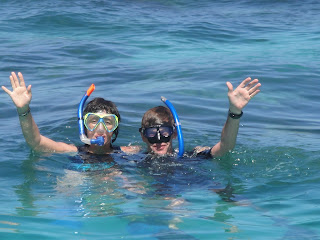
This reef was lovely. The last one was lovely but this one was lovelier. The coral was more luxuriant and there were lots of fish. In fact there were so many I gave up counting and just wrote "LOTS" on the fish slate. (By the way Alan was the underwater cameraman and has lots more Here).
We spent another hour on the second reef and wouldn't have minded staying longer. The plan was to head back in to meet around 4 pm but it was a lovely evening so sitting off sipping cool drinks and taking in the scenery would have been lovely but no we Citizen Scientists have obligations to keep and scientific data to submit.
But all in all it was a great day and according to BZS a great success. 20 boats went out meaning 40 new reefs were surveyed and important data gleaned. It will be repeated and simply underscores the fact that even non-experts can help doing important work if asked and managed properly. BZS did a great job of that so thanks to them for the organisation (this is where you can find them: BZS).
Thanks guys. It was a blast!
And check the YouTube clip too!
http://www.youtube.com/watch?v=Wh74JSrr4XM&feature=youtu.be&utm_source=BZS+eAlert+-+October+11%2C+2013&utm_campaign=REEF+WATCH2&utm_medium=email
Enter the amateur.
![]() |
| Ringlemere Cup |
Now if you, say, had a personal metal detector and liked to spend your weekends tramping across fields looking for metal traces that just might be valuable stuff like coins and came across the largest Saxon burial site discovered in years then maybe just maybe your findings may not be sniffed at as not being found in the 'right' way... and the whole concept of the enthusiastic amateur may not be dismissed out of hand but recognised for what it is. Namely, free help that may, I repeat may, find stuff more quickly (see http://www.theguardian.com/uk/2009/sep/24/anglo-saxon-treasure-hoard-gold-staffordshire-metal-detector and Ringlemere Cup).
Welcome Citizen Scientist!
Fortunately the folks at the Bermuda Zoological Society agree! For this year as the cash strapped Bermuda government pulled much of its funding for charities particularly for research that could be considered to be esoteric, they decided to ask the public for help instead.
Until I googled it just now I hadn't realised quite how many Bream Projects exist around the world. The one I am thinking about is this one -- http://bermudabream.blogspot.com. Dr. Thad Murdoch tells it better than me.
Bermuda’s coral reefs are vital to the persistence of our economy and wellbeing. Living coral reefs act as a self-healing protective sea wall, blocking storm waves from destroying our fragile limestone shoreline and the coastal infrastructure we built along its edge. Our tourism industry relies on the beauty and charisma of our island; contributed substantially by the many recreational and aesthetic opportunities provided by the coral reefs around us. An economic evaluation of the lagoonal reef, which represents half of the entire reef system, found that $750,000,000 to $1,250,000,000 are contributed to Bermuda’s economy annually by the reefs of Bermuda. It is strongly in our interests to ensure that the coral reef system that protects and sustains our lives is itself protected from the extensive harm that can be caused by bad human behaviour such as overfishing, dredging, shipping traffic and the global environmental threats of climate change and ocean acidification.
Pretty darned important for Bermuda then!
So after the topic was raised at a recent BZS board meeting I asked our friend Stan if he fancied getting involved (OK I was shameless, I was after his boat!) and he said 'you betcha' that put the onus on me to organise him and a crew of at least 4 to go out and spend a day on two of Bermuda's beautiful but unvisited reefs.
![]() |
| These are the reefs that have been visited so far. There are 35,000 so quite a few to go! |
Two things jump out: first, how do you assess the health of the reef and secondly how on earth do you tell fish apart say if there are 2 or more stripey ones, how do you know they are different or the same one dogging you? This is of course where the worth of the citizen scientist becomes questionable because unless you know, well you don't know do you? Fortunately the real scientists told us what to look for in reef health and how to tell fish apart and gave us each a hoola hoop and a couple of slates to record our findings. They also gave us GPS coordinates so we could find the particular reef.
Lynda at BZS asked us all to enter our crew's name and details on Crowdrise, a pledge site (see here to make YOUR own pledge: stanscrew) where we would give our donations and ask others to do so as well.
Don't you just love this new wave of social media? This is not Facebook or Twitter kind of social media but a means of doing things and raising money via crowd financing. The concept is simple: get a bunch of people to group together to do special things. I personally like the crowd financing concept whereby small businesses that cannot get bank financing (banks just not lending, not necessarily the businesses being bad risks) obtain business financing from individuals who aren't being paid anything for their bank deposits and want to earn a better return... and at the same time do good for the economy. For it is the growth of small and medium size businesses that increase real employment in an economy and turn things around. The UK has it and the UK government has in a moment of admirable forward thinking put its own skin in the game contributing in some cases the first 20% of the financing. The US is in the process of doing it after the passage of the JOBS Act. Canada doesn't have it yet but wants to. It all came out of the micro-financing idea propagated in Bangladesh and Africa and is moving towards the mainstream (see Microfinance for more).
We set out on Saturday with Stan's son Roger and friend Alan joining Viv, Stan and I on the trip. Stan had spent several hours the evening before programming the GPS coordinates into his device so we hoped finding our assigned reef wouldn't be too difficult... but this wasn't just any reef. It was one that had been surveyed from the air only. Nobody had actually knowingly been there! But it was big... supposedly the size of a house. It took quite a while to find but we ultimately did ... we think!
| Which one is ours? |
It was eerie leaving the safety of the boat some 5-6 miles offshore with the land looking pretty small ... and not being the world's greatest swimmer. I had to admire Viv, Alan and Roger who simply hopped off the side and then proceeded to heckle. I couldn't bring myself to ask Stan for a life jacket but I certainly wasn't going to miss out on a noodle. Anything that helps buoyancy is fine by me!
![]() |
| Which way's dry land? |
![]() |
| Citizen Scientist Roger at work ... note the noodle and recording slate |
This time of year, the water is still beautifully warm and the sea really is that colour. The water depth was 20 feet away from the reef but down to only a couple over the top of it. The slightly stingy fire coral would be a factor... if you knew which one it was!
But down to work. Viv and I were hoola hooping first time out, the idea being that you take the hoola hoop and lob it over the reef randomly and within the ring estimate how much of each type of coral was there, how much sand, weed, bare rock, etc.
![]() |
| Brain, finger, soft and star coral. Thankfully all in pretty good health. |
The next reef was in deeper water. Stan said 60 feet in some parts but again once on the reef itself it could be as little as a couple of feet. This time it was Viv's and my turn to count fish whilst Alan and Roger would check out the reef.
| The non-recording Citizen Scientists, Viv and Alan |
![]() |
| I'd never seen a shoal of parrotfish before. Usually they are in ones and twos. This one had 20 fish at least. |
![]() |
| Reef #7 on the chart. Such a dull name for such a lovely place. |
We spent another hour on the second reef and wouldn't have minded staying longer. The plan was to head back in to meet around 4 pm but it was a lovely evening so sitting off sipping cool drinks and taking in the scenery would have been lovely but no we Citizen Scientists have obligations to keep and scientific data to submit.
| Our reefs |
| Stan's Crew from left: Stan, Viv, Roger, Alan |
Thanks guys. It was a blast!
And check the YouTube clip too!
http://www.youtube.com/watch?v=Wh74JSrr4XM&feature=youtu.be&utm_source=BZS+eAlert+-+October+11%2C+2013&utm_campaign=REEF+WATCH2&utm_medium=email
Labels:
Bermuda,
Bermuda Zoological Society,
Reef Watch,
snorkeling
Wednesday, July 10, 2013
Sometimes You Just Need to Look in Your Own Back Yard
The old saying goes "familiarity breeds contempt" whilst not completely true in this case is getting there so far as myself and Bermuda beaches goes as its been probably a couple of years since I went to a beach here. For the life of me I can't think why as they probably are the loveliest anywhere in the world and on Sunday this came home to me even more strongly when we drove out to St. David's and took a look at the beaches now available to the public at Cooper's Island.
Bermuda's history is interesting none more so than St. David's which until the 1940's was cut off from the mainland -- if you can call Bermuda's chain of small islands 'mainland' that is. The narrow track railway reached St. David's since the 1920's but to get to, say, the Rum Swizzle bar and restaurant you needed a boat to reach the causeway and then the mainland. WWII changed all that with the strategic imperative to build an airport in the middle of the Atlantic to ferry planes and supplies over to Europe and in impressive style the Americans arrived as part of lend lease and did just that, flattening several islands along the way and building what became Kindley Field, later the L F Wade International Airport.
It also connected St. David's to the mainland. Whether this was a boon or not is difficult to say as until this day St. David's Islanders are a breed apart with plenty of interesting genealogical identity gathered in from who knows where. Some people never visit the mainland at all to this day. I know of one St. Davids Islander who last had a passport 30 years ago, visits Hamilton twice a year to conduct whatever business he needs to do and spends the rest of his time fishing. "Who needs any more?" is what he says when we meet.
The US maintained a base at Kindley Field stationing 3,000 or so servicemen there until the 1990's when a US TV expose showed them living the life of Reilly at US taxpayers expense. As this coincided with a major pullback all around the world following the collapse of the Soviet Empire, the US upped sticks and pulled out from Bermuda too.
My own involvement with St. David's has been limited with occasional attempts to visit the oldest house in Bermuda -- called Carter House -- on Thursdays which enabled you to also visit the PX and more importantly McDonald's for a Big Mac fix. Terrorism ended that in the late 1980's so it wasn't until the Americans pulled out that Bermudians were able to visit again. But it was only on a limited basis still as NASA maintained a tracking station at the very end of the island chain called Coopers Island which operated from the 1960's and entry beyond some very large gates was impossible until quite recently.
The Bermuda triathlon association trains there on Saturdays and I used to attend with Alistair in tow until he went to school in England and that pretty much concludes my attachment to that particular part of St. David's.
So when Viv said lets spend the afternoon there on Sunday I was skeptical but after the Wimbledon men's final (well done Andy Murray, incidentally) we left collecting our friends from the Villages, Christine and Andy along the way.
It is a near 40 minute drive from where we live so we arrived to a throng of people parked around the more popular and nearer Clearwater Beach. Cooper's Island was further along so we hoped for fewer people.
And boy was it ever beautiful!
| Our first view of one of the beaches |
| Observation tower at the end ... presumably a relic from NASA days |
| Another random beach ... there are several to chose from! |
We walked to the end of the island chain that the US had joined together with various causeways back in the 1940's and wondered what it was like in pristine condition. We also wondered how 'tough' it all must have been for the US servicemen stationed in that particular hardship post when, for example, an annoying space launch dragged the NASA bods off the beach and into the tracking station.
| Our snorkeling beach ... great reefs |
The park is managed by the BLDC, a government quango, tasked with the redevelopment of it. There are certainly a few yucky buildings from the old days but in my estimation not a lot needs to be done to enhance the beauty except clearing away some of the old detritus and putting in some decent gravel footpaths and a lot of trash bins for that beautiful place needs not to have trash all over.
It had been a couple of years since I last snorkeled and the familiar filling up of the sinuses with sea water was instantaneous as always readying me for uncontrolled evacuations at any time in the next 2 days from my nose, ears and sometimes eyes of globs of seawater. Partial deafness too! But it was worth it for the reef and the large numbers of fish. We even saw a couple of lobsters on one occasion but I won't say where as they are hunted a lot.
| Another totally deserted beach ... really, that colour! |
| Our farewell view of yet another lovely beach setting |
We will return. This place could be one of, if not THE best beach area in the world. It is that lovely.
| Sunset from Christine and Andy's porch ... not too shabby either! |
Labels:
Bermuda,
Bermuda beaches,
Cooper's Island,
NASA,
snorkeling,
St David's Island
Subscribe to:
Posts (Atom)