Showing posts with label Great Britain. Show all posts

Monday, July 11, 2022

The Odyssey -- Athens Day 2

 Day 2 in Athens would be a humdinger. All about the Acropolis. The itinerary said:

'We will arrange a private walking tour of Athens for 5 to 6 hours if you are up to it to visit all the important sites including the Acropolis and the New Acropolis Museum.'

We met our guide Theodora at the hotel and walked the 5 minutes along the street to the entrance to the Acropolis. There were lots of people. Theodora said today would likely be the busiest day of the year as a number of cruise ships had arrived at Piraeus with passengers’ first stop likely to be the Acropolis. 

Viv and I wondered why we would visit today then, or rather this morning as we could easily have visited in the afternoon. Oh well. 

The Acropolis hill is big. And tall. It was tough going slowly dragging ourselves up hill in the heat. Theodora told us the story as we went along.

Nearly there! First selfie du jour at the Greek theatre on the south side of the Acropolis

This is what it looked liked during the Hellenistic Period

The Acropolis had been populated for possibly 4,000 years initially as a fortress for people in the surrounds to retreat to at times of trouble and war. It certainly was imposing yet Theodora advised us that the Acropolis had been attacked, sacked and destroyed many times. Huh?

Very true. 

The Acropolis and the temple on the top known as the Parthenon (there are several other temples on the top but smaller) are relatively recent creations. One may think it looks like something of a rocky ruin, but in fact it’s only about 1,000 years old.

After the Persians attacked Athens, defeated them (Thermopylae was lost if you remember) and occupied Athens, they destroyed everything they could before they left the following year of 480 BC. That included the buildings on the top of the Acropolis hill. These included a partially built Parthenon as well as several other temples. The entire site was ruined.

The Athenians together with a full compliment of Spartans this time (not just the famous 300), annihilated the Persians the following year in 479 BC at Plataea removing all threats to the independent Greek states. To show that they were now the big dogs on the block, the Athenians immediately embarked on rebuilding on an immense scale.

The building of the Parthenon was completed in only 9 years while the crafting of the wondrous sculptures took a further 6 years. Marble was brought from a mountain 17 Kms away and was laboriously lugged up the hill that we were now stumbling up. 

Theodora continued with gusto. 

She certainly had a huge passion about the subject and had definite views on things that had impacted the Acropolis over the years. 

First were the Romans. Of course it would be. For some reason, the Greeks thought they could beat the Romans in the first century BC but the Roman tyrant general Sulla in 87 BC routed them, captured the entire region which wasn’t yet a country including Athens, sacked it thoroughly and enslaved the population. That is the entire population including all those philosophers that were still around.

Greece remained a Roman possession until 1458. 

Huh? I hear you say. What about the Byzantines? There were never any Byzantines. That is the name historians gave the eastern Roman Empire looking backwards at some point. The Romans themselves always called themselves Romans, even until the Ottomans took Constantinople in 1453. Byzantium was the name of the original Greek settlement that the Roman Emperor Constantine renamed in the 4th century AD when he moved the capital of the entire Roman Empire to Constantinople. So forget Byzantium. Actually you can't for every guide book says Byzantine this or that, mainly churches, so it is most confusing. Best to see Rome at the same time as you see Byzantium. 

When I was in Rome a couple of weeks ago I found a wonderful excerpt from a 2nd century AD travel book comparing the architecture of Greece and Rome. In typically patronising fashion, the writer said that the Greeks do build some pretty impressive structures but the stench, the disorganisation and the overall mess of Greek cities was something beyond the comprehension of a Roman. Happily Rome provided aqueducts so that every villa has its own water source for their fountains. Sewage for the endless ordure and stench. Plumbing so that buildings would remain well serviced during the wet season…. And so on. 

It was a Roman traveler from the 2nd century, one Pausanias, whom we all should thank for even the possibility of reconstruction and renovation. For it is only his writings and the earlier Herodotus (the Greek historian from centuries earlier) that give us the idea what these buildings and monuments look like. Fortunately both wrote at very great length and in Pausanias' case drew thousands of sketches and drawings, many of which survive.

The Romans in addition to their renowned organisation, also introduced a fully integrated taxation system that lasted until 1458 and beyond for the conquering Ottomans discovered they couldn’t do any better.

Specific to the Acropolis though were the changes wrought by the Romans to the amphitheater, the new theatre and performing arts centre that was built. Where the Greeks starting with Thespis, a comic writer of the golden age, wrote monologues, dialogues and drama, the Romans dug a big ditch, raised up a marble wall around the orchestra (aka stage) and staged mock naval battles and gladiatorial combat. The walls enabling the area to be filled with water for the first, and prevent blood spatters covering the 5,000 person audience in the second. Who needs monologues! 


Theodora was not impressed, then moved onto the Emperor Justinian (6th century emperor). She was even less impressed by Justinian. I couldn’t figure out exactly why but as he was the mover and shaker in rejigging the imperial tax policy for the final time, perhaps it was this. Certainly the Byzantines which Justinian was about to morph into (even I am falling into this Rome vs Byzantium thing), as opposed to the eastern Roman Empire, were not fans of the old pagan gods still widely revered in Greece. Under the ‘Christians’ (spoken with gritted teeth) they basically trashed everything to do with the old Gods. This is why most of the faces on statues have been disfigured. I didn't ask about why the male genitalia were also missing from most statues.

We hadn’t reached the entrance to the Acropolis at the top yet and Theodora wasn’t slowing down.

The British didn’t miss out either. Theodora was scathing about Elgin and his plundering of Greek antiquity in 1801 (this is the so called Elgin Marbles in the British Museum). Yet less so for the French who even before Elgin stole everything that was not nailed down (this in an instruction specifically written by the French ambassador in 1784 to an expedition in that year). And almost glossing over the Venetians who in their sack of Athens in 1687 had fired cannons at the defending Ottomans who’d retired to the Acropolis which they used as magazines. This cannon fire hit the magazines which exploded and destroyed about one third of the Parthenon. They then tried to take the remaining massive sculptures from the mantles which caused them to fall 30 feet and be irredeemably smashed. 

An even minded person may consider deliberate cannon fire, explosions and wanton destruction of rather more concern and remark than removing a few bits of marble that had been lying around anyway for centuries, a practice I should note that continues to this day.

We reached the entrance with some hundreds of other tourists and snaked past the temple to Nike and made it to the top of the Acropolis.


Athens' Acropolis is huge. About 3kms long by 1.5 kms wide. Lots of room for lots of temples, and there are lots of temples in varying levels of decay. Impressive. 

The Acropolis during Roman times

Theodora was a fantastic source of information and could talk on almost any related subject. She had artists' reconstructions of what the buildings may have looked like. They looked spectacular. Check out www.ancientathens3d.com to take a look. They may not be entirely accurate but are best guesses. 


The top temple is one to the goddess Athena who supposedly gave the gift of the first olive tree to the city, whilst the bottom temple is the Parthenon from the end where Elgin supposedly cut down all those marbles. Imagine the temple with a triangular shape on top of those flat bits. Inside that triangle were dozens of massive sculptures. It was these the Venetians and French could not cart off. It was Elgin's crew that devised the method of cutting the carved frontispiece off the monster 12 ton lump of marble that solved the logistics impasse. These statues we saw in the museum.

By now we were fading so decided to head for the Acropolis Museum which had A/C and a cafe to take a few minutes rest. There we had Freddo Capuccinos which are worthy of conversation in and of themselves.


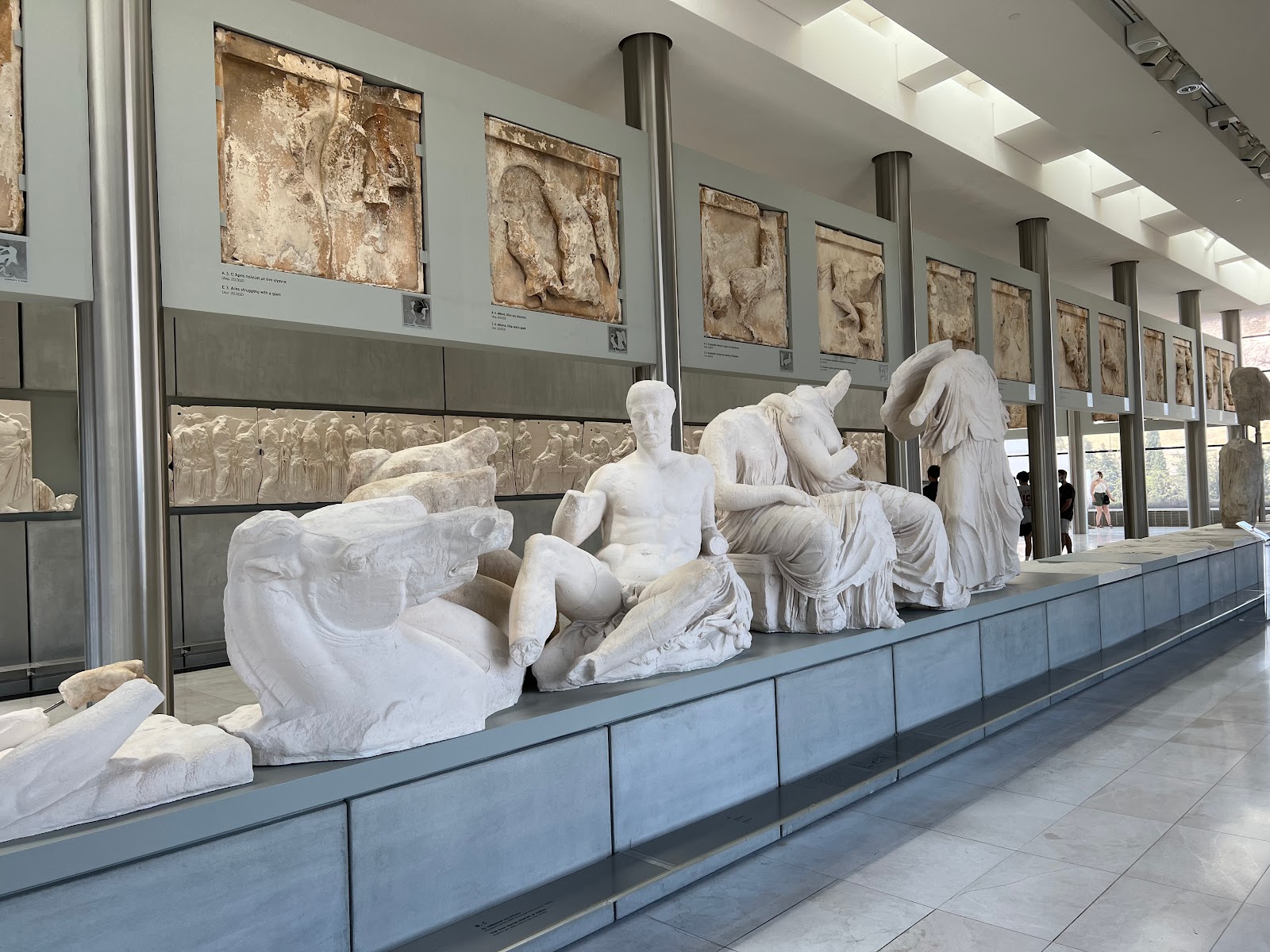
The museum contained many of the remaining statues from the Acropolis where Theodora was able to demonstrate which were original and which were reconstruction due to either being plundered (yawn) or destroyed. It was all very interesting.

View from the museum coffee shop

What is not understood is the size of the statues. They are truly enormous and in marble which means every block weighs some 12.5 tons. The practicality of how the blocks were transported was fantastic. Each block was dragged 17 kms and when the oxen could go no further up the hill, the carts carrying the blocks would be attached to a pulley system and a herd of mules would be encouraged to pull ropes that were at the other end of the pulleys. As they descended, the cart ascended. Thousands upon thousands of blocks.

So the simple art of pillaging was also very difficult. Lord Elgin was ambassador to the Ottomans based in Constantinople in 1799, this during the Napoleonic Wars. He canvassed the Caliph to enable him to survey some Greek sites with a view to removing any interesting objects. Silver smoothed the way and the Caliph, very keen to stay out of the way of the war as the Ottoman Empire had begun to weaken irredeemably, agreed. Elgin sent in a crew to see what they could find. 

What they found were the debris from previous multiple lootings and occupations from over the centuries. Athens had been sacked by the Herulians in 267 AD, by the Huns in 396 AD, the Goths in the 5th century, by the Slavs in the 7th century and so on. Long list. The Franks occupied the city in 1204 during the 4th Crusade and fortified it whilst the later occupying Byzantines built over original Greek structures. As well the locals had simply taken building materials just lying around for their own home construction. No metal. This had already gone. So not much in perfect condition. (Not many people either. Athens had become depopulated over time and it wasn't until 1834 when it was named capital of a newly independent Greece that people began to return to the city. Many government buildings for example date from after this date. Not antiquity at all).

What Elgin's crew did find were portions of sculptures and depictions of events carved into the marble blocks. However each weighed tons. Literally. So they cut the front of the blocks to save weight and shipped what they could back to England. In the museum today, on display are the original part blocks with plaster casts of the bits Elgin's crew took stuck on top. From my uneducated perspective it does look like bits and pieces of rubble. Sort of 'Oh look, Hercules' left shoulder' that sort of thing.

Several years later in 1816, Elgin canvassed the British Government who paid 35,000 GBP for the items which were then immediately displayed in the British Museum.

View from the Museum

These are the friezes taken down from the side of the Parthenon. Restoration is slow for a decision was taken by the EU (if you can imagine) that restoration should only happen when over 70% of the original materials of say a column are found. If these are lying around nearby then the columns can be put back together which is what happened. If not they are left to lie around, which explains the endless piles of rocks everywhere. Very timely, costly and difficult. Greece is a poor country so often has other priorities. 

Statues taken from the ends of the Parthenon, in those triangular parts I described before. If the sculptures are white, that means they are recreations. Often plaster casts taken from the originals in what ever museum they are currently displayed. Yes that means the Elgin Marbles but also the French, Germans and Turks hold plenty. As for the Venetians, well half the city is decorated with Greek stuff looted from their various occupations. If the sculptures look old and yellow, that is because they are the originals. The museum hopes to get back all the other yellow and old bits.

Theodora says that attempts are being made to recover these items which the British Museum is resisting. The French are not being pressed to return their pillaged items. Nor are the Turks who took over the items already removed by the Byzantines and Ottomans in centuries past. Just the British. Probably think the British are the softest touch. Could be right.


Fantastic day. So much history to absorb. Very painful on the brain cells.
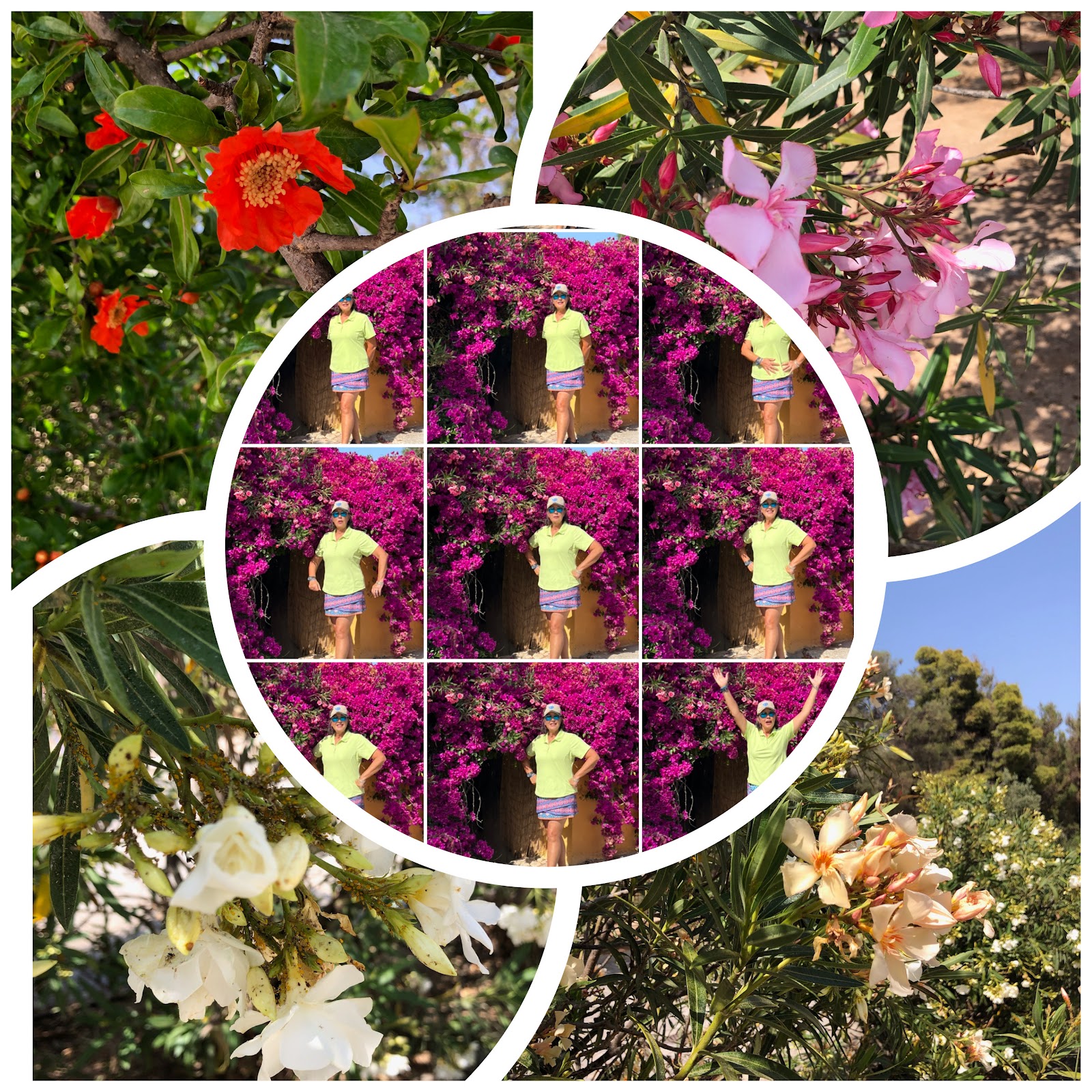
The flowers were gorgeous, particularly the Bougainvillaea. The colours were so intense and vibrant.

We's asked Yiannis and Anthony at the travel agent for recommendations for a good restaurant that locals would go to. Trying to avoid the tourist traps. Mistake actually as we discovered many of the tourist traps turned out mostly to be as good as the local spots. But anyway, Anthony suggested Dionysus as an option. We had a reservation at 9 pm.

Short walk near the Acropolis again and in a big car park this restaurant grew up the hill opposite to the Acropolis. It was rammed with people at a special event with many guards preventing the hoi pilloi getting in. It was a shipping company event obviously with some politicos or other big wigs. Armed guards at the front. Flunkies carried champagne on trays. Amazingly we were allowed entry, but turned away to the non event section. 

What a view of the Acropolis!! The menu was a typical fine dining menu from anywhere in the world but with a couple of local things. The 22 hour braised lamb was finished sadly. 


Fish soup and the other lamb option for me. Salad for Viv. Bottle of white wine, different grape for us. Chocolate soufflé to follow.

Very nice walk back along the ‘most beautiful street in Europe’ per Theodora. We decided we would not eat at such a place again. Bring on the tourist traps and grilled meat!


Friday, June 19, 2020

Nerds and Geeks

You don't just have to be a techie to be a nerd or geek, although many are. Just today for instance I was reading that the UK's version of the coronavirus track and trace app didn't work that well and they'd abandoned it in favour of the one jointly developed by Apple and Google. I don't know about anyone else but derrrrr. I did wonder at the outset why the UK government would bother trying to outdo the nerds and geeks from two of the biggest and in my view best tech companies going. It was always going to be an uphill battle but I'm glad at least they've now seen the light. What was it Churchill said about the Americans? He said you can always count on the Americans to do the right thing.... after they've tried everything else first. Sounds about right for the UK too.

Just this week we had some friends over for lunch (first time since the lockdown was eased) and somehow the conversation got around to accountants (spoiler alert I have an accounting qualification). Apparently they are all OCD (I think that's the correct acronym but in any event it means Obsessive Compulsive Disorder which is just about what our friend meant). Our friend therefore asked me if I am OCD. Tricky question actually. If I said no, any subsequent display of anything approaching compulsive behaviour would be highlighted no doubt. If I said yes, it would simply prove the point. Of course I said no... just before I wiped the kitchen counter 5 or 6 times. 

That isn't why I started this post though. I have been watching lots of You Tube videos in the past few lockdown weeks. What a choice! I started out searching for interesting things but quickly homed in on the daily broadcast from 10 Downing Street (I know, quite painful at times), some history podcasts about WWI in the main, but mostly live music from the bands and artists from the 60's and 70's that I like. It has become something of a compulsion for me now.... there I have acknowledged it... but what a wonderful journey.

I don't know how it has happened but as I type I am watching a 3 hour special celebrating the 25th anniversary of the death of Rory Gallagher. 


Not a well known name I know but Rory was a fantastic guitarist. I remember watching him many times in the 1970's and he was always great. He was one of those guys who had no idea or interest about the business, just about playing. He was very good indeed. This special has some people playing who I have never heard of and they are also really good. It made me think that you have to be really lucky to make it in that industry. Skill alone just does not cut it. But how on earth did I get here watching this?

It came about because I also found several channels on You Tube from people who assemble these wondrous clips and in some cases long segments of live concerts from the 1960's and 1970's ... the era that I listen to. I imagine there is the same for other interests and times. One guy I have now subscribed to has dozens of such long segments on his channel and only a couple of days ago I started looking at the dates when he/she put them together. Many were at random dates over the last 3-4 years but a growing number are coming every other day now. Clearly someone else has lots of time on their hands too! The fact that one of the segments I watched yesterday with Janis Joplin, Cream and Pink Floyd was premiered only 3 days before and had been watched by 20,000+ people already says lots I think. 

Not just me then.


Thursday, July 26, 2018

The first settlement

The full chronology of our visit to Quebec is on Chris' wonderful Track My Tour app which has a weblink here. Please check it out for the moment by moment updates (but do ignore the pic which has us over Manitoba. That was somewhere in Quebec over the St Lawrence River).

In 1538 Simon de Champlain landed in Quebec City before it was Quebec City of course and in so doing became the first European visitor to Canada... that is if you ignore the Vikings. However it wasn't until 1608 that the first settlement was established... only a year before Bermuda's first settlement. The French had it first but that ended in 1759 as part of the Seven Years War which saw the British move in permanently. This city was the first seat of all government in Canada. Well the eastern part of Canada that is.

Meat pie and poutine. A fine staple!

It is a lovely city. Well the old part is and that is the bit that we visited. We had a great time. It is a cool food city too. The local meat pie and poutine are a treat! The great and the good things that we found were in no particular order:

Chateau Frontenac

Plenty of places competed with this lovely hotel but to us if we wanted to visit, we just had to stay here. The back story is really insightful into the history of Canada too and bears repeating.

Dominion came in 1867 which brought virtual independence (although the Queen is still head of state) from the Mother country. Gone were the subsidies and monies that flowed from Britain. Canada had to stand on its own. This was one way.

One of the pre-conditions of dominion with British Columbia on the west coast (at this time there only 4 provinces -- Quebec, Ontario and Nova Scotia in the east and BC in the west) was the need to build a railway from east coast to west. Halifax to Vancouver. 4,000+ miles across prairie, mountains, etc.  A number of railway companies came and went until Canadian Pacific showed up. Like now they had an American CEO and he was the guy that finally made it happen. However it was in one section, the most difficult, that it all very nearly came to a crashing halt. This was in the approaches to the Rocky Mountains. The trains were really swanky but as there were no tunnels through mountains back then, it was really difficult to manoeuvre the train around the mountains and through the various passes. Particularly the dining car which was the heaviest.

So the train would stop just before attempting this bit and decouple the dining car before making its way into the mountains. Back then this was a lengthy process and so the passengers would hop off the train and basically hang around or go for a walk. This was in a place called Banff Springs and it was here that the lightbulb went off for the CP CEO who said that this place (Banff) would be one great place to build a hotel so passengers could spend some time in comfort whilst waiting for the final bit of the journey to Vancouver.

That was the first hotel of the chain that would link the railway line end to end. The Chateau Frontenac was the second. Each hotel was built in the style of the locale and remain amazing monuments to this day.


Plains of Abraham

Moving over the obvious reasons why the French aren't as appreciative of this than the British (i.e. they lost here) the plains are just a great city park. Abraham was the bloke that used to keep his cattle here way back when and that in itself is just one great reason why it should be called that! Who wouldn't want a lovely park named after them? Central Park.... really!

City Walls

Quebec City is the only town in North America that is still completely walled. Now if that doesn't deserve a mention on its own, I don't know what does.

La Citadelle

Dating from the same time as the fortifications in Bermuda (Fort St. Catherine, Paget Island, Dockyard), the citadel was built 1820-50 as defence against US invasion. A real prospect as the city had been occupied before (like Montreal and like in Montreal the Americans left because the weather was too cold), the British built this huge defence adjoining the city walls on THE most strategic height in the city. We did a tour there after... wait for it... after watching the daily changing of the guard ceremony.

View from the Citadel and the city walls controlling the St. Lawrence waterway

Lovely to see in itself, but this is the only regiment (Royal 22nd Regiment) and the only place that does this where all orders are given only in... French. I've seen this before in England and the ceremony is pretty similar with the soldiers all dressed in the same red uniforms and bearskins, but that was in English. So really nice to see this and I really do hope this is a tradition that endures. So many don't these days.


French

Quebec is far more French than Montreal. This didn't used to be the case but gradually the Anglos left for Montreal and Toronto particularly during the 1960-1970 period when the independence movement was at its height. Today less than 2% of the population's first language is English. Someone told me the number of people speaking Arabic as their first language is nearly 5%!

Charcuterie française

Anyway we were able to practice our lamentable schooldays French but unlike France in the old days, we found that people were very happy to help you out in English!

Why Canada?

One of the most fascinating things was during a trip to the Montmorency Falls just outside the city. Picturesque and a nice place to hike, but it was so much more than this. In the old days people would go logging up river and drive the logs along the river to lumber mills at the foot of the falls.

La Chutte Montmorency

But why would it be that Canada was so important for lumber at a time when let's face it, Canada was a place miles away, next to a noisy and antagonistic neighbour and which other than the maritimes didn't do very much for the mother country?

Well it was all about Napoleon Bonaparte as so much of French/British history is. Blame Boney or in this case thank Boney.

Britain had been at war pretty much continuously with France from 1792 through to 1815. First was the revolutionary period which was a bit of a shambles for everyone but once Boney had taken control of things, he created the process that governed how the war would be fought with Britain and it was called the Continental System. This closed all European ports to British ships and for a maritime nation reliant on overseas trade, this was a disaster.

If you look at it from the French side, this was fair enough for British contributions to the war were mainly naval except for the Iberian expeditions. They had blockaded the European ports first... a point that the US particularly disliked as that meant the Royal Navy would frequently stop, search and in many cases seize US ships bound for European ports and was a cause of the 1812-14 war. But from a British perspective, this was an outrage and a major problem for it meant that they could not obtain amongst other things lumber from Scandinavia to build ships.

Hence Canada and indeed Quebec for the new world at that point was almost entirely covered with rivers, lakes and .... trees. Lots of trees.

So thank you Boney.

**
Don't you just love the why's?


Monday, January 8, 2018

The Year That Was

First of all let me just say Happy New Year to everyone before I forget. As one ages even gracefully, the grey matter sometimes takes a little longer to boot up and connect properly.

I like to read, and that is not an apology, merely a statement, but that appears to be a declining art. It may seem to everyone that the world runs on 20 second sound bytes and a maximum 144 characters of text. That's all the time that anyone has to make a point. Certainly the US President seems to communicate exclusively in this way but even though those of us who believe we are smarter than he is may smugly nod our heads knowingly, he actually knows what he is doing. Well in this regard anyway.

We have had a full 12 months of him plus for an expat Brit like myself, we have had the unlikely sight of another unelectable, this time from the left, morph into the most unlikely next PM of Great Britain that there probably has ever been. All on the back of the highest level of incompetence from the elected elite and a massive groundswell of young support (and social media assistance) from the young people of the country. I read somewhere recently that Jeremy Corbyn has the support of something like 70% of all young people in the UK. And how do they communicate these days? Certainly not in debating societies, major newspapers or God forbid books. It is by 20 second soundbyte and those 144 miserable characters.

I just did a quick count of this blog post and discover to my dismay that 144 characters (includes spaces and punctuation) is about one and a half lines of my text. How on earth do you get your point across in such a limited way?

Perhaps the very fact that communication has come to this depressing and very superficial level will cause a reaction. Certainly I have been reading some commentators who are saying that their New Year's Resolution for 2018 is to come off Twitter or at the very least curtail their usage of it. My contribution has been to delete the Twitter app from my phone... but then again as I have never used it, I don't think that will tip any balance.

Reporting has been never endingly depressing in 2017 underlining the fact that only bad news is newsworthy so I was really, really happy to read an article from a website called Quartz (I was put onto this page by Bloomberg whom I have increasingly come to rely upon for impartial news, even though I still do take some things with a pinch of salt) that listed 99 things to be grateful for that took place in 2017. Here is the link but at random, here are some fantastic things that I never saw in the news but are fantastic, fantastic developments for the human race:

If you’re feeling despair about the fate of humanity in the 21st century, you might want to reconsider. In 2017, it felt like the global media picked up all of the problems, and none of the solutions. To fix that, here are 99 of the best stories from this year that you probably missed.
1. This year, the World Health Organisation unveiled a new vaccine that’s cheap and effective enough to end cholera, one of humanity’s greatest ever killers.
6. Trachoma, the world’s leading infectious cause of blindness, was eliminated as a public health problem in Oman and Morocco, and Mexico became the first country in the Americas to eliminate it.
16. And on the 17th November, the WHO said that global deaths from tuberculosis have fallen by 37% since 2000, saving an estimated 53 million lives. 
21. A province in Pakistan announced it has planted 1 billion trees in two years, in response to the terrible floods of 2015.
27. Eleven countries continued their plan to build a wall of trees from east to west across Africa in order to push back the desert. In Senegal, it’s already working.
30. In 2017, the ozone hole shrunk to its smallest size since 1988, the year Bobby McFerrin topped the charts with ‘Don’t Worry Be Happy.’
35. 275 million Indians gained access to proper sanitation between 2014 and 2017.
46. In 2017, the UK, France and Finland all agreed to ban the sale of any new petrol and diesel cars and vans by 2040.
54. Solar energy is now responsible for one in every 50 new jobs created in the United States, and the clean energy sector is growing at 12 times the rate of the rest of the economy.
69. As plunging crime closed prisons across the Netherlands, the government started turning them into housing and cultural hubs for ten of thousands of refugees instead.
80. You didn’t see this story in the evening news — in June, we heard that the homicide rate in Australia has dropped to one victim per 100,000 people, the lowest ever recorded.
98. One of China’s richest women, He Qiaonv, announced a $2 billion donation for wildlife conservation, the largest environmental philanthropic pledge of all time.

2017 was also the year that saw the passing of a close personal friend of mine as well as some greats of rock and roll: Tom Petty and Gregg Allman from my list of personal favourites. Fats Domino and Chuck Berry also passed away; even greater influences on the history of contemporary music. Sad to lose them all but each time I go somewhere and hear the soundtrack to buying groceries, waiting for the train, being in an airport, etc., and that turns out to be an instantly recognisable tune from the 1960's and 1970's, it makes me happy to know that they will be remembered by their music... even though people may not know the name of their great tunes rather like I recognize much classical music but cannot for the life of me remember who wrote what or when.

But then again this does provide me with an opportunity to ending this post with a wonderful live clip from YouTube with the full original band. I forgot that Butch Trucks, one of the drummers, also passed away in 2017. Gregg is on keyboards and sings.


Happy New Year!


Sunday, September 29, 2013

"You should have been here in the summer.."

I've just returned from nearly 3 weeks in England when it rained pretty much each day except for the last couple and the stock response was to mention the glorious Indian summer when everything turned brown.  Well suffice to say I saw none of it but as usual there was a hosepipe ban in force!

That's something I really don't get.  England has to be one of the wettest countries in the world yet always it is caught out by an insufficiency of water ... apparently ... meaning you cannot run hosepipes to maintain the garden or even wash your car.  I realise that a large part of the basic infrastructure of the country was built in the Victorian era of fewer people, homes, etc., and much of it is in need of update and in some cases repair.  But really it rained cats and dogs for weeks.  In Bermuda we catch rain on our roofs and a few days of heavy rain is enough to refill our tanks and turn everything green.  And we don't get anywhere near the amount of rain.

It was nice though to spend some time in both Canterbury and Southend (our respective home towns) but a couple of highlights stand out:  Beachy Head and Arundel Castle.  Both are in Sussex and definitely worth a visit.

Beachy Head is a chalk headland near Eastbourne (a corruption of Beau Chef or Beautiful Headland in French), the highest chalk cliff in the country actually at 531 feet.  It is also a place where 20 people a year go to commit suicide and is quite possibly the reason why the Industrial Revolution happened.

No French or Dutch in sight this time.

Back in 1653 the English fought the Dutch at the Battle of Portland over 4 days exhausting and finally demolishing the Dutch Navy who had big global trade aspirations and as a consequence took the decision they couldn't compete with the English any more (this was before Great Britain was created).  However in 1690 at the Battle of Beachy Head (same place) a combined English and Dutch fleet was royally thumped by the French who were supporting the recently deposed James II in Ireland and elsewhere.  The French followed up into the River Thames and the consternation it caused made the new king and queen William III and Mary determine to rebuild the navy properly.

As there was no money available, the Bank of England was created in 1694 as a private institution and in 12 days raised £1.2 million, half of which was for rebuilding the navy thereby creating the global behemoth that was subsequently the Royal Navy.  The industrial activity this caused country wide transformed the economy with iron works making nails to agriculture feeding the quadrupled strength of the Royal Navy undoubtedly sowing the seeds for the Industrial Revolution that followed in the 18th century.

Today it is a lovely place for a walk and some great views.


One thing that gets me though, and this is something that is endemic these days in Britain, is that everything costs money.  Everything.  Now I don't mind paying for things as upkeep of course costs money but at Beachy Head ... and we weren't even at the top ... the parking spots were all pay and display.  This doesn't sound much but consider that Beachy Head is very, very remote indeed and the likelihood of a traffic warden strolling by just as they would outside Sainsbury's, for example, is laughable.  Yet still you have to pay.

But that still didn't dampen my enthusiasm for the sights and scenery which were magnificent.  Tres beau indeed.

**

It was my idea to visit Arundel Castle.  As a cricketer I have long been enamoured of the wonderful tradition that the first match of any tour by a foreign team was against an invitation XI at Arundel.  This must be a fantastic event to play in.  The castle itself is anything but shabby too and well worth a visit.


Arundel is between Worthing and Chichester in Sussex and was established in 1067 immediately after the Norman Conquest as a means of controlling the rebellious Saxons and also to guard against another foreign invasion as Britain was wide open at that time and rich pickings for anyone from overseas.  It has stayed pretty much in the family since this time with brief moments when the then Earls of Sussex and then Arundel as well as the superceding Dukes of Norfolk backed the wrong side and the monarchs executed them and appropriated their lands.

This was actually a major consideration as England in the early to late middle ages went through several periods of civil wars which turned the nobility rather more than the country upside down.  Take the Matilda/Stephen war of some 20 years back in the later 1100's, a war that was country wide, disruptive and saw the swapping of the throne back and forth on a number of occasions.  If you were a noble back then, you had to pick a side so this meant that at some point in the conflict you were bound to be on the losing side.  And being on the losing side often meant execution and confiscation of lands.

The inner courtyard with the Motte and Keep on top in the background

One way out of this was that taken by Thomas Howard, the 2nd duke, who was a general for Richard III but found himself catastrophically on the losing side at Bosworth in 1485.  He spent 3 years in the Tower of London having been demoted from Duke of Norfolk to Earl of Surrey but more than recovered in 1513 when he took command of the English forces that destroyed the invading Scots at Flodden when Henry VII was away campaigning.  In addition to regaining his dukedom and lands, the 2nd Duke received an augmentation to his coat of arms, namely that of a Scottish lion shot through the throat with an arrow.

Next problem was religion.  The Norfolks were/are still a prominent Roman Catholic family which was all to the good during the early Henry VIII era but the next duke was a schemer who was able to marry not one but two nieces to the king, both of whom were subsequently executed for treason (Ann Boleyn and Catherine Howard).  This really didn't help the family fortunes much and when Elizabeth I took over, things got worse a later duke became involved in a plot to marry Mary Queen of Scots and was promptly executed for treason.

During the Civil War with Parliament, the Norfolks sided with Charles I but sensibly left the country for Italy until the Restoration in 1660 but the castle was scene of a number of engagements which damaged the structure considerably.  Fortunately the family married well, remained wealthy, regained all their prestige and over the next couple of centuries were able to reconstruct the castle in magnificent fashion.  The massive renovations in the Victorian era have brought the castle back to magnificent condition and the current family shows no sign of taking things easily.

One of the 65 loos put in by the Victorian restoration.  Still in use today.

Interestingly the Norfolks were the first family to establish family trusts to hold their various properties, a move designed to ward off the nastiness that is death duties in Britain.  The model they use has been widely copied around the country.

One of the bathrooms, still in use.

High spots for me were the magnificent library which is truly stunning, dozens of magnificent great works of art by Caneletto, Van Duyk and other great masters (one of the benefits of being around for 1,000 years, being wealthy and interested in art is that commissioning a Caneletto, say, when he was a young whipper snapper wasn't that expensive a proposition as today.  In fact they ordered 3, all hang in the Caneletto Room) and the garden which is very contemporary.

The 10,000 book library.  

The current Duchess is very keen on the garden and it shows.  I imagine spring time and early summer must be breath taking.  The magnolias and rhodedendrums were simply green when we visited. In early summer they'd be in their full glory.

Part of the garden with the Catholic Cathedral in the background.

Just lovely in fact.