Showing posts with label Napoleon. Show all posts

Saturday, July 27, 2019

The Wild West Part II -- Jackson

The town is called Jackson NOT Jackson Hole. Jackson Hole is the entire valley in which Jackson is situated at the southern end, with Yellowstone National Park in the north. The Hole was in fact first 'discovered' by western fur trappers, actually one Mr. Jackson after which ... you get the idea.

The 'Hole'


When you look back at history from say a couple of hundred years perspective and get past the old history book notion that history was just a series of unconnected dates, you do realize that they are not and it all goes back to Napoleon.

Why does that guy keep sticking his nose in everywhere? Years ago I was reading a PG Wodehouse book where a not very deep conversation between a couple of airhead drones touched on old Boney whereupon one of the savants came up with the glorious comment... "whatever did that poor fish do other than getting hammered at Waterloo?" Quite a bit actually including this. Tangentially this time though.

So... the French Revolution in 1789 brought forth many changes, one of which was almost endless war with practically everyone in Europe until said occasion in 1815. Wars are expensive so by the time Boney took over and completed his looting of the countries nearest to him, Switzerland and Italy, he realized that the loot so acquired was nowhere near enough so he cast around looking for any other family silver that wasn't cutting it whereupon one of his aides named Junot came in with yet another horrendous report from Haiti. The revolution there was going really well but for the wrong people; the freed slaves. They had been fighting against the revolutionary government in France who was acting in a very non revolutionary manner ever since the Revolution began. Despite Junot's genocidal tactics, whenever the French looked the other way, something bad happened that usually included French soldiers getting massacred in hideous ways. In short it was a total mess. Now Boney, had a strategic desire to create a major port in New Orleans and use Haiti as a stepping stone to upseat the British in all their Caribbean locations but that required time, effort, money and resources .... none of which Boney had to hand. Just this bloody European war. But the American colonists were friends of theirs, weren't they? And that feller Franklin something was ambassador. He was always droning on about this or that. But it did offer a neat way out. Sell him (well the Americans) the huge Louisiana territory and raise some cash which Boney really did need and could put to use at once. That other strategic thing was a nice thought but really he had to take care of business at home first. And of course, you never go broke by taking the money.

So Boney got the money and the Americans a huge new territory about as big again as what they had already. How they financed it is another fascinating story! The Americans certainly didn't have that kind of ready money. But it was done. And now they also had a huge new tract of land to explore and do something with. I mean they bought it, right? So it must be theirs irrespective of who was actually there right now. Read about the full story here from Wikipedia.

You got a lot for your money back then. 3 cents per acre.
This all took place in 1803 and towards the end of that year, the then US President Thomas Jefferson hosted a couple of roughnecks who had a mad cap idea to head out in canoes and explore the new territory starting in St Louis and then heading north or wherever the Missouri River led to in the end. Presumably the western ocean somewhere. Their names were Lewis and Clarke.

Their story is one of the great pioneering stories and is all the better known by virtue of the fact that they kept sending back reports to GHQ. This must have kept reducing the number in their party over time and it was on just one of these side trips one of the guys (John Colter) took in 1804 was with this just in mind. However he took a wrong turning by mistake (this is all river bound and rivers do look pretty much alike I think, certainly then) and tripped over and into Yellowstone Park, kept on going south and well as they say the rest is history.
You can see how a wrong turn back then would get you to a whole new place
The history books report all of this with such veneration that it almost behooves me to not do that as I can just imagine Lewis & Clarke rushing back to the president gushing with the news that this new area is millions and millions of square miles of virgin land with forests, lakes and rivers and such just waiting for new settlers from the east and elsewhere. To which I presume TJ saying something along the lines of what did you think would be there, if not that? But I am sure he didn't. He congratulated them and gave them comfy sinecures somewhere miles away from both the new lands and also TJ himself in Washington, so there was no chance of them bumping into him and asking how the settlement program was coming along. He would have filed it all away for future generations to figure out just what on earth they do with this enormous new land they had acquired as there were no new settlers to spare from back east just then.

Settlement didn't start until the 1820's but only sporadically as the entire valley was snow bound for seven months a year which wasn't very encouraging with the technologies then available. Think Grizzly Adams and the Revenant movies. Then make it a lot worse. However this also meant that for large parts of the year, there were no Indian tribes around either. In fact across the plains, there were few permanent Indian settlements courtesy of both terrain/weather but also the migratory patterns of the critters that they preyed upon. Given the size of the country and the few numbers of mainly itinerant people around, I find it amazing that anyone could find anybody else. So for many years, there was relative peace. Into the 1850's anyway.

We visited the Little Big Horn Battlefield Monument -- its actually about 7 hours drive away in south eastern Montana -- and in the visitor centre there is a picture of the agreement of 1851 which set aside vast tracts of land for the Indian tribes. The land size was virtually all of South and North Dakota and more than one-third each of Montana and Wyoming. Given that at one of the peak gatherings of several tribes on the eve of the battle itself encompassed some 6 tribes and 8,000 people, this seems to me like a tiny number of people with a huge amount of land.

It was that battle and the events that followed it that spurred greater settlement in the Jackson region but what took Jackson to all new heights was Theodore Roosevelt and the sheriff of  Deadwood, Seth Bullock. They were big friends and TR stayed with the sheriff when he was out west and just loved to roam around Yellowstone to the point that the pair of them decided rather informally that the scenery and location was of such grandeur that it should be protected in virgin state forever. This was before development so the perfect time to do this, and of course miles and miles and miles away from any other development like say Chicago. And no trains. And no roads. So they got together a state wide agreement to set aside the land and then jointly took it to Washington for federal approval. This took place in 1872 and so Yellowstone became the first national park in the US.

Soon after, train tracks were built and tourists started arriving and where should they find to stay but that charming little western town of Jackson.
The Grand Tetons
150 years later it is still small but still charming and has expanded its ambitions to encompass the Grand Teton National Park in 1929 (huge mountain range) and discovered that for some insane reason, otherwise perfectly rational people had this massive desire to launch themselves off the top of mountains down impossible slopes in winter, by tying sticks to their feet, and in summer, by bike. Same paths, I kid you not.

There are roads now and also traffic jams...
... but not everywhere

Oh yes, and those economists also like it.


Thursday, July 26, 2018

The first settlement

The full chronology of our visit to Quebec is on Chris' wonderful Track My Tour app which has a weblink here. Please check it out for the moment by moment updates (but do ignore the pic which has us over Manitoba. That was somewhere in Quebec over the St Lawrence River).

In 1538 Simon de Champlain landed in Quebec City before it was Quebec City of course and in so doing became the first European visitor to Canada... that is if you ignore the Vikings. However it wasn't until 1608 that the first settlement was established... only a year before Bermuda's first settlement. The French had it first but that ended in 1759 as part of the Seven Years War which saw the British move in permanently. This city was the first seat of all government in Canada. Well the eastern part of Canada that is.

Meat pie and poutine. A fine staple!

It is a lovely city. Well the old part is and that is the bit that we visited. We had a great time. It is a cool food city too. The local meat pie and poutine are a treat! The great and the good things that we found were in no particular order:

Chateau Frontenac

Plenty of places competed with this lovely hotel but to us if we wanted to visit, we just had to stay here. The back story is really insightful into the history of Canada too and bears repeating.

Dominion came in 1867 which brought virtual independence (although the Queen is still head of state) from the Mother country. Gone were the subsidies and monies that flowed from Britain. Canada had to stand on its own. This was one way.

One of the pre-conditions of dominion with British Columbia on the west coast (at this time there only 4 provinces -- Quebec, Ontario and Nova Scotia in the east and BC in the west) was the need to build a railway from east coast to west. Halifax to Vancouver. 4,000+ miles across prairie, mountains, etc.  A number of railway companies came and went until Canadian Pacific showed up. Like now they had an American CEO and he was the guy that finally made it happen. However it was in one section, the most difficult, that it all very nearly came to a crashing halt. This was in the approaches to the Rocky Mountains. The trains were really swanky but as there were no tunnels through mountains back then, it was really difficult to manoeuvre the train around the mountains and through the various passes. Particularly the dining car which was the heaviest.

So the train would stop just before attempting this bit and decouple the dining car before making its way into the mountains. Back then this was a lengthy process and so the passengers would hop off the train and basically hang around or go for a walk. This was in a place called Banff Springs and it was here that the lightbulb went off for the CP CEO who said that this place (Banff) would be one great place to build a hotel so passengers could spend some time in comfort whilst waiting for the final bit of the journey to Vancouver.

That was the first hotel of the chain that would link the railway line end to end. The Chateau Frontenac was the second. Each hotel was built in the style of the locale and remain amazing monuments to this day.


Plains of Abraham

Moving over the obvious reasons why the French aren't as appreciative of this than the British (i.e. they lost here) the plains are just a great city park. Abraham was the bloke that used to keep his cattle here way back when and that in itself is just one great reason why it should be called that! Who wouldn't want a lovely park named after them? Central Park.... really!

City Walls

Quebec City is the only town in North America that is still completely walled. Now if that doesn't deserve a mention on its own, I don't know what does.

La Citadelle

Dating from the same time as the fortifications in Bermuda (Fort St. Catherine, Paget Island, Dockyard), the citadel was built 1820-50 as defence against US invasion. A real prospect as the city had been occupied before (like Montreal and like in Montreal the Americans left because the weather was too cold), the British built this huge defence adjoining the city walls on THE most strategic height in the city. We did a tour there after... wait for it... after watching the daily changing of the guard ceremony.

View from the Citadel and the city walls controlling the St. Lawrence waterway

Lovely to see in itself, but this is the only regiment (Royal 22nd Regiment) and the only place that does this where all orders are given only in... French. I've seen this before in England and the ceremony is pretty similar with the soldiers all dressed in the same red uniforms and bearskins, but that was in English. So really nice to see this and I really do hope this is a tradition that endures. So many don't these days.


French

Quebec is far more French than Montreal. This didn't used to be the case but gradually the Anglos left for Montreal and Toronto particularly during the 1960-1970 period when the independence movement was at its height. Today less than 2% of the population's first language is English. Someone told me the number of people speaking Arabic as their first language is nearly 5%!

Charcuterie française

Anyway we were able to practice our lamentable schooldays French but unlike France in the old days, we found that people were very happy to help you out in English!

Why Canada?

One of the most fascinating things was during a trip to the Montmorency Falls just outside the city. Picturesque and a nice place to hike, but it was so much more than this. In the old days people would go logging up river and drive the logs along the river to lumber mills at the foot of the falls.

La Chutte Montmorency

But why would it be that Canada was so important for lumber at a time when let's face it, Canada was a place miles away, next to a noisy and antagonistic neighbour and which other than the maritimes didn't do very much for the mother country?

Well it was all about Napoleon Bonaparte as so much of French/British history is. Blame Boney or in this case thank Boney.

Britain had been at war pretty much continuously with France from 1792 through to 1815. First was the revolutionary period which was a bit of a shambles for everyone but once Boney had taken control of things, he created the process that governed how the war would be fought with Britain and it was called the Continental System. This closed all European ports to British ships and for a maritime nation reliant on overseas trade, this was a disaster.

If you look at it from the French side, this was fair enough for British contributions to the war were mainly naval except for the Iberian expeditions. They had blockaded the European ports first... a point that the US particularly disliked as that meant the Royal Navy would frequently stop, search and in many cases seize US ships bound for European ports and was a cause of the 1812-14 war. But from a British perspective, this was an outrage and a major problem for it meant that they could not obtain amongst other things lumber from Scandinavia to build ships.

Hence Canada and indeed Quebec for the new world at that point was almost entirely covered with rivers, lakes and .... trees. Lots of trees.

So thank you Boney.

**
Don't you just love the why's?


Thursday, August 25, 2016

Am I Allowed to call Paris Gay these days?

Like a previous trip I have been extremely remiss in not staying current on these posts.  However I did use that wonder App called Track My Tour (please tell Chris that I sent you if you check it out) which did a much better job.  Here is the link to this part of the trip -- Click here.

**

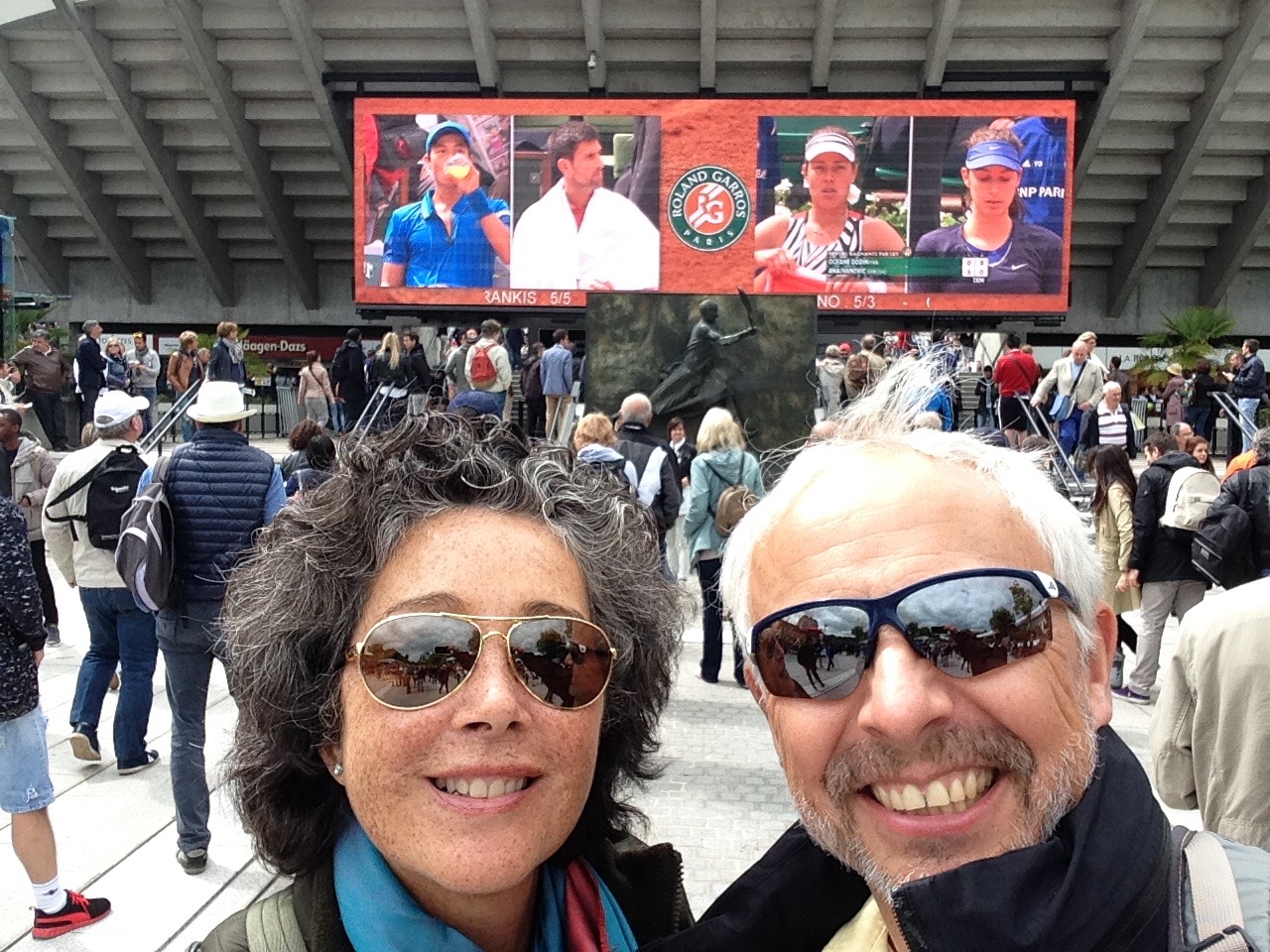
It has been quite a few years since I was in Paris and it was nice to be back despite the recent spate of horrific terrorist attacks.  As a result of that security was tight but it appeared to be administered in a fairly haphazard manner.  I suppose it is really difficult to make sure a city of 10 million people are all kept safe from random, senseless attack but they sure tried and started with the big event of that time which was the French Open tennis tournament.

Sorry about the Facebook logo

This was Viv's 4th event on the Grand Slam circuit so something we'd been looking forward to.  Our plan was to watch the first 4 days.  The tickets though were a real pain to get.  Corporate and VIP buyers had first dibs, followed by members of the French Federation.  Then and only then did the public have a chance -- that was us.  Everything was pretty much gone so we asked the Bermuda LTA to see if they could help us out.  It took ages so I'd gone out and bought 2 days already by the time the French Federation came back but the result was 4 days straight: corporate hospitality day 1, ground pass day 2, stadium day 3, ground pass day 4.


We discovered the grund pass days were a waste of time as they sold thousands of ground pass tickets but the practical reality was that most of the 12 outside courts could hold fewer than 100 spectators.  That meant the queues to get into the outside events were endless -- we were told 1 hour for Court 2 and we were 10th in line.  So in fact we bagged the final ground pass day and went sight seeing instead.

Paris is a truly great city to sight see.

As regular players, Viv and I have constant fascination for how the game is played.  The TV most always shows the down the court view.  That view is certainly great for the TV watcher but gives absolutely zero feel for hard the players work and how hard they hit the ball.  All the time.  We'd watched Djokovic and Nadal in Rome in possibly the best match we've ever seen and to no surprise at all found out that everyone (and that includes even the slightest of the ladies) beats the ball really hard.  Every time.  We watched a terrific ladies doubles match on an outer court with 2 Japanese playing 2 French.  One of the Japanese a tiny left hander who served no harder than I do but boy did she follow that up with amazing ground strokes!

The first day in retrospect was probably the best tennis day and coincided with our best seats of the week -- this was our corporare day out.


Hideously expensive but great food and wine and wonderful seats at the side about 10 rows up from the court in the middle.  Gilles Simon is a player I really like and on the TV he looks languid and barely mobile, most times rolling the ball down the middle of the court in a pleasing manner to his opponent.  In real life he is really tall and skinny, moves incessantly and quickly from side to side, up and back and really, really beats the lights out of the ball.  Every time.  He won something like 55% of the points so won in straight sets very easily.  That's the wonder of the game!

Next was Richard Gasquet who has a backhand of dreams.  I struggle with mine... I blame my arthritis of course.  But his is wonderful and he hits it really hard, all the time.  And he doesn't miss that much.  Really these guys are very, very good indeed!


Struggling with his backhand

Organisationally however the tournament is a mess and the French Open has now surpassed the US Open as my least favourite major tournament.

Missing that last day though gave us the chance to both enjoy some better weather (it rained a lot) and see some wonderful sights.

I like cheesy, touristy things.  I also like public transport and the Paris Metro was terrific too.  But most of all that day I liked the Tuileries and the Musee de L'Armee, a tribute to French military but really mostly to Napoleon.

Nice arch, shame about the...

The French are great.  They dumped their hideous monarchy over 200 years ago and essentially forced the state to be separate from the church and progress.  Along the way of course there were hiccups but thankfully Napoleon sorted out most of the early ones.  People remember his generalship but don't fully acknowledge how he changed the world for the better and for the long term.  The Code Napoleon was an attempt to order everything and still stands in the guise of civil law around the world these days.  He was a phenomenon although rather dismissed by the British because (a) we fought against him for over 20 years and (b) he lost at Waterloo.  Indeed P.G. Wodehouse, that paragon of English writers had one of his more brainless characters say about Napoleon: "The only thing he ever did was to get hammered at Waterloo."

Love the lower lip.  Doubtless in one of his grumpier moments.

The British of course living up to their reputation of perfidy did fight endlessly against the French but rarely on land and before Waterloo, rarely against Napoleon.  They did however pay the Prussians, Austrians, Russians and anyone else who offered to fight.

Napoleon died on St Helena probably of stomach cancer according to the wonderful biography I just read (they think that because a number of his male relatives all died early of stomach complications) and was brought back to Paris in triumph in 1840 by Louis Phillippe (before he was deposed, nice try mate!) and re-interred at the Tuileries.

Nifty little, understated tomb of the great man.

Go there and glory in it.  Then go to the museum and relive many of the battles that marked French history.  This is done through very clever dioramas with commentary that take you through each battle step by step, before, during and after.  Very effective indeed.  I could have stayed their 4 days but Viv would likely have objected!

Next time I return, I promise to spend more time and see more sights.  But I did see a couple of the biggies!


Thursday, June 2, 2016

Getting Ready for Pompeii

Like a previous trip I have been extremely remiss in not staying current on these posts.  However I did use that wonder App called Track My Tour (please tell Chris that I sent you if you check it out) which did a much better job.  Here is the link to this part of the trip -- Click here.

**

Probably the highlight of our sojourn in Naples was visiting the Archaeological Museum.  We hopped off the bus here for several hours which were just wonderful.

First of all, this entire region is really old.  There is loads of old stuff to house here.  But the really important raison d'etre of the museum is that anything of quality that could be found in the ruins of Pompeii and Herculaneum were moved here.

Not recently of course.  The Farnese family of the 16th century were popes and had a taste for antiquity so moved anything and everything that he could (statues, sculptures, mosaics, etc.) to his palaces in Rome.  Once Bonaparte invaded Italy in the last years of the 18th century, Italy's map was redrawn but one thing that remained was the Kingdon of the Two Sicilies which passed under the control of Murat, his great cavalry commander.  Murat took back all these wonders and put them into his palace which ultimately morphed into this fantastic museum.

Included too is a 'naughty' room where all those artifacts found in Pompeiian brothels are displayed.  In past days, only the bigwigs could view these delights.  Later on, just men.  It is now open to all over the age of 18.  Interesting sculptures, toys, trinkets, paintings and things couldn't really be identified.  As this is a smut free zone, I will leave the details to your imagination.

The young Augustus when he was still called Octavian
Uncle Julius with a very generously sculptured profile
One of the most famous mosaics from Pompeii

Imagine this was on the floor first of all.  This is what you walk on when entering a house in the Roman era.  It is a mosaic from a house in Pompeii that we later visited taken from an old Greek painting of one of Alexander's great battles against the Persians.  A copy of the painting is to the left.  Alexander's head is all that can be seen on the left.
This is a painting taken from the wall of a house in Pompeii.  The Romans painted directly onto the plaster which is why so few paintings remain.  This is red hued due to the heat of the big day in 79 AD.
The famous bull sculpture (room size from one single piece of marble apparently) reminds us why adultery is a bad thing.  If caught you get chained to a wild bull by your children like this God from antiquity.
Hercules after his 11th labour needed a rest so leaned on his big stick.  I had a cold drink and pizza.