Friday, April 26, 2024
The Road to Barcelona

Monday, July 11, 2022
The Odyssey -- Athens Day 2
Day 2 in Athens would be a humdinger. All about the Acropolis. The itinerary said:
'We will arrange a private walking tour of Athens for 5 to 6 hours if you are up to it to visit all the important sites including the Acropolis and the New Acropolis Museum.'
We met our guide Theodora at the hotel and walked the 5 minutes along the street to the entrance to the Acropolis. There were lots of people. Theodora said today would likely be the busiest day of the year as a number of cruise ships had arrived at Piraeus with passengers’ first stop likely to be the Acropolis.
Viv and I wondered why we would visit today then, or rather this morning as we could easily have visited in the afternoon. Oh well.
The Acropolis hill is big. And tall. It was tough going slowly dragging ourselves up hill in the heat. Theodora told us the story as we went along.
 |
| Nearly there! First selfie du jour at the Greek theatre on the south side of the Acropolis |
 |
| This is what it looked liked during the Hellenistic Period |
The Acropolis had been populated for possibly 4,000 years initially as a fortress for people in the surrounds to retreat to at times of trouble and war. It certainly was imposing yet Theodora advised us that the Acropolis had been attacked, sacked and destroyed many times. Huh?
Very true.
The Acropolis and the temple on the top known as the Parthenon (there are several other temples on the top but smaller) are relatively recent creations. One may think it looks like something of a rocky ruin, but in fact it’s only about 1,000 years old.
After the Persians attacked Athens, defeated them (Thermopylae was lost if you remember) and occupied Athens, they destroyed everything they could before they left the following year of 480 BC. That included the buildings on the top of the Acropolis hill. These included a partially built Parthenon as well as several other temples. The entire site was ruined.
The Athenians together with a full compliment of Spartans this time (not just the famous 300), annihilated the Persians the following year in 479 BC at Plataea removing all threats to the independent Greek states. To show that they were now the big dogs on the block, the Athenians immediately embarked on rebuilding on an immense scale.
The building of the Parthenon was completed in only 9 years while the crafting of the wondrous sculptures took a further 6 years. Marble was brought from a mountain 17 Kms away and was laboriously lugged up the hill that we were now stumbling up.
Theodora continued with gusto.
She certainly had a huge passion about the subject and had definite views on things that had impacted the Acropolis over the years.
First were the Romans. Of course it would be. For some reason, the Greeks thought they could beat the Romans in the first century BC but the Roman tyrant general Sulla in 87 BC routed them, captured the entire region which wasn’t yet a country including Athens, sacked it thoroughly and enslaved the population. That is the entire population including all those philosophers that were still around.
Greece remained a Roman possession until 1458.
Huh? I hear you say. What about the Byzantines? There were never any Byzantines. That is the name historians gave the eastern Roman Empire looking backwards at some point. The Romans themselves always called themselves Romans, even until the Ottomans took Constantinople in 1453. Byzantium was the name of the original Greek settlement that the Roman Emperor Constantine renamed in the 4th century AD when he moved the capital of the entire Roman Empire to Constantinople. So forget Byzantium. Actually you can't for every guide book says Byzantine this or that, mainly churches, so it is most confusing. Best to see Rome at the same time as you see Byzantium.
When I was in Rome a couple of weeks ago I found a wonderful excerpt from a 2nd century AD travel book comparing the architecture of Greece and Rome. In typically patronising fashion, the writer said that the Greeks do build some pretty impressive structures but the stench, the disorganisation and the overall mess of Greek cities was something beyond the comprehension of a Roman. Happily Rome provided aqueducts so that every villa has its own water source for their fountains. Sewage for the endless ordure and stench. Plumbing so that buildings would remain well serviced during the wet season…. And so on.
It was a Roman traveler from the 2nd century, one Pausanias, whom we all should thank for even the possibility of reconstruction and renovation. For it is only his writings and the earlier Herodotus (the Greek historian from centuries earlier) that give us the idea what these buildings and monuments look like. Fortunately both wrote at very great length and in Pausanias' case drew thousands of sketches and drawings, many of which survive.
The Romans in addition to their renowned organisation, also introduced a fully integrated taxation system that lasted until 1458 and beyond for the conquering Ottomans discovered they couldn’t do any better.
Specific to the Acropolis though were the changes wrought by the Romans to the amphitheater, the new theatre and performing arts centre that was built. Where the Greeks starting with Thespis, a comic writer of the golden age, wrote monologues, dialogues and drama, the Romans dug a big ditch, raised up a marble wall around the orchestra (aka stage) and staged mock naval battles and gladiatorial combat. The walls enabling the area to be filled with water for the first, and prevent blood spatters covering the 5,000 person audience in the second. Who needs monologues!

Theodora was not impressed, then moved onto the Emperor Justinian (6th century emperor). She was even less impressed by Justinian. I couldn’t figure out exactly why but as he was the mover and shaker in rejigging the imperial tax policy for the final time, perhaps it was this. Certainly the Byzantines which Justinian was about to morph into (even I am falling into this Rome vs Byzantium thing), as opposed to the eastern Roman Empire, were not fans of the old pagan gods still widely revered in Greece. Under the ‘Christians’ (spoken with gritted teeth) they basically trashed everything to do with the old Gods. This is why most of the faces on statues have been disfigured. I didn't ask about why the male genitalia were also missing from most statues.
We hadn’t reached the entrance to the Acropolis at the top yet and Theodora wasn’t slowing down.
The British didn’t miss out either. Theodora was scathing about Elgin and his plundering of Greek antiquity in 1801 (this is the so called Elgin Marbles in the British Museum). Yet less so for the French who even before Elgin stole everything that was not nailed down (this in an instruction specifically written by the French ambassador in 1784 to an expedition in that year). And almost glossing over the Venetians who in their sack of Athens in 1687 had fired cannons at the defending Ottomans who’d retired to the Acropolis which they used as magazines. This cannon fire hit the magazines which exploded and destroyed about one third of the Parthenon. They then tried to take the remaining massive sculptures from the mantles which caused them to fall 30 feet and be irredeemably smashed.
An even minded person may consider deliberate cannon fire, explosions and wanton destruction of rather more concern and remark than removing a few bits of marble that had been lying around anyway for centuries, a practice I should note that continues to this day.
We reached the entrance with some hundreds of other tourists and snaked past the temple to Nike and made it to the top of the Acropolis.

Athens' Acropolis is huge. About 3kms long by 1.5 kms wide. Lots of room for lots of temples, and there are lots of temples in varying levels of decay. Impressive.
 |
| The Acropolis during Roman times |
Theodora was a fantastic source of information and could talk on almost any related subject. She had artists' reconstructions of what the buildings may have looked like. They looked spectacular. Check out www.ancientathens3d.com to take a look. They may not be entirely accurate but are best guesses.

 |
| The top temple is one to the goddess Athena who supposedly gave the gift of the first olive tree to the city, whilst the bottom temple is the Parthenon from the end where Elgin supposedly cut down all those marbles. Imagine the temple with a triangular shape on top of those flat bits. Inside that triangle were dozens of massive sculptures. It was these the Venetians and French could not cart off. It was Elgin's crew that devised the method of cutting the carved frontispiece off the monster 12 ton lump of marble that solved the logistics impasse. These statues we saw in the museum. |
By now we were fading so decided to head for the Acropolis Museum which had A/C and a cafe to take a few minutes rest. There we had Freddo Capuccinos which are worthy of conversation in and of themselves.

The museum contained many of the remaining statues from the Acropolis where Theodora was able to demonstrate which were original and which were reconstruction due to either being plundered (yawn) or destroyed. It was all very interesting.
 |
| View from the museum coffee shop |
What is not understood is the size of the statues. They are truly enormous and in marble which means every block weighs some 12.5 tons. The practicality of how the blocks were transported was fantastic. Each block was dragged 17 kms and when the oxen could go no further up the hill, the carts carrying the blocks would be attached to a pulley system and a herd of mules would be encouraged to pull ropes that were at the other end of the pulleys. As they descended, the cart ascended. Thousands upon thousands of blocks.
So the simple art of pillaging was also very difficult. Lord Elgin was ambassador to the Ottomans based in Constantinople in 1799, this during the Napoleonic Wars. He canvassed the Caliph to enable him to survey some Greek sites with a view to removing any interesting objects. Silver smoothed the way and the Caliph, very keen to stay out of the way of the war as the Ottoman Empire had begun to weaken irredeemably, agreed. Elgin sent in a crew to see what they could find.
What they found were the debris from previous multiple lootings and occupations from over the centuries. Athens had been sacked by the Herulians in 267 AD, by the Huns in 396 AD, the Goths in the 5th century, by the Slavs in the 7th century and so on. Long list. The Franks occupied the city in 1204 during the 4th Crusade and fortified it whilst the later occupying Byzantines built over original Greek structures. As well the locals had simply taken building materials just lying around for their own home construction. No metal. This had already gone. So not much in perfect condition. (Not many people either. Athens had become depopulated over time and it wasn't until 1834 when it was named capital of a newly independent Greece that people began to return to the city. Many government buildings for example date from after this date. Not antiquity at all).
What Elgin's crew did find were portions of sculptures and depictions of events carved into the marble blocks. However each weighed tons. Literally. So they cut the front of the blocks to save weight and shipped what they could back to England. In the museum today, on display are the original part blocks with plaster casts of the bits Elgin's crew took stuck on top. From my uneducated perspective it does look like bits and pieces of rubble. Sort of 'Oh look, Hercules' left shoulder' that sort of thing.
Several years later in 1816, Elgin canvassed the British Government who paid 35,000 GBP for the items which were then immediately displayed in the British Museum.
 |
| View from the Museum |
 |
| These are the friezes taken down from the side of the Parthenon. Restoration is slow for a decision was taken by the EU (if you can imagine) that restoration should only happen when over 70% of the original materials of say a column are found. If these are lying around nearby then the columns can be put back together which is what happened. If not they are left to lie around, which explains the endless piles of rocks everywhere. Very timely, costly and difficult. Greece is a poor country so often has other priorities. |
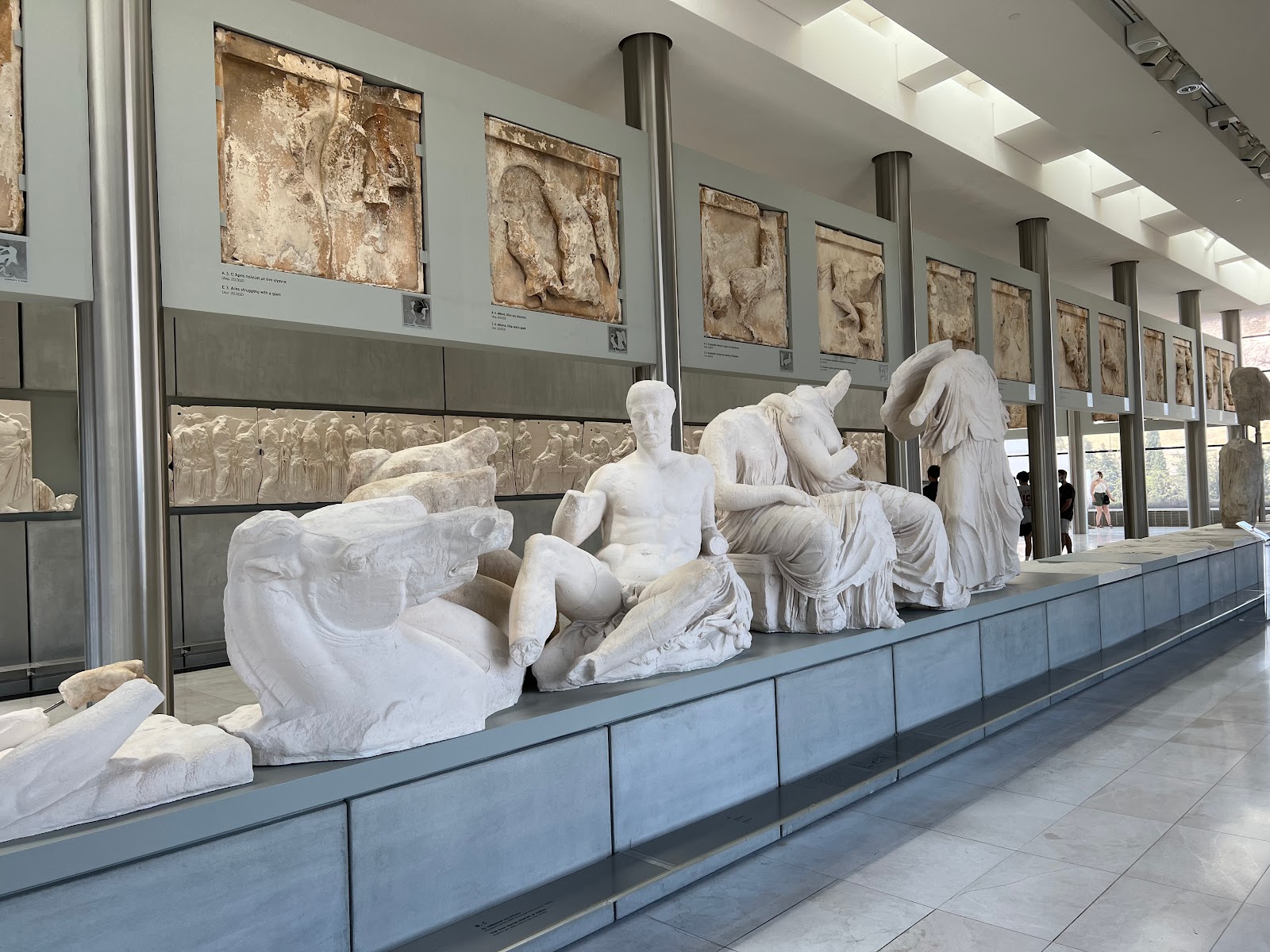 |
| Statues taken from the ends of the Parthenon, in those triangular parts I described before. If the sculptures are white, that means they are recreations. Often plaster casts taken from the originals in what ever museum they are currently displayed. Yes that means the Elgin Marbles but also the French, Germans and Turks hold plenty. As for the Venetians, well half the city is decorated with Greek stuff looted from their various occupations. If the sculptures look old and yellow, that is because they are the originals. The museum hopes to get back all the other yellow and old bits. |
Theodora says that attempts are being made to recover these items which the British Museum is resisting. The French are not being pressed to return their pillaged items. Nor are the Turks who took over the items already removed by the Byzantines and Ottomans in centuries past. Just the British. Probably think the British are the softest touch. Could be right.

Fantastic day. So much history to absorb. Very painful on the brain cells.
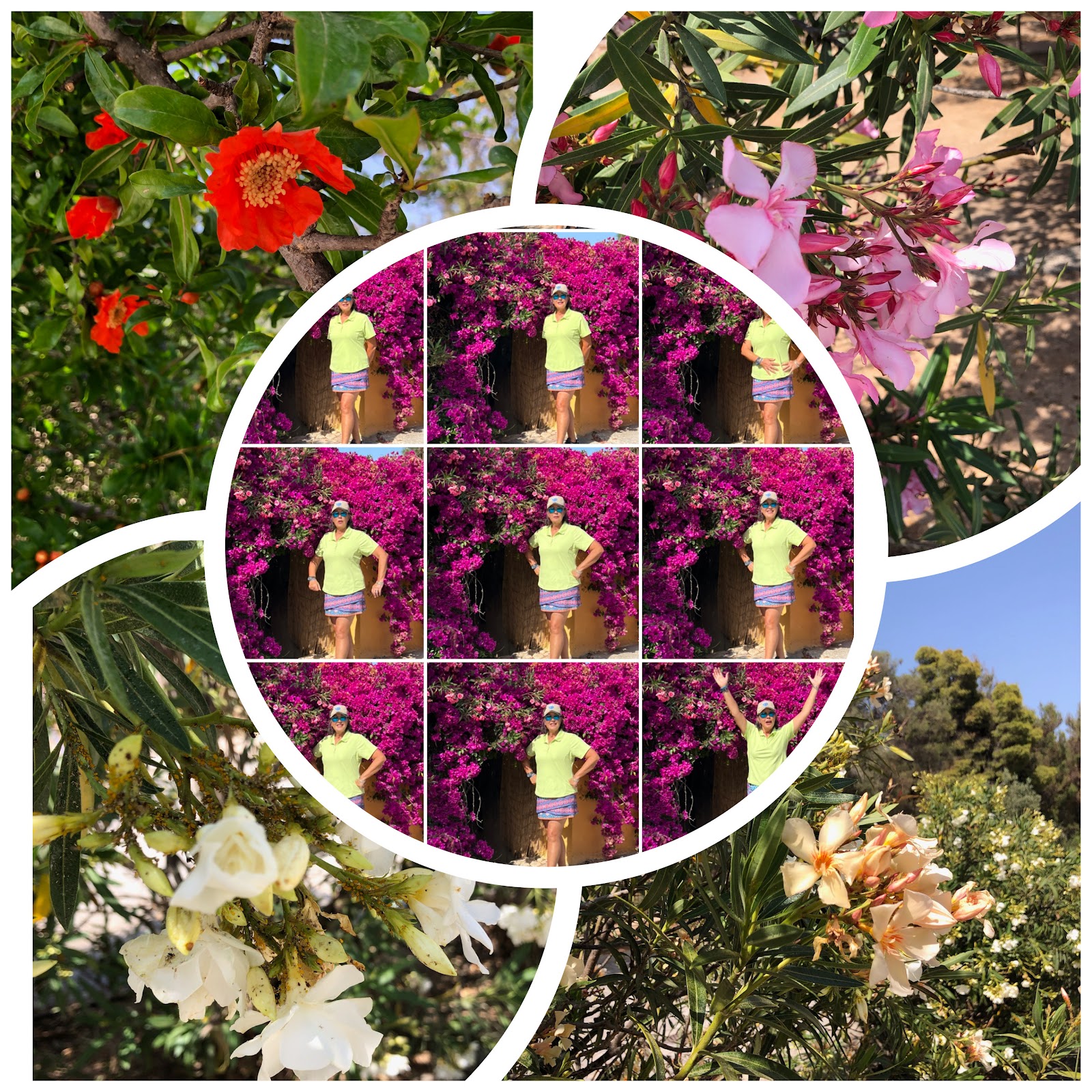 |
| The flowers were gorgeous, particularly the Bougainvillaea. The colours were so intense and vibrant. |
We's asked Yiannis and Anthony at the travel agent for recommendations for a good restaurant that locals would go to. Trying to avoid the tourist traps. Mistake actually as we discovered many of the tourist traps turned out mostly to be as good as the local spots. But anyway, Anthony suggested Dionysus as an option. We had a reservation at 9 pm.
Short walk near the Acropolis again and in a big car park this restaurant grew up the hill opposite to the Acropolis. It was rammed with people at a special event with many guards preventing the hoi pilloi getting in. It was a shipping company event obviously with some politicos or other big wigs. Armed guards at the front. Flunkies carried champagne on trays. Amazingly we were allowed entry, but turned away to the non event section.
What a view of the Acropolis!! The menu was a typical fine dining menu from anywhere in the world but with a couple of local things. The 22 hour braised lamb was finished sadly.

Fish soup and the other lamb option for me. Salad for Viv. Bottle of white wine, different grape for us. Chocolate soufflé to follow.
Very nice walk back along the ‘most beautiful street in Europe’ per Theodora. We decided we would not eat at such a place again. Bring on the tourist traps and grilled meat!
Thursday, July 26, 2018
The first settlement
In 1538 Simon de Champlain landed in Quebec City before it was Quebec City of course and in so doing became the first European visitor to Canada... that is if you ignore the Vikings. However it wasn't until 1608 that the first settlement was established... only a year before Bermuda's first settlement. The French had it first but that ended in 1759 as part of the Seven Years War which saw the British move in permanently. This city was the first seat of all government in Canada. Well the eastern part of Canada that is.
 |
| Meat pie and poutine. A fine staple! |
It is a lovely city. Well the old part is and that is the bit that we visited. We had a great time. It is a cool food city too. The local meat pie and poutine are a treat! The great and the good things that we found were in no particular order:
Chateau Frontenac
Plenty of places competed with this lovely hotel but to us if we wanted to visit, we just had to stay here. The back story is really insightful into the history of Canada too and bears repeating.
Dominion came in 1867 which brought virtual independence (although the Queen is still head of state) from the Mother country. Gone were the subsidies and monies that flowed from Britain. Canada had to stand on its own. This was one way.
One of the pre-conditions of dominion with British Columbia on the west coast (at this time there only 4 provinces -- Quebec, Ontario and Nova Scotia in the east and BC in the west) was the need to build a railway from east coast to west. Halifax to Vancouver. 4,000+ miles across prairie, mountains, etc. A number of railway companies came and went until Canadian Pacific showed up. Like now they had an American CEO and he was the guy that finally made it happen. However it was in one section, the most difficult, that it all very nearly came to a crashing halt. This was in the approaches to the Rocky Mountains. The trains were really swanky but as there were no tunnels through mountains back then, it was really difficult to manoeuvre the train around the mountains and through the various passes. Particularly the dining car which was the heaviest.
So the train would stop just before attempting this bit and decouple the dining car before making its way into the mountains. Back then this was a lengthy process and so the passengers would hop off the train and basically hang around or go for a walk. This was in a place called Banff Springs and it was here that the lightbulb went off for the CP CEO who said that this place (Banff) would be one great place to build a hotel so passengers could spend some time in comfort whilst waiting for the final bit of the journey to Vancouver.
That was the first hotel of the chain that would link the railway line end to end. The Chateau Frontenac was the second. Each hotel was built in the style of the locale and remain amazing monuments to this day.

Plains of Abraham
Moving over the obvious reasons why the French aren't as appreciative of this than the British (i.e. they lost here) the plains are just a great city park. Abraham was the bloke that used to keep his cattle here way back when and that in itself is just one great reason why it should be called that! Who wouldn't want a lovely park named after them? Central Park.... really!
City Walls
Quebec City is the only town in North America that is still completely walled. Now if that doesn't deserve a mention on its own, I don't know what does.
La Citadelle
Dating from the same time as the fortifications in Bermuda (Fort St. Catherine, Paget Island, Dockyard), the citadel was built 1820-50 as defence against US invasion. A real prospect as the city had been occupied before (like Montreal and like in Montreal the Americans left because the weather was too cold), the British built this huge defence adjoining the city walls on THE most strategic height in the city. We did a tour there after... wait for it... after watching the daily changing of the guard ceremony.
 |
| View from the Citadel and the city walls controlling the St. Lawrence waterway |
Lovely to see in itself, but this is the only regiment (Royal 22nd Regiment) and the only place that does this where all orders are given only in... French. I've seen this before in England and the ceremony is pretty similar with the soldiers all dressed in the same red uniforms and bearskins, but that was in English. So really nice to see this and I really do hope this is a tradition that endures. So many don't these days.

French
Quebec is far more French than Montreal. This didn't used to be the case but gradually the Anglos left for Montreal and Toronto particularly during the 1960-1970 period when the independence movement was at its height. Today less than 2% of the population's first language is English. Someone told me the number of people speaking Arabic as their first language is nearly 5%!
 |
| Charcuterie française |
Anyway we were able to practice our lamentable schooldays French but unlike France in the old days, we found that people were very happy to help you out in English!
Why Canada?
One of the most fascinating things was during a trip to the Montmorency Falls just outside the city. Picturesque and a nice place to hike, but it was so much more than this. In the old days people would go logging up river and drive the logs along the river to lumber mills at the foot of the falls.
 |
| La Chutte Montmorency |
But why would it be that Canada was so important for lumber at a time when let's face it, Canada was a place miles away, next to a noisy and antagonistic neighbour and which other than the maritimes didn't do very much for the mother country?
Well it was all about Napoleon Bonaparte as so much of French/British history is. Blame Boney or in this case thank Boney.
Britain had been at war pretty much continuously with France from 1792 through to 1815. First was the revolutionary period which was a bit of a shambles for everyone but once Boney had taken control of things, he created the process that governed how the war would be fought with Britain and it was called the Continental System. This closed all European ports to British ships and for a maritime nation reliant on overseas trade, this was a disaster.
If you look at it from the French side, this was fair enough for British contributions to the war were mainly naval except for the Iberian expeditions. They had blockaded the European ports first... a point that the US particularly disliked as that meant the Royal Navy would frequently stop, search and in many cases seize US ships bound for European ports and was a cause of the 1812-14 war. But from a British perspective, this was an outrage and a major problem for it meant that they could not obtain amongst other things lumber from Scandinavia to build ships.
Hence Canada and indeed Quebec for the new world at that point was almost entirely covered with rivers, lakes and .... trees. Lots of trees.
So thank you Boney.
**
Don't you just love the why's?

Thursday, August 25, 2016
Am I Allowed to call Paris Gay these days?
**
It has been quite a few years since I was in Paris and it was nice to be back despite the recent spate of horrific terrorist attacks. As a result of that security was tight but it appeared to be administered in a fairly haphazard manner. I suppose it is really difficult to make sure a city of 10 million people are all kept safe from random, senseless attack but they sure tried and started with the big event of that time which was the French Open tennis tournament.
 |
| Sorry about the Facebook logo |
This was Viv's 4th event on the Grand Slam circuit so something we'd been looking forward to. Our plan was to watch the first 4 days. The tickets though were a real pain to get. Corporate and VIP buyers had first dibs, followed by members of the French Federation. Then and only then did the public have a chance -- that was us. Everything was pretty much gone so we asked the Bermuda LTA to see if they could help us out. It took ages so I'd gone out and bought 2 days already by the time the French Federation came back but the result was 4 days straight: corporate hospitality day 1, ground pass day 2, stadium day 3, ground pass day 4.
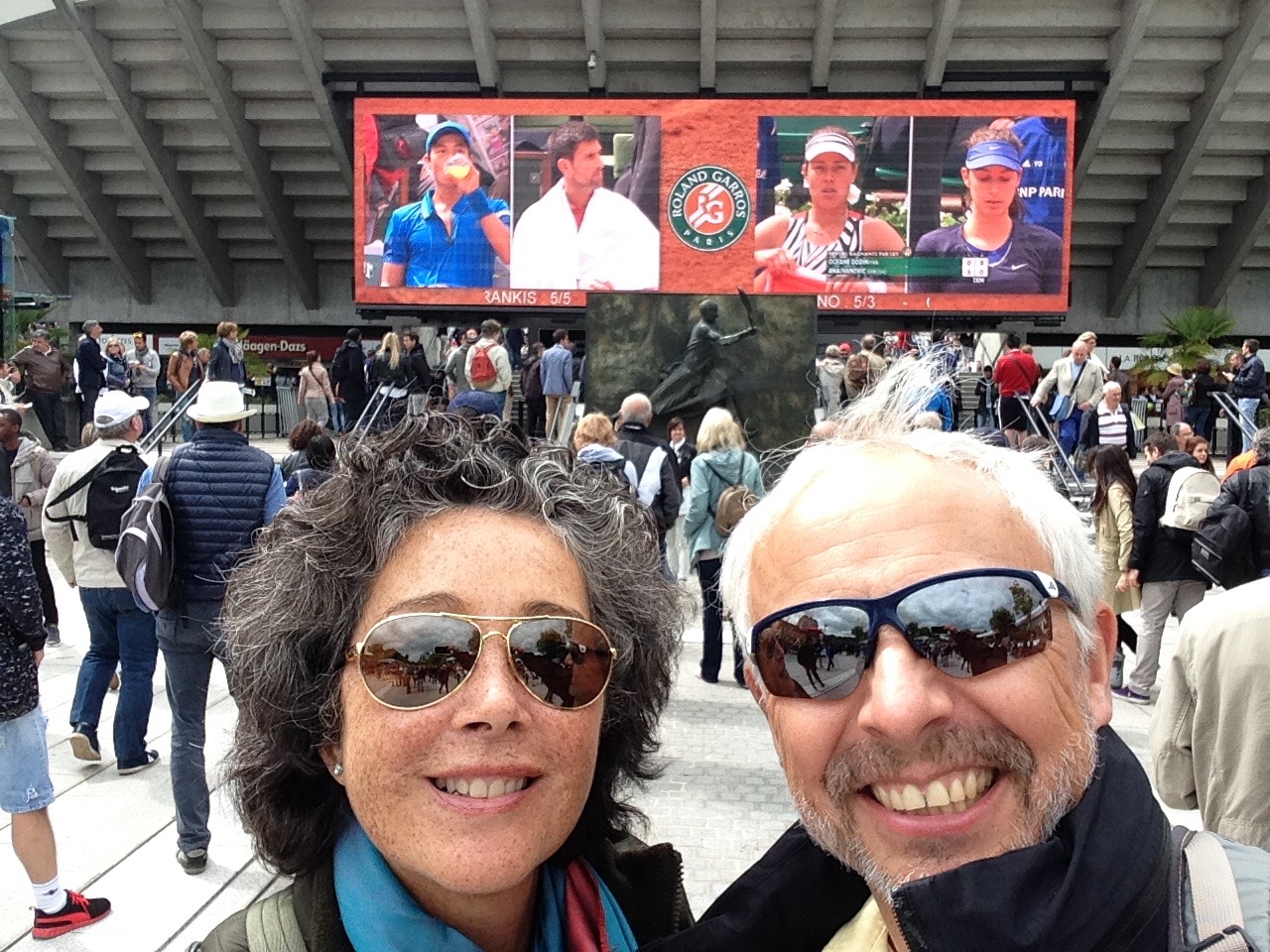
We discovered the grund pass days were a waste of time as they sold thousands of ground pass tickets but the practical reality was that most of the 12 outside courts could hold fewer than 100 spectators. That meant the queues to get into the outside events were endless -- we were told 1 hour for Court 2 and we were 10th in line. So in fact we bagged the final ground pass day and went sight seeing instead.
Paris is a truly great city to sight see.
As regular players, Viv and I have constant fascination for how the game is played. The TV most always shows the down the court view. That view is certainly great for the TV watcher but gives absolutely zero feel for hard the players work and how hard they hit the ball. All the time. We'd watched Djokovic and Nadal in Rome in possibly the best match we've ever seen and to no surprise at all found out that everyone (and that includes even the slightest of the ladies) beats the ball really hard. Every time. We watched a terrific ladies doubles match on an outer court with 2 Japanese playing 2 French. One of the Japanese a tiny left hander who served no harder than I do but boy did she follow that up with amazing ground strokes!
The first day in retrospect was probably the best tennis day and coincided with our best seats of the week -- this was our corporare day out.

Hideously expensive but great food and wine and wonderful seats at the side about 10 rows up from the court in the middle. Gilles Simon is a player I really like and on the TV he looks languid and barely mobile, most times rolling the ball down the middle of the court in a pleasing manner to his opponent. In real life he is really tall and skinny, moves incessantly and quickly from side to side, up and back and really, really beats the lights out of the ball. Every time. He won something like 55% of the points so won in straight sets very easily. That's the wonder of the game!
Next was Richard Gasquet who has a backhand of dreams. I struggle with mine... I blame my arthritis of course. But his is wonderful and he hits it really hard, all the time. And he doesn't miss that much. Really these guys are very, very good indeed!

 |
| Struggling with his backhand |
Missing that last day though gave us the chance to both enjoy some better weather (it rained a lot) and see some wonderful sights.
I like cheesy, touristy things. I also like public transport and the Paris Metro was terrific too. But most of all that day I liked the Tuileries and the Musee de L'Armee, a tribute to French military but really mostly to Napoleon.
 |
| Nice arch, shame about the... |
 |
| Love the lower lip. Doubtless in one of his grumpier moments. |
Napoleon died on St Helena probably of stomach cancer according to the wonderful biography I just read (they think that because a number of his male relatives all died early of stomach complications) and was brought back to Paris in triumph in 1840 by Louis Phillippe (before he was deposed, nice try mate!) and re-interred at the Tuileries.
 |
| Nifty little, understated tomb of the great man. |
Next time I return, I promise to spend more time and see more sights. But I did see a couple of the biggies!

Wednesday, July 30, 2014
Not the French again...
It seems to not matter where you go but there grinning at you is likely to be some Rene or Thierry smirking away because they got there first. Or at least that's what they say.
So it is in that vast tract of land in the middle of the USA called the mid-west.
Its all about two guys Pierre Laclede and Auguste Chouteau who in 1673 took their little canoes thousands and thousands of miles over many years from Quebec across the width of half of Canada through the great lakes and then down through various rivers until they hit the motherlode, the Mississippi, which in an instant whirled them down to the confluence firstly of the Illinois River (north easterly direction towards Chicago) and the Mississippi near a town today called Grafton, Illinois where they and their comrades carved a cross out of the rock for all to see next time they passed.
 |
| "Now listen Mr. Lewis, this is what I want you to do... see the big question mark? I want you to fill that in..." |
They didn't stop there though but carried on down the Mississippi until they came to the confluence of an even greater river system, namely the Mississippi and Missouri just outside modern day St. Louis. There they did stop and started an encampment that they called St. Louis after Louis IX, the patron saint of France. That was in 1674.
Other French Canadians carried on down the Mississippi until they came to the Gulf of Mexico where they founded yet another settlement called New Orleans (actually Nouvel Orleans if you want to be picky) where a whole bunch of French Canadians ended up after they lost the 7 Years War to England in 1763 and gave up all of Canada.
Fast forward 40 years to beyond the War of Independence and that other upstart Napoleon who had run the French treasury dry by his endless wars but was now at peace for a short period when the slave revolt in today's Haiti destroyed the French presence in the Caribbean. It made him realize that (a) there was no chance France could support a colony that far away from France without a navy that could challenge the Royal Navy, and (b) that maybe as those Yankees had asked to buy New Orleans, perhaps he could actually negotiate a better deal before he lost the territory altogether.
Ever the pragmatist Napoleon figured out that $15 million in 1803 money meant he could pay his armies for another couple of years to enable him to move against Austro-Hungary, the German states and Russia in a series of shattering campaigns that catapulted him to total supremacy in Europe, and promoted him to the position of Emperor.
It also doubled the size of the USA and prompted Jefferson to ask his personal secretary, Merriweather Lewis, to head west out of the new US city of St. Louis along the Missouri River to find the Pacific Ocean, meet and deal with Indians, chart maps and any new flora and fauna he may find, and generally enable the US to lay claim to more of the Pacific North West to bring Jefferson's vision of the USA 'from sea to shining sea' to fruition.
 |
| Doesn't sound much today but Lewis had the boats built in Pittsburg and sailed them down to St. Louis. Took months. |
Lewis contacted his former Army CO, Captain William Clark, to ask him to accompany him on the trek. Clark had opted out of the army so agreed. He it turned out was the practical one whilst Lewis was the botanist, zoologist, and general all round recorder of the trip. Clark was an experienced cartographer and his maps of the journey were amazingly only 40 miles out. No GPS to help him either.
 |
| Rather like at Jamestown, this was not an unplanned trip even though big. They took over a year to plan things out with a blank cheque from the President. Trouble was they didn't know what to take and why... all into the great unknown. Rather like planning a road trip today. |
We started our voyage of discovery at the Gateway Arch in St. Louis, a national park with security like any international airport (for goodness sake), where there was a museum dedicated to this journey only and its import in the expansion of the USA to what it is today.
 |
| Built in the 1970s this is a monster edifice. Great views. |
There's an interesting chronology of events year by year that follows the US between 1800 and 1900. In 1800 the population was not much over 2 million, by 1900 it was nearly 100 million. In summary after Lewis & Clark, other expeditions went out in other directions both further north and south as one main objective was to find a practical path through the Rockies. Lewis & Clark's expedition nearly died of starvation in the nightmare winter crossing as where they chose to cross was not that wise. Others found easier routes making the great westward treks more easy (they were still tough of course but not impossible). By 1850, the far west was colonized, Indians displaced and annoyed, and settlements were starting to put down real roots.
Amazing how quick it all was after that start.
We then went to the museum at the confluence of the Mississippi and Missouri -- 2 huge rivers which simply joined up north of St. Louis. Lewis & Clark kicked off from there in their great adventure and the museum made much of it (very well indeed).
 |
| Missouri to the left, Mississippi to the right. |
I'm always amazed how people with nothing more than a hope and a prayer and (in this case just as with the case of the Jamestown settlements) over a year of planning with the specific and direct assistance from the US President (Jefferson) can achieve such amazing results.
Only 1 person on the trip died -- soon from a burst appendix -- and unsurprisingly given what was to follow, there were no Indian incidents other than a couple of Blackfoot who stole from the party and were shot and the numerous incidents of STD's that the party picked up from the Indians who according to Lewis' journals were riddled with it -- not a point that is usually highlighted.
3,700 miles there and back over 2 and a half years. Sounds like a good road trip for us sometime soon! Hopefully in less time.