Showing posts with label Venice. Show all posts

Monday, July 11, 2022

The Odyssey -- Athens Day 2

 Day 2 in Athens would be a humdinger. All about the Acropolis. The itinerary said:

'We will arrange a private walking tour of Athens for 5 to 6 hours if you are up to it to visit all the important sites including the Acropolis and the New Acropolis Museum.'

We met our guide Theodora at the hotel and walked the 5 minutes along the street to the entrance to the Acropolis. There were lots of people. Theodora said today would likely be the busiest day of the year as a number of cruise ships had arrived at Piraeus with passengers’ first stop likely to be the Acropolis. 

Viv and I wondered why we would visit today then, or rather this morning as we could easily have visited in the afternoon. Oh well. 

The Acropolis hill is big. And tall. It was tough going slowly dragging ourselves up hill in the heat. Theodora told us the story as we went along.

Nearly there! First selfie du jour at the Greek theatre on the south side of the Acropolis

This is what it looked liked during the Hellenistic Period

The Acropolis had been populated for possibly 4,000 years initially as a fortress for people in the surrounds to retreat to at times of trouble and war. It certainly was imposing yet Theodora advised us that the Acropolis had been attacked, sacked and destroyed many times. Huh?

Very true. 

The Acropolis and the temple on the top known as the Parthenon (there are several other temples on the top but smaller) are relatively recent creations. One may think it looks like something of a rocky ruin, but in fact it’s only about 1,000 years old.

After the Persians attacked Athens, defeated them (Thermopylae was lost if you remember) and occupied Athens, they destroyed everything they could before they left the following year of 480 BC. That included the buildings on the top of the Acropolis hill. These included a partially built Parthenon as well as several other temples. The entire site was ruined.

The Athenians together with a full compliment of Spartans this time (not just the famous 300), annihilated the Persians the following year in 479 BC at Plataea removing all threats to the independent Greek states. To show that they were now the big dogs on the block, the Athenians immediately embarked on rebuilding on an immense scale.

The building of the Parthenon was completed in only 9 years while the crafting of the wondrous sculptures took a further 6 years. Marble was brought from a mountain 17 Kms away and was laboriously lugged up the hill that we were now stumbling up. 

Theodora continued with gusto. 

She certainly had a huge passion about the subject and had definite views on things that had impacted the Acropolis over the years. 

First were the Romans. Of course it would be. For some reason, the Greeks thought they could beat the Romans in the first century BC but the Roman tyrant general Sulla in 87 BC routed them, captured the entire region which wasn’t yet a country including Athens, sacked it thoroughly and enslaved the population. That is the entire population including all those philosophers that were still around.

Greece remained a Roman possession until 1458. 

Huh? I hear you say. What about the Byzantines? There were never any Byzantines. That is the name historians gave the eastern Roman Empire looking backwards at some point. The Romans themselves always called themselves Romans, even until the Ottomans took Constantinople in 1453. Byzantium was the name of the original Greek settlement that the Roman Emperor Constantine renamed in the 4th century AD when he moved the capital of the entire Roman Empire to Constantinople. So forget Byzantium. Actually you can't for every guide book says Byzantine this or that, mainly churches, so it is most confusing. Best to see Rome at the same time as you see Byzantium. 

When I was in Rome a couple of weeks ago I found a wonderful excerpt from a 2nd century AD travel book comparing the architecture of Greece and Rome. In typically patronising fashion, the writer said that the Greeks do build some pretty impressive structures but the stench, the disorganisation and the overall mess of Greek cities was something beyond the comprehension of a Roman. Happily Rome provided aqueducts so that every villa has its own water source for their fountains. Sewage for the endless ordure and stench. Plumbing so that buildings would remain well serviced during the wet season…. And so on. 

It was a Roman traveler from the 2nd century, one Pausanias, whom we all should thank for even the possibility of reconstruction and renovation. For it is only his writings and the earlier Herodotus (the Greek historian from centuries earlier) that give us the idea what these buildings and monuments look like. Fortunately both wrote at very great length and in Pausanias' case drew thousands of sketches and drawings, many of which survive.

The Romans in addition to their renowned organisation, also introduced a fully integrated taxation system that lasted until 1458 and beyond for the conquering Ottomans discovered they couldn’t do any better.

Specific to the Acropolis though were the changes wrought by the Romans to the amphitheater, the new theatre and performing arts centre that was built. Where the Greeks starting with Thespis, a comic writer of the golden age, wrote monologues, dialogues and drama, the Romans dug a big ditch, raised up a marble wall around the orchestra (aka stage) and staged mock naval battles and gladiatorial combat. The walls enabling the area to be filled with water for the first, and prevent blood spatters covering the 5,000 person audience in the second. Who needs monologues! 


Theodora was not impressed, then moved onto the Emperor Justinian (6th century emperor). She was even less impressed by Justinian. I couldn’t figure out exactly why but as he was the mover and shaker in rejigging the imperial tax policy for the final time, perhaps it was this. Certainly the Byzantines which Justinian was about to morph into (even I am falling into this Rome vs Byzantium thing), as opposed to the eastern Roman Empire, were not fans of the old pagan gods still widely revered in Greece. Under the ‘Christians’ (spoken with gritted teeth) they basically trashed everything to do with the old Gods. This is why most of the faces on statues have been disfigured. I didn't ask about why the male genitalia were also missing from most statues.

We hadn’t reached the entrance to the Acropolis at the top yet and Theodora wasn’t slowing down.

The British didn’t miss out either. Theodora was scathing about Elgin and his plundering of Greek antiquity in 1801 (this is the so called Elgin Marbles in the British Museum). Yet less so for the French who even before Elgin stole everything that was not nailed down (this in an instruction specifically written by the French ambassador in 1784 to an expedition in that year). And almost glossing over the Venetians who in their sack of Athens in 1687 had fired cannons at the defending Ottomans who’d retired to the Acropolis which they used as magazines. This cannon fire hit the magazines which exploded and destroyed about one third of the Parthenon. They then tried to take the remaining massive sculptures from the mantles which caused them to fall 30 feet and be irredeemably smashed. 

An even minded person may consider deliberate cannon fire, explosions and wanton destruction of rather more concern and remark than removing a few bits of marble that had been lying around anyway for centuries, a practice I should note that continues to this day.

We reached the entrance with some hundreds of other tourists and snaked past the temple to Nike and made it to the top of the Acropolis.


Athens' Acropolis is huge. About 3kms long by 1.5 kms wide. Lots of room for lots of temples, and there are lots of temples in varying levels of decay. Impressive. 

The Acropolis during Roman times

Theodora was a fantastic source of information and could talk on almost any related subject. She had artists' reconstructions of what the buildings may have looked like. They looked spectacular. Check out www.ancientathens3d.com to take a look. They may not be entirely accurate but are best guesses. 


The top temple is one to the goddess Athena who supposedly gave the gift of the first olive tree to the city, whilst the bottom temple is the Parthenon from the end where Elgin supposedly cut down all those marbles. Imagine the temple with a triangular shape on top of those flat bits. Inside that triangle were dozens of massive sculptures. It was these the Venetians and French could not cart off. It was Elgin's crew that devised the method of cutting the carved frontispiece off the monster 12 ton lump of marble that solved the logistics impasse. These statues we saw in the museum.

By now we were fading so decided to head for the Acropolis Museum which had A/C and a cafe to take a few minutes rest. There we had Freddo Capuccinos which are worthy of conversation in and of themselves.


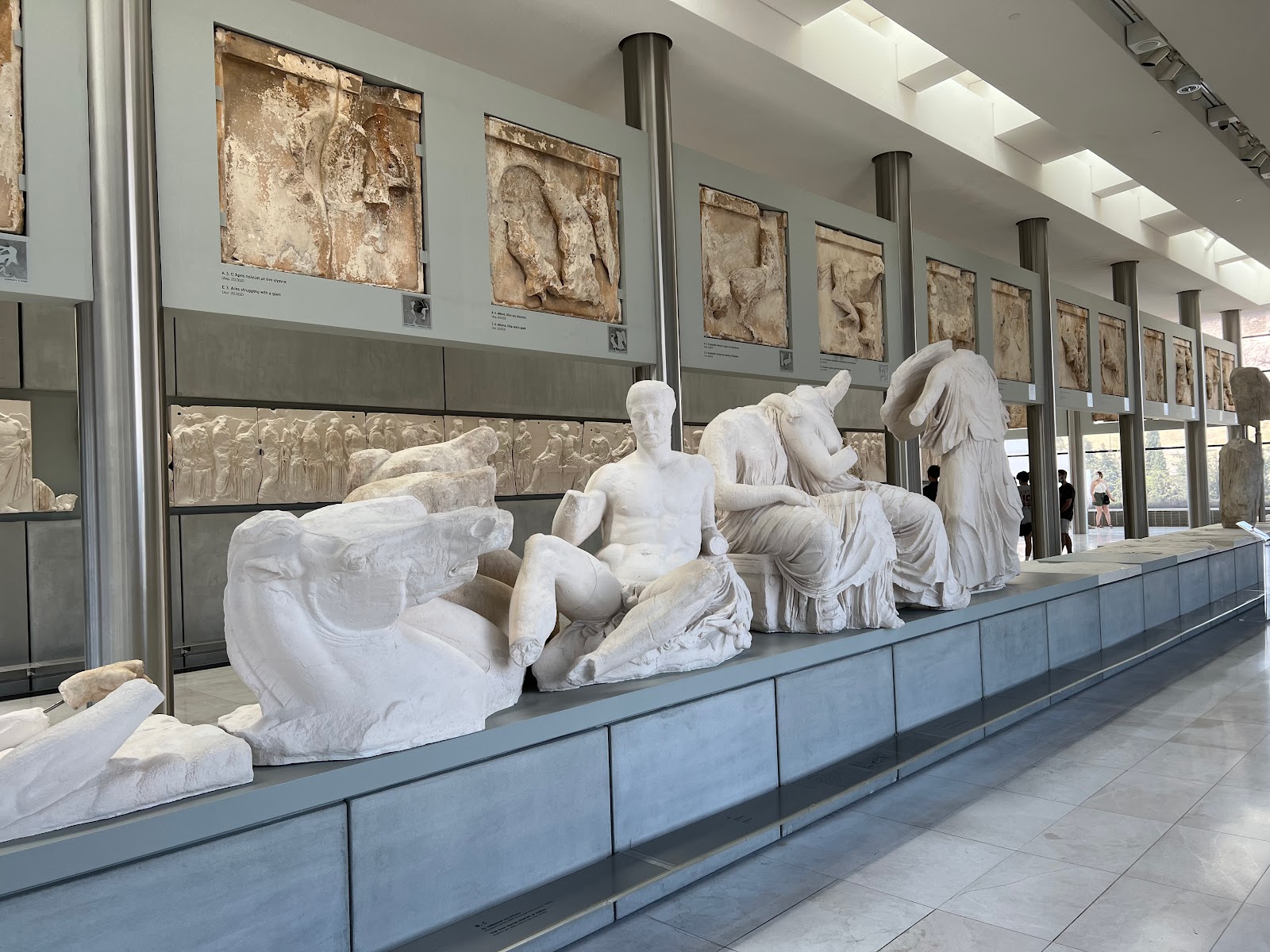
The museum contained many of the remaining statues from the Acropolis where Theodora was able to demonstrate which were original and which were reconstruction due to either being plundered (yawn) or destroyed. It was all very interesting.

View from the museum coffee shop

What is not understood is the size of the statues. They are truly enormous and in marble which means every block weighs some 12.5 tons. The practicality of how the blocks were transported was fantastic. Each block was dragged 17 kms and when the oxen could go no further up the hill, the carts carrying the blocks would be attached to a pulley system and a herd of mules would be encouraged to pull ropes that were at the other end of the pulleys. As they descended, the cart ascended. Thousands upon thousands of blocks.

So the simple art of pillaging was also very difficult. Lord Elgin was ambassador to the Ottomans based in Constantinople in 1799, this during the Napoleonic Wars. He canvassed the Caliph to enable him to survey some Greek sites with a view to removing any interesting objects. Silver smoothed the way and the Caliph, very keen to stay out of the way of the war as the Ottoman Empire had begun to weaken irredeemably, agreed. Elgin sent in a crew to see what they could find. 

What they found were the debris from previous multiple lootings and occupations from over the centuries. Athens had been sacked by the Herulians in 267 AD, by the Huns in 396 AD, the Goths in the 5th century, by the Slavs in the 7th century and so on. Long list. The Franks occupied the city in 1204 during the 4th Crusade and fortified it whilst the later occupying Byzantines built over original Greek structures. As well the locals had simply taken building materials just lying around for their own home construction. No metal. This had already gone. So not much in perfect condition. (Not many people either. Athens had become depopulated over time and it wasn't until 1834 when it was named capital of a newly independent Greece that people began to return to the city. Many government buildings for example date from after this date. Not antiquity at all).

What Elgin's crew did find were portions of sculptures and depictions of events carved into the marble blocks. However each weighed tons. Literally. So they cut the front of the blocks to save weight and shipped what they could back to England. In the museum today, on display are the original part blocks with plaster casts of the bits Elgin's crew took stuck on top. From my uneducated perspective it does look like bits and pieces of rubble. Sort of 'Oh look, Hercules' left shoulder' that sort of thing.

Several years later in 1816, Elgin canvassed the British Government who paid 35,000 GBP for the items which were then immediately displayed in the British Museum.

View from the Museum

These are the friezes taken down from the side of the Parthenon. Restoration is slow for a decision was taken by the EU (if you can imagine) that restoration should only happen when over 70% of the original materials of say a column are found. If these are lying around nearby then the columns can be put back together which is what happened. If not they are left to lie around, which explains the endless piles of rocks everywhere. Very timely, costly and difficult. Greece is a poor country so often has other priorities. 

Statues taken from the ends of the Parthenon, in those triangular parts I described before. If the sculptures are white, that means they are recreations. Often plaster casts taken from the originals in what ever museum they are currently displayed. Yes that means the Elgin Marbles but also the French, Germans and Turks hold plenty. As for the Venetians, well half the city is decorated with Greek stuff looted from their various occupations. If the sculptures look old and yellow, that is because they are the originals. The museum hopes to get back all the other yellow and old bits.

Theodora says that attempts are being made to recover these items which the British Museum is resisting. The French are not being pressed to return their pillaged items. Nor are the Turks who took over the items already removed by the Byzantines and Ottomans in centuries past. Just the British. Probably think the British are the softest touch. Could be right.


Fantastic day. So much history to absorb. Very painful on the brain cells.
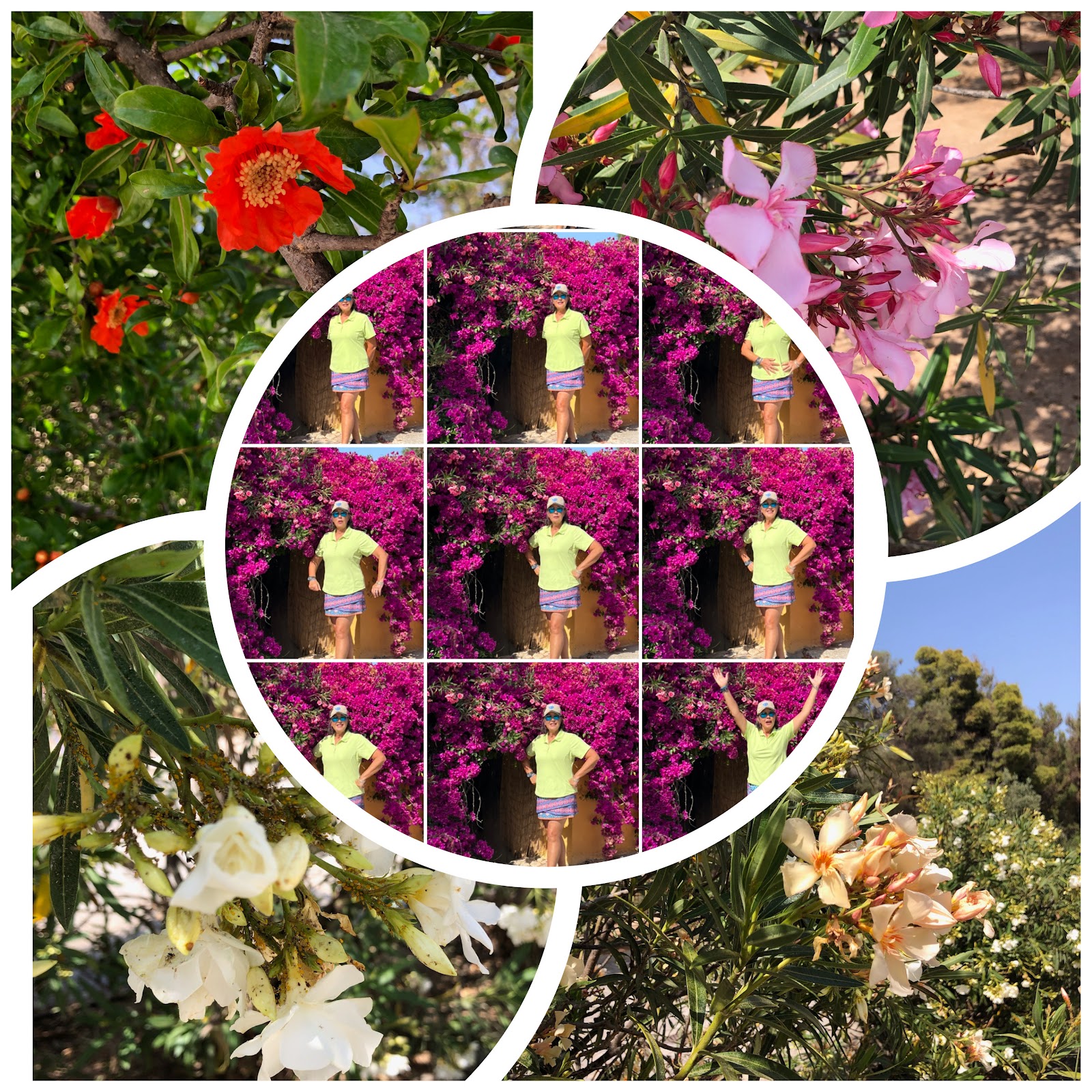
The flowers were gorgeous, particularly the Bougainvillaea. The colours were so intense and vibrant.

We's asked Yiannis and Anthony at the travel agent for recommendations for a good restaurant that locals would go to. Trying to avoid the tourist traps. Mistake actually as we discovered many of the tourist traps turned out mostly to be as good as the local spots. But anyway, Anthony suggested Dionysus as an option. We had a reservation at 9 pm.

Short walk near the Acropolis again and in a big car park this restaurant grew up the hill opposite to the Acropolis. It was rammed with people at a special event with many guards preventing the hoi pilloi getting in. It was a shipping company event obviously with some politicos or other big wigs. Armed guards at the front. Flunkies carried champagne on trays. Amazingly we were allowed entry, but turned away to the non event section. 

What a view of the Acropolis!! The menu was a typical fine dining menu from anywhere in the world but with a couple of local things. The 22 hour braised lamb was finished sadly. 


Fish soup and the other lamb option for me. Salad for Viv. Bottle of white wine, different grape for us. Chocolate soufflé to follow.

Very nice walk back along the ‘most beautiful street in Europe’ per Theodora. We decided we would not eat at such a place again. Bring on the tourist traps and grilled meat!


Sunday, February 22, 2015

La Serenissima: Venice Part 2

Today was going to be the next of the big two in Venice, namely the Doge's Palace.  However whilst yesterday was sunny albeit brisk, today was grey, drizzly and very cold indeed.  Definitely not a day for tramping around outside which was just as well as the Doge's Palace was all inside.

The interior courtyard

Interesting place Venice with interesting traditions.  The Doge for example was the elected leader and by the sound of it was not something you really aspired to.  People, always men of course, became Doge after a lifetime of successful business and service to Venice.  So Doges tended to be both old and short lived.  History tells us that there was one Doge in the 13th century who had the notion of turning it into a dynastic system, but he didn't last long as he was arrested, tried and executed.  That put something of a damper on future Doges thinking about dynasties.


The job itself was tough.  7 days a week cramped up in the Palace, which really actually isn't a palace at all.  It's something like the town hall.  Meeting rooms everywhere and only a couple of small private rooms for the Doge himself.  He rarely went home or saw his family after becoming Doge as he was kept so busy for remember Venice was the crossroads for commerce in that part of the Mediterranean.


Plenty of wondrous art in the many meeting rooms and waiting rooms

Being built in the old days, the place was dark and gloomy not helped at all by the fantastic collection of artwork (again lots of Tintoretto's) which itself was also dark and gloomy.  One particularly memorable room was of the chief justices throughout the centuries.  Every one of them had their own painting.  Imagine a huge room filled with paintings of grim faced, be-wigged men in red gowns.  Dozens of them.  Dozens.  Made me shudder, I can tell you.

See what I mean?

There were the lion's mouths too.  Very interesting.  In the middle of the mouth there was a flap through which you pushed your letters of denunciation.  This was a method of advising the authorities of someone's evil deeds but you couldn't simply make it up to get one over an adversary for example as you had to sign it and if the investigators found you'd made it up, it would be you that caught it in the neck.  Of course it was that old killjoy Bonaparte who took over the place in 1797 and ruled that this was complete nonsense so had all the lion's heads chopped off and the practice disbanded.  But you can still see where they were.


The post boxes front and back

Then there was the meeting room... it is enormous.  The guide said it was the biggest room in Europe for centuries and I can believe it.  At one end is a dais and the Doge's throne and that's it.  No chairs.  Loads and loads of paintings by ... you guessed it, Tintoretto again.  Huge paintings too but this time all very busy and crammed with action denoting Venice's commercial activities. Most impressive.


Let me guess... Tintoretto

The prisons were interesting though.  Like I mentioned before, the palace really isn't but a city hall and so has everything you could possibly need including cells in the dungeons.  Those are the really nasty ones as they are dank and disease ridden.  You wouldn't have much of a chance of coming out of that place if you'd been there a while.  So the Doge decided they needed to build another prison next door, but next door in Venice is actually not being next door but over a canal or river, they had to build a bridge over it through which the condemned passed... 2 corridors, one in and one out.  That is the famous Bridge of Sighs.  It looks way better from the outside than inside.


The Bridge of Sighs, inside and out

Good guide too.  We were part of a big group so were mic'd up so she could talk I think in 3 languages.  She told jokes too.  I'm always impressed by people who can speak lots of languages.  The lady guide said she was a university professor of history so liked doing this.  Good tour.

We found a brilliant place for lunch too.  A really tiny little trattoria by a canal with a couple of little rooms with tables crammed inside.  We even had some gondoliers for company and they really do have those stripy jumpers.  So we felt that we had found a popular place where locals go.

He had the black linguine with cuttlefish that comes out black.  I'll have to come back just for that!

We shared a mass of food, pasta, seafood, antipasti as well as the local liver with some local prosecco (of course) and red wine.  Lovely.

Razor clams, anchovies, prosciutto...
So having tramped around a bit and lunched well we felt the need for a bit more culture and as there was the Correr Museum on the piazza included in the price of entry with the Doge's Palace, we thought why not indeed.

The earliest ducat

The guidebook is pretty scatheing about the place saying that for a museum that is meant to be THE history of Venice, there really should be some rhyme or reason to how it is laid out.  Seeing as there is NO rhyme or reason to how Venice is laid out, I just thought that's a bit of a tough assessment.

The museum though has some amazing contents and again it all comes down to the antiquity of the place.  It started out in the late 5th century and that's when the contents of this museum start.  Actually not as they have some really decent Roman stuff of course which of course pre-dates the place.

Evidence of cricket during the Roman era

Marcus Aurelius


And some Byzantine art featuring a black St. Paul.  Don't see that very often.

But then it was cocktail hour and fortunately the original Harry's Bar was just around the corner and would no doubt offer up some warm conviviality.

Or at least that was what I hoped.  Boy was I disappointed.

It wasn't that the place was pretty spartan with plain wood floors, tables and chairs.  It wasn't that the Negroni's that we had cost an eye watering 24 Euros and really weren't that good.  I think it was because the service was really, really poor.  Talk about grumpy waiters.

I suppose from their point of view, the bar is one that tourists come to just for a single drink and a holiday snap so they know we won't be coming back so they don't give a hoot.  That's how it felt.


Anyway I was disappointed as I'd hoped to be a bit more impressed by a place that Ernest Hemingway used to frequent when he had some leave from the Isonzo Front in WW1 which isn't that far away from here.  He was a renowned drinker so the place must have had something back then.  It doesn't now.

And that was pretty much it for Venice.  Only time for 2 more fantastic meals and a couple more trips on the Vaporetto before our time was up.

Collecting trash in Venice. Not the most scenic of holiday snaps I'll grant but I found it fascinating. 

I will definitely be coming back!


Sunday, February 15, 2015

Gondolas: Venice Part 1

When you think about Venice, you think canals, old buildings and gondolas.  And you'd be right too for Venice has all of those in abundance but no cars, few (if any) cinemas and not that many supermarkets (that I saw anyway).


Truth is that its a very small place indeed.  Indeed the Centro Historico -- that part of Venice that is not part of the mainland or other small islands that make up the entire commune -- has only 60,000 inhabitants in an area that I could walk across in a couple of hours -- always provided that I didn't get totally lost which is a real issue.  Wikipedia says the commune size is 170 square miles but the centro isn't much more than 10-15% of this total.  Given that in the old days, the centro held 200,000 people, it must have been really crowded (smelly and noxious too).  Its crowded now, for goodness sake.

The entirety of Venice from the air

The place is fascinating though.  In England we tend to think there's a 500+ year gap for the so-called Dark Ages between the Romans leaving and 1066 when decent records restarted, but not Venice.  They know what happened here and what happened here had a huge influence on Europe, far more than our own, situated as we are on the fringes of things.

Venice was first settled at the end of the Roman Empire when the remnants of the inhabitants of the North East part of Italy (called the Venetii) fled to the islands and marshes to avoid Attila the Hun whose troops didn't like the water.  To guard against bigger enemies over running them, Venice allied themselves with the Eastern Roman Empire in Constantinople (now called Byzantium), a move that gave them validity.

Given they couldn't venture on land (because the Lombards and later Charlemagne came after them in vain as it turned out), they became a maritime nation of traders.  Actually THE nation of maritime traders of the time.

AND they kept records.  Lots and lots of them.  So we have the history of western Europe from the 5th century available in Venice.  And art, and statues from antiquity, and wondrous precious items from centuries of commerce and conquest.

So given there are 30+ art galleries containing some of the world's greatest art treasures and more museums you can shake a stick at, we just picked a couple of highlights and put the rest down to another time.  For Venice really is another place you can keep coming back to if you're interested in antiquity.  A number of years ago, Viv and I talked about coming to Venice with our then teenage and not quite teenage sons.  We made lists of great things we'd love to see before young voices perked up:  "What is there for us?"  Actually, that was a great question so we put off the visit and went somewhere more child friendly.


Venice really does like the tourist books!

For Venice isn't a place for the young.  And you can see that with the inhabitants now too.  Virtually no young people as there's little work outside of tourism.  The young go to the mainland where property is cheaper, more spacious and there's work.

Our hotel was really nice (Hotel Canal Grande).  It was an old palazzo and faced onto the Grand Canal, which is the main water thoroughfare, opposite the train station and on the main waterbus routes.  So very convenient.

Our welcoming Negroni

The concierge (not a local, just like the other staff) organised a water taxi to go to Murano (home of the glass works) and as it was a totally clear, blue sky day, the entire thing was glorious.  It really is special to travel around like this and Venice is set up to be serviced in this manner.  There really isn't any other choice.  I don't know how many photos we took of people going about their business: emptying the trash, delivering food and drinks, moving stuff like beds.  We found it fascinating that that's how it is done in Venice, but obviously it's entirely normal for the Venetians.


Such a beautiful day for our excursion to Murano

In the old days, craftsmen who worked at Murano weren't allowed to leave the island on pain of death (it is a very small island too) so it was very much a father to son thing.  These days, like so many other craftsmen activities, there's precious few young people willing to apprentice themselves learning how to do everything by hand (as they've always been done).  But the work itself is breathtaking.  No pictures allowed in the fancy galleries though (sadly) to protect each craftsman's own designs so you'll have to visit to see for yourselves.  It is worth it... but expensive if you buy some things.

The workroom...

... the Apprentice in the foreground and the Maestro behind ...

Some random chandelier... the output

Leaving Murano, the water taxi took us the long way around the island passing the impressive Arsenale along the way (where 15,000 people once worked and it was said that they could build and fit out a new ship in 1 day if they were so inclined) to St. Mark's Square where the Doge's Palace stood out proud and recognisable.


The Doge's Palace

We spotted a sign advertising a (Venetian composer) Vivaldi concert in a nearby church for that evening and decided an evening of culture (and the Four Seasons) would be pretty good.  So having bought tickets we headed for the Basilica di San Marco nearby.

One thing we hadn't really considered was the fact that it would be cold in January but by the same token, there weren't any queues to speak of and the canals did not smell (like they do in warmer times).  There wasn't any queue to go into the Basilica at all... amazing really.  As was the interior.

Basilica San Marco

Viv and I compared notes about the most fantastic cathedrals, churches or other places of worship and tried to place San Marco in the pantheon.  Pretty impressive was our conclusion but not as fancy as the Abu Dhabi mosque, say, or the cathedral in Valetta... but then again it was built in the 9th century after two merchants stole the body (sarcophagus) of St. Mark from Alexandria and brought it home (St. Mark is Venice's patron saint) with additions every so often for the next 1,000 years.  So it is old.  Very, very old.

And yes there is scaffolding on part of the building.

The guide book describes some of the wonders to be seen in the Basilica, no more so than the artwork.  By the time we left, we felt we needed to see no more Titians or Tintorettos.  There were that many.  And they are pretty dark and gloomy too, in keeping with the times I expect.  But the Pala d'Oro was most impressive -- an altar screen made in Constantinople in 976 AD but much enriched by some of the impressive (if not rather tacky) booty from the 4th Crusade.

A small part of the Pala d'Oro with the chunky booty from the 4th Crusade

Then came lunch!  And what a joy that was!!

I'd forgotten that Prosecco is a nearby region and its produce, the sparkly wine, is deliciously available by the vat at virtually no cost even in the swanky restaurant on St. Mark's Square that we went to.  What a treat and what wonderful fresh pasta and prosciutto and local produce and coffee and...

Prosciutto, anchovies and the delicious bread

Linguine Vongole -- wow!

It's been a while since I've eaten in Italy so had almost forgotten how even in the throw away restaurants (the trattoria or the osteria or the enoteca...) the food can taste so good.  Definitely no need to go to swanky restaurants (OK, this time was because it was there and we were cold) or drink vintages off the wine list as the local stuff is just wonderful.

The break did enable us to restore tissues most satisfactorily to the point where I could easily have patted a small child on the head and given him/her sixpence, as PG Wodehouse once memorably described.  So we decided to walk back to the hotel as I had a street map.

Getting to the Rialto Bridge (Ponte di Rialto) was easy.  We just followed the street signs and the mass of people and shops leading there from St. Mark's.  The shops were pretty much all tourist related selling Venetian trinkets, faux Murano glass (or so we'd been advised in Murano) and oddly enough selfie sticks -- things you attach to your phone enabling better selfies to be taken.  But there were a host of bars and eateries too that all looked most interesting.

Ponte di Rialto
The famous bridge itself was if I was to be honest rather shabby.  Maybe its the time of year or the fact that there were a number of empty shop fronts but this is a real tourist haven.  You can tell that even without looking at the street map... which I think may have been the case as some hour or so later we turned up in yet another Piazza, with canals in all directions and signposts not helpful at all, that we ultimately found on the map to be .... rather a long way away from our hotel.  However as we were near a waterbus stop (or Vaporetto) we decided to take it back to St. Mark's and find somewhere to eat and drink something small prior to the Vivaldi concert.

Vaporetto stop at dusk

So we did and it all worked out rather well.