Showing posts with label British Empire. Show all posts

Monday, July 11, 2022

The Odyssey -- Athens Day 2

 Day 2 in Athens would be a humdinger. All about the Acropolis. The itinerary said:

'We will arrange a private walking tour of Athens for 5 to 6 hours if you are up to it to visit all the important sites including the Acropolis and the New Acropolis Museum.'

We met our guide Theodora at the hotel and walked the 5 minutes along the street to the entrance to the Acropolis. There were lots of people. Theodora said today would likely be the busiest day of the year as a number of cruise ships had arrived at Piraeus with passengers’ first stop likely to be the Acropolis. 

Viv and I wondered why we would visit today then, or rather this morning as we could easily have visited in the afternoon. Oh well. 

The Acropolis hill is big. And tall. It was tough going slowly dragging ourselves up hill in the heat. Theodora told us the story as we went along.

Nearly there! First selfie du jour at the Greek theatre on the south side of the Acropolis

This is what it looked liked during the Hellenistic Period

The Acropolis had been populated for possibly 4,000 years initially as a fortress for people in the surrounds to retreat to at times of trouble and war. It certainly was imposing yet Theodora advised us that the Acropolis had been attacked, sacked and destroyed many times. Huh?

Very true. 

The Acropolis and the temple on the top known as the Parthenon (there are several other temples on the top but smaller) are relatively recent creations. One may think it looks like something of a rocky ruin, but in fact it’s only about 1,000 years old.

After the Persians attacked Athens, defeated them (Thermopylae was lost if you remember) and occupied Athens, they destroyed everything they could before they left the following year of 480 BC. That included the buildings on the top of the Acropolis hill. These included a partially built Parthenon as well as several other temples. The entire site was ruined.

The Athenians together with a full compliment of Spartans this time (not just the famous 300), annihilated the Persians the following year in 479 BC at Plataea removing all threats to the independent Greek states. To show that they were now the big dogs on the block, the Athenians immediately embarked on rebuilding on an immense scale.

The building of the Parthenon was completed in only 9 years while the crafting of the wondrous sculptures took a further 6 years. Marble was brought from a mountain 17 Kms away and was laboriously lugged up the hill that we were now stumbling up. 

Theodora continued with gusto. 

She certainly had a huge passion about the subject and had definite views on things that had impacted the Acropolis over the years. 

First were the Romans. Of course it would be. For some reason, the Greeks thought they could beat the Romans in the first century BC but the Roman tyrant general Sulla in 87 BC routed them, captured the entire region which wasn’t yet a country including Athens, sacked it thoroughly and enslaved the population. That is the entire population including all those philosophers that were still around.

Greece remained a Roman possession until 1458. 

Huh? I hear you say. What about the Byzantines? There were never any Byzantines. That is the name historians gave the eastern Roman Empire looking backwards at some point. The Romans themselves always called themselves Romans, even until the Ottomans took Constantinople in 1453. Byzantium was the name of the original Greek settlement that the Roman Emperor Constantine renamed in the 4th century AD when he moved the capital of the entire Roman Empire to Constantinople. So forget Byzantium. Actually you can't for every guide book says Byzantine this or that, mainly churches, so it is most confusing. Best to see Rome at the same time as you see Byzantium. 

When I was in Rome a couple of weeks ago I found a wonderful excerpt from a 2nd century AD travel book comparing the architecture of Greece and Rome. In typically patronising fashion, the writer said that the Greeks do build some pretty impressive structures but the stench, the disorganisation and the overall mess of Greek cities was something beyond the comprehension of a Roman. Happily Rome provided aqueducts so that every villa has its own water source for their fountains. Sewage for the endless ordure and stench. Plumbing so that buildings would remain well serviced during the wet season…. And so on. 

It was a Roman traveler from the 2nd century, one Pausanias, whom we all should thank for even the possibility of reconstruction and renovation. For it is only his writings and the earlier Herodotus (the Greek historian from centuries earlier) that give us the idea what these buildings and monuments look like. Fortunately both wrote at very great length and in Pausanias' case drew thousands of sketches and drawings, many of which survive.

The Romans in addition to their renowned organisation, also introduced a fully integrated taxation system that lasted until 1458 and beyond for the conquering Ottomans discovered they couldn’t do any better.

Specific to the Acropolis though were the changes wrought by the Romans to the amphitheater, the new theatre and performing arts centre that was built. Where the Greeks starting with Thespis, a comic writer of the golden age, wrote monologues, dialogues and drama, the Romans dug a big ditch, raised up a marble wall around the orchestra (aka stage) and staged mock naval battles and gladiatorial combat. The walls enabling the area to be filled with water for the first, and prevent blood spatters covering the 5,000 person audience in the second. Who needs monologues! 


Theodora was not impressed, then moved onto the Emperor Justinian (6th century emperor). She was even less impressed by Justinian. I couldn’t figure out exactly why but as he was the mover and shaker in rejigging the imperial tax policy for the final time, perhaps it was this. Certainly the Byzantines which Justinian was about to morph into (even I am falling into this Rome vs Byzantium thing), as opposed to the eastern Roman Empire, were not fans of the old pagan gods still widely revered in Greece. Under the ‘Christians’ (spoken with gritted teeth) they basically trashed everything to do with the old Gods. This is why most of the faces on statues have been disfigured. I didn't ask about why the male genitalia were also missing from most statues.

We hadn’t reached the entrance to the Acropolis at the top yet and Theodora wasn’t slowing down.

The British didn’t miss out either. Theodora was scathing about Elgin and his plundering of Greek antiquity in 1801 (this is the so called Elgin Marbles in the British Museum). Yet less so for the French who even before Elgin stole everything that was not nailed down (this in an instruction specifically written by the French ambassador in 1784 to an expedition in that year). And almost glossing over the Venetians who in their sack of Athens in 1687 had fired cannons at the defending Ottomans who’d retired to the Acropolis which they used as magazines. This cannon fire hit the magazines which exploded and destroyed about one third of the Parthenon. They then tried to take the remaining massive sculptures from the mantles which caused them to fall 30 feet and be irredeemably smashed. 

An even minded person may consider deliberate cannon fire, explosions and wanton destruction of rather more concern and remark than removing a few bits of marble that had been lying around anyway for centuries, a practice I should note that continues to this day.

We reached the entrance with some hundreds of other tourists and snaked past the temple to Nike and made it to the top of the Acropolis.


Athens' Acropolis is huge. About 3kms long by 1.5 kms wide. Lots of room for lots of temples, and there are lots of temples in varying levels of decay. Impressive. 

The Acropolis during Roman times

Theodora was a fantastic source of information and could talk on almost any related subject. She had artists' reconstructions of what the buildings may have looked like. They looked spectacular. Check out www.ancientathens3d.com to take a look. They may not be entirely accurate but are best guesses. 


The top temple is one to the goddess Athena who supposedly gave the gift of the first olive tree to the city, whilst the bottom temple is the Parthenon from the end where Elgin supposedly cut down all those marbles. Imagine the temple with a triangular shape on top of those flat bits. Inside that triangle were dozens of massive sculptures. It was these the Venetians and French could not cart off. It was Elgin's crew that devised the method of cutting the carved frontispiece off the monster 12 ton lump of marble that solved the logistics impasse. These statues we saw in the museum.

By now we were fading so decided to head for the Acropolis Museum which had A/C and a cafe to take a few minutes rest. There we had Freddo Capuccinos which are worthy of conversation in and of themselves.


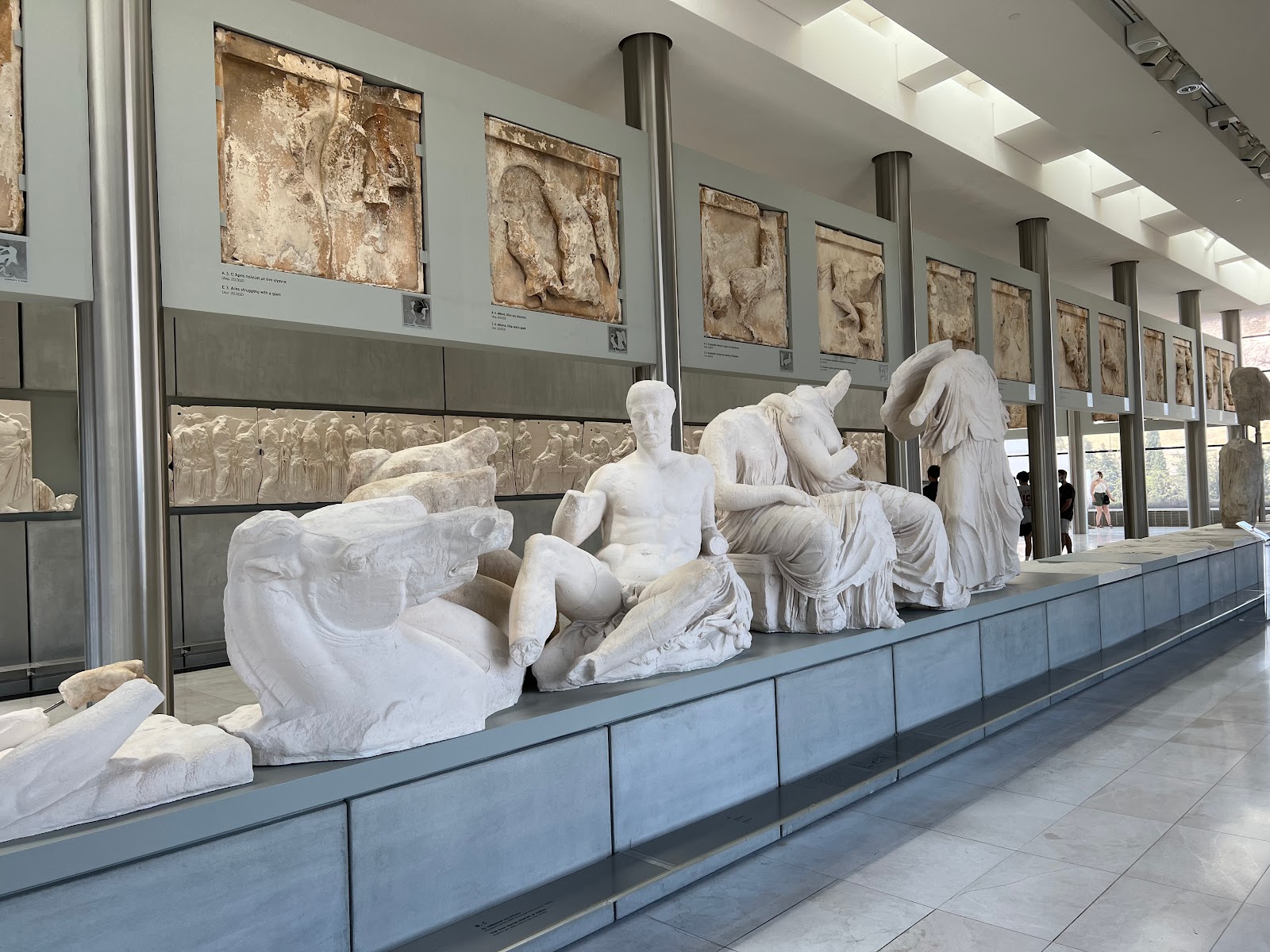
The museum contained many of the remaining statues from the Acropolis where Theodora was able to demonstrate which were original and which were reconstruction due to either being plundered (yawn) or destroyed. It was all very interesting.

View from the museum coffee shop

What is not understood is the size of the statues. They are truly enormous and in marble which means every block weighs some 12.5 tons. The practicality of how the blocks were transported was fantastic. Each block was dragged 17 kms and when the oxen could go no further up the hill, the carts carrying the blocks would be attached to a pulley system and a herd of mules would be encouraged to pull ropes that were at the other end of the pulleys. As they descended, the cart ascended. Thousands upon thousands of blocks.

So the simple art of pillaging was also very difficult. Lord Elgin was ambassador to the Ottomans based in Constantinople in 1799, this during the Napoleonic Wars. He canvassed the Caliph to enable him to survey some Greek sites with a view to removing any interesting objects. Silver smoothed the way and the Caliph, very keen to stay out of the way of the war as the Ottoman Empire had begun to weaken irredeemably, agreed. Elgin sent in a crew to see what they could find. 

What they found were the debris from previous multiple lootings and occupations from over the centuries. Athens had been sacked by the Herulians in 267 AD, by the Huns in 396 AD, the Goths in the 5th century, by the Slavs in the 7th century and so on. Long list. The Franks occupied the city in 1204 during the 4th Crusade and fortified it whilst the later occupying Byzantines built over original Greek structures. As well the locals had simply taken building materials just lying around for their own home construction. No metal. This had already gone. So not much in perfect condition. (Not many people either. Athens had become depopulated over time and it wasn't until 1834 when it was named capital of a newly independent Greece that people began to return to the city. Many government buildings for example date from after this date. Not antiquity at all).

What Elgin's crew did find were portions of sculptures and depictions of events carved into the marble blocks. However each weighed tons. Literally. So they cut the front of the blocks to save weight and shipped what they could back to England. In the museum today, on display are the original part blocks with plaster casts of the bits Elgin's crew took stuck on top. From my uneducated perspective it does look like bits and pieces of rubble. Sort of 'Oh look, Hercules' left shoulder' that sort of thing.

Several years later in 1816, Elgin canvassed the British Government who paid 35,000 GBP for the items which were then immediately displayed in the British Museum.

View from the Museum

These are the friezes taken down from the side of the Parthenon. Restoration is slow for a decision was taken by the EU (if you can imagine) that restoration should only happen when over 70% of the original materials of say a column are found. If these are lying around nearby then the columns can be put back together which is what happened. If not they are left to lie around, which explains the endless piles of rocks everywhere. Very timely, costly and difficult. Greece is a poor country so often has other priorities. 

Statues taken from the ends of the Parthenon, in those triangular parts I described before. If the sculptures are white, that means they are recreations. Often plaster casts taken from the originals in what ever museum they are currently displayed. Yes that means the Elgin Marbles but also the French, Germans and Turks hold plenty. As for the Venetians, well half the city is decorated with Greek stuff looted from their various occupations. If the sculptures look old and yellow, that is because they are the originals. The museum hopes to get back all the other yellow and old bits.

Theodora says that attempts are being made to recover these items which the British Museum is resisting. The French are not being pressed to return their pillaged items. Nor are the Turks who took over the items already removed by the Byzantines and Ottomans in centuries past. Just the British. Probably think the British are the softest touch. Could be right.


Fantastic day. So much history to absorb. Very painful on the brain cells.
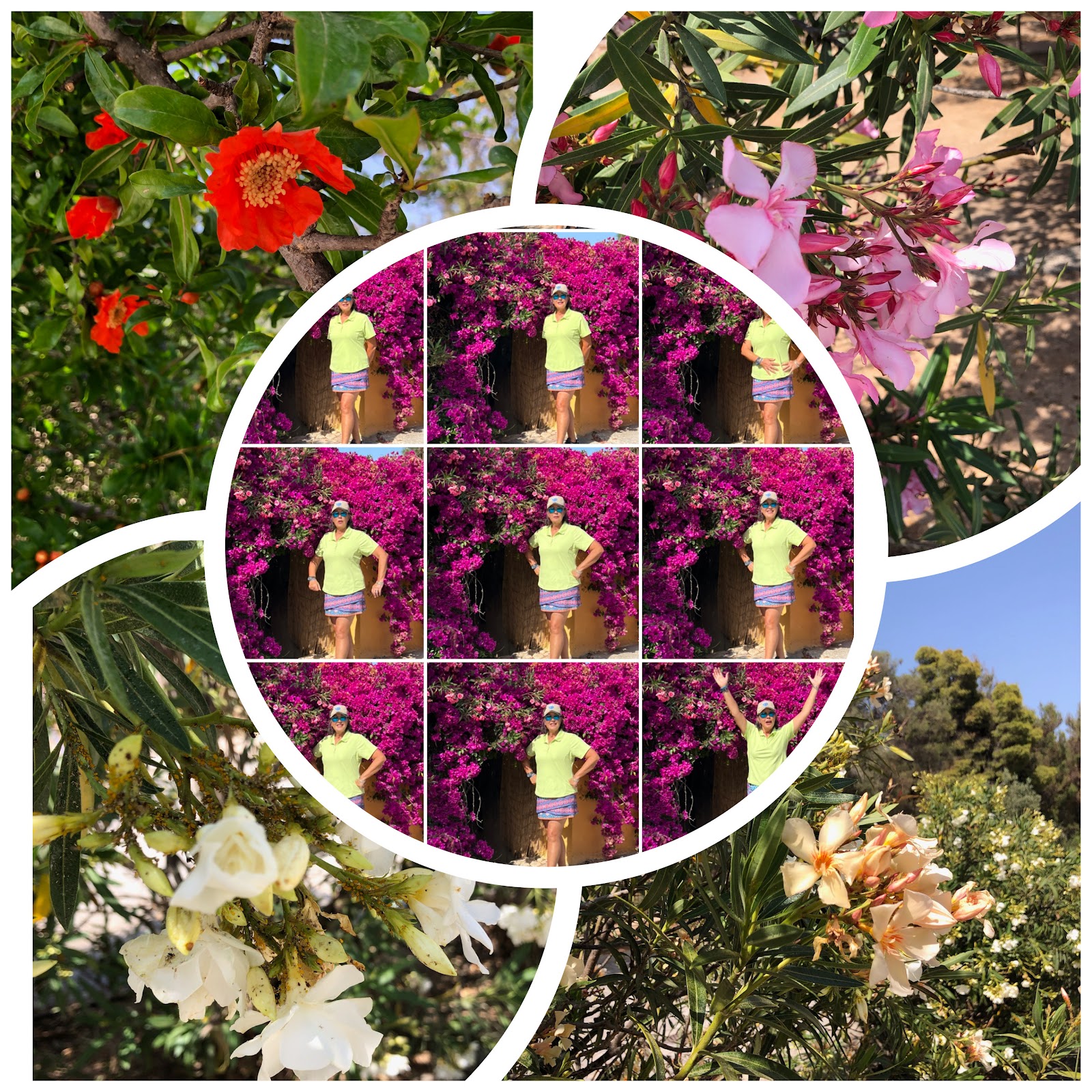
The flowers were gorgeous, particularly the Bougainvillaea. The colours were so intense and vibrant.

We's asked Yiannis and Anthony at the travel agent for recommendations for a good restaurant that locals would go to. Trying to avoid the tourist traps. Mistake actually as we discovered many of the tourist traps turned out mostly to be as good as the local spots. But anyway, Anthony suggested Dionysus as an option. We had a reservation at 9 pm.

Short walk near the Acropolis again and in a big car park this restaurant grew up the hill opposite to the Acropolis. It was rammed with people at a special event with many guards preventing the hoi pilloi getting in. It was a shipping company event obviously with some politicos or other big wigs. Armed guards at the front. Flunkies carried champagne on trays. Amazingly we were allowed entry, but turned away to the non event section. 

What a view of the Acropolis!! The menu was a typical fine dining menu from anywhere in the world but with a couple of local things. The 22 hour braised lamb was finished sadly. 


Fish soup and the other lamb option for me. Salad for Viv. Bottle of white wine, different grape for us. Chocolate soufflé to follow.

Very nice walk back along the ‘most beautiful street in Europe’ per Theodora. We decided we would not eat at such a place again. Bring on the tourist traps and grilled meat!


Sunday, July 28, 2019

The Wild West Part V -- Custer's Last Stand

I have tracked this part fairly relentlessly with the Track My Tour app which you can follow here if you like.... Whoops. I quickly took a look at that blog and realized I missed out a whole chunk that I thought I'd mentioned which was our visit to the Little Big Horn Battlefield. Lots of bits about the prairie (which admittedly is very, very big) but nothing about that. My bad.

The location is SE Montana and nearly 7 hours drive from Jackson so we had a great drive mainly through prairies and small towns like Cody, named after Buffalo Bill which is your ultimate one horse town. Really enjoyable. I think we went through two iPlayer stories and maybe a podcast or so. This did mean that we got there late, around 4 pm, but as it is just about the lightest time of the year and pretty far north, it wouldn't get dark until well past 10 pm. It was also a beautiful clear evening.


The visitor place is interesting and gave a nice background. We sat through the video but more interestingly a native Indian ranger's talk on the events with her perspective. Both sides in fact.


I didn't know what to expect really but as we'd driven 7 hours across prairie without seeing too many people, I had started to get an idea what it may have been like 150 years ago... no roads, no towns, just prairie. No telephone or radios, just wireless but without the wires which helped not at all. So with no communications means, hindsight would say that the objective of the punitive expedition was almost certainly doomed to failure. Obviously, the actual events were unexpected but ...

1851 Treaty of Laramie that set the Sioux lands
The lands set aside for the Indians (Sioux, but this is a collective for a number of smaller tribes as well) was massive and realistically there were not very many of them in total, so a huge parcel of land. On one side, the Indians did not like being encumbered in any way and on the other settlers kept encroaching from the east. Most notably when gold was discovered in Deadwood (modern day South Dakota) which is in the Black Hills, a sacred place for the Indians. So both together made for a fraught time and it was realistically the continual and increasing encroachment which pushed things over the edge.

So many books have been written about the subject by so many different people with different perspectives that I won't add my two pennyworth, but here is Wikipedia's take on things. From what I saw and heard and subsequently read, it does seem to have been a series of errors, misunderstandings and simple cock ups combined with a lot of bad luck, rather like the Battle of Isandlwana in the South African Zulu wars and with a very similar aftermath: ultimate destruction for the victors.

The land area firstly is huge and the numbers of participants on either side were relatively few. In total some 8,000 Indians and on the US Army side, no more than 5,000 soldiers and cavalry split into two columns. The intent was to approach the Indians from two sides and deal with them that way. In practice, as soon as they split up there was no chance of subsequent coordination of any attack. Each column would have to deal with things as they came up all alone. The main body of soldiers didn't show up until 2-3 days later by which time it was all far too late and the Indians had long gone.

The tree line in the distance is the river where all the Indian tribes were encamped. Skirmishers went down from this vantage and were rapidly chased back. Surprise that had been total was now irredeemably lost.

The ridge line along which the battle was fought

Rolling ground with many gullies where Indian braves could hide and ridges from which they could shoot

History has portrayed Custer as many things ranging from doomed super hero to brainless buffoon but he was a long time serving soldier who had reached General rank in the civil war and was intent on carrying out his orders; so probably somewhere in between. It was the combination of no intelligence (as in news of what was going on), massive distances and lack of determination by support troop commanders combined with his own over eagerness and pure bad luck running into the entire Indian population on the banks of the Little Big Horn river that did it. By the time he and his men had advanced into what turned out to be the main battlefield area, it was too late to retire. Particularly after they killed their horses to provide cover.

Last stand hill
I remember history classes from my early school days, in the early 1960's, when people could remember the empire. Teachers would say that the British never lost the final battle even though they lost many along the way. Same goes for here. Even though this battle realistically was nothing more than a minor skirmish, in terms of significance it was massive. Just as at Isandlwana, news of the disaster awoke an anger and determination to finish the war and smash the Indians totally. As the president at the time was Grant, the Civil War generalissimo, there was no way that this would turn out other than badly for the Indians and so it proved.

However what cannot be gainsaid is that all those that participated in the battle were doing it for what they deemed right reasons and for the most part fought and died bravely. This memorial I think does remember that very well indeed.

In writing this, just thinking that whenever history books are written, what people remember most are the times when things go wrong. Like here. The Battle of the Little Big Horn is one of the main high points in the history of the Wild West, at least as taught to British school children like me at the time. I cannot remember a single subsequent battle that took place that went the other way. Same as in the South African conflict that I mentioned earlier. Everyone remembers Isandlwana as a total fiasco and annihilation of a British army at the hands of the Zulus and the ensuing encounter at Rorke's Drift which in reality had zero effect on the war but was an amazingly fortunate encounter that caught the public eye. Nobody remembers the rest of the war, the battles nor even the treaty that ended it. Just the fiasco. Curious that.


Thursday, March 7, 2019

Past Historic

I have basically dropped the ball on following up on our visit to the historic tin town of Ipoh with a post on this blog but in self defense I have been thinking, well a bit anyway, about how I should couch the blog.

If you fancy following the moment by moment stuff, then I would urge you to take a look at my Track My Tour, wonderful app, thanks Chris as usual, which I have attached here. Viv and I really enjoyed our short visit but it wasn't quite what we thought and why we thought it may have been as enjoyable as it was. If you see what I mean (and rereading that last bit, I'm afraid I don't quite know what I was trying to say). Take it as being the things we thought would be good were either absent or underwhelming, those that we hadn't considered or felt were of lesser importance really stepped up and more than filled the gap.

It is the history that I am referring to.

So brief back up again: we wanted to visit Ipoh because it was an important historic town in Malaysia's development and was pretty close to Penang, in fact about an hour and a half on the motorway. Also we had been advised the food was really good there as was the famous Old Town White Coffee (it was).

So history: Ipoh was pretty much nothing more than a collection of huts before tin mining and the devastating series of Tin Wars (see Wikipedia link to the four different but rapidly consecutive wars collectively called the Larut War here) prompted the protagonists, initially competing Chinese regional tin miners but later also the Malay rulers who fell into a civil war in the state of Perak, to call in the British to restore order as they could not. These wars fell between 1861 and 1874 when the final Treaty of Pangkor was signed and this pretty much signaled the start of Ipoh as a place of significance. It also signaled the arrival of the British who to that point in the development of the country had held themselves only in the Straits Settlements -- Penang, Singapore and Malacca.... but also Pangkor, which was the port town for the Perak River, the means by which most tin made its way to the outside world.

The little blue bits are the tin lakes that now dot the area. Imagine 100 years ago these were mostly open cast mines.
Say what you will about the good and bad of British imperialism and Pax Britannica but this treaty brought peace to the area again and a new level of organisation and infrastructure that had previously never existed. It also forced the British to redefine their relationship with Malay states and set the starting point for closer cooperation, then the colonial era which followed. In a nutshell, the British took administration, foreign policy and defense. The Malay sultans kept religion (Islam) and cultural matters. Of course this meant almost total British control. However it wasn't as though the non-British parties didn't go into this eyes open. Probably though they may not have thought through the exact level of control they would be giving up by inviting the British in. Or for how long it would last.

In Ipoh, we went to two Chinese tin mining museums. One outside Ipoh and one in the old town. Both of these were private museums funded by in the first case a wealthy Chinese tin mine owner and in the second case by the Haka Tin Miner's Association. So both I knew would be as politically incorrect as could be imagined... and they were, all with the perfectly acceptable intention of providing the truth, the whole truth and nothing but the truth (Jack Nicholson speech in "A Few Good Men" springs to mind here).


Pre-1800 tin mining was pretty much a fringe thing conducted by local Malays. It wasn't until global demand picked up during the Industrial Revolution along with prices that the Chinese became interested. That also coincided with numerous rebellions and civil unrest in the fin de siecle period of the Ming dynasty, so people left China in droves for peace and an economic uptick.


Open cast mining was not eco-friendly and was very labour intensive. It also required massive volumes of water to be diverted from the Perak River and pumped through hoses to wash away soil and other detritus from the underlying tin ore.

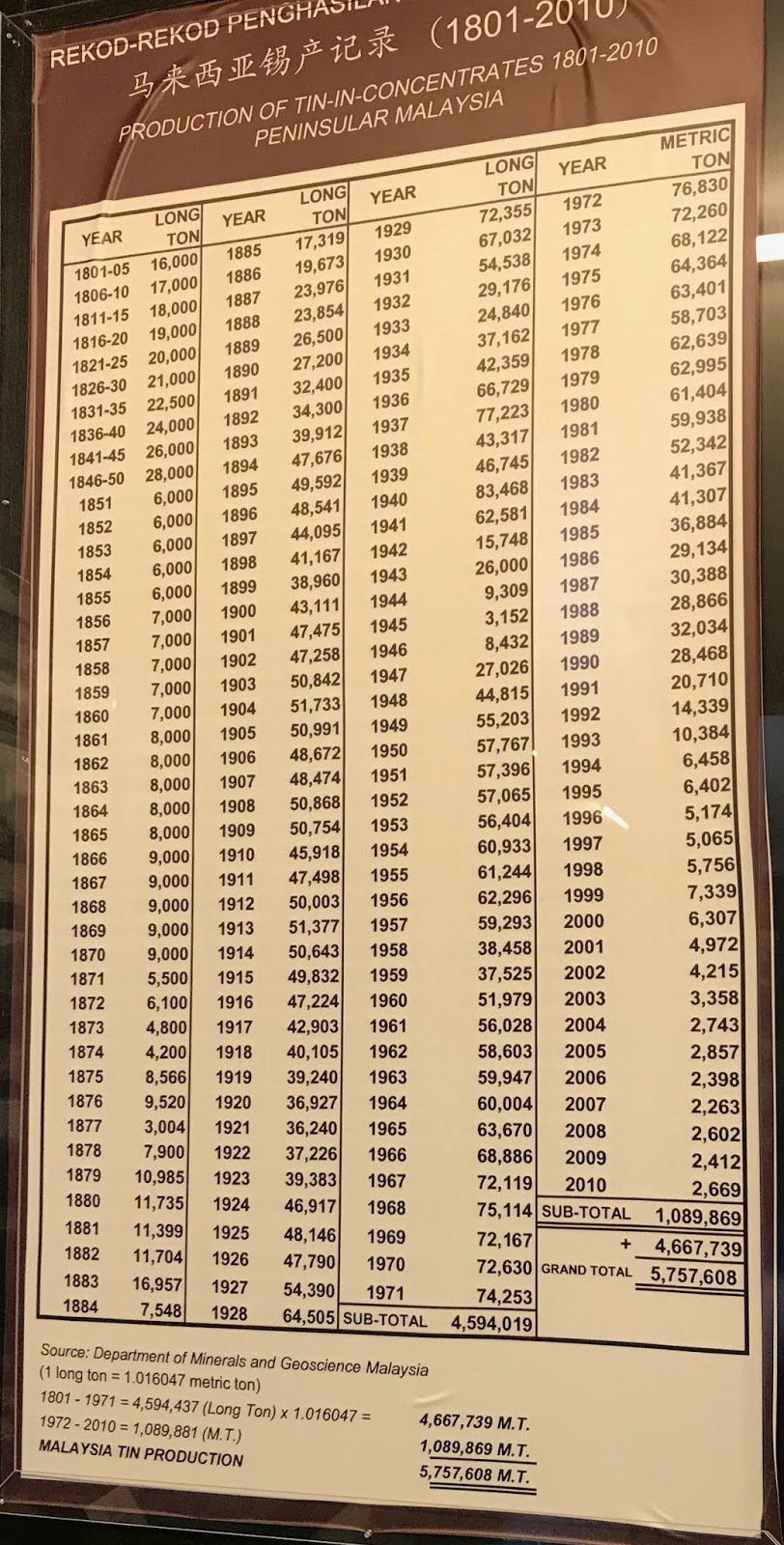
This is wonderfully documented by the first museum as the owner has all the industry statistics you could possibly want for this industry and dutifully and relentlessly published the lot of them on frame boards in the museum along with dioramas 'interpreting' those statistics.

Data going back to 1800!

Mostly they were statues of Chinese workers 'coolies' holding some sort of tool connected with mining. In this time tens of thousands of mainly men came each year for the next 60 years. In all about just over 1 million. Most came for the mining which was centred around this area. I haven't read anything that talks about the demographic impact of having this many new immigrants in a specific location, in a specific industry, and in such a short period of time. But it must have been overwhelming for the indigenous population and obviously contributed in no small measure to the Larut Wars, which were essentially inter-Chinese turf wars squabbling over resources. No wonder the sultan lost control of things. (Malaya's population in 1950 was still just 6 million!).


We had a guide for both days we were in Ipoh who was very informative and in his non PC way told us: "The Chinese miners were only here for the money. They didn't care about who controlled what or how they got the tin. They just knew that tin was worth money and that was it." He was more direct than that on a wider variety of subjects too but I just restrict myself to this.

So there you have Malaya in a nutshell (and still pretty much modern day Malaysia too, from what I have seen). The Chinese just want to do business and don't care about how they go about it, whose toes they trample on, who is the 'ruler' and that other stuff like personal freedoms, rights, rules about intellectual property, all of that. So for them in 1874, getting the British in was a no brainer. Obviously the Malays may have had different priorities.

One downside to this is heritage. Living in a UNESCO world heritage site (Penang) it is almost ironic that this should be the case for this UNESCO accreditation comes with specific rules and regulations governing what you can and cannot do to 'heritage' buildings and other artifacts. The practical downside in Penang is the almost endless number of colonial era mansions that are derelict and left to rot. Conflicting reasons for this. One is that the UNESCO rules make it very expensive to renovate (ironically McDonalds and KFC have taken over and renovated mansions for their purposes) and the other main one being that they are owned by old time trusts (Chinese clans presumably) with many different strands of ownership meaning that nobody can agree on anything, so nothing happens.

Specific to Ipoh and the reason that I have taken the path in this post are the railway station together with the city administrative building right opposite. Both are WWI constructs in the Imperial fashion -- massive long white buildings -- the railway station is in use but much changed to accommodate modern traffic whilst the city council building has been abandoned and is being left to rot whilst the current city employees work in their new blinged up glass and concrete high rise just down the road. So from a 'heritage' position ... and this is something that Ipoh Tourism really focuses on (that is if you read their website blurb and visit the Tourist Information office) and if you have followed my trail to this point, you will remember that prior to 1874 Ipoh did not exist so anything 'old' from then will perforce have had to be .... Imperial era construction, which sad to say is being ignored probably to ruin at some point. You can already see green plants growing out of the walls of the old city building. As Ipoh virtually burned down in 1892 it had to almost entirely be rebuilt. This is where the town's grid layout dates from.... again here heritage = Imperial era construction.

The magnificent railway station in Ipoh. Its derelict brother lies just across the road... in fact I took this picture standing right in front of it
Heritage wise, this visit for us really didn't work out as we thought but then again it did. For those parts that did elevate our time here were those specific private museums and the energy and dedication put into those. So all of what I said about the general attitude completely falls apart when you consider just how conscious these private benefactors (who were outside the norm) are in preserving the history of the tin miners of Ipoh. They did a great job. Other heritage, not so much. You can see it being ignored on a daily basis as younger people in the modern times presumably simply don't care about the past so much. I think it's a shame but then again I just turned 65 so am what is now considered 'past historic'.

PH definitely looking past it on the left hand side in front of some Ipoh street art that our guide rather amusingly dismissed out of hand. He was right though, most of it was just graffiti masquerading as something else
Looking at it a different way, heritage is expensive and a question of priorities. As a lover of Italy, I am continually amazed by the almost total disregard by the population of the old ruins of this and that that lie around everywhere. To restore everything to its former glory (and define that if you can) would be prohibitively expensive and time consuming. In the US by contrast, a country with virtually no similar heritage or history, every speck of rock that can be deemed 'heritage' of some sort or other has its own national park surrounding it with display panels, interpretive films and tourist centers. Last year we visited the site where the 1850's go west homesteaders covered wagon tracks can still be seen. You can't see anything. The site is a huge..... prairie covered in grass.

I will leave this post with some comments from a magazine that I just read whose editorial reported that even though 2020 has been designated Visit Malaysia Year, Tourism Malaysia is cutting funding for marketing purposes. One should remember that the country is up to its ears in debt from past corruption scandals and over spending on infrastructure that nobody needs or uses, so the new government is presumably doing its best in prioritizing what it can without continuing the damaging debt trend. This said it could also up its game a bit for as this same magazine says "it does suffer a bit from the all too common local hallmarks of subpar service and mediocre maintenance."

Ipoh was great fun though. And the food.... well who wouldn't love to find a fantastic tandoori restaurant laid out just like a high end steakhouse in the US? Visit the Tandoori Grill!!!


Sunday, December 2, 2018

The Honorable Lanka

Living in Penang you see the word 'Sri' all the time in front of a group of other words and for the longest time I had no thought really about what it meant, if it meant something, or it was something else. It took our visit to Lanka in October to settle things. The word 'Sri' is an honorific which I take to mean something like 'the honorable' or something like that. As the pre-Colonial name for the country was Lanka, that is what they first named the country after 'Ceylon' was ditched after independence adding the 'Sri' only a little later. Claro?

I used Chris' wonderful app Track My Tour for the day to day stuff and if you want to follow that you can do so here but wanted to add some other bits that I didn't write about or thought about after.

First up, great country. Lovely people. Hopeless infrastructure. My goodness, does it rain. Animals everywhere.

OK that's it all done.... well not quite. Any people that do read my posts know that I probably drone on at too much length so a post this short and sweet just isn't going to happen. So here it is, the memories that will stay with me in no particular order.

1. Elephants

Nothing more to add, just that it was fabulous to see them in the wild

2. History

In a later post I will refer to Malacca in Malaysia as part of a recent road trip that Viv and I did with some friends from Bermuda. It bears striking similarities to Sri Lanka as it was the Portuguese who were the first colonial settlers and it was they who were summarily kicked out by the next settlers, namely the Dutch, who in turn were removed by the British who then never left and generally fixed the things that the others hadn't.


The Portuguese settlements were very much at the fringes, seaside settlements in the south with just the one in the pointy bit at the top, which is Jaffna. So easy meat for the Dutch who came in force over 100 years later and kicked them out. They tried to take over the entire island but couldn't manage the middle section (which was where Buddha's tooth ended up, Kandy) and made a big mistake by not preventing the British from settling Trincomalee (sort of top right, below Jaffna but above the middle fat bits on the right hand side) and creating a naval base there opposing the French in Madras. The British liked the place so when the French marched into Holland in 1792, the Dutch presumably much against their will and definitely their better judgement asked the British to care of things for a while. Until the French left. No problem, thanks. Trouble was when in 1815 they asked for it back (as they did in Malacca and other places further east) the British said no thanks, we like it here. Oh yes and if you want to try and take it back, let me introduce you to the Duke of Wellington who just thrashed Boney up and down Europe... and some of his friends in red jackets.

Well that wasn't going to work so getting the best deal out of a pretty poor situation was all they had left so the Dutch said OK you can have Ceylon (they called it Ce-lun apparently, a corruption of a misheard Portuguese word) and Malacca and if you must Singapore, but we wouldn't mind having back Java and Sumatra. Probably don't fit in with your imperial plans. The Brits had no imperial strategy of course, only the East India Company, a bunch of penny pinching capitalists and absolutely no desire to take on anything else after that ruinously expensive 30 year war against the French so said thanks and generally history moved on.

Having acquired the new territories though meant actually doing things with them and in general the British did fairly well by Ceylon, as it was now called. Or so it seems to me. Certainly when we visited the big historical and archaeological sites, it was the British who 'discovered' them. Apparently even the locals had forgotten about these places as they were abandoned centuries beforehand and the previous colonizers being typically inefficient and generally useless had walked right past them.

3. Tea

I suppose if you don't much care for tea, then this bit will be irrelevant for you, but as a tea lover I was totally taken with the tea plantations. Even today, the tea industry is the single largest industry in Sri Lanka. 


This picture tells you all you need to know about when, where and how tea came to be in Sri Lanka. Apparently the original plants were not from the already entrenched Indian plantations but came straight from original Chinese plants which is what gives Ceylon Tea its distinct flavor. We bought loads!

4. Infrastructure

The subtext to the above note on tea is actually a very sad one as reliance on a tea industry as the number one component of the economy means that that economy is not very developed. It isn't. One of the key reasons why stems from the 30-year civil war between the majority Sinhalese (mostly in the south) and the minority Tamils (in the north). Add religion into the mix too: Buddhist vs Hindu, and the mix was very toxic indeed.

I read a little about it from my first point of contact for most things these days, Wikipedia, and what was written was sad enough but you just know the reality was worse.

So to dates. Independence finally in 1972, add 30 years and a few before and after the civil war and you come to now. The war itself ended within the last 5 years so there simply has been no time to repair or even build any infrastructure. Also factor in the unforeseen catastrophe that was the Boxing Day Tsunami in 2004 which absolutely devastated the southern part of the island particularly around Galle, and this is the situation Sri Lanka finds itself in. You can see it or rather the lack of it everywhere however all the people we met were some of the nicest, friendly, most optimistic people I have ever met. 

The tuk tuk is the solution!

5. The Weather

People in England talk about the weather all the time, particularly the rain and the deadly grayness of the country between November and March. That is true of course and I personally think it is the greyness that is the worst thing. After weeks of it, things are so depressing. My birthday is in February and it always rained.  Ugh. But not like Sri Lanka.

My goodness does it rain. I had to chuckle that the England cricket team were touring Sri Lanka just about at the same time as us and I really wondered if anyone that did the schedule actually bothered to ask what the weather would be like around then because it is in one of the many rainy seasons here and when they say rainy, they do mean rainy.

Facing a broadly similar issue in Penang about determining exactly when the seasons start and end I asked Fernando, our guide, and he told me that now was the rainy season. He may have said it was the North West monsoon but could also easily have said the South East one for apparently there are many rainy seasons here. Our time until December for one, then becomes dry for the month of January. After that comes the different direction (maybe SW) monsoon season for Feb-March and then another month of comparative dry before the NE monsoon season kicks in during May and which lasts to the end of July. August is most likely relatively dry but then you get the slow drag that is the beginning of the NW monsoon season that really gets going in October again and ....

So the island is very green and you often see scenes like this where only the day before was dry land.

Love the water buffaloes though!
Loved it. Ready to return at any time! And I didn't even get to talk about the dogs and cows ...