Showing posts with label food. Show all posts

Sunday, July 17, 2022

Athens Day 3 -- Battlefields

This is the first battlefield day and the first step on our Greek road trip. Yannis picked us up to drive the 26 miles 285 yards to the Marathon battlefield which apparently is just a field and very little else. Nobody goes there these days and Yannis told us we were only the third group he’d ever had in 10 years!
It was just a field with a large burial mound in the middle. A tumulus it is called here. It holds the bodies of 192 dead Greeks whilst the Persians who were seriously routed lost 6,500 or so.
What brought the attack was simply the Persians who had a simply enormous Asian empire, were concerned about their noisy neighbours in Europe who they kept running into around the eastern Mediterranean. Diplomacy failed, so to war. The Persians sent 25,000 men by sea to the gradual sloping beaches at Marathon at the behest of a banished former Greek tyrant (there were many of those as the Greeks have a history of quarrelling over everything, still today) who promised to be a good neighbour next time if the Persians put him back in charge. The Bay of Marathon these days has been heavily silted up so is pretty much unrecognisable from what it was like 2500 years ago. Same for many of the coastal areas. The battlefield today is some 5 kms inland as a result. The Persians landed with a lot of cavalry to meet 10,000 Greeks, mostly Athenians, who stayed resolutely in the surrounding mountains. After 3 days the cavalry took off for the ships and more food so the Greeks launched a sudden attack on the remainder of the invading army. Taken by surprise the Persians formed up and the two armies met. The Greeks under Militiades were weakest in the centre but strong on both wings. The Persians pushed forward in the centre as the Greeks gave way, soon the Persians were surrounded and the killing began. The lack of cavalry lost the day for the Persians. History has it that one soldier ran back to Athens with the news….. apparently not. This man’s name was Pheidippides and in actuality a few days earlier he had run some 200 kms to Sparta to ask for help. Bad timing as it was a big religious festival (another one!) and the Spartans said we’ll come along after it’s over. He ran back to Athens and thence to the army at Marathon. After the battle, the Persians reboarded their ships and set sail for Athens proper. They still had a superior number to the Greeks so a direct assault on Athens was still viable. The victorious Greek army to a man ran the 26 miles and 285 yards back to Athens so as to be able to form up on the shoreline showing the Persians they were ready for them again. The Persians went home. Pheidippides ran back to Sparta again to say don’t bother, we won and it was there that he really dropped dead. The real road race therefore would have to be a mere 200 kms or so. The classic 26+ mile Marathon route is marked out still and it was that route taken in both the 1896 and 2004 Olympic Games. I’ll bet no Turks took part. We followed up with a tour of a nearby archaeological museum and went into a tumulus for the Plateans who had been killed in the battle at Marathon, another 12 of them.
After this we set out for Cape Sounion to the south of Athens with Yannis talking away about history and mythology. On the way from Marathon to Cape Sounion, we stopped at one of Yannis’ favourite rest stops near the airport for some Freddo cappuccinos (again)!! Very nice. He added to what Theodora said about the Athenians using the Parthenon rebuild to project Athenian power amongst the independent city states. Apparently it was the later war with the Persians, the one that was lost and when Athens was subsequently sacked, looted and destroyed. The Athenians demanded recompense from the other cities. If the city had sent troops, like Platea, that was OK. If they did not, like many others, they sent money instead. It was a lot of money and even with the early reversals, they found themselves at the end with a huge dollop of cash. So being democratic, the leaders asked the people if they’d like to spend the cash on a big glowing memorial to Athenian bravery, skill and honour. Not necessarily Greek, but Athenian. The people said yes and so the money was used to rebuild the Parthenon and a bunch of other destroyed buildings. So there you have it. On the road, Cape Sounion was at the very end of the promontory which led out from Athens. Today it is the beach area. Very affluent. Further along and out is the Cape where there is little other than a lovely bay with two beach hotels and the cliffs upon which stood the Temple to Poseidon. You may remember from yesterday that Poseidon and Athena competed for supremacy in Athens. Poseidon provided a miraculous spring of sea water, Athena provided the first ever olive tree. Athena won so the Athenians cautious about offending a major God like Poseidon decided to dedicate a temple to him on this spot. It is a spectacular spot.
Yiannis told the story of Theseus and the Minotaur. Part bull, part man this beast lived in caves in Crete and ate everyone that tried to kill it. Theseus son of the King of Athens, named Aegis, offered himself to try the next time. He told his dad that if he succeeded in killing the Minotaur he would return with white sails on his ship. Theseus went to Crete and first thing he did was meet the beautiful daughter of the King, Ariadne, who helped him first find the caves and then with a ball of twine helped him find the way out of the maze in which the Minotaur lived. Killing the Minotaur was pretty straightforward but getting out was tricky but the ball of twine helped. Theseus returned to Athens. All good so far but in all the excitement he’d forgotten quite what he’d promised his father about the colour of his sails. He used black ones. Standing on the peninsula of the Temple of Poseidon at Cape Sounion, the entrance into Athens, all Aegis saw was black sails which meant his one and only son was dead. Aegis threw himself off the rocks in his grief. In response the Athenians called the body of water the Aegean Sea in his memory. Why would you ever have children? This was where Cape Sounion was and the temple is located. Utterly spectacular!
It was nearing 4 pm and Yiannis said there was a nice seafood restaurant nearby that would be great for a late lunch. It was! What a great spot too, right on the bay opposite the Temple of Poseidon. And if you think either of us was ready, willing and able to think about dinner after, think again.
When we returned to Athens no more than an hour or so later, we decided a meat feast was called for. First though we felt the need for a brief wander around the gardens nearby where stood the Temple of Zeus and the Arch of Hadrian. The Temple had been destroyed by the Persians centuries before and was a gift by the Emperor Hadrian to the people of Athens when he visited the city. In return the Athenians built a ceremonial arch to the emperor as thanks for the gift.
Nearby was the Parliament building where Yiannis had told us that on the hour there was a change of the guards that we really shouldn't miss. We queued up with maybe a couple of hundred other tourists and waited. First of all the guards dress in what is loosely termed 'traditional' fashion. I never 'knew' much about fashion as a youngster but one thing I did 'know' was that Greek men wore skirts. Quite how and why this was a 'known' fact when I was growing up is unclear to me but that was one of the things that I as a young person 'knew'. I imagine this was it. It is a thick tunic with what look like really thick stockings and those shoes with the bobble on top!
Of course there must be some basis for it in practicality measure. Greece can be very cold indeed so thick clothes would be a boon. As for those shoes though, we came across some in a museum a day or so later and they are very simply hob nailed boots with that bobble on top. Presumably they took the bobble off to fight. And of course OK, OK in England we have the guards at Buckingham Palace wearing those busbies. The changing of the guard ceremony itself took about 10 minutes and looks exhausting. Lots of stamping around and leg and arm swinging. The leg movements look like something out of Monty Python's Ministry of Silly Walks. After it was all over and the guards had been changed, one of the senior officers presumably came around with a towel to dry off the sweat on their faces. It was really hot so those guys must have been suffering. After last night's faux pas with our dining choice, we'd asked Anthony at the travel agents for a recommendation where local people go. It was out in some suburb or other so we took a taxi there. It was a kebab shop called Kir Aristos. Talk about grumpy and useless! The waiters did virtually nothing so we waited and waited. But when the food came it was fantastic but enormous! We chose a mixed grill to share with another salad. Really stuffed.
We would go back to that place again. Grumpy or not!! This is the route we took today.

Monday, July 11, 2022

The Odyssey -- Athens Day 2

 Day 2 in Athens would be a humdinger. All about the Acropolis. The itinerary said:

'We will arrange a private walking tour of Athens for 5 to 6 hours if you are up to it to visit all the important sites including the Acropolis and the New Acropolis Museum.'

We met our guide Theodora at the hotel and walked the 5 minutes along the street to the entrance to the Acropolis. There were lots of people. Theodora said today would likely be the busiest day of the year as a number of cruise ships had arrived at Piraeus with passengers’ first stop likely to be the Acropolis. 

Viv and I wondered why we would visit today then, or rather this morning as we could easily have visited in the afternoon. Oh well. 

The Acropolis hill is big. And tall. It was tough going slowly dragging ourselves up hill in the heat. Theodora told us the story as we went along.

Nearly there! First selfie du jour at the Greek theatre on the south side of the Acropolis

This is what it looked liked during the Hellenistic Period

The Acropolis had been populated for possibly 4,000 years initially as a fortress for people in the surrounds to retreat to at times of trouble and war. It certainly was imposing yet Theodora advised us that the Acropolis had been attacked, sacked and destroyed many times. Huh?

Very true. 

The Acropolis and the temple on the top known as the Parthenon (there are several other temples on the top but smaller) are relatively recent creations. One may think it looks like something of a rocky ruin, but in fact it’s only about 1,000 years old.

After the Persians attacked Athens, defeated them (Thermopylae was lost if you remember) and occupied Athens, they destroyed everything they could before they left the following year of 480 BC. That included the buildings on the top of the Acropolis hill. These included a partially built Parthenon as well as several other temples. The entire site was ruined.

The Athenians together with a full compliment of Spartans this time (not just the famous 300), annihilated the Persians the following year in 479 BC at Plataea removing all threats to the independent Greek states. To show that they were now the big dogs on the block, the Athenians immediately embarked on rebuilding on an immense scale.

The building of the Parthenon was completed in only 9 years while the crafting of the wondrous sculptures took a further 6 years. Marble was brought from a mountain 17 Kms away and was laboriously lugged up the hill that we were now stumbling up. 

Theodora continued with gusto. 

She certainly had a huge passion about the subject and had definite views on things that had impacted the Acropolis over the years. 

First were the Romans. Of course it would be. For some reason, the Greeks thought they could beat the Romans in the first century BC but the Roman tyrant general Sulla in 87 BC routed them, captured the entire region which wasn’t yet a country including Athens, sacked it thoroughly and enslaved the population. That is the entire population including all those philosophers that were still around.

Greece remained a Roman possession until 1458. 

Huh? I hear you say. What about the Byzantines? There were never any Byzantines. That is the name historians gave the eastern Roman Empire looking backwards at some point. The Romans themselves always called themselves Romans, even until the Ottomans took Constantinople in 1453. Byzantium was the name of the original Greek settlement that the Roman Emperor Constantine renamed in the 4th century AD when he moved the capital of the entire Roman Empire to Constantinople. So forget Byzantium. Actually you can't for every guide book says Byzantine this or that, mainly churches, so it is most confusing. Best to see Rome at the same time as you see Byzantium. 

When I was in Rome a couple of weeks ago I found a wonderful excerpt from a 2nd century AD travel book comparing the architecture of Greece and Rome. In typically patronising fashion, the writer said that the Greeks do build some pretty impressive structures but the stench, the disorganisation and the overall mess of Greek cities was something beyond the comprehension of a Roman. Happily Rome provided aqueducts so that every villa has its own water source for their fountains. Sewage for the endless ordure and stench. Plumbing so that buildings would remain well serviced during the wet season…. And so on. 

It was a Roman traveler from the 2nd century, one Pausanias, whom we all should thank for even the possibility of reconstruction and renovation. For it is only his writings and the earlier Herodotus (the Greek historian from centuries earlier) that give us the idea what these buildings and monuments look like. Fortunately both wrote at very great length and in Pausanias' case drew thousands of sketches and drawings, many of which survive.

The Romans in addition to their renowned organisation, also introduced a fully integrated taxation system that lasted until 1458 and beyond for the conquering Ottomans discovered they couldn’t do any better.

Specific to the Acropolis though were the changes wrought by the Romans to the amphitheater, the new theatre and performing arts centre that was built. Where the Greeks starting with Thespis, a comic writer of the golden age, wrote monologues, dialogues and drama, the Romans dug a big ditch, raised up a marble wall around the orchestra (aka stage) and staged mock naval battles and gladiatorial combat. The walls enabling the area to be filled with water for the first, and prevent blood spatters covering the 5,000 person audience in the second. Who needs monologues! 


Theodora was not impressed, then moved onto the Emperor Justinian (6th century emperor). She was even less impressed by Justinian. I couldn’t figure out exactly why but as he was the mover and shaker in rejigging the imperial tax policy for the final time, perhaps it was this. Certainly the Byzantines which Justinian was about to morph into (even I am falling into this Rome vs Byzantium thing), as opposed to the eastern Roman Empire, were not fans of the old pagan gods still widely revered in Greece. Under the ‘Christians’ (spoken with gritted teeth) they basically trashed everything to do with the old Gods. This is why most of the faces on statues have been disfigured. I didn't ask about why the male genitalia were also missing from most statues.

We hadn’t reached the entrance to the Acropolis at the top yet and Theodora wasn’t slowing down.

The British didn’t miss out either. Theodora was scathing about Elgin and his plundering of Greek antiquity in 1801 (this is the so called Elgin Marbles in the British Museum). Yet less so for the French who even before Elgin stole everything that was not nailed down (this in an instruction specifically written by the French ambassador in 1784 to an expedition in that year). And almost glossing over the Venetians who in their sack of Athens in 1687 had fired cannons at the defending Ottomans who’d retired to the Acropolis which they used as magazines. This cannon fire hit the magazines which exploded and destroyed about one third of the Parthenon. They then tried to take the remaining massive sculptures from the mantles which caused them to fall 30 feet and be irredeemably smashed. 

An even minded person may consider deliberate cannon fire, explosions and wanton destruction of rather more concern and remark than removing a few bits of marble that had been lying around anyway for centuries, a practice I should note that continues to this day.

We reached the entrance with some hundreds of other tourists and snaked past the temple to Nike and made it to the top of the Acropolis.


Athens' Acropolis is huge. About 3kms long by 1.5 kms wide. Lots of room for lots of temples, and there are lots of temples in varying levels of decay. Impressive. 

The Acropolis during Roman times

Theodora was a fantastic source of information and could talk on almost any related subject. She had artists' reconstructions of what the buildings may have looked like. They looked spectacular. Check out www.ancientathens3d.com to take a look. They may not be entirely accurate but are best guesses. 


The top temple is one to the goddess Athena who supposedly gave the gift of the first olive tree to the city, whilst the bottom temple is the Parthenon from the end where Elgin supposedly cut down all those marbles. Imagine the temple with a triangular shape on top of those flat bits. Inside that triangle were dozens of massive sculptures. It was these the Venetians and French could not cart off. It was Elgin's crew that devised the method of cutting the carved frontispiece off the monster 12 ton lump of marble that solved the logistics impasse. These statues we saw in the museum.

By now we were fading so decided to head for the Acropolis Museum which had A/C and a cafe to take a few minutes rest. There we had Freddo Capuccinos which are worthy of conversation in and of themselves.


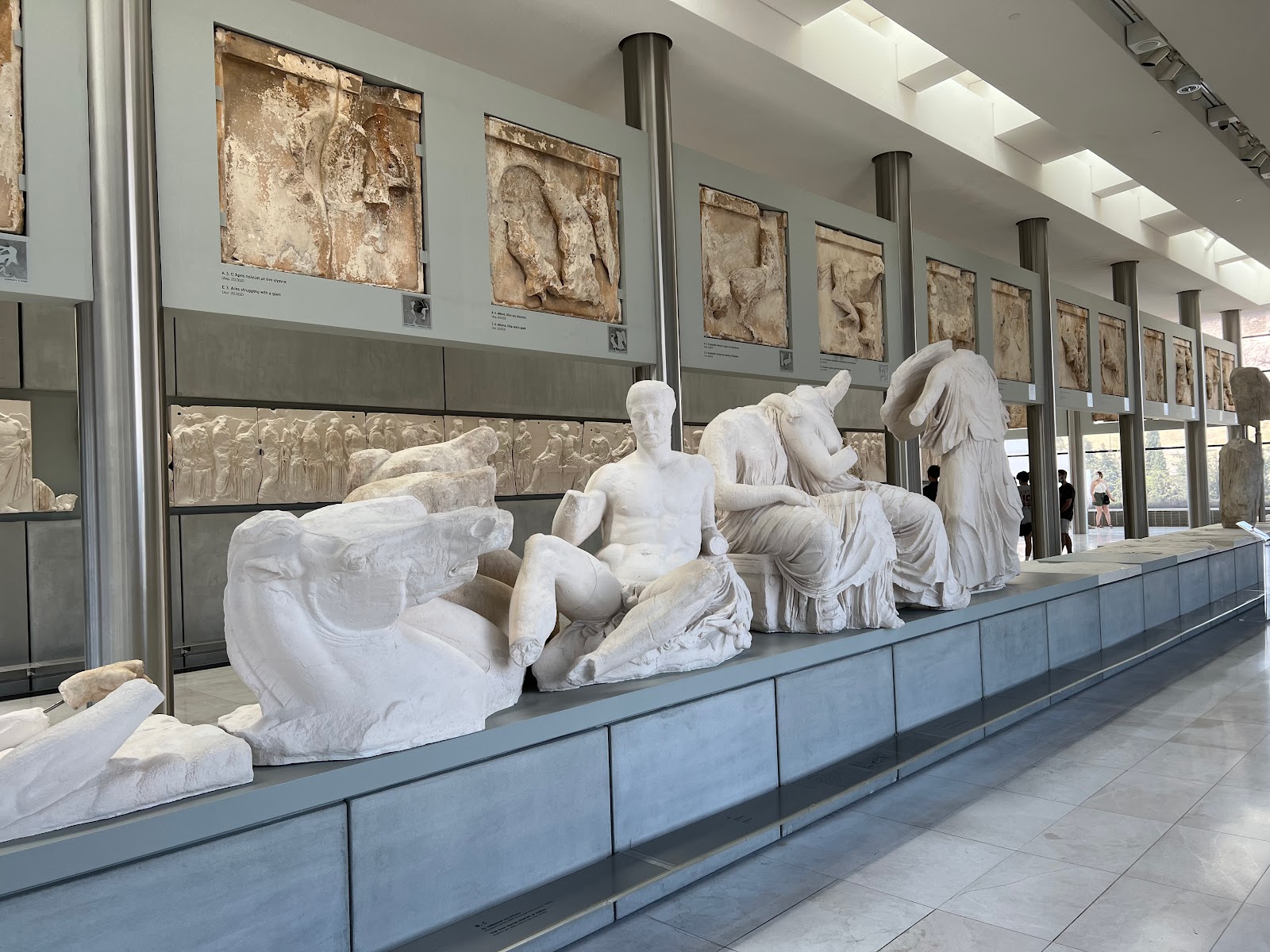
The museum contained many of the remaining statues from the Acropolis where Theodora was able to demonstrate which were original and which were reconstruction due to either being plundered (yawn) or destroyed. It was all very interesting.

View from the museum coffee shop

What is not understood is the size of the statues. They are truly enormous and in marble which means every block weighs some 12.5 tons. The practicality of how the blocks were transported was fantastic. Each block was dragged 17 kms and when the oxen could go no further up the hill, the carts carrying the blocks would be attached to a pulley system and a herd of mules would be encouraged to pull ropes that were at the other end of the pulleys. As they descended, the cart ascended. Thousands upon thousands of blocks.

So the simple art of pillaging was also very difficult. Lord Elgin was ambassador to the Ottomans based in Constantinople in 1799, this during the Napoleonic Wars. He canvassed the Caliph to enable him to survey some Greek sites with a view to removing any interesting objects. Silver smoothed the way and the Caliph, very keen to stay out of the way of the war as the Ottoman Empire had begun to weaken irredeemably, agreed. Elgin sent in a crew to see what they could find. 

What they found were the debris from previous multiple lootings and occupations from over the centuries. Athens had been sacked by the Herulians in 267 AD, by the Huns in 396 AD, the Goths in the 5th century, by the Slavs in the 7th century and so on. Long list. The Franks occupied the city in 1204 during the 4th Crusade and fortified it whilst the later occupying Byzantines built over original Greek structures. As well the locals had simply taken building materials just lying around for their own home construction. No metal. This had already gone. So not much in perfect condition. (Not many people either. Athens had become depopulated over time and it wasn't until 1834 when it was named capital of a newly independent Greece that people began to return to the city. Many government buildings for example date from after this date. Not antiquity at all).

What Elgin's crew did find were portions of sculptures and depictions of events carved into the marble blocks. However each weighed tons. Literally. So they cut the front of the blocks to save weight and shipped what they could back to England. In the museum today, on display are the original part blocks with plaster casts of the bits Elgin's crew took stuck on top. From my uneducated perspective it does look like bits and pieces of rubble. Sort of 'Oh look, Hercules' left shoulder' that sort of thing.

Several years later in 1816, Elgin canvassed the British Government who paid 35,000 GBP for the items which were then immediately displayed in the British Museum.

View from the Museum

These are the friezes taken down from the side of the Parthenon. Restoration is slow for a decision was taken by the EU (if you can imagine) that restoration should only happen when over 70% of the original materials of say a column are found. If these are lying around nearby then the columns can be put back together which is what happened. If not they are left to lie around, which explains the endless piles of rocks everywhere. Very timely, costly and difficult. Greece is a poor country so often has other priorities. 

Statues taken from the ends of the Parthenon, in those triangular parts I described before. If the sculptures are white, that means they are recreations. Often plaster casts taken from the originals in what ever museum they are currently displayed. Yes that means the Elgin Marbles but also the French, Germans and Turks hold plenty. As for the Venetians, well half the city is decorated with Greek stuff looted from their various occupations. If the sculptures look old and yellow, that is because they are the originals. The museum hopes to get back all the other yellow and old bits.

Theodora says that attempts are being made to recover these items which the British Museum is resisting. The French are not being pressed to return their pillaged items. Nor are the Turks who took over the items already removed by the Byzantines and Ottomans in centuries past. Just the British. Probably think the British are the softest touch. Could be right.

Fantastic day. So much history to absorb. Very painful on the brain cells.

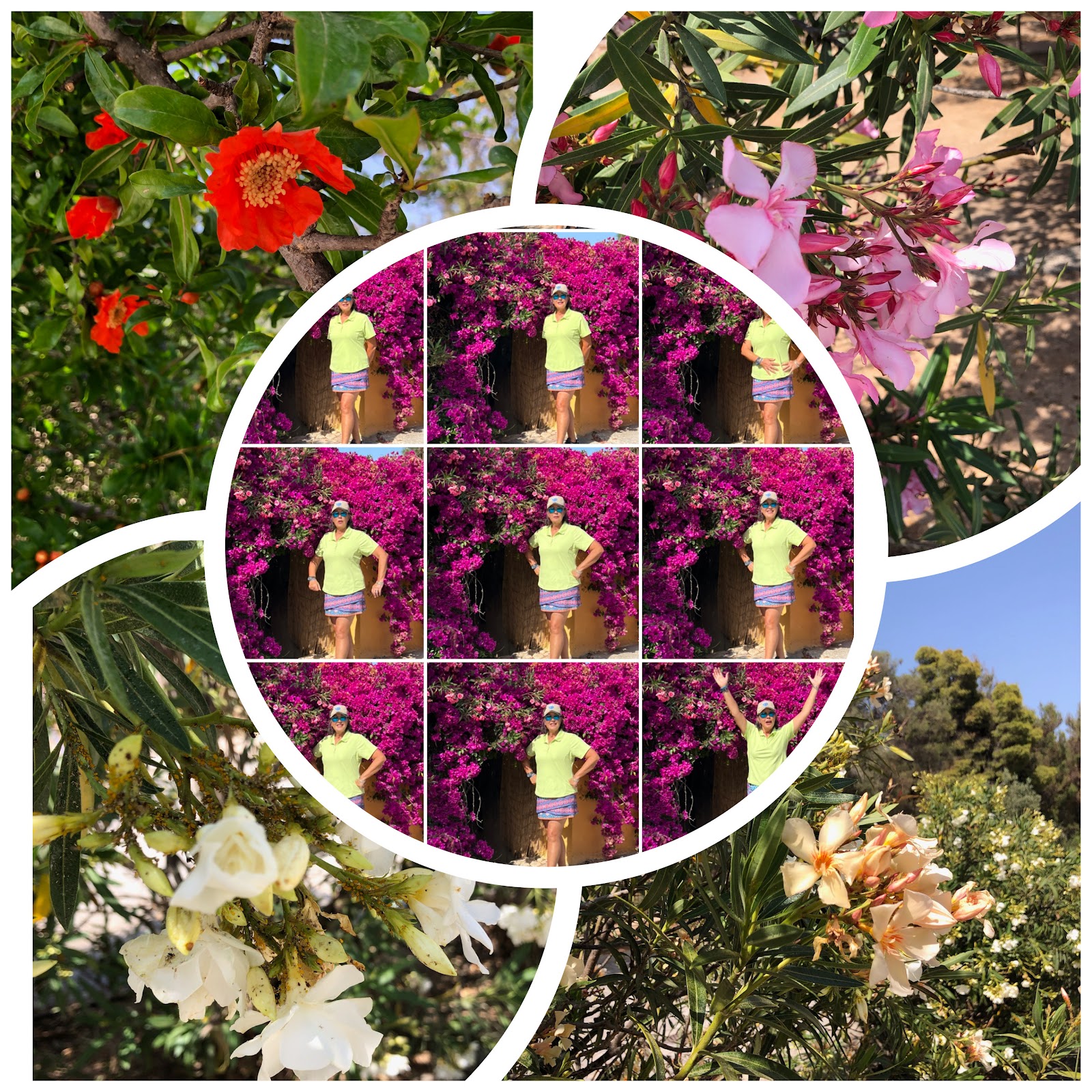
The flowers were gorgeous, particularly the Bougainvillaea. The colours were so intense and vibrant.

We's asked Yiannis and Anthony at the travel agent for recommendations for a good restaurant that locals would go to. Trying to avoid the tourist traps. Mistake actually as we discovered many of the tourist traps turned out mostly to be as good as the local spots. But anyway, Anthony suggested Dionysus as an option. We had a reservation at 9 pm.

Short walk near the Acropolis again and in a big car park this restaurant grew up the hill opposite to the Acropolis. It was rammed with people at a special event with many guards preventing the hoi pilloi getting in. It was a shipping company event obviously with some politicos or other big wigs. Armed guards at the front. Flunkies carried champagne on trays. Amazingly we were allowed entry, but turned away to the non event section. 

What a view of the Acropolis!! The menu was a typical fine dining menu from anywhere in the world but with a couple of local things. The 22 hour braised lamb was finished sadly. 


Fish soup and the other lamb option for me. Salad for Viv. Bottle of white wine, different grape for us. Chocolate soufflé to follow.

Very nice walk back along the ‘most beautiful street in Europe’ per Theodora. We decided we would not eat at such a place again. Bring on the tourist traps and grilled meat!


Monday, March 23, 2020

Visitors Volume 3 -- Charlie!!

The whirlwind continued with Indy, Cat and Charlie due to arrive for a couple of weeks. We'd talked a lot about the coronavirus and whether they should still come but as that point things hadn't deteriorated as much as later, the answer was yes!! Couldn't wait. Also they were flying in through Doha which to that moment had had no issues... another plus!!

It all seems such a long time ago now though for as I write this we are into Day 4 of the lockdown here in Penang due to that *&%$$#%#@ coronavirus. It is quite amazing how fast it has taken over the lives of I would think everyone on the planet.

I wonder what Charlie will think. Obviously he's too young to have a detailed memory of his trip here but he had a whole series of firsts whilst with us (as did Mum and Dad) including:

  • first time in a swimming pool
I think he enjoyed the swim
  • first time seeing orang utans ... he slept through most of it so maybe that memory won't be too strong
  • his first laughing session with a cuddly warthog; that character from the Lion King movie courtesy of Uncle Dee Dee


At this age, they seem to grow up bit by bit before your eyes. If there's something he didn't do yesterday, well he's doing it today and he's an expert already. 

But he would not roll over. 

He would but obviously he wasn't that fussed as he put either an arm or leg in just the right spot to stop him rolling over. I'd push him but after the first time that he immediately vomited onto the carpet, I stopped doing that. Don't get it. If he just rolled over, he would be able to push himself up on his arms and start to at least think about crawling. When he was having his 'tummy time' he'd almost immediately roll over and lay on his back like a dead bug. He would be waggling his arms and legs though and often laughing and chuckling to himself.


As for mum and dad, well obviously lovely to see them too. Viv and I were able to take Charlie for the evening actually on three occasions so they could have a date night out. I say Viv and I but it was mostly Viv, I was almost useless and had forgotten almost everything about being a new dad but Viv just picked it up from where she'd left off with Dee Dee back in 1989 and rolled on.


Food as can be imagined played an enormous part. We'd been winding Indy up in particular and had many (far too many) gastronomic events. The one he'd been looking forward to the most was the seafood dinner with congee as the last course that I'd told him about. It was again terrific. Our friends Lisa and Ted came along with us too as it needed to be a big affair so we could order enough things. I shouldn't have worried!


Like I said before, it all seems such a long time ago. The virus here has formally put us into lockdown nationwide until 31st March but today's paper suggested that may have to be extended to 60 days as people here keep gathering together contrary to health warnings about the virus' spread. We don't plan to be going out anywhere other than for food and other necessary things. Writing this I wonder if the next time I see Charlie, he'll be walking or not.

Doesn't matter, I'll treasure the time they were all here with us. 

Charlie's and my evening ritual


Wednesday, March 18, 2020

Visitors Volume 2

With Dick and Anna leaving, Hannah arrived. Hannah is Viv's god daughter and is on a post university tour around the world. As Hannah's plan was to spend 3 weeks in Hainan Island in China around this time, tacking on a week before would be easy. It didn't turn out that way later on but nobody had heard of coronavirus at that time.

We decided that amongst all the hanging out, eating and drinking we'd also head off for some outings and as Hannah's degree was to do with marine biology and environmental protection, we thought take her out for some animal-y things, starting with the butterfly farm called Entopia.

This was the first time we'd been there and it was really good. Lots of butterflies of course but also the big monitor lizards and other things were there too. Sort of an aquatic zoo as opposed to an aquarium.

Clever, they had laid out these hibiscus flowers and covered them with I think honey so the butterflies swarmed all over them for the benefit of we patrons to enjoy


Another day we drove out to Bukit Merah to check out the orang utans again. We'd done this before with Hannah's mum and it was really nice to go back particularly when we ran into one of the celebrity occupants who was riveted by the actions of a workman and tracked what he was doing. We'd had virtually no rain for months by this point so the lake in which the orang utan refuge island stood was at a very low level exposing lots of the foreshore. As there had been a fire at the centre a short while before, there was plenty of debris lying around and it was this that the workmen were clearing up.

I watched for ages and of course this is ridiculous but after a while I had the notion that I knew what the orang utan was about to do. I used the 'well of course their DNA is a 97% match to humans' hypothesis for my incredible scientific breakthrough, but its true. I just knew that when the workman got close enough, the orang utan would just scrabble away at the sand and throw a handful at him. And he did! Really hilarious to watch!!


Mind you, I didn't share this mind meld that I had just experienced with anyone else. I kept that to myself.

We also went back to Kee Lok See temple at night to check out the lights which were truly spectacular. This time we climbed the 7 storeys of the pagoda and were rewarded with fantastic views. The lights were terrific.


All along Hannah had been in touch with the school in Hainan where she was supposed to be teaching English for 3 weeks when all of a sudden she told us there may be a problem with her getting there as there was a disease that was spreading all over, a new type of virus.

We'd heard that there was something going on in Wuhan in China but not much else. However as we all know now, things moved fast from this point and the virus spread out exponentially to the point where the school said sorry, no children to teach so no need to come. I think we were all a bit peeved that that had happened for Hannah's sake not realising the enormity of things for after this cases started cropping up in other countries too. We suggested that Hannah should therefore head south to Australia instead as she had another internship organised in Sydney after the proposed Hainan trip which in the end did happen.

Our farewell dinner -- Korean BBQ
In fact all ended well for Hannah organised a nice road trip along the east coast of Australia to her new internship. Bon voyage and thanks for coming!

Visitors Volume 1


In early January, we'd just returned from spending Christmas in Canada with Dee Dee and the following day Viv's mum Anna moved in, swiftly followed by Viv's uncle Dick a day later. This is Dick's first visit and he hadn't seen Anna for several years. 

It was just before Chinese New Year started (which began in the last week of January and lasted 2 weeks this year). It is the Year of the Rat so everywhere was highly decorated with what looked to me less like rats but more like cuddly-ish mice so everywhere was very pretty and as it is the new year, pretty much everything was cleaned up too.


We did a lot of stuff! 

Georgetown's UNESCO World Heritage Centre was decked out nicely and after a nice walk and some lunch one day we went to the Sun Yet Sen Museum in Armenian Street.

Sun Yat Sen was the father of the Chinese Republic and amongst other places lived for a while in Penang. The object of that really was to raise funds for his next rebellion. He was involved in several unsuccessful ones as well so was a person of interest for the Chinese who after a little while objected to the British about his rabble rousing presence in Penang, whereupon they asked him to move on. In all, he was in Penang for less than one year.


Fascinating museum. Small but amongst it all, you get to learn a bit about Sun Yet Sen the man too, in particular his lady loves which were described in some detail rather surprisingly. Most know him as the revolutionary not the lover, husband and all the rest. However, he was very active and traveled everywhere trying to raise interest and of course funding. One exhibit was set aside just to this; how much he raised and in which country. Remember this is back at the turn of the 20th century so the amounts are of course smaller but the country which provided the most funds for his struggle was..... wait for it.... Canada! Who'd have thought?  

Very nice museum housed in a lovely shophouse in Armenian Street. Well worth a visit!

Viv's tennis friend, Lee Pin, asked us out for a day trip over to the mainland in Butterworth to visit a Chinese temple that was both huge and beautifully decked out for Chinese New Year. We'd never really been to Butterworth other than on that occasion when we'd taken a wrong turning and were headed towards the docks so were keen to check it out. Basically it's just one Main Street with a temple at the end. Big temple though.


Lee Pin had organised a dinner at a restaurant on the beach at Batu Ferringhi with a special dish she wanted us to try (Duck and Yam soup) after the temple but before that she wanted us to try the 'best ' local Rojak. Now when a Penangite says that such and such is the 'best' it of course means in their opinion which again is of course reason enough to try it out. Viv and I had eaten rojak before but not Anna and Dick so this would be all new to them.

The famous rojak kopi (coffee) shop
Rojak
The place was a coffee shop in the middle of Butterworth. Coffee shops like this are where the locals go for dessert and of course the local incredibly black coffee. Beans are roasted in a special way so that the beans are coal black as is the coffee. Not terribly strong but with a definite flavour to which is added condensed milk -- that's for the black coffee which apparently without the condensed milk is rather like engine sump oil. For the white coffee, you add evaporated milk to the mix. Did I mention sugar? Lots of that too. The experience leaves quite a film in and around your mouth for quite some time.

How to describe rojak? It is a popular dessert hereabouts. Take cut up chunks of fruit and raw vegetables and cover it with a sweet and sour but something else thick, sticky, gooey gloop and sprinkle with ground nuts. It is a curious taste to be sure, and not unpleasant. 'Interesting' was a word I heard quite a bit from Dick and Anna.

On the way back we stopped off at the snake temple near the airport for a brief visit. Snakes were everywhere although thankfully not crawling around too much. Just sort of lying there and writhing. I think they all came around one day and nobody cleared them out, so the snakes stayed.


I'd driven through Batu Ferringhi often enough. It's where the tourist resorts are located but as the beaches are pretty awful and the water very muddy brown with pollution and run off from farming on the mainland, we never had any intention of going to the beach. Not after Bermuda anyway! However the restaurant we went to was right on the beach and it turned out to be actually.... really rather lovely: the beach not the water. As was the duck/yam soup and the meal overall. Thanks Lee Pin!

Sunset on the beach at Batu Ferringhi
We also decided to take Dick to the Blue Mansion in Georgetown. He is keen on history and heritage, or at least he said he was so we made sure to load him up on it.

The Blue Mansion
The Blue Mansion is simply extraordinary. The original house was built and lived in by a Chinese guy called Cheong Fatt Tze. A true rags to riches story, he started out as a coolie labourer in Indonesia in the 1870's where he made his first great move: he married the boss' daughter and took over his trading business. 

He was really good at it and moved to Penang because the British were there and more trade was possible. He was into everything, built this mansion and became the wealthiest man in China towards the end of the 19th century. The Emperor even appointed him as special counsellor making him the 3rd most powerful person in China even though he didn't live there. We went on a tour of the mansion which has been massively renovated after it became derelict during WWII when the Japanese arrived. They persecuted important local Chinese people and Cheong's heirs (he was dead by this time) received no favours from them and had to rent out the mansion to several hundred squatters simply to survive. The result was dereliction and the mansion was abandoned for years until private money acquired it and turned it into this lovely museum.

It has been a movie set many times including movies based on the life of Sun Yat Sen but more recently of Anna and the King of Siam. Because the Thai government felt that the movie disrespected the royal family, they refused permission to film in Bangkok so the movie used the Blue Mansion and more generally Penang as the site location for the movie.

Another outing, although not so long but still pretty onerous was visiting the Kee Lok See temple at Penang Hill. It is the largest such temple in SE Asia. For Chinese New Year, they always garland the temple and grounds in flowers, lights and all the other ornate stuff that goes with Chinese New Year so at this time of the year it is definitely worth a visit. Lots of stairs but very worth it.

The seven storey pagoda is a key point in the temple
I think Dick was exhausted by the time he left!!