Showing posts with label Monty Python. Show all posts

Sunday, July 17, 2022

Athens Day 3 -- Battlefields

This is the first battlefield day and the first step on our Greek road trip. Yannis picked us up to drive the 26 miles 285 yards to the Marathon battlefield which apparently is just a field and very little else. Nobody goes there these days and Yannis told us we were only the third group he’d ever had in 10 years!
It was just a field with a large burial mound in the middle. A tumulus it is called here. It holds the bodies of 192 dead Greeks whilst the Persians who were seriously routed lost 6,500 or so.
What brought the attack was simply the Persians who had a simply enormous Asian empire, were concerned about their noisy neighbours in Europe who they kept running into around the eastern Mediterranean. Diplomacy failed, so to war. The Persians sent 25,000 men by sea to the gradual sloping beaches at Marathon at the behest of a banished former Greek tyrant (there were many of those as the Greeks have a history of quarrelling over everything, still today) who promised to be a good neighbour next time if the Persians put him back in charge. The Bay of Marathon these days has been heavily silted up so is pretty much unrecognisable from what it was like 2500 years ago. Same for many of the coastal areas. The battlefield today is some 5 kms inland as a result. The Persians landed with a lot of cavalry to meet 10,000 Greeks, mostly Athenians, who stayed resolutely in the surrounding mountains. After 3 days the cavalry took off for the ships and more food so the Greeks launched a sudden attack on the remainder of the invading army. Taken by surprise the Persians formed up and the two armies met. The Greeks under Militiades were weakest in the centre but strong on both wings. The Persians pushed forward in the centre as the Greeks gave way, soon the Persians were surrounded and the killing began. The lack of cavalry lost the day for the Persians. History has it that one soldier ran back to Athens with the news….. apparently not. This man’s name was Pheidippides and in actuality a few days earlier he had run some 200 kms to Sparta to ask for help. Bad timing as it was a big religious festival (another one!) and the Spartans said we’ll come along after it’s over. He ran back to Athens and thence to the army at Marathon. After the battle, the Persians reboarded their ships and set sail for Athens proper. They still had a superior number to the Greeks so a direct assault on Athens was still viable. The victorious Greek army to a man ran the 26 miles and 285 yards back to Athens so as to be able to form up on the shoreline showing the Persians they were ready for them again. The Persians went home. Pheidippides ran back to Sparta again to say don’t bother, we won and it was there that he really dropped dead. The real road race therefore would have to be a mere 200 kms or so. The classic 26+ mile Marathon route is marked out still and it was that route taken in both the 1896 and 2004 Olympic Games. I’ll bet no Turks took part. We followed up with a tour of a nearby archaeological museum and went into a tumulus for the Plateans who had been killed in the battle at Marathon, another 12 of them.
After this we set out for Cape Sounion to the south of Athens with Yannis talking away about history and mythology. On the way from Marathon to Cape Sounion, we stopped at one of Yannis’ favourite rest stops near the airport for some Freddo cappuccinos (again)!! Very nice. He added to what Theodora said about the Athenians using the Parthenon rebuild to project Athenian power amongst the independent city states. Apparently it was the later war with the Persians, the one that was lost and when Athens was subsequently sacked, looted and destroyed. The Athenians demanded recompense from the other cities. If the city had sent troops, like Platea, that was OK. If they did not, like many others, they sent money instead. It was a lot of money and even with the early reversals, they found themselves at the end with a huge dollop of cash. So being democratic, the leaders asked the people if they’d like to spend the cash on a big glowing memorial to Athenian bravery, skill and honour. Not necessarily Greek, but Athenian. The people said yes and so the money was used to rebuild the Parthenon and a bunch of other destroyed buildings. So there you have it. On the road, Cape Sounion was at the very end of the promontory which led out from Athens. Today it is the beach area. Very affluent. Further along and out is the Cape where there is little other than a lovely bay with two beach hotels and the cliffs upon which stood the Temple to Poseidon. You may remember from yesterday that Poseidon and Athena competed for supremacy in Athens. Poseidon provided a miraculous spring of sea water, Athena provided the first ever olive tree. Athena won so the Athenians cautious about offending a major God like Poseidon decided to dedicate a temple to him on this spot. It is a spectacular spot.
Yiannis told the story of Theseus and the Minotaur. Part bull, part man this beast lived in caves in Crete and ate everyone that tried to kill it. Theseus son of the King of Athens, named Aegis, offered himself to try the next time. He told his dad that if he succeeded in killing the Minotaur he would return with white sails on his ship. Theseus went to Crete and first thing he did was meet the beautiful daughter of the King, Ariadne, who helped him first find the caves and then with a ball of twine helped him find the way out of the maze in which the Minotaur lived. Killing the Minotaur was pretty straightforward but getting out was tricky but the ball of twine helped. Theseus returned to Athens. All good so far but in all the excitement he’d forgotten quite what he’d promised his father about the colour of his sails. He used black ones. Standing on the peninsula of the Temple of Poseidon at Cape Sounion, the entrance into Athens, all Aegis saw was black sails which meant his one and only son was dead. Aegis threw himself off the rocks in his grief. In response the Athenians called the body of water the Aegean Sea in his memory. Why would you ever have children? This was where Cape Sounion was and the temple is located. Utterly spectacular!
It was nearing 4 pm and Yiannis said there was a nice seafood restaurant nearby that would be great for a late lunch. It was! What a great spot too, right on the bay opposite the Temple of Poseidon. And if you think either of us was ready, willing and able to think about dinner after, think again.
When we returned to Athens no more than an hour or so later, we decided a meat feast was called for. First though we felt the need for a brief wander around the gardens nearby where stood the Temple of Zeus and the Arch of Hadrian. The Temple had been destroyed by the Persians centuries before and was a gift by the Emperor Hadrian to the people of Athens when he visited the city. In return the Athenians built a ceremonial arch to the emperor as thanks for the gift.
Nearby was the Parliament building where Yiannis had told us that on the hour there was a change of the guards that we really shouldn't miss. We queued up with maybe a couple of hundred other tourists and waited. First of all the guards dress in what is loosely termed 'traditional' fashion. I never 'knew' much about fashion as a youngster but one thing I did 'know' was that Greek men wore skirts. Quite how and why this was a 'known' fact when I was growing up is unclear to me but that was one of the things that I as a young person 'knew'. I imagine this was it. It is a thick tunic with what look like really thick stockings and those shoes with the bobble on top!
Of course there must be some basis for it in practicality measure. Greece can be very cold indeed so thick clothes would be a boon. As for those shoes though, we came across some in a museum a day or so later and they are very simply hob nailed boots with that bobble on top. Presumably they took the bobble off to fight. And of course OK, OK in England we have the guards at Buckingham Palace wearing those busbies. The changing of the guard ceremony itself took about 10 minutes and looks exhausting. Lots of stamping around and leg and arm swinging. The leg movements look like something out of Monty Python's Ministry of Silly Walks. After it was all over and the guards had been changed, one of the senior officers presumably came around with a towel to dry off the sweat on their faces. It was really hot so those guys must have been suffering. After last night's faux pas with our dining choice, we'd asked Anthony at the travel agents for a recommendation where local people go. It was out in some suburb or other so we took a taxi there. It was a kebab shop called Kir Aristos. Talk about grumpy and useless! The waiters did virtually nothing so we waited and waited. But when the food came it was fantastic but enormous! We chose a mixed grill to share with another salad. Really stuffed.
We would go back to that place again. Grumpy or not!! This is the route we took today.

Sunday, April 12, 2020

Binge Watching

Another thing that being in lockdown provides is the time to binge watch TV shows and box sets. Typically we don't like to watch programmes when they are ongoing as once started we just want to go through the whole thing. We recently did this with Game of Thrones (GOT).


What we have noticed with other long running series is that the best ideas typically come in the first season when the budget is smallest and it is when the networks pick them up for more seasons that the storyline feels like its getting weaker whilst the budget is bigger enabling the writer to come up with more and more fantastic set pieces. GOT falls into this characterisation I think.

More and more as we watch through the seasons, I like to go onto Wikipedia and find out not so much about where the story is going, but more to who the cast are and who the writer is and where it all takes place. For GOT the scenery is simply fantastic and even though it says Northern Ireland, I simply don't believe all those scenes were filmed there. OK I do know that it was filmed in other places too.... but I have been to most of those places and for the life of me cannot remember seeing any of them. Anyway that's a side thing but during this Wikipedia trawl I took a look at the writer (one George R.R. Martin) and discovered he's a sci fi and fantasy writer.

One of my favourite all time books is Lord of the Rings by J.R.R Tolkien (same middle initials? coincidence??) and obviously it is a book of its time. Written in the 1940's at the time when Britain was on the verge of losing WWII to Nazi Germany and using Tolkien's harrowing experiences in the trenches of WWI as backdrop. Clearly his writing, whilst superbly eloquent and articulate is coloured by his experiences and the time in which it was written.

Scroll forward to Mr. Martin who is 71 (according to Wikipedia).  That's only a few years older than me so his life influences are pretty much the same as mine, except of course he is American and I am not. That means the Beatles, rock and roll, the A/H bomb, Vietnam, swinging 60's, drugs, feminism amongst other things. Now I haven't read the books which is something I will correct as simply by watching the HBO series, I am amazed how much swearing, basically soft porn and really violent and gory action takes place. The stories have loose similarities but the context is totally different. I am amazed each episode has any story in it at all given the need for multiple sex scenes, ritual dismemberment and generally people standing around swearing their heads off. So I do wonder if that is how the books are written. I'll find out.

I did enjoy the earlier series more than the later ones. In the early ones, the dialogue just cracked along. Every one of the 'hero' men were as a friend of mine describes as being 'strong as horse, dumb as tree' and made clearly massively wrong decisions every step of the way. I am amazed that any survived through 8 series at all. All the women, no actually only most of the women, were far smarter and could easily out think their male counterparts. By the final series I was pretty worn out listening to all of Daenerys Targaryen's ridiculous titles particularly when things came to important moments when she or someone else had to shout out 'you are in the presence of...' and 5 minutes later came to the end. I suppose it did pad out the shows to their full time allotment. And those eyebrows.... don't get me going on that!

The baddies got all the good lines. I did like that however as the series went on and on, the dialogue became more serious and even the baddies' lines ran out of steam and sting. At the start, the most fun characters were Jaime Lannister and his diminutive brother Tyrion but as things wore on, they became far more serious and consequently less entertaining. In reading the Wikipedia entries, I couldn't make out whether Mr. Martin had actually written any of the later series (I know he didn't write the last one) or if it was just the HBO screenwriters talking to him to 'agree where the story line was going'. As an avid reader of Robert Heinlein in the sci fi genre, what made his stories so great was not necessarily the sci fi aspect rather it was the energy that he brought to the writing even when the books went on to very great length. He never let up which is rather in the end what I think happened with GOT.  Anyway, like I said earlier I'll read the first book now.

I'd like to think that left to himself Mr. Martin may have come up with something like this in the later series.


The F Word

Having time on my hands means that I can read much more and as my personal favourite topic were I to be asked onto Mastermind is 'Mindless Trivia', I of course followed an internet string that began with the words 'First Use of the F-word in Recorded Literature'.

Whilst the history is fascinating enough it is what it all portends that made me laugh like I hadn't for many years. And given our present situation in lockdown, what we all need is a darn good belly laugh.  Here's the headline:

"WAN FUKKIT FUNLING" —

500-year-old manuscript contains one of earliest known uses of the “F-word”

The Bannatyne Manuscript is an anthology of some 400 medieval Scottish poems.

Whilst the spelling is not contemporary, the feeling is perfectly encapsulated in those three words which mean.... well, er, this is where it gets tricky for these words came about during a bout of 'Flyting' between two gentlemen by the name of William Dunbar and Walter Kennedy.

Flyting is a poetic genre in Scotland—essentially a poetry slam or rap battle, in which participants exchange creative insults with as much verbal pyrotechnics (doubling and tripling of rhymes, lots of alliteration) as they can muster. (It's a safe bet Shakespeare excelled at this art form.)

Dunbar and Kennedy supposedly faced off for a flyting in the court of James IV of Scotland around 1500, and their exchange was set down for posterity in Bannatyne's manuscript. In the poem, Dunbar makes fun of Kennedy's Highland dialect, for instance, as well as his personal appearance, and he suggests his opponent enjoys sexual intercourse with horses. Kennedy retaliates with attacks on Dunbar's diminutive stature and lack of bowel control, suggesting his rival gets his inspiration from drinking "frogspawn" from the waters of a rural pond. You get the idea.

And then comes the historic moment: an insult containing the phrase "wan fukkit funling," marking the earliest known surviving record of the F-word.

It all sounds wonderful! I wish I had been there but as the manuscript itself was put together when this Mr. Bannatyne was locked down with the plague (rather like as now except that the plague killed somewhere between 30% and 80% of populations that became infected), perhaps not. In any event this brings to mind immediately Monty Python's Oscar Wilde sketch which although really funny also was based (although very loosely) on real events that regularly took place.


Now this is flyting!

Monday, April 6, 2020

Rockers Class of 2019... RIP

Each year I write a short post remembering those rockers who made a musical difference to me that passed away the year before. I am very late this year, I know, but here goes for 2019.

Neil Innes

Neil wasn't a real rocker but has a significant place in my memory because he wrote so many great songs for the Bonzo Dog Doo-Dah Band (who can forget Urban Spaceman?), Rutland Weekend Television and of course Monty Python. If you remember the 'Holy Grail' movie, Neil sang the 'Brave Sir Robin' song amongst others. A wonderful story surrounding his time in the Rutles (with Eric Idle of MPFC fame) was when struggling for a musical interlude in a show, they asked George Harrison from the Beatles to come on. He agreed but refused to play his then Number 1 song 'My Sweet Lord' on the show, which ended up in total disarray. Wonderful stuff.


Iain Sutherland

Back in 1971, I went to a day concert at The Oval in South London to see a host of different bands but mainly to see Frank Zappa who had his orchestra with him for that tour. The opening act was a band called Quiver and they were terrific. A year or so later they joined forces with a Scottish duo, the Sutherland Brothers, and I went to see them in Southend at the Queens Hotel, a dark and dingy basement club that always had great music. You never knew if they were open, or who was playing, but you knew if they did it would be on a Sunday night and this night they were open and the Sutherland Brothers and Quiver played. They were tremendous. Their big song wasn't even a big song for them but for Rod Stewart (Sailing), a song I never really liked, but they had tons of other great songs. Great band, great songs.


Ginger Baker

I first heard this maniac drumming I think in 1966 and wondered what the hell was all that noise about. He just kept on going and going and going in all directions at once. Powerful, yup. Melodic, yup. Played with the best group of ALL time, yup. That was Cream, by the way, but he also played in Blind Faith. I saw him first in Southend with a band called the Baker-Gurvitz Army. Lots of silly stories about his previous band Air Force but this one played all the old Cream songs. The band were actually pretty terrible but seeing Ginger was a pleasure all by itself. What a player.


Robert Hunter

It was my brother Jan that got me first to listen to the Grateful Dead. The LP was Live Dead, in retrospect a magnificent record and great intro to the Dead. I wish I realised at the time that even though the songs were 24 minutes long and seemed connected one with the next all through the record, that that was a pretty good thing. Many years later I managed to listen to the show all the way through without having to turn the record over every 20 minutes or so and it was fantastic. Robert wrote the lyrics to most of the tunes the band wrote, mostly with Jerry Garcia but also with the others if they needed it. So Trucking' with Bob Weir and Jerry, Box of Rain with Phil Lesh. Many others too. Great lyrics. So much more than girl meets boy, falls in love, etc. Made the songs sound interesting and also in many cases downright weird. Just what do the lyrics from Dark Star mean --- 'transitive nightfall of diamonds' -- or Box of Rain, or...


Gary Duncan

Before the Monterey Pop Festival brought Jimi Hendrix and The Who to America, US rock bands had a different edge to them. Listen to the older Big Brother and Quicksilver albums and you'll immediately know what I mean. They played and sort of played in a classical manner. Then came Jimi and The 'Oo and everything changed. Among my first introduction to San Francisco music prompted by the Dead and Jefferson Airplane, I found 'Happy Trails', a live album by Quicksilver Messenger Service. What a record. What a band. What great guitarists. Yes John Cipollina of course but also yes Gary Duncan. Great player.


Peter Tork

It was only the really young teeny-boppers that liked the Monkees but OK yes some of us others also liked them but didn't really admit to it. I liked the songs. I thought they were really good, catchy tunes, really nice harmonies, all the rest of it. I didn't care if the actors really didn't do the playing. I still don't know what instrument Peter Tork played. Some episodes had him on keyboards, others some sort of guitar, others still nothing just that goofy grin. Peter Tork was definitely my favourite Monkee.


Others

As the years pass and I acknowledge how old I am, I then have to add on a few years and pretty soon it gets to three score and ten, 70. Lots of the old rockers who are left are comfortably past this landmark. Mention goes out to Larry Wallis of the Pink Fairies (just listen to The Pigs of Uranus, that's him), Larry Taylor of Canned Heat, Ian Gibbons of the original Kinks, Dr. John and Dick Dale, the original surfing guitar guy. Also Peter Fonda of Easy Rider fame which movie brought the world Steppenwolf and many other great classic rock bands of the 70's. RIP all.

Anyway I'll leave the last word to Neil Innes and George Harrison from Rutland Weekend TV.


Friday, September 13, 2019

Lost in Translation...maybe

Spending time in Penang has been a wonder and a great enjoyment, although at times it has been a little puzzling. The local "can" is a trip for example but it's not just here that has them. I did wonder how many people speak English or a variant globally and from my pretty basic Google search, it looks to be around 1.5 billion or 20% of the world's population (see here and here). Of these probably a quarter are native speakers, the remainder speak English either as a second language or an official language of the country (where for example many dialects exist so English becomes the lingua franca). Obviously many of these latter countries are ex-colonies but it certainly has spread the language far and wide.

As I mentioned before, there are local varietals. Take 'can' for example, this is what Merriam Webster's dictionary says:

'intransitive verb. archaic : to have knowledge or skill. auxiliary verb. 1a : know how to She canread. b : be physically or mentally able to He can lift 200 pounds.'


Manglish on the other hand is a little different but essentially similar so whilst you think you get what the other person is saying, somehow it doesn't quite go all the way. There's a neat book called 'Honk If You're Malaysian' that tries to explain. 


It cannot because the English spoken here is a dynamic evolving language not the one written in the OED for example. Here is an example of the use of 'can':

'English: Would you be so good as to turn on the tap, please? Of course!
Manglish: Can on the tap-ah? Can!' 

Hope this helps.

History is a bit difficult to follow too. Winston Churchill once said 'history is written by the victors', as did the first Indian leader Nehru but these quotes simply followed Bonaparte's dismissive put down: 'what is history but a set of lies agreed upon'. So those history books that you read at school were pretty likely wrong or at the very best put forward only the history of one side, ignoring and maybe even demonising the other. Having visited Rome many times and taking in the majesty of Trajan's Column at the end of the Forum, you do wonder if you know some of the story behind it, just why Trajan chose to destroy and entirely eradicate the Dacians (modern day Romania) with the only reference to it remaining being the hieroglyphics on the side of the column. 


Nobody knows all the details. Perhaps the written histories have been lost over time. This is quite likely as only fragments of Rome's long and fabulous history have survived. Sacking by the Goths, Visgoths, Vandals, Huns and probably any other barbarian tribe that happened to be passing in the late 5th and 6th centuries didn't help; but also a specific and deliberate erasure of bits of history that the next major incumbents (the Catholic Church) found distasteful or which presented the Romans in a better way than the new church wanted. OK to talk about feeding christians to the lions in the arena (Romans are bad guys) but probably not so much about all the learning and medical advances that the 'evil' empire promoted (Romans were innovative and enlightened). That may encourage people to learn more about the Romans and appreciate what they brought to the world... and maybe think twice. That wouldn't support the contemporary initiatives at all. 

This isn't unusual in a post colonial world or in a world where major change has occurred. The new incumbents recreate a recidivist form of history that makes them look better. The Soviets for example had to acknowledge the Tsars of the past but their take on things were that these Tsars were an unelected elite that just kept fighting wars against other countries' unelected elites in order to maintain control over an empire of starving serfs. Of course the irony of this point of view was totally lost on the Soviets themselves; as they were in fact doing the precise same thing.


This is all a roundabout way of talking about Singapore's 'creation'. Colonial history has it that Stamford Raffles founded the colony in 1819 taking a malarial swamp and turning it into THE entrepôt of the Far East. Subsequent history is broadly aligned as probably there is so much of it written down, however pre-history is substantially lacking as virtually nothing is written down and I can imagine those first colonial settlers thinking there's nothing here, let's do something. But there was pre-colonial history and here is Wikipedia's brief take on things. What is not stated is how many people were about at the time. Now there's 7 million but back then were far fewer.

Singapore's geography of course has always meant that it has acted as a significant entrepôt for the region. The Romans had heard of it but the Chinese, Indians and Middle Easterners were very familiar with it. Pre-steam engines, traders could only trade abroad courtesy of the seasonal prevailing winds. This meant an annual trip with a 6 month wait for the winds to turn the other way and therefore something approaching permanent settlement by non-native traders. None of this was apparent to the British when they arrived however. All they saw was swamp. Hasn't that changed? You should see Sentosa Island these days; more Las Vegas than anything else.

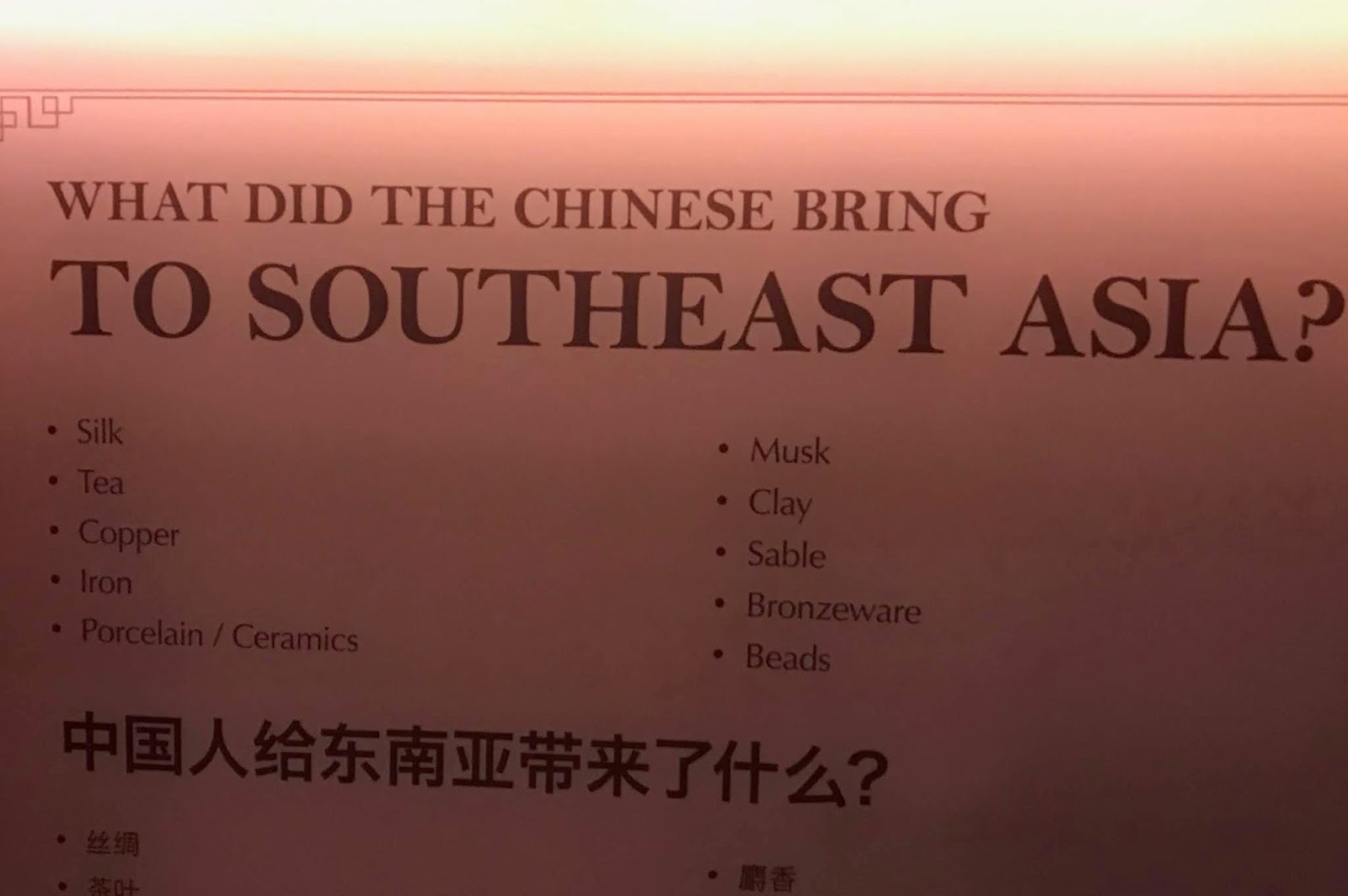
Whilst we were visiting we went to a museum, the name of which eludes me and which dealt in sections with the early history and pre-colonial history. One section dealt with the traders that came from overseas and what they brought to the island. The Middle Easterners brought tons of stuff. Africa brought ivory and gold; the Middle East brought frankincense, pearls, turtle shells, corals, perfumes and oils; South India and Sri Lanka brought cotton, textiles, gemstones, ivory, ebony and pepper.


The Chinese brought tons of stuff too: silk, tea, cotton, iron, porcelain/ceramics, musk, clay, sable, bronze ware and beads.


As for the Europeans, well...


Made me think of Monty Python again.


Monday, September 5, 2016

WTBs

When I first arrived in Bermuda back in 1985 I played cricket with a Greek accountant from London who first coined this term.  It has stayed with me ever since and despite periods when it receded into the depths of my memory, a recent event brought it forward again.

However it also made me think about things and in particular how it can be in a group of people who’ve known each other for years and talk about events that took place 30, 40 or 50 years ago with fondness and wistfulness.  But that’s me too for when I’m in such a group (which happens fairly often these days) I enjoy it thoroughly and really don’t give any thought to others.  I suppose growing old means there’s more memories to look back on with pleasure and even those which really weren’t that great at the time seem pretty cool today by contrast.

And that brought me onto my next thought process – why is it people reinvent a story about themselves that sounds like something you might read at the start of a Star Wars movie, say, when it starts with “Long, long ago in a galaxy far, far away…”  People do that for themselves and their families and again it was remarkable that I should have noticed it so abundantly for it is something I don’t think I do... but am now wondering if I should.

Bermuda is a really small place of 60,000 people so it’s impossible to not run into people all the time.  Of course you have your own circles but from time to time you bump into other people’s orbits too and last night was one of those occasions.  You either know slightly or know of a lot of people, or you may have used to know them in one shape or another, from work dealings, for example, so you go into the dance.

“What are you doing with yourself these days?”

“How are your children doing?”

That sort of thing.  The questions themselves are fairly non-controversial and are likely to keep you going through a conversation or two in an evening even if they do not form the basis for ongoing lasting friendship.  But the answers though seem to have changed over the years.  Take this one from another fairly safe line of conversation starting with “how long have you been in Bermuda?”

“Well I arrived here in 19XX but my parents had been here before me and suggested I come out here to visit.  I found work here and then met (spouse’s name) and stayed on ever since.  We moved around a lot, here and there, you know, all tied up with work and things but Bermuda was in our blood and we just had to come home.” It turned out to be a 10 minute monologue!

People just have to justify a long term connection to Bermuda even if there is none, like here.  Real story is that the person came to Bermuda years ago as an expat probably on a 2 year contract like everyone else (well, certainly me anyway) and met someone that just happened to be Bermudian and stayed.  The end.

I think though that what really prompted this line of thought was the next thing this person said which was “Are you a Bermudian?”

No, was/is the answer but why is that important?  But to Bermudians, it is.  Vitally important.  Even to paper Bermudians (i.e. those that acquired citizenship by means other than being born in Bermuda to Bermudian parents) and quite possibly more so for them as there is always the dangling question “So how did you get that then…?” rather like the Monty Python segment in The Holy Grail movie.


Maybe it’s me getting older but the longer I remain in Bermuda, lovely as it is, the more I think about a book written by an English sci-fi writer called Michael Moorcock who wrote about a group of people with super powers – this was before the recent craze of super powered people, these were all immortals described in full by Wikipedia:


“The setting of which is the End of Time, an era "where entropy is king and the universe has begun collapsing upon itself". The inhabitants of this era are immortal decadents, who create flights of fancy using power rings that draw on energy devised and stored by their ancestors millions of years prior. Time travel is possible, and throughout the series various points in time are visited and revisited. Space travelers are also common, but most residents of the End of Time find leaving the planet distasteful and clichéd.”

They were in an eternal party at the end of time which they managed to somehow perpetuate by creating a time loop so the last week of forever kept resetting and going back to the beginning of the week so it (and time … and of course them) would never end.

Eerie.


Sunday, July 24, 2016

Mozzarella, Vino and the best view in the world!

Like a previous trip I have been extremely remiss in not staying current on these posts.  However I did use that wonder App called Track My Tour (please tell Chris that I sent you if you check it out) which did a much better job.  Here is the link to this part of the trip -- Click here.

**

One great thing about Daniele is his enthusiasm for life.  Everything is in absolutes.  The best mozzarella, the best wine in the region and the best view in the world.  All today!  Who couldn't be excited by all this?

Meet Daniele! On the left.
First stop along the coast road was half way up between Positano and Ravello on one of the many hairpin turns.  Of course being Italy there were cars everywhere, even here, but I suppose it was still just about walking distance from the jammed streets and lanes of Positano.  Easier to walk in and out than struggle with the traffic.

Not a bad view!
The scenic overlook was spectacular though.

Ravello as far as I can make out is the 3rd biggest attraction in this region after Positano and the coast road itself.  It is a very pretty little village but it is not at the top of the hills here like all the other high villages which were created as refuges from marauding pirates.  It is sort of about half way up and on either side of a ravine through which a river passes.  Swanky hotels are here a-plenty.  This is definitely the place where the rich and famous come.

The other side of the ravine with Ravello in the centre
Our purpose here though was rather more prosaic -- we'd asked for a day of local gastronomy and of course the local vino and this was it.

First stop was a childhood friend of Daniele who just happened to be the local cheesemaker but not just any cheese but the local mozzarella -- not buffalo milk, just cow this time.  His name is Biagio and he owns the local cheese factory... which just happened to be next to a bar owned by Eugenio, an Anglo-Italian who sounds more English than I do but whose family comes from Ravello.  And if there's one thing the Italians do well (other than pasta, cheese, wine...) is family.  The call home even if he'd never lived there was too strong.  Factor in a young lady also from Ravello and really there's not much chance Croydon has it over this little jewel of the Amalfi Coast.

Together they thought of starting up a hands on thing for tourists on a lovely shady spot opposite their respective business fronts also overlooking the spectacular ravine.

Viv and I were experts on Mozzarella now but have never actually handled the stuff which is what Biagio made us do.  The cutting, kneading and stretching are all pretty simple.  The stumbling block comes with tearing the perfect little balls you've made off the larger chunk of the stuff.  Mozzarella when stretched and kneaded has the consistency of rubber so to rip off the lovingly moulded little ball without mangling it beyond recognition did not come as second nature to us.  Biagio of course soothed our grumblings and said they were really very good, symmetrical and perfect to serve in any 5 star restaurant.

Biagio at work. Nest step is to tear the little ball off the dangly bits without making it look odd
Just to prove a point he went away leaving us to sip wine with Daniele and eat some little deep fried appetizers from Eugenio's bar, returning with a huge tray of artistically arranged mozzarella based treats.


He served our creations alongside his and looking at them arranged on a tray it did make us think how much they looked like a sperm.  Or rather the pictures of them you see in a biology book from school. Sort of like an early stage tadpole but that white colour.  I think I better stop here before this segment becomes too mixed up with the wrong kind of thing.  Really it was all about the mozzarella, not the... OK, you see what I mean.  Move on.

See what I mean?

The final word on the mozzarella interlude will come from Monty Python. Good luck Biagio and Eugenio.


The trouble with sipping a little wine with deep fried yummies and some odd shaped mozzarella meant that our immediate next stop at Tramonte in the mountains at yet another friend of Daniele's vineyard for lunch promised to be an all out assault on our stomachs and our very ability to keep going.  As it turned out we gritted our teeth and managed a good showing courtesy of a reasonable delay while they got things ready after we arrived.

The vineyard
This part of the region is actually over the hills and on the other side so has no sea view at all.  Just more pretty hills and valleys.  The region has been farmed since the pre-Roman era and is very fertile.

Our favourite was the rose
Daniele filled the gap by manfully uncorking wines seemingly by the gallon.  They were very good indeed particularly the rose which was a simply lovely colour, the same as the local roses as Viv pointed out.


Daniele is really something.  His background like so many Italians seemingly is the hospitality industry.  He has worked in hotels and restaurants and has a background as sommelier meaning he could talk with enthusiam and knowledge about the wines we were drinking.  The local varietals of course include some of the common grapes but many date back to Roman times which are very unusual.

Lunch was home made pasta with fava beans and veal with local broccoli and just the 4 wines: 1 white, 1 rose and 2 reds.  We of course agreed to buy a mixed case of wines to be shipped home which will probably make them the single most expensive wines ever once landed.  Ah well.  It was a great lunch and terrific time.  We just hoped the next segment would not include food or drink.

We made it to Ravello around 5 pm which was when things were gradually winding down and Daniele dropped us off in the central piazza which like many things here is on the side of a ravine and which is home to a whole bunch of tourist shoppes (of course), bars and restaurants and just down a little, actually not so little, lane to the Villa Cremoni which these days is a very swanky hotel.  However they do allow people to stroll around the gardens and take in the view which just may be the best view on the Amalfi Coast.

Ravello from the central piazza. Ravines everywhere!
That bit is right at the very end of the gardens on a long terrace with Romanesque busts of probably emperors or gods at every turn.


As for the best view in the whole world.  You decide.

Sunday, February 15, 2015

Gondolas: Venice Part 1

When you think about Venice, you think canals, old buildings and gondolas.  And you'd be right too for Venice has all of those in abundance but no cars, few (if any) cinemas and not that many supermarkets (that I saw anyway).


Truth is that its a very small place indeed.  Indeed the Centro Historico -- that part of Venice that is not part of the mainland or other small islands that make up the entire commune -- has only 60,000 inhabitants in an area that I could walk across in a couple of hours -- always provided that I didn't get totally lost which is a real issue.  Wikipedia says the commune size is 170 square miles but the centro isn't much more than 10-15% of this total.  Given that in the old days, the centro held 200,000 people, it must have been really crowded (smelly and noxious too).  Its crowded now, for goodness sake.

The entirety of Venice from the air

The place is fascinating though.  In England we tend to think there's a 500+ year gap for the so-called Dark Ages between the Romans leaving and 1066 when decent records restarted, but not Venice.  They know what happened here and what happened here had a huge influence on Europe, far more than our own, situated as we are on the fringes of things.

Venice was first settled at the end of the Roman Empire when the remnants of the inhabitants of the North East part of Italy (called the Venetii) fled to the islands and marshes to avoid Attila the Hun whose troops didn't like the water.  To guard against bigger enemies over running them, Venice allied themselves with the Eastern Roman Empire in Constantinople (now called Byzantium), a move that gave them validity.

Given they couldn't venture on land (because the Lombards and later Charlemagne came after them in vain as it turned out), they became a maritime nation of traders.  Actually THE nation of maritime traders of the time.

AND they kept records.  Lots and lots of them.  So we have the history of western Europe from the 5th century available in Venice.  And art, and statues from antiquity, and wondrous precious items from centuries of commerce and conquest.

So given there are 30+ art galleries containing some of the world's greatest art treasures and more museums you can shake a stick at, we just picked a couple of highlights and put the rest down to another time.  For Venice really is another place you can keep coming back to if you're interested in antiquity.  A number of years ago, Viv and I talked about coming to Venice with our then teenage and not quite teenage sons.  We made lists of great things we'd love to see before young voices perked up:  "What is there for us?"  Actually, that was a great question so we put off the visit and went somewhere more child friendly.


Venice really does like the tourist books!

For Venice isn't a place for the young.  And you can see that with the inhabitants now too.  Virtually no young people as there's little work outside of tourism.  The young go to the mainland where property is cheaper, more spacious and there's work.

Our hotel was really nice (Hotel Canal Grande).  It was an old palazzo and faced onto the Grand Canal, which is the main water thoroughfare, opposite the train station and on the main waterbus routes.  So very convenient.

Our welcoming Negroni

The concierge (not a local, just like the other staff) organised a water taxi to go to Murano (home of the glass works) and as it was a totally clear, blue sky day, the entire thing was glorious.  It really is special to travel around like this and Venice is set up to be serviced in this manner.  There really isn't any other choice.  I don't know how many photos we took of people going about their business: emptying the trash, delivering food and drinks, moving stuff like beds.  We found it fascinating that that's how it is done in Venice, but obviously it's entirely normal for the Venetians.


Such a beautiful day for our excursion to Murano

In the old days, craftsmen who worked at Murano weren't allowed to leave the island on pain of death (it is a very small island too) so it was very much a father to son thing.  These days, like so many other craftsmen activities, there's precious few young people willing to apprentice themselves learning how to do everything by hand (as they've always been done).  But the work itself is breathtaking.  No pictures allowed in the fancy galleries though (sadly) to protect each craftsman's own designs so you'll have to visit to see for yourselves.  It is worth it... but expensive if you buy some things.

The workroom...

... the Apprentice in the foreground and the Maestro behind ...

Some random chandelier... the output

Leaving Murano, the water taxi took us the long way around the island passing the impressive Arsenale along the way (where 15,000 people once worked and it was said that they could build and fit out a new ship in 1 day if they were so inclined) to St. Mark's Square where the Doge's Palace stood out proud and recognisable.


The Doge's Palace

We spotted a sign advertising a (Venetian composer) Vivaldi concert in a nearby church for that evening and decided an evening of culture (and the Four Seasons) would be pretty good.  So having bought tickets we headed for the Basilica di San Marco nearby.

One thing we hadn't really considered was the fact that it would be cold in January but by the same token, there weren't any queues to speak of and the canals did not smell (like they do in warmer times).  There wasn't any queue to go into the Basilica at all... amazing really.  As was the interior.

Basilica San Marco

Viv and I compared notes about the most fantastic cathedrals, churches or other places of worship and tried to place San Marco in the pantheon.  Pretty impressive was our conclusion but not as fancy as the Abu Dhabi mosque, say, or the cathedral in Valetta... but then again it was built in the 9th century after two merchants stole the body (sarcophagus) of St. Mark from Alexandria and brought it home (St. Mark is Venice's patron saint) with additions every so often for the next 1,000 years.  So it is old.  Very, very old.

And yes there is scaffolding on part of the building.

The guide book describes some of the wonders to be seen in the Basilica, no more so than the artwork.  By the time we left, we felt we needed to see no more Titians or Tintorettos.  There were that many.  And they are pretty dark and gloomy too, in keeping with the times I expect.  But the Pala d'Oro was most impressive -- an altar screen made in Constantinople in 976 AD but much enriched by some of the impressive (if not rather tacky) booty from the 4th Crusade.

A small part of the Pala d'Oro with the chunky booty from the 4th Crusade

Then came lunch!  And what a joy that was!!

I'd forgotten that Prosecco is a nearby region and its produce, the sparkly wine, is deliciously available by the vat at virtually no cost even in the swanky restaurant on St. Mark's Square that we went to.  What a treat and what wonderful fresh pasta and prosciutto and local produce and coffee and...

Prosciutto, anchovies and the delicious bread

Linguine Vongole -- wow!

It's been a while since I've eaten in Italy so had almost forgotten how even in the throw away restaurants (the trattoria or the osteria or the enoteca...) the food can taste so good.  Definitely no need to go to swanky restaurants (OK, this time was because it was there and we were cold) or drink vintages off the wine list as the local stuff is just wonderful.

The break did enable us to restore tissues most satisfactorily to the point where I could easily have patted a small child on the head and given him/her sixpence, as PG Wodehouse once memorably described.  So we decided to walk back to the hotel as I had a street map.

Getting to the Rialto Bridge (Ponte di Rialto) was easy.  We just followed the street signs and the mass of people and shops leading there from St. Mark's.  The shops were pretty much all tourist related selling Venetian trinkets, faux Murano glass (or so we'd been advised in Murano) and oddly enough selfie sticks -- things you attach to your phone enabling better selfies to be taken.  But there were a host of bars and eateries too that all looked most interesting.

Ponte di Rialto
The famous bridge itself was if I was to be honest rather shabby.  Maybe its the time of year or the fact that there were a number of empty shop fronts but this is a real tourist haven.  You can tell that even without looking at the street map... which I think may have been the case as some hour or so later we turned up in yet another Piazza, with canals in all directions and signposts not helpful at all, that we ultimately found on the map to be .... rather a long way away from our hotel.  However as we were near a waterbus stop (or Vaporetto) we decided to take it back to St. Mark's and find somewhere to eat and drink something small prior to the Vivaldi concert.

Vaporetto stop at dusk

So we did and it all worked out rather well.