Showing posts with label Roman Catholic. Show all posts

Friday, September 13, 2019

Lost in Translation...maybe

Spending time in Penang has been a wonder and a great enjoyment, although at times it has been a little puzzling. The local "can" is a trip for example but it's not just here that has them. I did wonder how many people speak English or a variant globally and from my pretty basic Google search, it looks to be around 1.5 billion or 20% of the world's population (see here and here). Of these probably a quarter are native speakers, the remainder speak English either as a second language or an official language of the country (where for example many dialects exist so English becomes the lingua franca). Obviously many of these latter countries are ex-colonies but it certainly has spread the language far and wide.

As I mentioned before, there are local varietals. Take 'can' for example, this is what Merriam Webster's dictionary says:

'intransitive verb. archaic : to have knowledge or skill. auxiliary verb. 1a : know how to She canread. b : be physically or mentally able to He can lift 200 pounds.'


Manglish on the other hand is a little different but essentially similar so whilst you think you get what the other person is saying, somehow it doesn't quite go all the way. There's a neat book called 'Honk If You're Malaysian' that tries to explain. 


It cannot because the English spoken here is a dynamic evolving language not the one written in the OED for example. Here is an example of the use of 'can':

'English: Would you be so good as to turn on the tap, please? Of course!
Manglish: Can on the tap-ah? Can!' 

Hope this helps.

History is a bit difficult to follow too. Winston Churchill once said 'history is written by the victors', as did the first Indian leader Nehru but these quotes simply followed Bonaparte's dismissive put down: 'what is history but a set of lies agreed upon'. So those history books that you read at school were pretty likely wrong or at the very best put forward only the history of one side, ignoring and maybe even demonising the other. Having visited Rome many times and taking in the majesty of Trajan's Column at the end of the Forum, you do wonder if you know some of the story behind it, just why Trajan chose to destroy and entirely eradicate the Dacians (modern day Romania) with the only reference to it remaining being the hieroglyphics on the side of the column. 


Nobody knows all the details. Perhaps the written histories have been lost over time. This is quite likely as only fragments of Rome's long and fabulous history have survived. Sacking by the Goths, Visgoths, Vandals, Huns and probably any other barbarian tribe that happened to be passing in the late 5th and 6th centuries didn't help; but also a specific and deliberate erasure of bits of history that the next major incumbents (the Catholic Church) found distasteful or which presented the Romans in a better way than the new church wanted. OK to talk about feeding christians to the lions in the arena (Romans are bad guys) but probably not so much about all the learning and medical advances that the 'evil' empire promoted (Romans were innovative and enlightened). That may encourage people to learn more about the Romans and appreciate what they brought to the world... and maybe think twice. That wouldn't support the contemporary initiatives at all. 

This isn't unusual in a post colonial world or in a world where major change has occurred. The new incumbents recreate a recidivist form of history that makes them look better. The Soviets for example had to acknowledge the Tsars of the past but their take on things were that these Tsars were an unelected elite that just kept fighting wars against other countries' unelected elites in order to maintain control over an empire of starving serfs. Of course the irony of this point of view was totally lost on the Soviets themselves; as they were in fact doing the precise same thing.


This is all a roundabout way of talking about Singapore's 'creation'. Colonial history has it that Stamford Raffles founded the colony in 1819 taking a malarial swamp and turning it into THE entrepôt of the Far East. Subsequent history is broadly aligned as probably there is so much of it written down, however pre-history is substantially lacking as virtually nothing is written down and I can imagine those first colonial settlers thinking there's nothing here, let's do something. But there was pre-colonial history and here is Wikipedia's brief take on things. What is not stated is how many people were about at the time. Now there's 7 million but back then were far fewer.

Singapore's geography of course has always meant that it has acted as a significant entrepôt for the region. The Romans had heard of it but the Chinese, Indians and Middle Easterners were very familiar with it. Pre-steam engines, traders could only trade abroad courtesy of the seasonal prevailing winds. This meant an annual trip with a 6 month wait for the winds to turn the other way and therefore something approaching permanent settlement by non-native traders. None of this was apparent to the British when they arrived however. All they saw was swamp. Hasn't that changed? You should see Sentosa Island these days; more Las Vegas than anything else.

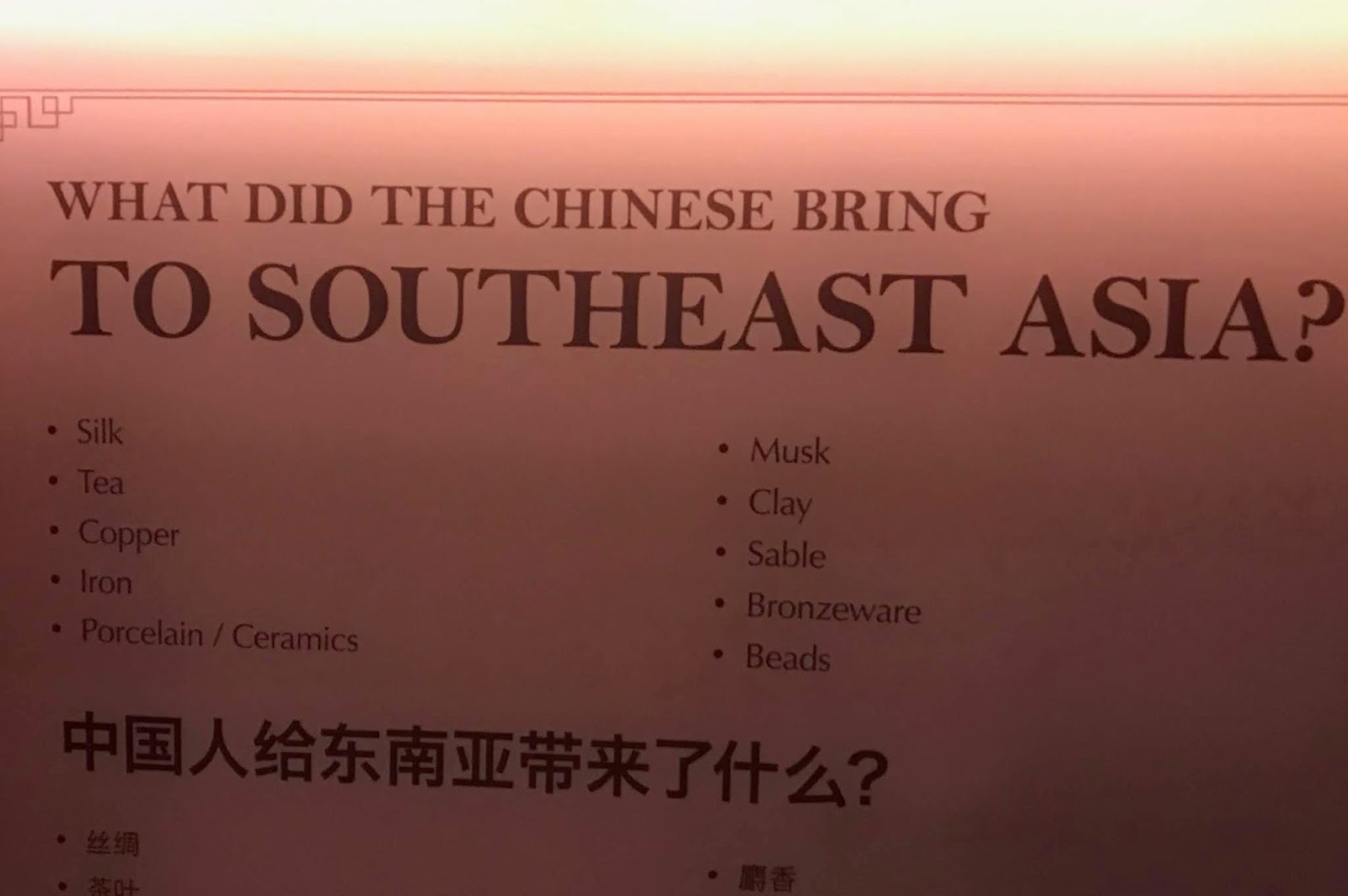
Whilst we were visiting we went to a museum, the name of which eludes me and which dealt in sections with the early history and pre-colonial history. One section dealt with the traders that came from overseas and what they brought to the island. The Middle Easterners brought tons of stuff. Africa brought ivory and gold; the Middle East brought frankincense, pearls, turtle shells, corals, perfumes and oils; South India and Sri Lanka brought cotton, textiles, gemstones, ivory, ebony and pepper.


The Chinese brought tons of stuff too: silk, tea, cotton, iron, porcelain/ceramics, musk, clay, sable, bronze ware and beads.


As for the Europeans, well...


Made me think of Monty Python again.


Thursday, April 17, 2014

Repentance and Compassion


It had to happen.  We had to turn south again and today was the day.  Most gloomy we were too as this has been a great trip.  Marvellous scenery and lovely people too.  So it was with regret we headed out of Eureka back along 101 – I think retracing steps is the gloomy part.  Things start becoming familiar instead of creating that squiggly feeling in your belly about the new things that you are about to experience.

We stopped briefly in Ferndale largely because we’d watched a Food TV programme called Diners, Drive Ins and Dives which had featured this small town.  Located 15 miles out of Eureka it is definitely off the beaten track but we found a healthy sprinkling of tourists like us with cameras at the ready. 


Annoyingly the reason we’d come was closed today!  This was a bakery making bacon and cheese scones that appealed to Viv so our stay was brief.  Cute town though with lots of Victorian style buildings.

Our trip to the next destination Ukiah (the county capital of Mendocino County incidentally with a county topping population of 36,000) took us through the Avenue of the Giants again, and this time we stopped and bimbled (see website here).

Fires cause this hollowing out effect in the tree trunks.  The tree remains in perfectly good health otherwise, this one being a monster.
The redwoods were just as large and lovely as elsewhere on the road trip and of course we had our daily hug again – this will be something we’ll miss when we leave California.  Simply walking through the trees and finding absolute silence is priceless.

Roosevelt Elk in the forest


We’d targeted Ukiah as I’d spotted in some brochure a comment about the City of Ten Thousand Buddhas being located there -- see website here.  It intrigued us for sure and having visited I still wonder why they located it there.  Perhaps when they started out in the 1970’s, the closure of the old county hospital gave them a start in infrastructure that they could readily use.


The man who started it all, Hsuan Hua, came originally from Manchuria via various parts of China.  There he met a 109 year old Buddhist patriarch who prophesied that the young man would be one of the most important leaders of the faith. In 1948 possibly co-terminous with the ending of the civil war in China, he left for Hong Kong which he left in the late 1960’s again possibly co-terminous with the Cultural Revolution on the mainland which threatened Hong Kong’s existence at the time.  Arriving in the US to spread the word he established the city as a place of teaching, reflection and worship.

The city is a regular school as well as everything else with children from all backgrounds studying there all with an overlay of the religious principles of Buddhism which appear to my superficial gaze to be the third way; namely neither materialistic/anarchist nor religious ascetic.  Just do the right thing and achieve an internal state of peace.  Very similar to the early precepts of Christianity really.

One thing I couldn’t answer was why or how the religion has been taken over by the Chinese for the original Buddha was an Indian prince born in 563 BC who gave up the material world at age 28 to teach inner peace and the third way as he traveled through that part of Asia.  He clearly did a great job as there are lots of Bhuddists globally today.  But when did the Chinese take over? 


Siddartha Guatama, the original 'awakened one' with his 5 companions that comprised the first 'Sangha' (from a painting in a Laotian temple) 
Not sure.  A question to answer to be sure.


We’d come to join in the ceremony of Repentance and Compassion, a daily ritual much like a mass in the Catholic church, held daily at 12.30 pm.  There weren’t many attendees, mainly monks and students by the look of them – the former wore sandals, the latter sneakers under their robes – who were on the right hand side of the hall.  We lay people were on the left hand side, women at the back, men at the front. 

Fortunately Viv and I were helped in our respective places by kind, patient and generous folk who pointed out in the book that accompanied the service where we are.  Viv thinks it was Mandarin, but the book was interesting in that it laid out the service first in English, next in characters and then finally in phonetic Chinese.  This was what they chanted in, very fast too so it was tough to read the English and follow the ritual despite my friend’s help.

The overall tone of the ritual was inner peace, seeking forgiveness for past transgressions and looking forward to a life of learning, compassion and repentance.  Again not much different from much of the Catholic and other Christian rituals.

This was a good experience.

The rest of the day was a madcap rush down the highway to San Francisco airport but as we’d chosen the no freeway option on our GPS much was over mountains again with more chicanes and windy bends than I could count and along the very high cliff top highway 1 – I had a death grip on the wheel of the car for much of it! 


But we got there in the end, staying at Pacifica just down the road from the airport and an early start tomorrow.


Thanks California and using the words of ex-Governor Arnold Schwarzeneggar, “We’ll be back!”