Showing posts with label English. Show all posts

Friday, September 13, 2019

Lost in Translation...maybe

Spending time in Penang has been a wonder and a great enjoyment, although at times it has been a little puzzling. The local "can" is a trip for example but it's not just here that has them. I did wonder how many people speak English or a variant globally and from my pretty basic Google search, it looks to be around 1.5 billion or 20% of the world's population (see here and here). Of these probably a quarter are native speakers, the remainder speak English either as a second language or an official language of the country (where for example many dialects exist so English becomes the lingua franca). Obviously many of these latter countries are ex-colonies but it certainly has spread the language far and wide.

As I mentioned before, there are local varietals. Take 'can' for example, this is what Merriam Webster's dictionary says:

'intransitive verb. archaic : to have knowledge or skill. auxiliary verb. 1a : know how to She canread. b : be physically or mentally able to He can lift 200 pounds.'


Manglish on the other hand is a little different but essentially similar so whilst you think you get what the other person is saying, somehow it doesn't quite go all the way. There's a neat book called 'Honk If You're Malaysian' that tries to explain. 


It cannot because the English spoken here is a dynamic evolving language not the one written in the OED for example. Here is an example of the use of 'can':

'English: Would you be so good as to turn on the tap, please? Of course!
Manglish: Can on the tap-ah? Can!' 

Hope this helps.

History is a bit difficult to follow too. Winston Churchill once said 'history is written by the victors', as did the first Indian leader Nehru but these quotes simply followed Bonaparte's dismissive put down: 'what is history but a set of lies agreed upon'. So those history books that you read at school were pretty likely wrong or at the very best put forward only the history of one side, ignoring and maybe even demonising the other. Having visited Rome many times and taking in the majesty of Trajan's Column at the end of the Forum, you do wonder if you know some of the story behind it, just why Trajan chose to destroy and entirely eradicate the Dacians (modern day Romania) with the only reference to it remaining being the hieroglyphics on the side of the column. 


Nobody knows all the details. Perhaps the written histories have been lost over time. This is quite likely as only fragments of Rome's long and fabulous history have survived. Sacking by the Goths, Visgoths, Vandals, Huns and probably any other barbarian tribe that happened to be passing in the late 5th and 6th centuries didn't help; but also a specific and deliberate erasure of bits of history that the next major incumbents (the Catholic Church) found distasteful or which presented the Romans in a better way than the new church wanted. OK to talk about feeding christians to the lions in the arena (Romans are bad guys) but probably not so much about all the learning and medical advances that the 'evil' empire promoted (Romans were innovative and enlightened). That may encourage people to learn more about the Romans and appreciate what they brought to the world... and maybe think twice. That wouldn't support the contemporary initiatives at all. 

This isn't unusual in a post colonial world or in a world where major change has occurred. The new incumbents recreate a recidivist form of history that makes them look better. The Soviets for example had to acknowledge the Tsars of the past but their take on things were that these Tsars were an unelected elite that just kept fighting wars against other countries' unelected elites in order to maintain control over an empire of starving serfs. Of course the irony of this point of view was totally lost on the Soviets themselves; as they were in fact doing the precise same thing.


This is all a roundabout way of talking about Singapore's 'creation'. Colonial history has it that Stamford Raffles founded the colony in 1819 taking a malarial swamp and turning it into THE entrepôt of the Far East. Subsequent history is broadly aligned as probably there is so much of it written down, however pre-history is substantially lacking as virtually nothing is written down and I can imagine those first colonial settlers thinking there's nothing here, let's do something. But there was pre-colonial history and here is Wikipedia's brief take on things. What is not stated is how many people were about at the time. Now there's 7 million but back then were far fewer.

Singapore's geography of course has always meant that it has acted as a significant entrepôt for the region. The Romans had heard of it but the Chinese, Indians and Middle Easterners were very familiar with it. Pre-steam engines, traders could only trade abroad courtesy of the seasonal prevailing winds. This meant an annual trip with a 6 month wait for the winds to turn the other way and therefore something approaching permanent settlement by non-native traders. None of this was apparent to the British when they arrived however. All they saw was swamp. Hasn't that changed? You should see Sentosa Island these days; more Las Vegas than anything else.

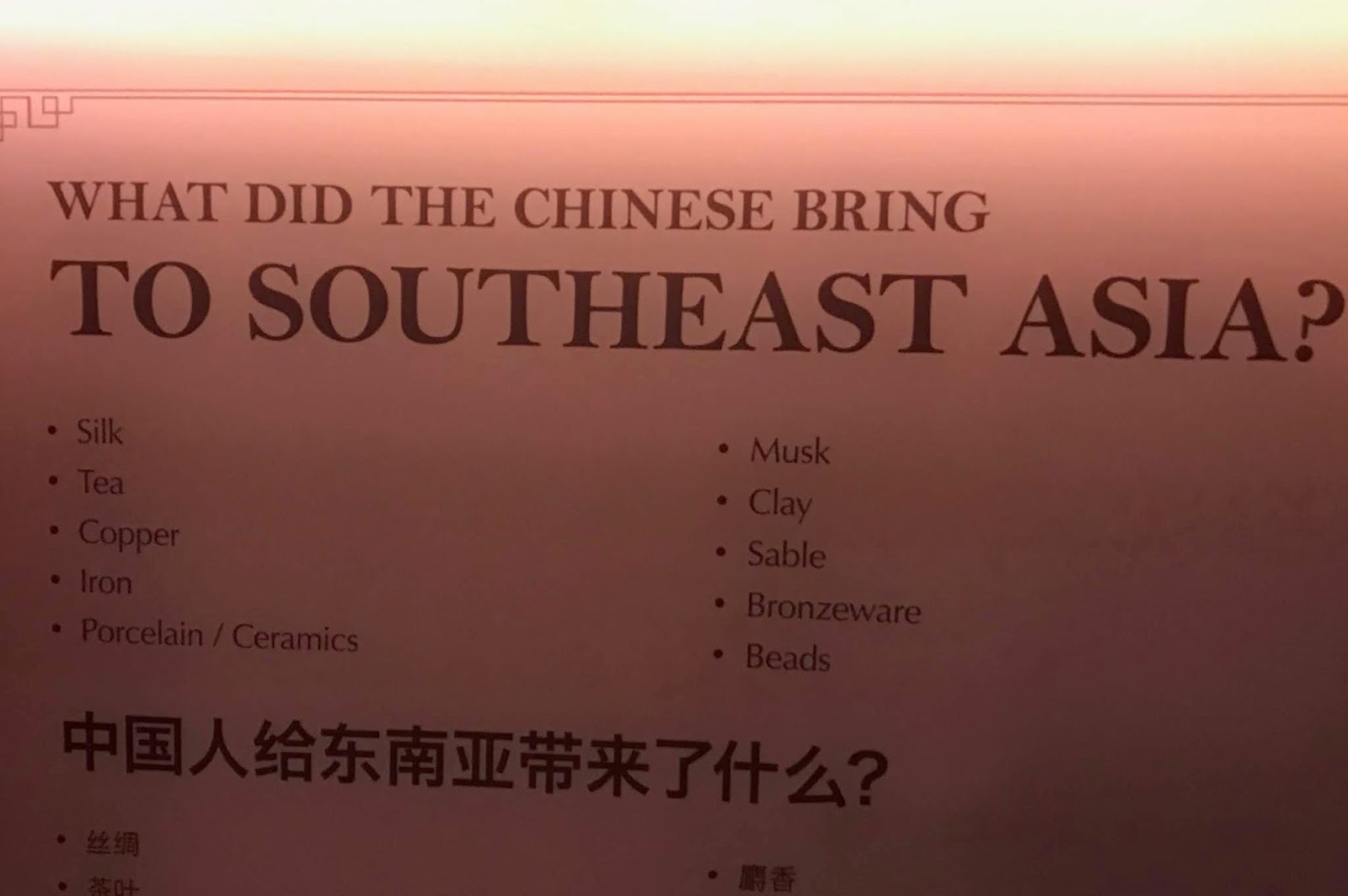
Whilst we were visiting we went to a museum, the name of which eludes me and which dealt in sections with the early history and pre-colonial history. One section dealt with the traders that came from overseas and what they brought to the island. The Middle Easterners brought tons of stuff. Africa brought ivory and gold; the Middle East brought frankincense, pearls, turtle shells, corals, perfumes and oils; South India and Sri Lanka brought cotton, textiles, gemstones, ivory, ebony and pepper.


The Chinese brought tons of stuff too: silk, tea, cotton, iron, porcelain/ceramics, musk, clay, sable, bronze ware and beads.


As for the Europeans, well...


Made me think of Monty Python again.


Monday, April 22, 2019

"Don't know about the Dicky Dirt, Trev"

We have lived outside the UK, well actually England, since 1985 and on occasion some people ask how English I feel and such things like that. Well the answer is a tough one as whilst I still have the same English voice that I have always had, we have lived essentially in a North American environment for nearly 35 years. So I like (a lot) and am used to lots of things that North Americans take for granted. Stuff like driving big cars, pancakes with maple syrup, great steak restaurants, fantastic cocktail bars, big houses, tall ceilings, wide and long parking spaces, yes even tall buildings, but not bacon or sausages I'm afraid. English are still the best there. Chocolate too.

So mixed feelings is I guess the answer.

What about politics? Please don't ask me that! It is only the current Brexit mess that has forced me to even know the names of current British politicians. And armed with that knowledge I now regret even that as I don't think many of them have covered themselves in glory and seem to have succeeded only in ruining a previously very good reputation for a parliamentary system that whilst quirky had stood the test of time and sort of kind of worked. But I do know the American politicians and system reasonably well. Canadian too. All I will say there is that seemingly no leader anywhere is currently giving a great impression of being a statesman. Everyone is too busy taking care of themselves and their re-election prospects even as the (whichever) country is at risk of going to the dogs.

Politics isn't the theme of this blog though, rather it is the question of Englishness. Great word that. The French with all their Academie Francaise hubris don't have a word for it. They'd probably use 7 or 8 words along the lines of 'le coeur et l'âme d'être français' and that still doesn't mean the same thing.

I just returned from England where I watched a couple of Tottenham Hotspur games, one Premier League and the other Champions League, and rediscovered (I did need reminding) what a great city London is. Huge, busy, so many different languages on the street, so many different ethnic restaurants. Even one of those really annoying advertisements you get which end in a voice speaking really fast telling you what the ghastly side effects of this new wonder drug is, was a French girl. Speaking English very fast and with great articulation. Made me really sad to think that this could all go soon.

Some things don't change though.

It was at the first football match which was the first game at the new Tottenham stadium. Great stadium, lots of fanfare, completely inexplicable opening ceremony which had a rapper and a gospel singer duetting something for some reason that eluded me. Great seats, wonderful view, good facilities inside for the fan and the really neat thing that I liked was that whilst it was built along the lines of a US NFL stadium (as it plans to host NFL games too), there is absolutely zero parking. The stadium is right in the middle of Tottenham, so houses and little shops and pubs across the street and all around. The local co-op is just around the corner. Walking out of the train station, the stadium was right there in your face and well so was the rest of Tottenham.  (An aside here: I do hope my reader understands that Tottenham is nowhere near the centre of London. It is 30 minutes by overground from Liverpool Street Station. Miles away in fact. Tottenham Court Road is in central London and I suspect its name reference is pure accident).

It was at the other end that things of course fell apart and sometimes you do wonder. The stadium build overran by 6-7 months and it is clear that the club is hurrying to get it open so at least some games in the 2018/19 season can be played at the new home. I don't want to think that that is a money reason, but it obviously could be. Most things are.

Opening night for the stadium
So the station is half built and on coming out at the end it was clear that nobody had mentioned to the train/tube people (it isn't London Transport any more, it has another name that I don't remember) that around 10 pm over 60,000 people would be coming out of the ground looking for a way to get home. Stuff like this is something I definitely do think the English (OK British. Why just diss the English on this?) do not do well. In the USA/Canada, this would have been thought through and dealt with so that within 30 minutes everyone would be gone. It took ages but as Tottenham won 2-0, all were in good humor.

Great view of the match
Credit where it is due though for by the second game, this had been resolved. Sort of. For someone had hand written a time table of trains heading back into London so that at least we all knew what the situation was even though we still had to wait. And as a subsequent follow up, I just received a notice that the club is now putting on free shuttles from the ground to 4 or 5 different public transport hubs around so at least this issue has been recognized. It would have been better or course to consider this in advance rather than have to scramble around for bandaid solutions.

Now that I have exposed myself as a football fan, I will get to the point. Having returned to Penang I found myself staying up half the night watching Tottenham games and by association other games that have an impact on the final league standings. So I don't know how I ended up watching a West Ham game a few days ago. But I did. These days there's always at least two commentators for every sporting event, the primary one and then the analyst. I missed the names for this game but the analyst was clearly a West Ham fan and potentially an ex-player so the primary commentator spent a lot of time making general clarifying comments for the audience as the analyst was getting quite worked up as it was a really close game.

The camera panned round into the crowd and found a familiar face, someone I immediately recognized as one of the greatest footballers of the time that I was growing up and familiar with when I was living in England, namely Trevor (or rather Sir Trevor) Brooking. The analyst picked up on this fact and waxed lyrical about him before coming up with THE line of the day:

"Oooh, don't know about the Dicky Dirt, Trev".

Now my home town is Southend-on-Sea, only some 20 miles down the road from West Ham and our local patois is not entirely dissimilar to cockney, which was what the analyst was. It is curious for only a couple of days previously I had had dinner in Penang with someone from Streatham in South London and to the untrained ear, the accent is the same. Sort of what is these days called 'Estuary English'. But it isn't. South London is quite different from Estuary and very different from Cockney and indeed my own Essex whine (which I keep only for special occasions and school friends). But I understand them all intuitively so as soon as these words were uttered I almost wet myself laughing.

This would have been fine at any other time but unfortunately I was drinking a cup of tea and my laughing made me ingest the tea which went down the wrong way, sparking a mass of coughing and spluttering, gulping for air, more laughing and culminating in the spectacle of my tea making a reappearance out of my nose. From where it ran down onto my shirt. Sorry Viv!

What made things funnier I think was the realization that I was probably one of only 5 or 6 people in the whole world who actually understood what had been said for this was the Premier League's own feed so it would have not been sold in England, only outside. In England, the Premier League rights are owned by Sky and BT Sport only. It occurred to me then and now that it would be almost impossible for any non-native English speaker to have a clue what had been said. It wasn't rude although I was waiting for the rest of the program for the analyst to make the ruder follow on comment, say, about Trevor Brooking's neighbor, referring to him as a 'friend of Trev' -- which is!

Confused yet?


Friday, April 20, 2018

Beer Can

Its been nearly three months that we have been in Penang and it has been great. This said having lived 32 years in Bermuda, another island, I do feel many similarities abound. The endless motorcycles of course. Weaving in and out of traffic on both sides, no helmets here and I have seen 5 people on one bike as my personal record -- that didn't happen in Bermuda or rather I don't think it did anyway. Craziness, yes. But perhaps not quite this crazy.

Both are islands so that does mean a certain insularity. An apartness from those on the mainland, wherever or however far away that mainland actually is -- in Bermuda it is 600 miles but we still feel it.

Shared heritage too. Both are/were British colonies, Bermuda rather older than the upstart that is Penang by some 177 years or so (1786 versus 1609). So both share the same common language, that knot that binds us together. (I have just finished watching the Commonwealth Games which I thought were wonderful, part of which prompted this post). Or do we?

Bermudjian is the way the local people speak the language in Bermuda and it really does have its oddities. My children Alex and Ali speak it like the natives that they are and can turn it off and on at will. Sounds strange sometimes to hear them cracking along with their friends in what sounds like another language but then comes down to that lowest common denominator:

"That's what I'm talking about".

"You got that right!"

"I'm saying."

"Uh huh"

and of course the ubiquitous:

"Fat, bye" which has no known translation but which can be used just about anywhere in conversational Bermudjian.

With these short simple phrases you can have a conversation lasting hours, with the duration of the conversation being dependent on the availability of some fine local rum or Elephant beer, Carlsberg of course, "to refrAsh the vocal chords, don't you know (pronounced "doan-chu-noow")."

The Beer-muda Triangle

No spelling mistake there as Bermudjian often replaces vowels with others seemingly at random. As for double negatives and malapropisms, well...

Take this simple phrase: "You don't tell me nuffin'"

Loosely translated it means "You don't tell me nothing". A double negative, yes... but is it?

At first glance this could be a cry from the heart of someone desperate to know things but who is being deliberately excluded from those things as in "you doan tAll me nuffin, bye". But on reflection it could also be a directive in the same way as "doan chu tAll me nuffin, bye" is a directive although slightly differently worded. A request given rather peremptorily to someone to not give him or her instructions, the implied undertone being that the instructions will not be followed and that the requestee is rather put out by the fact that someone has the temerity to think about giving an instruction when clearly that other person has no right to do so and in all likelihood is being "dis-respActful".

This is the worst thing that anyone can do to another Bermudjian. Be dis-respActful.

Coming to Penang it has been an assault on many of my senses, one being the language. Of course the local language takes precedence but when it comes to the use of English, some times it makes my eyes water until you actually get into the rhythm of what is being said.

The loose translation of 'yes' is 'ya'. I never realized that until I filled in an official form for something which had one of those yes/no boxes translated into both languages and saw the yes/ya option presented for the first time. I had thought that 'ya' was a very chummy greeting as in the Bermudjian "ya ya mon".

After playing tennis one day in chatting with one of the other guys who turned out to be a business coach, he told me that the Malays didn't finish what they were saying when they spoke. They ran out of context and content before they finished usually so they would add a few cheerful "ya's" or most normal "la's" to the end of what they were saying as in:

"Bring me a beer la".


The 'la' is redundant but it does end the phrase correctly and makes the sound of what has been said feel about right. And I guess at the end of the day we can drone on and on about the mangling of the Queen's English but it is a living language in the way that say Latin no longer is and has a life and breadth of its own, wherever you may go. It just takes a little while to get to grips with how the language is chosen and what the local rhythm is. Makes for tricky moments when the gap in understanding is fairly wide but one of the solutions certainly here in Penang is the use of the word 'can'. It is used on its own in the context of "certainly that can be done. No problem. Hope you enjoy the outcome." But this is all truncated in popular use so that the correct response to that earlier request would be:

"Beer can"

Hope this is all clear.