Showing posts with label Wikipedia. Show all posts

Sunday, April 12, 2020

Binge Watching

Another thing that being in lockdown provides is the time to binge watch TV shows and box sets. Typically we don't like to watch programmes when they are ongoing as once started we just want to go through the whole thing. We recently did this with Game of Thrones (GOT).


What we have noticed with other long running series is that the best ideas typically come in the first season when the budget is smallest and it is when the networks pick them up for more seasons that the storyline feels like its getting weaker whilst the budget is bigger enabling the writer to come up with more and more fantastic set pieces. GOT falls into this characterisation I think.

More and more as we watch through the seasons, I like to go onto Wikipedia and find out not so much about where the story is going, but more to who the cast are and who the writer is and where it all takes place. For GOT the scenery is simply fantastic and even though it says Northern Ireland, I simply don't believe all those scenes were filmed there. OK I do know that it was filmed in other places too.... but I have been to most of those places and for the life of me cannot remember seeing any of them. Anyway that's a side thing but during this Wikipedia trawl I took a look at the writer (one George R.R. Martin) and discovered he's a sci fi and fantasy writer.

One of my favourite all time books is Lord of the Rings by J.R.R Tolkien (same middle initials? coincidence??) and obviously it is a book of its time. Written in the 1940's at the time when Britain was on the verge of losing WWII to Nazi Germany and using Tolkien's harrowing experiences in the trenches of WWI as backdrop. Clearly his writing, whilst superbly eloquent and articulate is coloured by his experiences and the time in which it was written.

Scroll forward to Mr. Martin who is 71 (according to Wikipedia).  That's only a few years older than me so his life influences are pretty much the same as mine, except of course he is American and I am not. That means the Beatles, rock and roll, the A/H bomb, Vietnam, swinging 60's, drugs, feminism amongst other things. Now I haven't read the books which is something I will correct as simply by watching the HBO series, I am amazed how much swearing, basically soft porn and really violent and gory action takes place. The stories have loose similarities but the context is totally different. I am amazed each episode has any story in it at all given the need for multiple sex scenes, ritual dismemberment and generally people standing around swearing their heads off. So I do wonder if that is how the books are written. I'll find out.

I did enjoy the earlier series more than the later ones. In the early ones, the dialogue just cracked along. Every one of the 'hero' men were as a friend of mine describes as being 'strong as horse, dumb as tree' and made clearly massively wrong decisions every step of the way. I am amazed that any survived through 8 series at all. All the women, no actually only most of the women, were far smarter and could easily out think their male counterparts. By the final series I was pretty worn out listening to all of Daenerys Targaryen's ridiculous titles particularly when things came to important moments when she or someone else had to shout out 'you are in the presence of...' and 5 minutes later came to the end. I suppose it did pad out the shows to their full time allotment. And those eyebrows.... don't get me going on that!

The baddies got all the good lines. I did like that however as the series went on and on, the dialogue became more serious and even the baddies' lines ran out of steam and sting. At the start, the most fun characters were Jaime Lannister and his diminutive brother Tyrion but as things wore on, they became far more serious and consequently less entertaining. In reading the Wikipedia entries, I couldn't make out whether Mr. Martin had actually written any of the later series (I know he didn't write the last one) or if it was just the HBO screenwriters talking to him to 'agree where the story line was going'. As an avid reader of Robert Heinlein in the sci fi genre, what made his stories so great was not necessarily the sci fi aspect rather it was the energy that he brought to the writing even when the books went on to very great length. He never let up which is rather in the end what I think happened with GOT.  Anyway, like I said earlier I'll read the first book now.

I'd like to think that left to himself Mr. Martin may have come up with something like this in the later series.


Wednesday, January 1, 2020

Hills

Like many people, I try to make plans. In my case as I am retired, this often involves great ideas (in my opinion) that may or may not require preparation before the big event whatever it is takes place.

A few weeks ago after a tough day of playing in a tennis tournament, I was chatting with one of the players, the club pro, bemoaning the fact that I wasn't able to hit the tennis ball as hard as the young lads who'd thumped us all over the court all day. He put an arm round my shoulders in an amicable fashion, patted my stomach with the other and kept on saying what sounded like "20 pounds" over and over. Being rather a literal person I hadn't a clue what he meant but assumed that he meant that I should start pumping iron to build up some more muscle. He is as skinny as a rake so I thought this was a bit rich coming from him. In any event he kept droning on about '20 pounds, 20 pounds' and drumming my tummy so I said something along the lines of 'OK, you're right maybe I could do something about my puny arms...' but he said "No, no. Lose 20 pounds. Here".... with 'here' being you guessed it, my stomach. Bloody cheek. I've been trying to lose 20 pounds for the last 20+ years, mate!

In my defense, the food in Penang really doesn't help. So good but very heavy on the carbs: rice, noodles, beer. I know I could be a little more iron willed but that really hasn't worked out that well. Clearly.

The most recent fiesta and the scene of my most recent fall from grace
So plan B.

Penang Island is a really interesting place. Topographically speaking. This is what Wikipedia says:

As for the terrain, much of the centre of Penang Island consists of granitic hills covered by rainforest jungles. The central hills of Penang Island, including Penang Hill, serve as a giant green lung for the entire island and an important forested catchment area.[15]

Generally speaking, the island can be distinguished into five areas:
  • The northeastern plains form a triangular promontory where George Town is centred. This densely populated city centre is the administrative, commercial and cultural centre of Penang.
  • The southeast, where Bayan Lepas is located, was once an agricultural area consisting of rice fields and mangroves. Due to the massive industrialisation of the 1970s, this area has been developed into new townships and industrial areas.
  • The north, including Batu Ferringhi, Tanjung Bungah and Tanjung Tokong, consists of narrow sandy beaches lined with resort hotels and residences that form the northwestern edge of George Town.
  • The southwest (Balik Pulau) contains the only large pockets of scenic countryside with fishing villages, fruit orchards, and mangroves.
The giant green lung
We live in the north of the island which is well populated but in the middle and south, the hills go straight up making construction difficult. So much so that the authorities are reclaiming ever greater chunks out to the north and east which constitutes the Malacca Straits, which are actually quite shallow and very tidal.

The British in colonial days built stations in the hills where you can escape the relentless heat of the lowlands. They also built reservoirs and dams in the hills to provide a guaranteed water source for the island. Accessing each of these meant trails, roads and paths which today make great hiking trails. This was my plan B.

I found a group of hardy hikers who weren't so serious that a newbie like me would suffer and off we went. The first week's walk was to the Batu Ferringhi aqueduct. A light, gently upward stroll past the remnants of colonial engineering which still works just fine. My fellow walkers were a bunch of similarly shaped and aged people to me, so I felt right at home. 


It was all rather pleasant. People chatted, stopped every 20 minutes or so for a rest and drink, that sort of thing. And right at the end we met that charming monkey. The white eyed ones are quite affable unlike the grey macaques that predominate, which travel in large groups and which are aggressive. This is why most walkers go on hikes with sticks.

It was therefore with quiet confidence that I approached the next week's walk. One of the guys that also plays tennis told me that this wasn't a really heavy walk in terms of difficulty, maybe 7 out of ten, so I was felt pretty good about things as I drove down to the southern part of the island; a village called Balik Pulau. The plan was to start in the village, walk through some of the farms and then take to the hills. The hills are all interconnected so a really long, tough one would head all the way north towards Penang Hill. We wouldn't be doing that although we would be going up through the durian farms.

I was in bits at the end.


Scenery was lovely and what I clearly missed were the breaks for chats and drinks. None of the more social walkers had chosen to do this walk this time, I had missed that! The hardy bunch that did make it were all lithe and athletic looking and obviously used to this kind of thing.

Lovely scenery though!


Saturday, September 21, 2019

42


Maybe it's just me but in the last couple of days, mathematicians have been able to solve one of life's most intractable mathematical problems and uncover the meaning of life as defined by Douglas Adams' wonderful book Life, The Universe and Everything (here is Wikipedia's note).


I feel kind of sorry that this has happened for this is a mystery of life that has been solved... by a math geek, using 100 connected PC's. This was the issue:

The original problem, set in 1954 by University of Cambridge researchers, looked for solutions of the Diophantine equation x3 + y3 + z3 = k, with k being all the numbers from one to 100. Beyond the easily found small solutions, the problem soon became intractable as the more interesting answers could not possibly be calculated, so vast were the numbers required. But slowly, over many years, each value of k was eventually solved for (or proved unsolvable), thanks to sophisticated techniques and modern computers — except the last two, the most difficult of all: 33 and 42 (read about it here).
It all seems .... a little flat. I'd have hoped for fanfares, maybe an angelic chorus or two and the Great Redeemer saying 'well done, now I've got a really tough one for you'. Or something like that. But all we got was a You Tube video.


I much prefer this answer.


Haze. Pea Soup.... let's just call it Pollution.

This last week has been unpleasant so far as the weather is concerned. It is the time of year that Indonesian farmers burn fields to make ready for new planting to take place in a few weeks time. The foliage has dried out so it is much easier to simply burn the scrubby bits left over from last year than manually prepare the ground. So they burn. They don't have to do this and in fact there are laws forbidding this practice, but it still happens and nobody takes action. It's not new news out here but it is in the West. This is what the BBC has to say about it.

Penang is highlighted. The wind here is negligible for the next few days so we will be suffering from this haze for a while yet
It has been going on forever and this is the time of year that it all takes place. For Penang, the areas that most affect us are in Sumatra and with the South West monsoon season here until Christmas, the SW winds that prevail are simply pushing this ghastly messy.... haze all over us. It wasn't anywhere like this last year from memory; apparently it is really bad this year.  Even Bloomberg is paying attention.


I remember growing up the fogs or rather pea soupers in the towns in England. Dense fogs that would hang around for days. For those of you that do not know about these, here is Wikipedia's comment. These fogs were brought about by the coal burning that everyone did in those days (and people wonder why coal has become bit by bit an untouchable fossil fuel) and it wasn't until the 1950's that policy action actually did anything about it. I remember our shirt collars being coated in grime and coughing continuously and the phlegm. Yuk, it was black. Respiratory diseases were prevalent everywhere. I had whooping cough when I was really young and coughs and colds all the time later on.  Pneumonia, TB were everywhere. Mind you every adult still smoked like chimneys.

The tipping point was the pea souper of 1952 which is shown here at Piccadilly Circus. You wouldn't know it was but you can see Eros to the left.
The important takeaway from the above is that regrettably it took 'policy action' to do anything about the pea soupers in England.... aka government intervention by law. I recently read an interview with a very prominent engineer who ran BP for many years (here is the full interview transcript) whose view on the world was from a very engineering viewpoint, of course, but the context was that companies would not do anything until policy makers make them. The technology to fix things is all there but it is not being used because companies don't have to.  Here's an edited excerpt:

JOHN BROWNE: Well ...oil or wood or cutting down forests, but also giving people a very different modern way. So... we’ve created a problem and I’ve been on this point for almost a quarter century now saying... it’s the oil and gas industries that’s created this problem and we need to fix it. And the way to fix it is not to stop engineering, is to apply more engineering to solving the problem...And actually, in this area, I would say that we have already all the engineering processes to stop pumping ... CO2 into the atmosphere and actually even to clean up some of the CO2. The problem is that the ...engineered products are too expensive until they are all rolled out in massive scale because …This is where policy comes in. So in other words, policy has to push these …new engineered products to the point where they become more economical. You don’t have to invent, we need to apply and this is where engineering is very good because as you apply more and more, so the unit cost comes down. We know that for sure. So you need a policy lever... the biggest policy lever you need is a price on carbon. Carbon taxes...have got to be priced high enough so that people can and will actually do something to get it out of the system.

The argument that fixes cost money simply don't wash. This was the argument the car industry used in the 1960's but the lead pollution laws were passed and the issue went away. The car industry is now running pell mell to be the first to produce mass market electric cars.

So all of this is both avoidable and fixable. Granted the developing nations don't want to hear developed nations who polluted away years ago sanctimoniously tell them what to do. But the alternative is pretty desolate.

This week versus normal times


Friday, September 13, 2019

Lost in Translation...maybe

Spending time in Penang has been a wonder and a great enjoyment, although at times it has been a little puzzling. The local "can" is a trip for example but it's not just here that has them. I did wonder how many people speak English or a variant globally and from my pretty basic Google search, it looks to be around 1.5 billion or 20% of the world's population (see here and here). Of these probably a quarter are native speakers, the remainder speak English either as a second language or an official language of the country (where for example many dialects exist so English becomes the lingua franca). Obviously many of these latter countries are ex-colonies but it certainly has spread the language far and wide.

As I mentioned before, there are local varietals. Take 'can' for example, this is what Merriam Webster's dictionary says:

'intransitive verb. archaic : to have knowledge or skill. auxiliary verb. 1a : know how to She canread. b : be physically or mentally able to He can lift 200 pounds.'


Manglish on the other hand is a little different but essentially similar so whilst you think you get what the other person is saying, somehow it doesn't quite go all the way. There's a neat book called 'Honk If You're Malaysian' that tries to explain. 


It cannot because the English spoken here is a dynamic evolving language not the one written in the OED for example. Here is an example of the use of 'can':

'English: Would you be so good as to turn on the tap, please? Of course!
Manglish: Can on the tap-ah? Can!' 

Hope this helps.

History is a bit difficult to follow too. Winston Churchill once said 'history is written by the victors', as did the first Indian leader Nehru but these quotes simply followed Bonaparte's dismissive put down: 'what is history but a set of lies agreed upon'. So those history books that you read at school were pretty likely wrong or at the very best put forward only the history of one side, ignoring and maybe even demonising the other. Having visited Rome many times and taking in the majesty of Trajan's Column at the end of the Forum, you do wonder if you know some of the story behind it, just why Trajan chose to destroy and entirely eradicate the Dacians (modern day Romania) with the only reference to it remaining being the hieroglyphics on the side of the column. 


Nobody knows all the details. Perhaps the written histories have been lost over time. This is quite likely as only fragments of Rome's long and fabulous history have survived. Sacking by the Goths, Visgoths, Vandals, Huns and probably any other barbarian tribe that happened to be passing in the late 5th and 6th centuries didn't help; but also a specific and deliberate erasure of bits of history that the next major incumbents (the Catholic Church) found distasteful or which presented the Romans in a better way than the new church wanted. OK to talk about feeding christians to the lions in the arena (Romans are bad guys) but probably not so much about all the learning and medical advances that the 'evil' empire promoted (Romans were innovative and enlightened). That may encourage people to learn more about the Romans and appreciate what they brought to the world... and maybe think twice. That wouldn't support the contemporary initiatives at all. 

This isn't unusual in a post colonial world or in a world where major change has occurred. The new incumbents recreate a recidivist form of history that makes them look better. The Soviets for example had to acknowledge the Tsars of the past but their take on things were that these Tsars were an unelected elite that just kept fighting wars against other countries' unelected elites in order to maintain control over an empire of starving serfs. Of course the irony of this point of view was totally lost on the Soviets themselves; as they were in fact doing the precise same thing.


This is all a roundabout way of talking about Singapore's 'creation'. Colonial history has it that Stamford Raffles founded the colony in 1819 taking a malarial swamp and turning it into THE entrepôt of the Far East. Subsequent history is broadly aligned as probably there is so much of it written down, however pre-history is substantially lacking as virtually nothing is written down and I can imagine those first colonial settlers thinking there's nothing here, let's do something. But there was pre-colonial history and here is Wikipedia's brief take on things. What is not stated is how many people were about at the time. Now there's 7 million but back then were far fewer.

Singapore's geography of course has always meant that it has acted as a significant entrepôt for the region. The Romans had heard of it but the Chinese, Indians and Middle Easterners were very familiar with it. Pre-steam engines, traders could only trade abroad courtesy of the seasonal prevailing winds. This meant an annual trip with a 6 month wait for the winds to turn the other way and therefore something approaching permanent settlement by non-native traders. None of this was apparent to the British when they arrived however. All they saw was swamp. Hasn't that changed? You should see Sentosa Island these days; more Las Vegas than anything else.

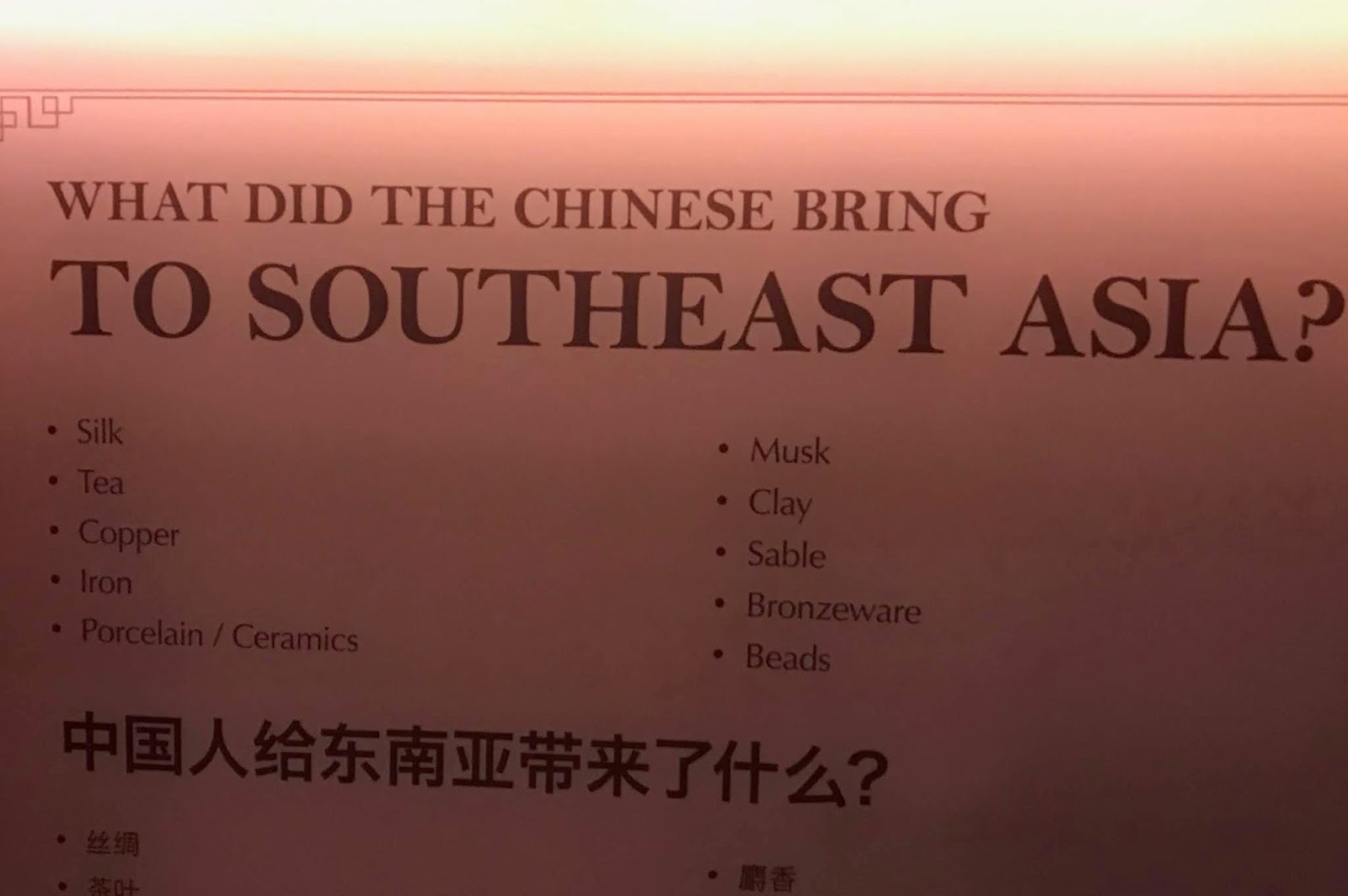
Whilst we were visiting we went to a museum, the name of which eludes me and which dealt in sections with the early history and pre-colonial history. One section dealt with the traders that came from overseas and what they brought to the island. The Middle Easterners brought tons of stuff. Africa brought ivory and gold; the Middle East brought frankincense, pearls, turtle shells, corals, perfumes and oils; South India and Sri Lanka brought cotton, textiles, gemstones, ivory, ebony and pepper.


The Chinese brought tons of stuff too: silk, tea, cotton, iron, porcelain/ceramics, musk, clay, sable, bronze ware and beads.


As for the Europeans, well...


Made me think of Monty Python again.


Saturday, April 20, 2019

Headhunting

We made it back from Sabah a couple of weeks ago now and if you are interested you may follow the daily detail on Chris' wonderful Track My Tour App... thanks as always Chris.... right here. If not, well that's OK just follow on from below once I get going.

Sabah is well within my 3 1/2 hour circle for direct flights from Penang...
Sabah is the top right bit
So Borneo, well Wikipedia has a lot to say of course (see here and thanks for this) and as you take a look at where it is located on both the maps, remember that 73% is Indonesia so the rest of it is now Malaysia with a hint of Brunei thrown in. That is the top part. The left hand side is Sarawak and the right is British North Borneo that was but is now known as Sabah (again thanks Wikipedia -- see here). So now you have all the history that you could possibly want and need, that is the 'official' history. Of course, what is said and what is not are sometimes worlds apart. I cannot say that our 10 days there gave me any great insights about the histories of things but present day observation sure adds some color and textures to what is formally stated.

The old British version of Borneo. Looks like the Dutch were pressing into the British but that wasn't the case at all. The island is so big, they barely met even though the green runs next to the pink. The Dutch were in the south of the island.
Direct flights to Kota Kinabalu (KK from now on as the name is far too long to keep typing) from Korea, Japan and China mean that this formally lush and serene paradise island (actually it never was that!) is now no longer quite so serene. At sundown, the coastal beaches facing the setting sun are overrun with coaches and coaches of tourists bussed in just for the occasion which I have to say is pretty darn amazing actually (not the coaches although that is quite a sight too but of a different kind). I have watched loads of sunsets but never before has it been so cloud free for all of it as the first I witnessed here. One minute the sun is there, the next ... poof... its gone!

Our first sunset!

Our last sunset
Anyway I was busily being cynical about bus loads of tourists clustering together on limited beach space for the 30 minutes that the sunset takes to happen; well approximately if you don't add a couple of cocktails along with things, like we did. Then it gets a bit longer.

But it wasn't me though being the cynical one, it was our Grab driver who rolled his eyes when talking about this. I merely nodded sagely and noted it for future reference as it joins in with a whole lot of other stuff that is out there clear as day but totally either missed or ignored (deliberately or not I wonder) starting with trash. It is everywhere. I asked one of our great guides/drivers/boat crew from Borneo Ecotours (terrific incidentally, thanks guys!!) about this and he was polite and diplomatic to a painful degree. Obviously it doesn't show people in a great light and this is the problem (I don't like that word but this time I will use it because it is a 'problem'). For the problem is that the newly wealthier tourists don't think of the environment at all. Hoovering up all endangered species they can as face cream, special soups, or just deep fried with noodles.

Not endangered of course but rather nice deep fried with noodles
Nothing on land, sea or in the air is off limits. Factor in also on a local basis the indigenous peoples who are poor as church mice and therefore have no compunction hunting a particular creature to extinction if there is the possibility of making a little extra money. And finally.... and this is something I really do not get .... there are really very, very few trash bins so even if you didn't want to throw stuff all over the place willy nilly, the only alternative is stuffing it in your pockets. Which let me tell you people do not do.

This is one of the picturesque tourist islands near the beach. At least this trash is in a bag but that does not deter monitor lizards from getting stuck in one bit. Incidentally I thought these were horrible creatures until our guide told us that is these lizards that clean up the jungle and keep it both clean and smell free. They are carrion eaters. Sounds nasty but very necessary.
If you listen to David Attenborough on the wildlife shows -- which I do as he is simply terrific, there probably is a better word for it but I cannot think of it. On a plane recently I watched a wildlife program about penguins narrated by Morgan Freeman, who has a great voice, but.... it just is not David Attenborough so even though it is really well done, it just isn't.... well David Attenborough, so it can't be right. Well, not as right as when David Attenborough says it. So when David Attenborough speaks, you listen and you give weight (or should anyway) to what he says. He says that Borneo is a stunning paradise for wildlife and then goes on about habitats and stuff. And he is right but then when he is joined by olive oil manufacturing companies who say 'yeah, look at those palm oil plantations...' that is when you should stop and start to think: 'why would that olive oil company (could be any related company) agree with David Attenborough on this?' Answer economics.

This is where I get a bit cynical about the whole eco thing because whilst I totally agree that we are making a mess ecologically speaking and doing things that will have a significant deleterious impact on the planet at some point, I do also think that some of the people going on about it have motives that are not 100% planet positive related, rather money related. And for others, well it is a bit rich them having a go at a newly emerging country trying to make its way when they have systematically cut down all their first growth trees, exterminated all their large mammal populations, turned their countries into concrete jungles, etc. etc. All for them to have a better life. So it's OK for them to do it, but it's not OK for someone else to have a go at making a better life for themselves??

Nice mess we've made for ourselves, isn't it?

It would be nice to see all those eco-friendly joiners in and armchair experts actually come out to all those places and see for themselves and.... try to do something about it out there instead of complaining to their MP back home or gluing themselves to a London Underground (happened yesterday.... really!) or having sunrise group yoga sessions for the world before their Starbucks soya milk lattes. It really isn't easy and there is no easy solution as economics and sinister lobby groups do rather get in the way as they cynically and self servingly talk about carbon footprints and the Paris Accord. But really, will pressure groups in so-called developed nations of the west actually convince the rest of the (developing) world to do what they couldn't and didn't do and in fact raced full pelt to actively do once they found out they could?

Sadly my bet isn't on the answer 'Yes'.

Being in the jungle even if for only a few days and staying at a slick resort does not make me an expert by any means but it does seem meaningful to me that one of our guides is an ex-hunter turned eco-fanatic. Clearly engagement did work with him and of course his uncle, presumably the senior partner in their previous enterprise who became the guardian of the last two Borneo rhinos in existence. They are still alive but sadly both males so don't expect much unless a miracle happens. The species was declared extinct in 2015 but there are still large tracts of first growth jungle remaining -- that is 100 million year old forests that have remained untouched by humans -- where people have never ventured so who knows maybe a miracle will happen. Hope so.

It was all rather wonderful though to be somewhere where critters that David Attenborough in his whispering voice tells us are endangered with their habitats disappearing all over the place simply wander up and start chowing down on some of the many jungle fruit seemingly on every tree and bush. Totally unconcerned by our presence. We kept tripping over orang utans and proboscis monkeys but still the thrill of seeing them in the wild remained. Catching some sun bears wrestling was rather wonderful. As for those noisy hornbills, well you couldn't keep them quiet. What a racket. Sadly no elephants this time nor rhinos and leopards, but there was this rather amazing civet (weasel shaped cat creature) that acted just like my cat Bella (alright ex-cat).

Through a telescope, well it was a long way away but somehow the ranger spotted it

Proboscis monkeys by the river bank. During the heat of the day, they retreat into the jungle but return at dusk to sleep 

This sun bear was terrific to watch enjoying that carrot. Surely not a jungle fruit? Well no it was in the sun bear sanctuary, there being so few remaining in the wild. That's what people think but as they never see them, how do they know?

During the time we were in Sabah, we heard about the kimodo dragon island nearby on one of the Indonesian islands being closed to tourists to protect not the tourists from the dragons, but the other way around. At about the same time, newspapers reported the illegal transshipment of one in a cooler box. The report that did make me almost cheer was that of the unfortunate poacher in Africa who seeking rhinos was trampled by an elephant and eaten by lions. He ticked all the boxes in a wrong way! However, it all makes me realize that there is less and less time still available to visit and see all the marvels that the world has to offer before things change forever and they are gone. We'd better get to it then.


Thursday, March 7, 2019

Past Historic

I have basically dropped the ball on following up on our visit to the historic tin town of Ipoh with a post on this blog but in self defense I have been thinking, well a bit anyway, about how I should couch the blog.

If you fancy following the moment by moment stuff, then I would urge you to take a look at my Track My Tour, wonderful app, thanks Chris as usual, which I have attached here. Viv and I really enjoyed our short visit but it wasn't quite what we thought and why we thought it may have been as enjoyable as it was. If you see what I mean (and rereading that last bit, I'm afraid I don't quite know what I was trying to say). Take it as being the things we thought would be good were either absent or underwhelming, those that we hadn't considered or felt were of lesser importance really stepped up and more than filled the gap.

It is the history that I am referring to.

So brief back up again: we wanted to visit Ipoh because it was an important historic town in Malaysia's development and was pretty close to Penang, in fact about an hour and a half on the motorway. Also we had been advised the food was really good there as was the famous Old Town White Coffee (it was).

So history: Ipoh was pretty much nothing more than a collection of huts before tin mining and the devastating series of Tin Wars (see Wikipedia link to the four different but rapidly consecutive wars collectively called the Larut War here) prompted the protagonists, initially competing Chinese regional tin miners but later also the Malay rulers who fell into a civil war in the state of Perak, to call in the British to restore order as they could not. These wars fell between 1861 and 1874 when the final Treaty of Pangkor was signed and this pretty much signaled the start of Ipoh as a place of significance. It also signaled the arrival of the British who to that point in the development of the country had held themselves only in the Straits Settlements -- Penang, Singapore and Malacca.... but also Pangkor, which was the port town for the Perak River, the means by which most tin made its way to the outside world.

The little blue bits are the tin lakes that now dot the area. Imagine 100 years ago these were mostly open cast mines.
Say what you will about the good and bad of British imperialism and Pax Britannica but this treaty brought peace to the area again and a new level of organisation and infrastructure that had previously never existed. It also forced the British to redefine their relationship with Malay states and set the starting point for closer cooperation, then the colonial era which followed. In a nutshell, the British took administration, foreign policy and defense. The Malay sultans kept religion (Islam) and cultural matters. Of course this meant almost total British control. However it wasn't as though the non-British parties didn't go into this eyes open. Probably though they may not have thought through the exact level of control they would be giving up by inviting the British in. Or for how long it would last.

In Ipoh, we went to two Chinese tin mining museums. One outside Ipoh and one in the old town. Both of these were private museums funded by in the first case a wealthy Chinese tin mine owner and in the second case by the Haka Tin Miner's Association. So both I knew would be as politically incorrect as could be imagined... and they were, all with the perfectly acceptable intention of providing the truth, the whole truth and nothing but the truth (Jack Nicholson speech in "A Few Good Men" springs to mind here).


Pre-1800 tin mining was pretty much a fringe thing conducted by local Malays. It wasn't until global demand picked up during the Industrial Revolution along with prices that the Chinese became interested. That also coincided with numerous rebellions and civil unrest in the fin de siecle period of the Ming dynasty, so people left China in droves for peace and an economic uptick.


Open cast mining was not eco-friendly and was very labour intensive. It also required massive volumes of water to be diverted from the Perak River and pumped through hoses to wash away soil and other detritus from the underlying tin ore.

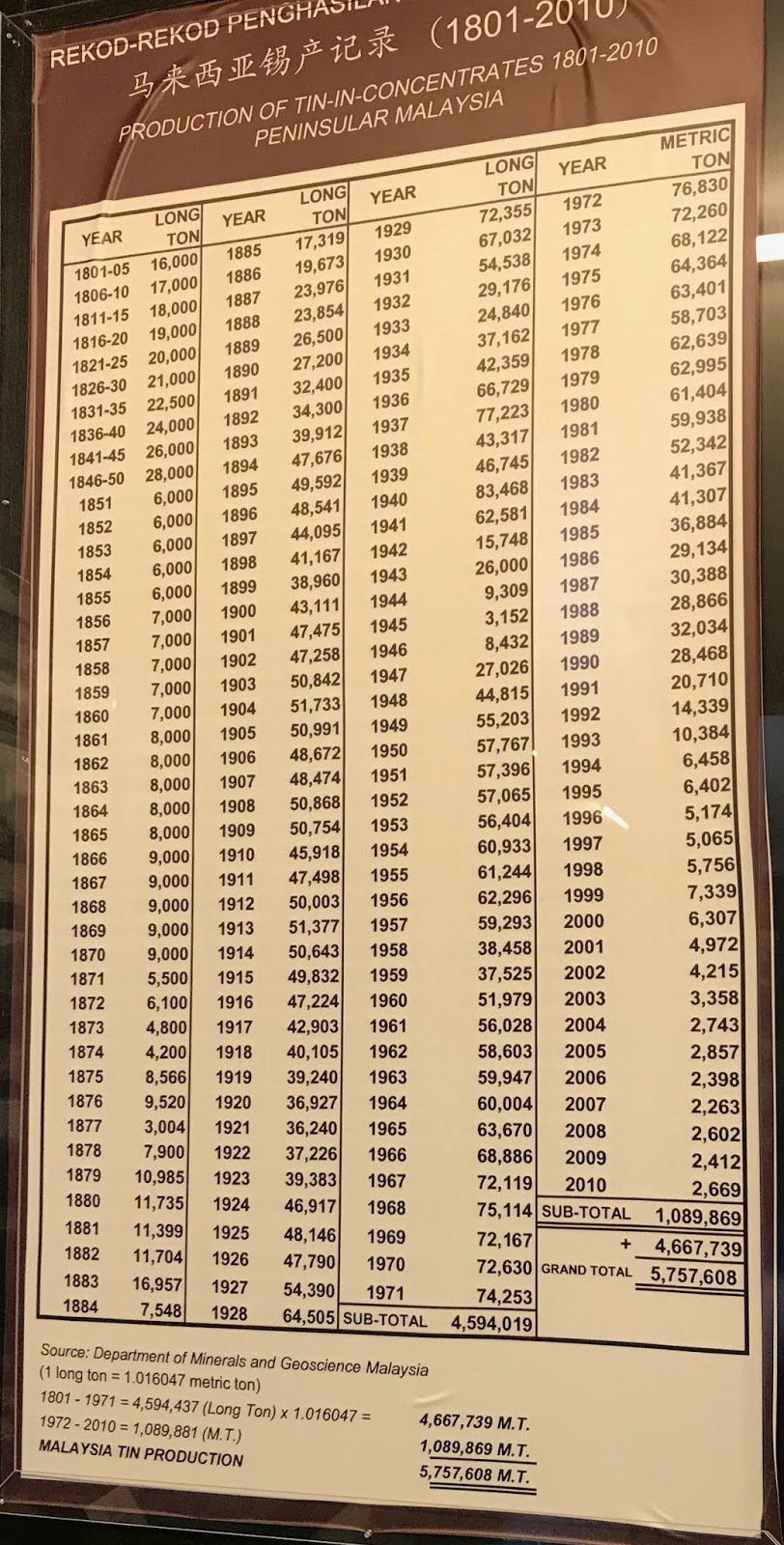
This is wonderfully documented by the first museum as the owner has all the industry statistics you could possibly want for this industry and dutifully and relentlessly published the lot of them on frame boards in the museum along with dioramas 'interpreting' those statistics.

Data going back to 1800!

Mostly they were statues of Chinese workers 'coolies' holding some sort of tool connected with mining. In this time tens of thousands of mainly men came each year for the next 60 years. In all about just over 1 million. Most came for the mining which was centred around this area. I haven't read anything that talks about the demographic impact of having this many new immigrants in a specific location, in a specific industry, and in such a short period of time. But it must have been overwhelming for the indigenous population and obviously contributed in no small measure to the Larut Wars, which were essentially inter-Chinese turf wars squabbling over resources. No wonder the sultan lost control of things. (Malaya's population in 1950 was still just 6 million!).


We had a guide for both days we were in Ipoh who was very informative and in his non PC way told us: "The Chinese miners were only here for the money. They didn't care about who controlled what or how they got the tin. They just knew that tin was worth money and that was it." He was more direct than that on a wider variety of subjects too but I just restrict myself to this.

So there you have Malaya in a nutshell (and still pretty much modern day Malaysia too, from what I have seen). The Chinese just want to do business and don't care about how they go about it, whose toes they trample on, who is the 'ruler' and that other stuff like personal freedoms, rights, rules about intellectual property, all of that. So for them in 1874, getting the British in was a no brainer. Obviously the Malays may have had different priorities.

One downside to this is heritage. Living in a UNESCO world heritage site (Penang) it is almost ironic that this should be the case for this UNESCO accreditation comes with specific rules and regulations governing what you can and cannot do to 'heritage' buildings and other artifacts. The practical downside in Penang is the almost endless number of colonial era mansions that are derelict and left to rot. Conflicting reasons for this. One is that the UNESCO rules make it very expensive to renovate (ironically McDonalds and KFC have taken over and renovated mansions for their purposes) and the other main one being that they are owned by old time trusts (Chinese clans presumably) with many different strands of ownership meaning that nobody can agree on anything, so nothing happens.

Specific to Ipoh and the reason that I have taken the path in this post are the railway station together with the city administrative building right opposite. Both are WWI constructs in the Imperial fashion -- massive long white buildings -- the railway station is in use but much changed to accommodate modern traffic whilst the city council building has been abandoned and is being left to rot whilst the current city employees work in their new blinged up glass and concrete high rise just down the road. So from a 'heritage' position ... and this is something that Ipoh Tourism really focuses on (that is if you read their website blurb and visit the Tourist Information office) and if you have followed my trail to this point, you will remember that prior to 1874 Ipoh did not exist so anything 'old' from then will perforce have had to be .... Imperial era construction, which sad to say is being ignored probably to ruin at some point. You can already see green plants growing out of the walls of the old city building. As Ipoh virtually burned down in 1892 it had to almost entirely be rebuilt. This is where the town's grid layout dates from.... again here heritage = Imperial era construction.

The magnificent railway station in Ipoh. Its derelict brother lies just across the road... in fact I took this picture standing right in front of it
Heritage wise, this visit for us really didn't work out as we thought but then again it did. For those parts that did elevate our time here were those specific private museums and the energy and dedication put into those. So all of what I said about the general attitude completely falls apart when you consider just how conscious these private benefactors (who were outside the norm) are in preserving the history of the tin miners of Ipoh. They did a great job. Other heritage, not so much. You can see it being ignored on a daily basis as younger people in the modern times presumably simply don't care about the past so much. I think it's a shame but then again I just turned 65 so am what is now considered 'past historic'.

PH definitely looking past it on the left hand side in front of some Ipoh street art that our guide rather amusingly dismissed out of hand. He was right though, most of it was just graffiti masquerading as something else
Looking at it a different way, heritage is expensive and a question of priorities. As a lover of Italy, I am continually amazed by the almost total disregard by the population of the old ruins of this and that that lie around everywhere. To restore everything to its former glory (and define that if you can) would be prohibitively expensive and time consuming. In the US by contrast, a country with virtually no similar heritage or history, every speck of rock that can be deemed 'heritage' of some sort or other has its own national park surrounding it with display panels, interpretive films and tourist centers. Last year we visited the site where the 1850's go west homesteaders covered wagon tracks can still be seen. You can't see anything. The site is a huge..... prairie covered in grass.

I will leave this post with some comments from a magazine that I just read whose editorial reported that even though 2020 has been designated Visit Malaysia Year, Tourism Malaysia is cutting funding for marketing purposes. One should remember that the country is up to its ears in debt from past corruption scandals and over spending on infrastructure that nobody needs or uses, so the new government is presumably doing its best in prioritizing what it can without continuing the damaging debt trend. This said it could also up its game a bit for as this same magazine says "it does suffer a bit from the all too common local hallmarks of subpar service and mediocre maintenance."

Ipoh was great fun though. And the food.... well who wouldn't love to find a fantastic tandoori restaurant laid out just like a high end steakhouse in the US? Visit the Tandoori Grill!!!




Sunday, December 2, 2018

The Honorable Lanka

Living in Penang you see the word 'Sri' all the time in front of a group of other words and for the longest time I had no thought really about what it meant, if it meant something, or it was something else. It took our visit to Lanka in October to settle things. The word 'Sri' is an honorific which I take to mean something like 'the honorable' or something like that. As the pre-Colonial name for the country was Lanka, that is what they first named the country after 'Ceylon' was ditched after independence adding the 'Sri' only a little later. Claro?

I used Chris' wonderful app Track My Tour for the day to day stuff and if you want to follow that you can do so here but wanted to add some other bits that I didn't write about or thought about after.

First up, great country. Lovely people. Hopeless infrastructure. My goodness, does it rain. Animals everywhere.

OK that's it all done.... well not quite. Any people that do read my posts know that I probably drone on at too much length so a post this short and sweet just isn't going to happen. So here it is, the memories that will stay with me in no particular order.

1. Elephants

Nothing more to add, just that it was fabulous to see them in the wild

2. History

In a later post I will refer to Malacca in Malaysia as part of a recent road trip that Viv and I did with some friends from Bermuda. It bears striking similarities to Sri Lanka as it was the Portuguese who were the first colonial settlers and it was they who were summarily kicked out by the next settlers, namely the Dutch, who in turn were removed by the British who then never left and generally fixed the things that the others hadn't.


The Portuguese settlements were very much at the fringes, seaside settlements in the south with just the one in the pointy bit at the top, which is Jaffna. So easy meat for the Dutch who came in force over 100 years later and kicked them out. They tried to take over the entire island but couldn't manage the middle section (which was where Buddha's tooth ended up, Kandy) and made a big mistake by not preventing the British from settling Trincomalee (sort of top right, below Jaffna but above the middle fat bits on the right hand side) and creating a naval base there opposing the French in Madras. The British liked the place so when the French marched into Holland in 1792, the Dutch presumably much against their will and definitely their better judgement asked the British to care of things for a while. Until the French left. No problem, thanks. Trouble was when in 1815 they asked for it back (as they did in Malacca and other places further east) the British said no thanks, we like it here. Oh yes and if you want to try and take it back, let me introduce you to the Duke of Wellington who just thrashed Boney up and down Europe... and some of his friends in red jackets.

Well that wasn't going to work so getting the best deal out of a pretty poor situation was all they had left so the Dutch said OK you can have Ceylon (they called it Ce-lun apparently, a corruption of a misheard Portuguese word) and Malacca and if you must Singapore, but we wouldn't mind having back Java and Sumatra. Probably don't fit in with your imperial plans. The Brits had no imperial strategy of course, only the East India Company, a bunch of penny pinching capitalists and absolutely no desire to take on anything else after that ruinously expensive 30 year war against the French so said thanks and generally history moved on.

Having acquired the new territories though meant actually doing things with them and in general the British did fairly well by Ceylon, as it was now called. Or so it seems to me. Certainly when we visited the big historical and archaeological sites, it was the British who 'discovered' them. Apparently even the locals had forgotten about these places as they were abandoned centuries beforehand and the previous colonizers being typically inefficient and generally useless had walked right past them.

3. Tea

I suppose if you don't much care for tea, then this bit will be irrelevant for you, but as a tea lover I was totally taken with the tea plantations. Even today, the tea industry is the single largest industry in Sri Lanka. 


This picture tells you all you need to know about when, where and how tea came to be in Sri Lanka. Apparently the original plants were not from the already entrenched Indian plantations but came straight from original Chinese plants which is what gives Ceylon Tea its distinct flavor. We bought loads!

4. Infrastructure

The subtext to the above note on tea is actually a very sad one as reliance on a tea industry as the number one component of the economy means that that economy is not very developed. It isn't. One of the key reasons why stems from the 30-year civil war between the majority Sinhalese (mostly in the south) and the minority Tamils (in the north). Add religion into the mix too: Buddhist vs Hindu, and the mix was very toxic indeed.

I read a little about it from my first point of contact for most things these days, Wikipedia, and what was written was sad enough but you just know the reality was worse.

So to dates. Independence finally in 1972, add 30 years and a few before and after the civil war and you come to now. The war itself ended within the last 5 years so there simply has been no time to repair or even build any infrastructure. Also factor in the unforeseen catastrophe that was the Boxing Day Tsunami in 2004 which absolutely devastated the southern part of the island particularly around Galle, and this is the situation Sri Lanka finds itself in. You can see it or rather the lack of it everywhere however all the people we met were some of the nicest, friendly, most optimistic people I have ever met. 

The tuk tuk is the solution!

5. The Weather

People in England talk about the weather all the time, particularly the rain and the deadly grayness of the country between November and March. That is true of course and I personally think it is the greyness that is the worst thing. After weeks of it, things are so depressing. My birthday is in February and it always rained.  Ugh. But not like Sri Lanka.

My goodness does it rain. I had to chuckle that the England cricket team were touring Sri Lanka just about at the same time as us and I really wondered if anyone that did the schedule actually bothered to ask what the weather would be like around then because it is in one of the many rainy seasons here and when they say rainy, they do mean rainy.

Facing a broadly similar issue in Penang about determining exactly when the seasons start and end I asked Fernando, our guide, and he told me that now was the rainy season. He may have said it was the North West monsoon but could also easily have said the South East one for apparently there are many rainy seasons here. Our time until December for one, then becomes dry for the month of January. After that comes the different direction (maybe SW) monsoon season for Feb-March and then another month of comparative dry before the NE monsoon season kicks in during May and which lasts to the end of July. August is most likely relatively dry but then you get the slow drag that is the beginning of the NW monsoon season that really gets going in October again and ....

So the island is very green and you often see scenes like this where only the day before was dry land.

Love the water buffaloes though!
Loved it. Ready to return at any time! And I didn't even get to talk about the dogs and cows ...

Friday, March 2, 2018

Call that traffic? This is traffic!

It has been a week or so since we returned to Penang, sorry home to Penang, from Bangkok but as with my previous post about Penang I wanted to ruminate a while rather than jump right in. I did use the wonderful Track My Tour app (thanks to Chris as always) for those keen on a more contemporaneous account of our short trip there -- you can view it here -- but this post is made with the benefit of thinking about things a little first.

If you think that the header for this post is Crocodile Dundee-is you are right. That bit was my favorite part of the movie but exchange things for traffic and you have Bangkok.

Yes, that scene!
I thought Penang was busy and bustling with humanity after Bermuda and then Canada but then we arrived in Bangkok and my goodness. In the previous post I said that Penang was an assault on all my senses and it was but Bangkok is that on steroids.

5 million + people, endless traffic, small streets except for the freeways, monstrous buildings except for the tiny streets, hawker stands, market stalls... It was endless. Returning to Penang has made it seem that my new home town is serene in comparison.

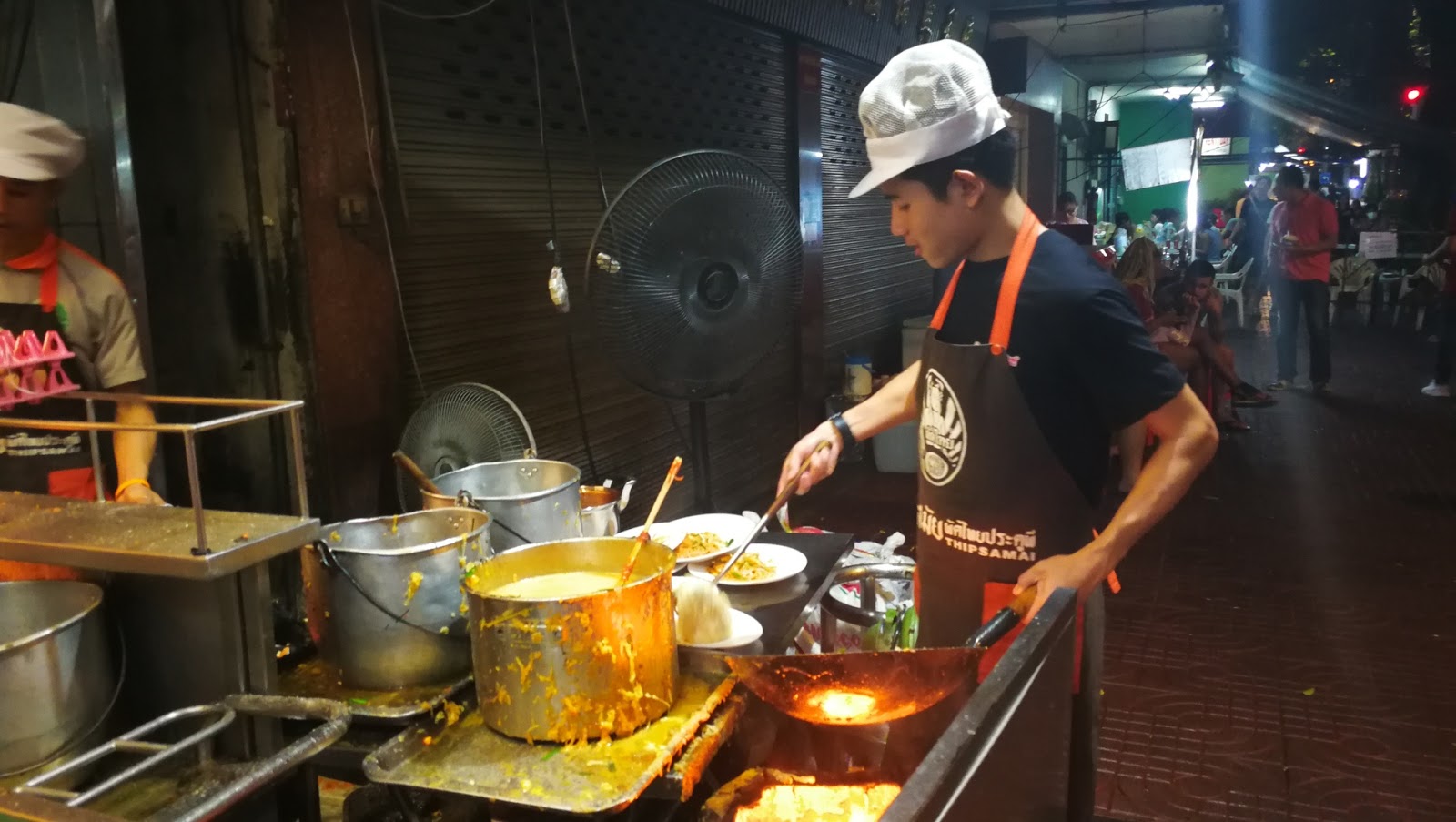
We went on a night time tuk-tuk eating tour to some of the city's most famous restaurants, local not fancy. This one for deep fried chicken had its kitchen in the alley behind the restaurant itself.
Even though Thailand is the next door country to Malaysia, there are huge differences starting with religion. 95% of Thais are Buddhists and you can see this everywhere. Apparently 441 temples are in the city and I can believe it. You keep coming across them everywhere. Some not so grand but all reverently cared for and respected.

The Temple of Dawn by the river with the late King (left), the late King's wife (middle) and the current king (right). Their pictures were everywhere in the city. All huge pictures too.
And respect is a word that could be used widely in Bangkok, at least from my vantage of 4 busy days of visiting, sightseeing, eating (particularly) and drinking with our friends Tracy and Norbert from Malta (but also ex-Bermuda hands). From the greeting that practically everyone does -- the two hands together plus bow -- to the respect shown for Buddha and their King whose pictures are simply everywhere, particularly the late King who ruled for a long time and was considered a man of the people.

But yes whenever I think of the King of Thailand I do always think of Yul Brynner and Deborah Kerr in The King and I. That was a wonderful movie with one of the classic movie lines of all time: "Dance after Dinner!" Just watch the movie and you will understand.


In that movie in the more serious scenes, few and far between I know, the undercurrent is clear that the King is fully aware that his kingdom is one of the few independent ones around. Every one of their neighbors is part of one empire or another and he is trying to make sure Siam as it was known then stays that way. Quite how that all happened is not clear to me even after reading my favorite go to knowledge site Wikipedia who sadly failed me in this question. Anyway, well done to him and his successors for managing it. No wonder the people revere their kings.

One popular connotation for Bangkok is sleaze -- girly bars and lady boys. In addition back packers and people that look as though they sort of arrived in 1970 and never left abound. This is strange to me as drugs are illegal and trafficking carries a death sentence but clearly people don't care and still come and stay in one of the endless back street hostels and get a tattoo and some body piercing. Why on earth would you get one of either of those in a grungey back street parlor where of course they sterilize their needles?

Oh yes, back to sleaze. I never saw a girly bar nor a lady boy, unless they were very good which I understand many are. We went to Khao San Road where endless westernized bars exist alongside mobile phone shops and trashy tourist souvenir shoppes. We also went to Pat Pong market which seemed to be grunge central alongside the massive night market selling trashy tourist items -- I bought some of these! I am sure they exist but just saying, we never found them.

What we did find were shopping malls. Endless and huge shopping malls. We didn't even go to the famous Chatuchak outdoor market. Didn't have to as there are so many others. All huge. All with massive hawker stands dotted inside and out.

On our food tour, the guide took photos so we didn't have to however  in every photo that included me, I had my head down in some dish or other! He could have said "say cheese" or something.
We also found traffic. Lots and lots and lots of traffic. Nobody uses taxis as they are considered untrustworthy. Rarely would they use a meter and would then charge a fortune for a ride. Particularly tourists. So people use Grab and Uber and of course the tuk-tuk. They also use the motor bike taxi which is not for the faint hearted as no helmet is provided and like I said there is lots and lots and lots of traffic. Also did I say that nobody pays attention to little things like road signs, give way notices, traffic lights... and as for the dividing line in the middle of the road. Chicken!

Chinatown just before Chinese New Year was thronging with people and traffic. I asked the guide if it was due to CNY that it was so busy and she said "no, its just Tuesday". As in on any day the crowds are like this...
One night we were planning to go our for a dinner to a place in the centre of the city -- we stayed in the old part, near the river -- and our hotel first asked why we wanted to go there as there were loads of great places nearby, then said it would take us an hour and a half to get there by taxi because of the traffic, and then offered to make us a local reservation. Our Uber took 20 minutes! I know it depends on your luck as on other occasions it did take a while but never that much.

And then there's the bugs! I suppose it is a 5 million person city so you should expect there to be 5 billion bugs. But did they have to all decide to eat me that one night?

I counted over 100 bug bites on both my legs from that one night sitting out by the river at night!
Brilliant city though. Loved it and am looking to return!