Showing posts with label World War 2. Show all posts

Sunday, July 10, 2022

The Odyssey: Athens Day 1

We'd caught a latish flight from Heathrow to Athens where we were met by Yiannis, the guy who would be our driver up and down Greece for the next 19 days. He dropped us off at our hotel in central Athens where we'd had dinner in the roof top restaurant which had a great view of the Parthenon. 


My notes are from a diary kept at the time. This is what our itinerary for the day stated:

22 May 2022 -- Arrive in Athens at different times and meet and greet by our English-speaking driver and transfer to your hotel.

22 – 26 May -- 3 nights at Hotel Athens Gate (4 *) – 1 double superior room with a view to Temple of Zeus and breakfast.

***


Busy day today (23/5), our first in Athens and all unplanned. Early start too, straight after a really rather blah breakfast at the hotel. 


Nice location though. Opposite the Temple of Zeus and just turn left and left again and there is the Acropolis. We have a tour there tomorrow so today is for exploring the streets. 


The Temple of Zeus from our balcony. Almost everything is under restoration.

What's a Greek Urn? This is.


The Athens Gate Hotel is on the outskirts of the Plaka district. Very touristy but jammed full of ancient buildings and ruins. The whole city is full of them. Our general aim was to start at the Roman Agora or Forum and go from there.


Our fantastic tour hats that we bought immediately. We melded right into the local environment wearing our tour hats. It was only when we chose not to wear them that we got picked as tourists.

Typical touristy stuff!

Athens has 4 million people and the same number again in tourists, many from cruise ships. Ok that’s an exaggeration but it feels like it. This was Sunday so it wasn’t so bad just bimbling around. 


Athens and of course Greece has a very rich history. Birthplace of democracy, Alexander the Great and of course the Spartans!!!! But if I have my history about right, Greece hasn’t won a war since Alexander and was occupied by conquering nations between the late first century BC and 1821 when a coalition of western nations helped them gain independence from the Ottomans who had occupied the country for 400 years. That’s about 2,000 years of being occupied by someone or other. Not Greek. 


First it was the Romans. The great general Sulla sacked Athens in 87 BC and that was about it for the Greeks for some reason they thought they could slide out from under Roman rule in Augustus’ time and discovered rather rudely that that was not the case. 


First the western Roman empire, then the eastern empire after the split in 330 AD. They morphed seamlessly into the Byzantines until 1456 when the Ottomans overthrew the empire and that stayed the case until 1821. 


Since then I don’t believe that the new Greek republic has won any wars. They joined the Allies in WWI almost by accident. The king was pro-German, the PM Venizelos was pro-Allies. The British and French landed in Salonika anyway so the Greeks almost reluctantly joined in. That gave them a seat at the table in Versailles, but not an important one. 


They attacked the remnants of the collapsed Ottoman Empire in Turkey in 1919 seeking territory in Asia Minor and were resoundingly beaten by the new Young Turks of Kemal Attaturk. The loss of all the age old Greek cities in Asia must have been hard to take. 


The Italians invaded in 1941 but were resoundingly beaten back by the Greek army forcing Hitler to divert the Wehrmacht through the Balkans and into Greece fatally delaying the start of Operation Barbarossa for 6 weeks.


When the Germans withdrew in 1944, that was the signal to start the Greek Civil War which stretched on for several years. Greek fought Greek (again) but this time it was Communist versus Democrats. With much help from the USA and Britain, democracy won in the end. 


The king was voted out in the 1970s after an army coup, and the country is now a republic. Anyway back to Athens…


We walked nearby Plaka and passed by several monuments and Byzantine churches on the way. Streets are of course narrow and windy and hilly so it wasn’t all plain sailing. Then we reached the Roman Agora. Obviously not as big as in Rome but then again the Greeks had one already so all the Romans did was adapt what was there and make a few tweaks. 


The Roman Agora

The Greek version is huge. But then again they’d had a couple of millennia to get things in order of which the last 500 or so years related to their ‘golden age’. The age of democracy. The age of when the Greeks were the top dogs. This was the 500 or so years between 600 BC and the Roman conquest.


I really liked the Tholos, this is the small round building that held the 20 or so decision makers that ran the city state of Athens for 35 days before passing the job off to one of the other 10 tribes of Athens. This was the democracy that ruled. Everyone had a chance to be ruler for a day.  The building doesn’t exist any more but the foundations remain. The building is tiny yet so important.


The Greek Agora extends over a really huge area in the midst of which is a roadway that was used amongst other things for the annual processional during a religious festival all the way up to the Parthenon, where all the other temples were as well.

This temple is in much better condition than the Parthenon on top of the Acropolis (hill on top of the town) and is in the Agora

If you like ancient history, this is the place. Just like Rome except it is older and  as the Roman travel writer I’d read in Rome a week earlier said from a 2nd century travelogue the Romans did drains and sewers far better than the Greeks even though the buildings could be pretty impressive. As for the aqueducts….


In one of those did you know moments, we learned that statues of Roman Emperors like Hadrian here (in the Agora) often didn't have the correct head. This is because the sculptures were tricky to make so the heads were swapped once the Emperor died and the new one's head was affixed. The head was therefore simple to lift off. They know this is Hadrian because of the statue's armour and the fact that he loved Greece very much, or rather one particular Greek boy, and visited the province three times during his reign. He didn't build a wall though but did arrange for lots of aqueducts.

The Romans loved the Greeks and identified with them strongly even though they considered the Greeks to be wimps by the time they’d taken over. Every Greek God had a Roman equivalent. The mark of an educated Roman was the ability to speak Greek. Many if not most serious teachers of wealthy Romans was a Greek scholar, often slaves. Yet the Romans also knew they were superior and patronised the Greeks accordingly.


Almost everywhere in Greece had a statue of Hercules doing something or other, mainly in connection with his 12 labours. Statues always had a lion skin (one of his labours) somewhere assisting identification.

The Greek Agora is the place where all activities in Athens took place. Start to finish. Rich or poor. Noble or slave. Truly a unique place. The remains are very impressive yet modernity wasn’t far away as today the Metro goes right through the middle of it. 


We spent several hours in all this and felt the need for rest, recuperation and refreshment to be in order and selected a lovely looking cafe for the task. Antica.


Beer was cool. Moussaka was hot and satisfying. Greek salad was immense chunks of everything topped with a vast slab of feta. Just great!!


Viv discovered the delights of ‘Freddo’ Espresso. Essentially iced coffee but done differently with style. Simply but differently made. Two shots of espresso plus a few chunks of ice and a bit of sugar in a blender. Whizz a while and you get a coffee confection with a mass of foam at the top. Pour over ice into a Whisky tumbler and voila!! Really nice. 


We also visited the central market to check out the fresh fish and meat. Very interesting and the produce looked great! 


After this we bumbled back checking out various stores along the way as we had to meet one of the tour guides from the firm we’d used to arrange the trip. The message we had at the hotel when we got back said this meeting couldn’t take place at 5 pm but at 7 pm as something had come up. We couldn’t make this so rearranged till tomorrow and went out for dinner.


There is a central theme developing here centring around eating and drinking! We found a road side restaurant in Plaka nearby which provided Greek wine, ouzo and vast amounts of Greek meat. We couldn’t leave until we’d tried and tasted everything in the house…..


The reason for the blur. It is normal for Ouzo such as this to be served in 200 ml bottles as opposed by the glass. It doesn't travel so you have to finish it...

The rest of the day was a blur!


Great day.


Wednesday, March 18, 2020

Visitors Volume 1


In early January, we'd just returned from spending Christmas in Canada with Dee Dee and the following day Viv's mum Anna moved in, swiftly followed by Viv's uncle Dick a day later. This is Dick's first visit and he hadn't seen Anna for several years. 

It was just before Chinese New Year started (which began in the last week of January and lasted 2 weeks this year). It is the Year of the Rat so everywhere was highly decorated with what looked to me less like rats but more like cuddly-ish mice so everywhere was very pretty and as it is the new year, pretty much everything was cleaned up too.


We did a lot of stuff! 

Georgetown's UNESCO World Heritage Centre was decked out nicely and after a nice walk and some lunch one day we went to the Sun Yet Sen Museum in Armenian Street.

Sun Yat Sen was the father of the Chinese Republic and amongst other places lived for a while in Penang. The object of that really was to raise funds for his next rebellion. He was involved in several unsuccessful ones as well so was a person of interest for the Chinese who after a little while objected to the British about his rabble rousing presence in Penang, whereupon they asked him to move on. In all, he was in Penang for less than one year.


Fascinating museum. Small but amongst it all, you get to learn a bit about Sun Yet Sen the man too, in particular his lady loves which were described in some detail rather surprisingly. Most know him as the revolutionary not the lover, husband and all the rest. However, he was very active and traveled everywhere trying to raise interest and of course funding. One exhibit was set aside just to this; how much he raised and in which country. Remember this is back at the turn of the 20th century so the amounts are of course smaller but the country which provided the most funds for his struggle was..... wait for it.... Canada! Who'd have thought?  

Very nice museum housed in a lovely shophouse in Armenian Street. Well worth a visit!

Viv's tennis friend, Lee Pin, asked us out for a day trip over to the mainland in Butterworth to visit a Chinese temple that was both huge and beautifully decked out for Chinese New Year. We'd never really been to Butterworth other than on that occasion when we'd taken a wrong turning and were headed towards the docks so were keen to check it out. Basically it's just one Main Street with a temple at the end. Big temple though.


Lee Pin had organised a dinner at a restaurant on the beach at Batu Ferringhi with a special dish she wanted us to try (Duck and Yam soup) after the temple but before that she wanted us to try the 'best ' local Rojak. Now when a Penangite says that such and such is the 'best' it of course means in their opinion which again is of course reason enough to try it out. Viv and I had eaten rojak before but not Anna and Dick so this would be all new to them.

The famous rojak kopi (coffee) shop
Rojak
The place was a coffee shop in the middle of Butterworth. Coffee shops like this are where the locals go for dessert and of course the local incredibly black coffee. Beans are roasted in a special way so that the beans are coal black as is the coffee. Not terribly strong but with a definite flavour to which is added condensed milk -- that's for the black coffee which apparently without the condensed milk is rather like engine sump oil. For the white coffee, you add evaporated milk to the mix. Did I mention sugar? Lots of that too. The experience leaves quite a film in and around your mouth for quite some time.

How to describe rojak? It is a popular dessert hereabouts. Take cut up chunks of fruit and raw vegetables and cover it with a sweet and sour but something else thick, sticky, gooey gloop and sprinkle with ground nuts. It is a curious taste to be sure, and not unpleasant. 'Interesting' was a word I heard quite a bit from Dick and Anna.

On the way back we stopped off at the snake temple near the airport for a brief visit. Snakes were everywhere although thankfully not crawling around too much. Just sort of lying there and writhing. I think they all came around one day and nobody cleared them out, so the snakes stayed.


I'd driven through Batu Ferringhi often enough. It's where the tourist resorts are located but as the beaches are pretty awful and the water very muddy brown with pollution and run off from farming on the mainland, we never had any intention of going to the beach. Not after Bermuda anyway! However the restaurant we went to was right on the beach and it turned out to be actually.... really rather lovely: the beach not the water. As was the duck/yam soup and the meal overall. Thanks Lee Pin!

Sunset on the beach at Batu Ferringhi
We also decided to take Dick to the Blue Mansion in Georgetown. He is keen on history and heritage, or at least he said he was so we made sure to load him up on it.

The Blue Mansion
The Blue Mansion is simply extraordinary. The original house was built and lived in by a Chinese guy called Cheong Fatt Tze. A true rags to riches story, he started out as a coolie labourer in Indonesia in the 1870's where he made his first great move: he married the boss' daughter and took over his trading business. 

He was really good at it and moved to Penang because the British were there and more trade was possible. He was into everything, built this mansion and became the wealthiest man in China towards the end of the 19th century. The Emperor even appointed him as special counsellor making him the 3rd most powerful person in China even though he didn't live there. We went on a tour of the mansion which has been massively renovated after it became derelict during WWII when the Japanese arrived. They persecuted important local Chinese people and Cheong's heirs (he was dead by this time) received no favours from them and had to rent out the mansion to several hundred squatters simply to survive. The result was dereliction and the mansion was abandoned for years until private money acquired it and turned it into this lovely museum.

It has been a movie set many times including movies based on the life of Sun Yat Sen but more recently of Anna and the King of Siam. Because the Thai government felt that the movie disrespected the royal family, they refused permission to film in Bangkok so the movie used the Blue Mansion and more generally Penang as the site location for the movie.

Another outing, although not so long but still pretty onerous was visiting the Kee Lok See temple at Penang Hill. It is the largest such temple in SE Asia. For Chinese New Year, they always garland the temple and grounds in flowers, lights and all the other ornate stuff that goes with Chinese New Year so at this time of the year it is definitely worth a visit. Lots of stairs but very worth it.

The seven storey pagoda is a key point in the temple
I think Dick was exhausted by the time he left!!


Wednesday, November 20, 2019

Life and Death in Penang, well mostly Death really

We just came back for a trek that took us round the world, rather to our surprise. It just happened that way. We wanted to be with Indy and Cat when their new baby was born (our first grandchild!!) and then we sort of just carried on. I will write about that in a separate post but during our trek we for some reason realised that we have just done maybe two things as a tourist/visitor in the near two years since we arrived in Penang. OK we had sort of planned it this way thinking that we'd go with visitors, but when that happened we .... well didn't. Whoops and all that. So we decided we'd do something about it when we got back.

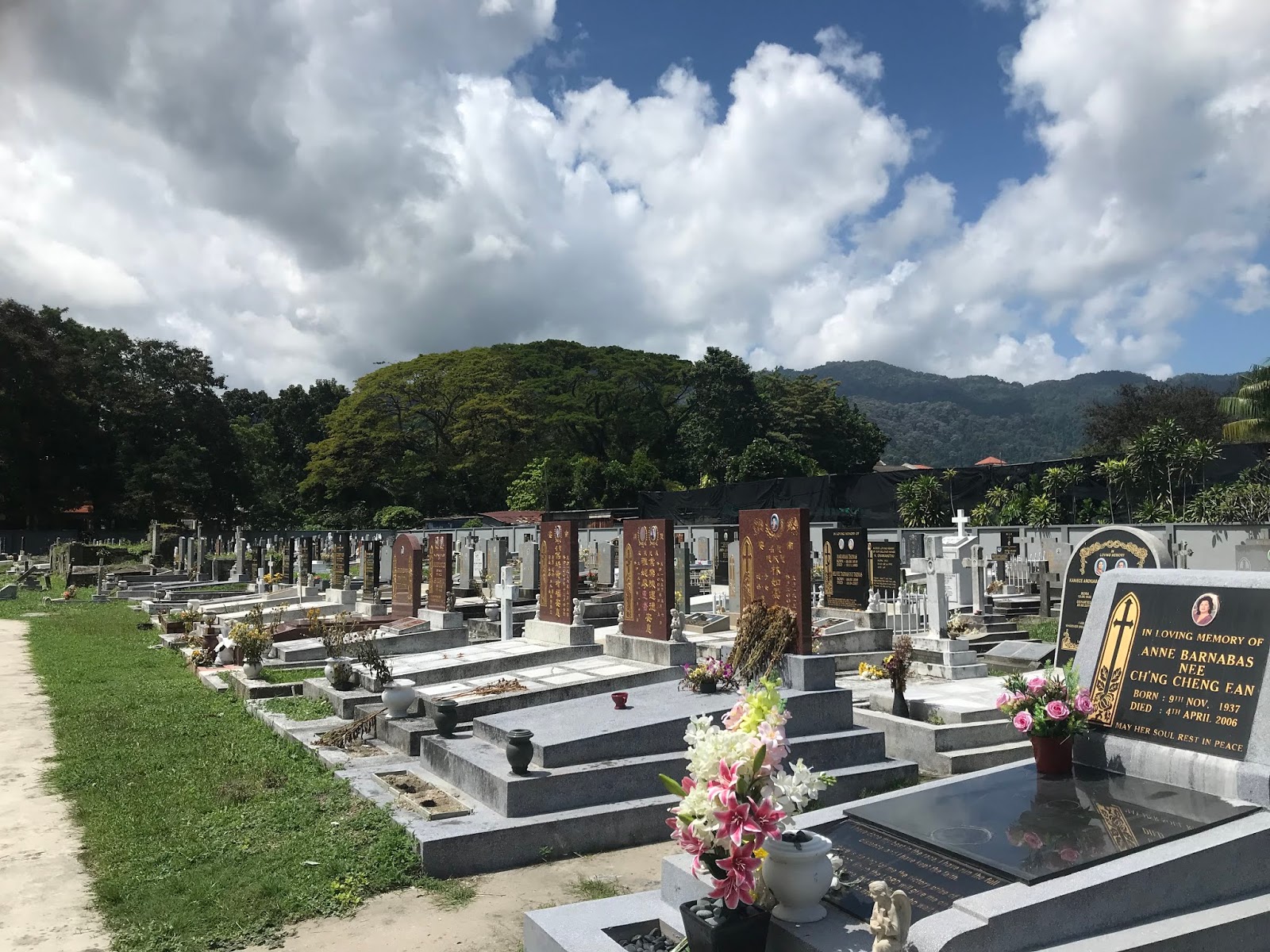
There's a monthly newsletter sent around by mailing list by a long time resident English lady named Michelle who just loves this place and just loves organising things, or so it seems to me. Anyway first up was a tour of the old graveyards in Georgetown narrated by a guy we'd run into one of our other tours, Clement. Very informative it was too. Particularly as Georgetown has magnificent colonial heritage dating back to first inhabitation in 1786 under the purview of one Francis Light and his employers, the East India Company.

Francis Light only lasted 5 years in Georgetown before he succumbed. He didn't want a fancy gravestone so was originally buried very simply but about 100 years later in full Victorian vanity, the local burghers upgraded him to this one.
Back then of course the population was tiny and the first settlers started in the area of the harbour from where the town expanded outwards. However small the population was did not deter the onset of death for this is the tropics, aka the white man's grave. So graveyards were needed and needed fast. Immediately however rose a problem... what to do about the catholics.

The Jackson family was particularly unfortunate
Sounds ridiculous today, but really does it? Back in the late 18th century, church was much stronger than today and from Great Britain it was solidly protestant, and in the early days solidly Church of England (CofE). The laws of the land (now including Penang) discriminated actively against catholics primarily via the Act of Settlement which prevent catholics from holding any high office (still do as this Act has never been repealed). The law itself is a hangover from the end of the Stuart era and start of the Hannoverians, which in itself is a longer hangover from the Civil War, and was aimed at securing royal succession in Protestant hands as both the last Stuart Queens (Mary and Anne) could not keep any of their children alive whilst Dad (the ousted James II) and his catholic heirs had no such problem (remember Bonny Prince Charlie?). Check it out on Wikipedia here for the fuller story. Anyway when the couple of hundred first colonists/settlers arrived, they included both protestants and catholics and the local bacteria and other bugs had no problem getting stuck into the pair of them irrespective of religion. So graveyards.

First, there was a sort of NIMBY thing regarding graveyards so they were set aside well out of town (then anyway, not so now) and on land that was rather low lying that nobody really wanted to build upon anyway. A wall was built delineating the protestant side from the catholic side with the lower land (and hence far more prone to flooding) given over to the catholics. Typical.

The very ornate gravestones apparently are all Scottish families, but you can see the wall in the background
Second, what to do about all those others who also showed up? In addition to the original settlers came traders from other nations as well as people from the mainland and elsewhere seeking work in the new bustling trading entrepôt (which immediately shut down Malacca as a place of importance). The Dutch retreated (actually they were ejected) to Java, their possession. Nearly forgot and backing up a bit, when the Dutch originally arrived in the early 16th century, they kicked out the incumbent Portuguese who were/are catholics. In the 150 years or so that the Portuguese had been in Malacca and elsewhere they had intermarried so virtually everyone was Eurasian by now and with the Dutch persecuting catholics, they simply left with many going to Phuket where by coincidence they met with the same but younger Francis Light who later founded Penang. He took up with a Eurasian girl (probably married her but this would have been a social gaffe of the first order back then, so he said nothing about it to his employers) and when he came to Penang and saw how many new settlers were catching everything going and dying in droves, invited the Phuket Portuguese to come along and pad out the numbers again.

Aaaagh! What a palaver. All these catholics but at least this lot were almost European. Can't have any of the new locals in the graveyards too.

Third, some of the locals (Chinese, Indians, Armenians, etc.) turned out to be terrific businessmen and did really well becoming extremely wealthy in the process. It also transpired that they were prone to dying too (although not so young as the newbies).

The upshot to all this was the typical British muddle/compromise. If you had the wherewithal, you were in.... except the catholics who went the other side of the wall.


However the Japanese were no respecters of well, pretty much everything if you read about their actions in WWII and simply bombed the place to bits.  Part of it anyway. The Catholic side was locked up so we couldn't go inside but looked pretty much empty of gravestones. If it wasn't the bombing, it was the flooding most like. No, most likely the protestants!

Spare a thought for the Jews though. They had been in Penang since the start but in far smaller numbers. Clement said the Jews that came to Penang were from the Middle East not Europe. Turkey, Persia, Mesopotamia. They were/are a different tribe to the Europeans and had their own ceremonies and ways. Francis Light when he set to creating Georgetown created enclaves for the various races and sects. The Jews had their own together with one synagogue and one graveyard.

The different Jewish tribes have different burial traditions. Some of the gravestones are triangular, some rounded. All are supposed to point towards Jerusalem.
All gone now. The Jews left after the Seven Day War in 1967 for Israel, the synagogue closed but the graveyard which was slated for redevelopment was saved by private donations (as it is to this day). It is maintained by an Indian family and remains beautifully cared for. This ensures that people don't break in and desecrate the gravestones (which did happen in the past).

These days the main Christian graveyard is on Western Road and is pretty huge. Again the theme throughout is that they are beautifully maintained. Clement tried to raise some enthusiasm for this graveyard but in reality it was far less interesting than the older ones. Exception being the mausoleum remembering the crew of a Russian warship which had the misfortune to be visiting Penang at the outbreak of WWI. A German raider, the Emden, snuck in at dusk one day and sunk the Russian vessel with heavy loss of life. Thankfully not the captain... he was tucked up in bed at the E&O Hotel with his mistress. History relates that he was recalled and court martialled. Every year the Russian ambassador visits the site where a remembrance ceremony is held on the anniversary of the action. Clement said this happened even during the Soviet era. Nice.

By now, all were going through graveyard fatigue so clearly this was the time for the visit to the new catholic cemetery. Typical protestant bias! I've driven past the graveyard a hundred times, its on a main road, but had never seen it before so this was nice.


The names were mainly Chinese with a few Portuguese names like De Silva and Perreira thrown in for good measure along with some Indian and western names. But really... no trees! In every other cemetery there were lovely trees giving pleasant shade but here... nothing! Hope some get planted soon.

Saturday, April 20, 2019

Not our war, mate

Quite a few points to ponder coming away from Sabah/Borneo unrelated to cute jungle creatures, rather the nastier aspects of history. In this case WWII. It is my age, I know, and background that gives me this interest in this time of history. For both my parents, it was the defining part of their lives. Had WWII not happened, there would have had to have been some extraordinary circumstances and coincidences to have taken place for me to be sitting here typing away like this. Anyway this is my blog, so there!

When big history remembers WWII, it is the western front and D-Day, the US' staged jumps through the Pacific islands and the Soviet march to Berlin. Rarely do people remember all the rest. That is why the army that conducted the Allied Burma campaign was referred to as the 'forgotten fourteenth' and General Slim is all but forgotten/ignored despite his record of almost unblemished major victories. So who remembers Sandakan?

What? Who? Where?

This is the top right part of Borneo. In WWII there were no roads in the interior, just jungle trails. Everything that moved, moved by sea. The Death Marches of 1945 went in virtually a straight line from Sandakan to Jesselton... but none got there

It is difficult to visualize if you don't know where it is so hopefully the map helps.

The Japanese landed here very soon after the first landings in Malaya and were as successful as quickly as on the mainland. Borneo was considered a source of raw materials for Japan after sanctions were imposed by the USA and Britain over atrocities in China by the invading Japanese armies choked off the supply of oil and other raw materials. Japan has virtually zero natural resources so imports everything. On the other hand, oil, timber and a host of other raw materials are to be found in abundance in Borneo and elsewhere in the region. Hence the notion of the 'Greater South East Asia Co-Prosperity Sphere' -- what a euphemism! Chairman Mao didn't have to look far for inspiration for his little red book!

As is documented elsewhere, the Japanese were awful colonial masters. Terrorising, torturing and killing virtually anyone they came across, it must have made for a shocking time for the local population of whom one in six were killed during their less than 4 year occupation. As for the POW's who were shipped in and housed at a camp at Mile 8 (outside Sandakan town and into the jungle), their job was to build a runway for the Japanese Air Force. Over 3,000 mainly Aussies plus also British had the job but did it (deliberately) so slowly and inefficiently that by early 1945, it was clear to the Japanese that even if the airport could be commissioned, it would never be used because of the dominance of Allied air power. So they stopped work, burned the town to the ground and marched all the POW's out into the jungle in a series of Death Marches and massacred them all. Only 6 survived (all Aussies) because they were able to escape and were helped by local people which is how this story is known. Who knows where else in the Co-Prosperity Sphere did this get repeated but with no witnesses?

The survivors
But seemingly this story is known only in Sandakan (and of course presumably in the families of the dead).


We only learned the story because we visited the memorial with a group of Germans as it turns out. Both Viv and I were riveted by the sad story but the Germans were in and out in less than 10 minutes. Not their war. Theirs was probably worse by a magnitude. But it did make me wonder because all of this was fully known and a number of Japanese were tried for war crimes and executed, just why is it that the world excoriates the Nazi regime (totally justifiably) but pretty much gives the Japanese a pass? Is it because 2 atom bombs were dropped and people feel guilty about that? For I certainly don't. The Japanese would have fought to the death. At the time of the surrender there were 2.5 million Japanese soldiers still under arms and given the experience throughout the Pacific campaign, there was no chance they'd simply surrender. Allied plans called for at least 1.5 million US and British troops to take part in the invasion of Japan with the transfer from Europe already taking place... Including my mother who was an army driver and had received her posting instructions to 'somewhere in the Far East'.  Bloody Hell, Mum!

Anyway, I now know and I will remember.


Friday, December 29, 2017

Danubia

There's a brilliant book written by Simon Winder that provides a marvellous history of the countries, cities and people that inhabit the regions around the Danube in central Europe and at the same time provides a historical perspective of the old Holy Roman Empire and the Hapsburg family that ruled the Austro-Hungarian Empire until the cataclysm of WWI brought everything crashing down.


I read it voraciously and couldn't wait to visit the area now that the Iron Curtain is no more so when Viv and a friend said they wanted to visit the Christmas Markets in the area, of course I wanted to be a part of it. Particularly so when Viv said the itinerary would be Budapest, Vienna, Salzburg and then Prague.

At its peak, the Empire had over 60 million inhabitants and covered a vast area of central and eastern Europe. The economic powerhouse was Hungary... when it had Transylvania. The manufacturing powerhouse was Bohemia.
I have written a detailed blog tracked on the marvelous Track My Tour app which you can read here but plenty didn't make it to that blog hence this ramble.

Budapest is only 2 1/2 hours from Heathrow but courtesy of 50 years of the Soviet yoke it seems light years behind, except that isn't the right word. Western Europe has had 50 years of Marshall Plan stimulus followed by growth whilst the nations behind the Iron Curtain simply stopped dead. The catastrophe of WWII when the Nazis turned the city into a Fortress City (Festung Budapest) condemned it to almost total destruction. Our tour guide said that 70% of the city was destroyed in the process of 'liberation'. The Germans used the castle on the Buda side of the city as a base and consequently great aiming point for the terrible Soviet artillery.

Nearly half a million people died in this final battle. This is the Royal Palace. It still hasn't been restored.
One of the things I love about Wikipedia is that it provides massive amounts of insights nobody ever teaches you at school. My history taught me nothing about Hungary, Czechoslovakia or any other of the Iron Curtain countries other than the fact that the 'liberating' Red Army took them over and the Iron Curtain was created. Sort of makes you wonder if there was a specific desire to re-write history and gloss over the fact that the Soviet era was just as bad if not worse and regrettably much, much longer than the Nazis in Germany. The Yalta Conference was all about the Soviets getting what they wanted from a sick and ailing FDR and a marginalised Winston Churchill who could realistically do nothing to thwart Soviet intentions. With the fall of the Berlin Wall and the end of the Soviet era, much new information has been learned and more importantly disseminated so that nobody can gloss over the unpleasant facts any more. Or rather shouldn't.

Historians agree that it was the Treaty of Versailles in 1919 that essentially paved the way for the rise of the Nazis in Germany, but it was also the catalyst for the right wing, ultra-nationalist regimes that spread across the new nations created by the dissolution of the Austro-Hungarian Empire after WWI.

Hungary lost all the green parts, some 75% of its previous size.
Hungary, for example, lost 75% of its territory including the ultra important province of Transylvania which provides practically all the natural resources of the country. Yes, that one. The same as the one popularised by that guy in a cloak with funny teeth, violent habits and curious taste for blood. Its intra-war government was right wing, just as annoyed with the Treaty of Versailles and favoured the Nazis to the point of formally allying with them and joining their armies with the Wehrmacht in Russia, Yugoslavia and elsewhere.

The very brief rewards of being allies with the Nazis.
The Soviets therefore in their advance during 1944 showed little mercy. Over 900,000 Hungarians died in WWII, two-thirds civilians, and in the immediate aftermath over 100,000 ethnic Germans were deported to Siberian labour camps (few returned) and an additional 600,000 were 'transported' to the Soviet Union for what was termed 'little projects' -- massive rebuilding projects to repair war damage. Only half survived to return to Hungary with the final 'volunteer workers' only returning after Stalin's death in 1953. This is a staggering event in the history of a country of fewer than 10 million inhabitants.

All of this is dealt with by the House of Terror Museum just up the road from our hotel on Andrassy Ut, the main street of Budapest, equivalent to the Champs Elysee, Oxford Street or 5th Avenue. The building is eerie and fobidding as is the subject matter covered by the museum -- far more of the Soviet era than the Nazi era which was comparatively short as the countries were in fact allies for much of the time. I had the same feeling as when Viv and I visited Dachau which is in a lovely, very green suburb of Munich right next to people's back gardens. But for me (and I do reiterate that this blog is my story, not a history book) all that took place in WWII was before I was born and is therefore history to me, albeit very recent history. What transpired behind the Iron Curtain in the Soviet era took place when I was growing up listening to the Beatles and the Grateful Dead thinking of nothing more than love, peace and happiness and making the world a better place. For the people there it was all about survival each and every day. They couldn't even begin to hope to plan as I could and as for the occupying forces, well the Soviets had zero need to build up these puppet nations. All they ever were were buffer states between the motherland and the west for the impending WWIII, so therefore completely expendable. This can be seen particularly in Budapest where war damage was never repaired, new building rarely if ever took place and on any street downtown, there could easily be a gap between row homes which had never been rebuilt or which had been turned into the now famous ruin bars.

The really interesting thing about visiting new places if you take a local guide is that they provide you with anecdotal snippets that don't make it to the history books or guide books but are those normal, day to day things that impact people. A particularly good guide can be a revelation. Our guides were terrific. Whether they are historically accurate or not, I don't know but they were certainly entertaining and if you're like me and like trying to piece together the why's and how's of places, even the smallest thing can be eye opening.

In Budapest for example, we talked about what Hungary actually does -- answer it doesn't other than agriculture really. Part of the reason for this is that they no longer control Transylvania, Romania does. And Romania was neutral at the start of the war and allied with the Soviets at the end. So no surprise that in the post WWII division of the world they got what they wanted. What Hungary does is agriculture and my visit to the Terror Museum was largely about the post war persecution of the farmers by the Soviets. Farmers were the closest thing to bourgeoisie in Hungary and the Soviets really focused their nastiest attention on the middle classes everywhere they were. As a result average earnings are around USD 400 per month today. That said, our guide and driver (Attilla, really) were very upbeat and well educated and spoke 4-5 languages.

We loved the place and cannot wait to return.

The difference between Hungary and Austria is enormous. Pre WWI, Austria even though it is the ancestral home of the Hapsburgs did essentially nothing. The economy of the empire was driven by Bohemia (maunfacturing) and Hungary (agriculture and whatever came out of Transylvania). According to our very humourous guide who kept on calling us "my dears" the Austrians were really bad at choosing allies for much of their history and were very much in favour of union with the Nazis despite whatever recidivist post WWII history may say. However they were still 'the West' and so in the post WWII division of Europe were lucky enough to come up on this side of the line... and so they thrived.

We really enjoyed Vienna. The Hofburg is a wondrous place and clearly the entire empire depended on the wise choices of one very strong woman at a very key moment in history -- the Empress Maria Theresa. Her father realising he had no male heir tried to get ahead of things and got all the interested heads of state around Europe to recognise his daughter as empress, something they changed their minds about the minute he died and which came to be known as the War of the Austrian Succession (in my history books anyway).

Pretty much all I remember is that there was something to do with a Captain Jenkins' Ear, the Prussians marched into Silesia (the empire's coal district so really important), King George II actually led British troops into battle at a place called Dettingen (the last time this has ever happened incidentally) and overall the British lost so had to give up a few possessions in the West Indies and India that they recovered only a decade later. Austria also lost a few possessions but importantly the peace treaty did ensure Maria Theresa's succession, particularly so as she got married and fairly promptly had 16 children, 10 of whom survived, 6 males in the total so her succession woes would not be repeated.

There was still time to nearly lose everything when the Turks nearly reached Vienna again but they prevailed with Polish help. Ha! And what did they do to say thank you? They, Prussia and Russia promptly 'partitioned' Poland between them! Ever heard of that phrase put not your trust in princes?

So much for just leaving it at 'Thank You'.
In the mid 19th century as the Ottoman threat had gone away, the then emperor had the city walls demolished and built the inner ring road that we see today. The land left over was sold off (mainly to Jewish merchants) which financed the building of the Hofburg to its current size.

Brilliant city. We want to return and spend more time there.

Salzburg was nice but the final highlight was Prague which is simply a lovely, huge medieval city. For some reason it did not suffer the same fate as Budapest in WWII and survived pretty much unscathed even though the Nazis wrought terrible oppression on the non-German people.  We didn't have the chance to visit many of the contemporary museums as the Castle on top of the hill in the centre of the city was so large and demanded our time.

The lovely Charles Bridge over the Danube
Our guide again was great fun and provided plenty of interesting insights but as with many people there are clearly subjects that you do not talk about. I think I found one and its all about the Sudetenland. I think. Certainly Slovakia.

In the map of the Empire at the start of this blog, if you look at the part that says Bohemia, think Slovakia and the Czech Republic for today. Back then it was all Czechoslovakia. Slovakia is the closest part to Germany and those reddish parts show where the 'German' population lived. The term 'German' is not what it means today as if you remember your history, German unification only happened in the 1850's and 1860's under Bismarck. Before that 'Germany' was dozens, if not hundreds of mini-states which together comprised a decent chunk of the Holy Roman Empire which became defunct in 1809 courtesy of Napoleon Bonaparte. This is why if you travel down the Rhine there are so many castles in the middle of relatively nowhere and comparatively speaking close together. They could be dukedoms, princedoms, archbishoprics or a host of other structures. As I said hundreds of them. Germanic was the loose term that held them all together in the same way as Italian related to the people that live in that republic today, in the past they weren't the same nationality at all. And that was how they wanted it too. In Germany, it was the Prussians who were the driving force and even they couldn't call the now unified 'Empire' Prussia, it would be Germany. So Germanic relates to ethnicity not nationality. (Simon Winder's previous book called Germania focuses on just this).


Austria is the orange part, Prussia the blue part. The smorgasbord of other colours represent the mass of other states and statelets that were subsequently swallowed up by Prussia
Hitler didn't care about the niceties, he just used it as an excuse for expansion and would have continued to do so if not stopped. Why Sudeten? I don't know I'm afraid. Today it is Slovakia and even though there was a bit of opposition to the move, it wasn't that severe. Any opposition that there was came from the Czechs who realised that Hitler wouldn't stop at just the Sudetenland (he didn't).

A couple of days ago I was reading an article on the BBC about the current Ashes Test match and for some reason went off on a tangent to look at something about the Timeless Test of 1939 which only ended because England had to leave to catch their boat home from South Africa (there can't be too many games in history where the team batting last and chasing scored 654-5 and didn't win but if there's a cock up to make, England will).

Wonderful quote from a SA player that he hadn't played in two many games where he'd had to have two haircuts during the course of play.
At the end of the article there were some headlines from major events that were happening at that time elsewhere in the world one of which was about Slovakia's ruling party allying themselves with the Nazi party line and philosophy. I wish I could find it again as I hope I have this right for it may be central to my story in that when I asked our Prague guide why after 500+ years of Slovaks being joined at the hip to the Czechs, mostly under the Austrians, that when the Soviet era ended it took about one minute and a half to decide to go their own way.

Her answer was that the Slovak language is flippant as are they as a people whilst the Czechs are serious as is their language, so why on earth would they want to be joined up to one another?

I think I am missing something here.

Prague today is doing slightly better than Hungary due to its manufacturing prowess but still lags the west and remains outside of the European Monetary System so doesn't have the Euro. It is a great place too and one that we want to return to again at much greater length. So much to explore and find out. So much more to enjoy.

Can't wait!