Showing posts with label Malacca. Show all posts

Wednesday, November 20, 2019

Life and Death in Penang, well mostly Death really

We just came back for a trek that took us round the world, rather to our surprise. It just happened that way. We wanted to be with Indy and Cat when their new baby was born (our first grandchild!!) and then we sort of just carried on. I will write about that in a separate post but during our trek we for some reason realised that we have just done maybe two things as a tourist/visitor in the near two years since we arrived in Penang. OK we had sort of planned it this way thinking that we'd go with visitors, but when that happened we .... well didn't. Whoops and all that. So we decided we'd do something about it when we got back.

There's a monthly newsletter sent around by mailing list by a long time resident English lady named Michelle who just loves this place and just loves organising things, or so it seems to me. Anyway first up was a tour of the old graveyards in Georgetown narrated by a guy we'd run into one of our other tours, Clement. Very informative it was too. Particularly as Georgetown has magnificent colonial heritage dating back to first inhabitation in 1786 under the purview of one Francis Light and his employers, the East India Company.

Francis Light only lasted 5 years in Georgetown before he succumbed. He didn't want a fancy gravestone so was originally buried very simply but about 100 years later in full Victorian vanity, the local burghers upgraded him to this one.
Back then of course the population was tiny and the first settlers started in the area of the harbour from where the town expanded outwards. However small the population was did not deter the onset of death for this is the tropics, aka the white man's grave. So graveyards were needed and needed fast. Immediately however rose a problem... what to do about the catholics.

The Jackson family was particularly unfortunate
Sounds ridiculous today, but really does it? Back in the late 18th century, church was much stronger than today and from Great Britain it was solidly protestant, and in the early days solidly Church of England (CofE). The laws of the land (now including Penang) discriminated actively against catholics primarily via the Act of Settlement which prevent catholics from holding any high office (still do as this Act has never been repealed). The law itself is a hangover from the end of the Stuart era and start of the Hannoverians, which in itself is a longer hangover from the Civil War, and was aimed at securing royal succession in Protestant hands as both the last Stuart Queens (Mary and Anne) could not keep any of their children alive whilst Dad (the ousted James II) and his catholic heirs had no such problem (remember Bonny Prince Charlie?). Check it out on Wikipedia here for the fuller story. Anyway when the couple of hundred first colonists/settlers arrived, they included both protestants and catholics and the local bacteria and other bugs had no problem getting stuck into the pair of them irrespective of religion. So graveyards.

First, there was a sort of NIMBY thing regarding graveyards so they were set aside well out of town (then anyway, not so now) and on land that was rather low lying that nobody really wanted to build upon anyway. A wall was built delineating the protestant side from the catholic side with the lower land (and hence far more prone to flooding) given over to the catholics. Typical.

The very ornate gravestones apparently are all Scottish families, but you can see the wall in the background
Second, what to do about all those others who also showed up? In addition to the original settlers came traders from other nations as well as people from the mainland and elsewhere seeking work in the new bustling trading entrepĂ´t (which immediately shut down Malacca as a place of importance). The Dutch retreated (actually they were ejected) to Java, their possession. Nearly forgot and backing up a bit, when the Dutch originally arrived in the early 16th century, they kicked out the incumbent Portuguese who were/are catholics. In the 150 years or so that the Portuguese had been in Malacca and elsewhere they had intermarried so virtually everyone was Eurasian by now and with the Dutch persecuting catholics, they simply left with many going to Phuket where by coincidence they met with the same but younger Francis Light who later founded Penang. He took up with a Eurasian girl (probably married her but this would have been a social gaffe of the first order back then, so he said nothing about it to his employers) and when he came to Penang and saw how many new settlers were catching everything going and dying in droves, invited the Phuket Portuguese to come along and pad out the numbers again.

Aaaagh! What a palaver. All these catholics but at least this lot were almost European. Can't have any of the new locals in the graveyards too.

Third, some of the locals (Chinese, Indians, Armenians, etc.) turned out to be terrific businessmen and did really well becoming extremely wealthy in the process. It also transpired that they were prone to dying too (although not so young as the newbies).

The upshot to all this was the typical British muddle/compromise. If you had the wherewithal, you were in.... except the catholics who went the other side of the wall.


However the Japanese were no respecters of well, pretty much everything if you read about their actions in WWII and simply bombed the place to bits.  Part of it anyway. The Catholic side was locked up so we couldn't go inside but looked pretty much empty of gravestones. If it wasn't the bombing, it was the flooding most like. No, most likely the protestants!

Spare a thought for the Jews though. They had been in Penang since the start but in far smaller numbers. Clement said the Jews that came to Penang were from the Middle East not Europe. Turkey, Persia, Mesopotamia. They were/are a different tribe to the Europeans and had their own ceremonies and ways. Francis Light when he set to creating Georgetown created enclaves for the various races and sects. The Jews had their own together with one synagogue and one graveyard.

The different Jewish tribes have different burial traditions. Some of the gravestones are triangular, some rounded. All are supposed to point towards Jerusalem.
All gone now. The Jews left after the Seven Day War in 1967 for Israel, the synagogue closed but the graveyard which was slated for redevelopment was saved by private donations (as it is to this day). It is maintained by an Indian family and remains beautifully cared for. This ensures that people don't break in and desecrate the gravestones (which did happen in the past).

These days the main Christian graveyard is on Western Road and is pretty huge. Again the theme throughout is that they are beautifully maintained. Clement tried to raise some enthusiasm for this graveyard but in reality it was far less interesting than the older ones. Exception being the mausoleum remembering the crew of a Russian warship which had the misfortune to be visiting Penang at the outbreak of WWI. A German raider, the Emden, snuck in at dusk one day and sunk the Russian vessel with heavy loss of life. Thankfully not the captain... he was tucked up in bed at the E&O Hotel with his mistress. History relates that he was recalled and court martialled. Every year the Russian ambassador visits the site where a remembrance ceremony is held on the anniversary of the action. Clement said this happened even during the Soviet era. Nice.

By now, all were going through graveyard fatigue so clearly this was the time for the visit to the new catholic cemetery. Typical protestant bias! I've driven past the graveyard a hundred times, its on a main road, but had never seen it before so this was nice.
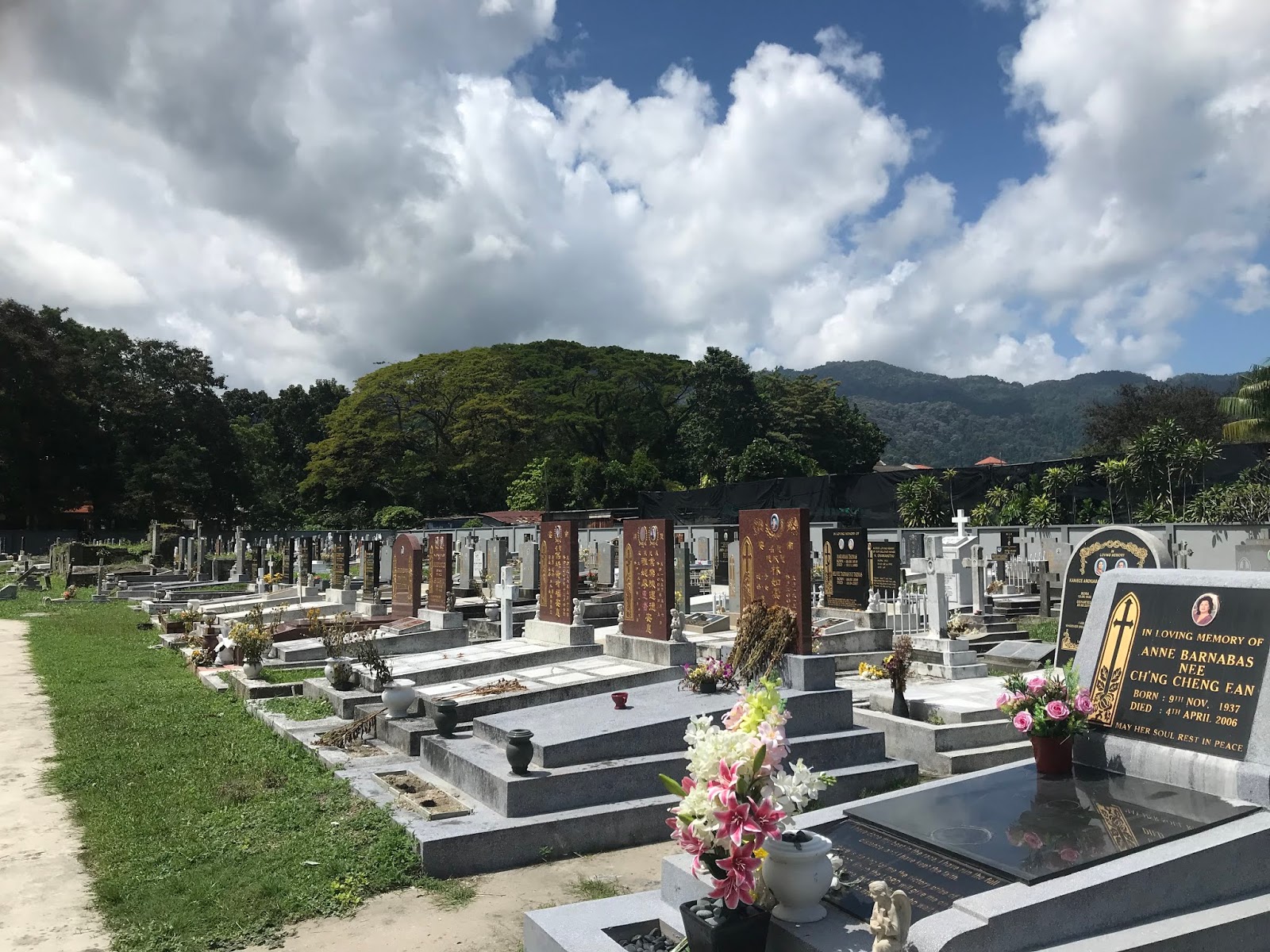

The names were mainly Chinese with a few Portuguese names like De Silva and Perreira thrown in for good measure along with some Indian and western names. But really... no trees! In every other cemetery there were lovely trees giving pleasant shade but here... nothing! Hope some get planted soon.

Wednesday, December 12, 2018

Another Road Trip


It has been a while since we went on another road trip from Penang ultimately down to Singapore via the orang utan reserve at Bukit Merah, Taiping, the Cameron Highlands and Malacca accompanied by our Bermuda friends Charmaine and Dave. I did the Track My Tour thing here but wanted to add some other bits as an afterthought.

Orang Utans

Everyone has seen these hairy but gentle apes on TV programs like the BBC's Earth or something like that and to my surprise we discovered that there's a refuge just over an hour away in Bukit Merah. I thought it was great as the apes are housed on an island but visitors are within a caged tunnel so you can view but the apes are free to roam. It is home to the early stage apes saved from death in the wild. There is another 2nd stage which gets the apes more used to fending for themselves and then its vroom, out into the big wide world.

The island at Bukit Merry

Except if you're a full grown male that is. The really big ones get to 200 kgs (that is huge!) and they don't much like moving around in the trees as that's a heck of a lot to swing from branch to branch. They also don't like the rain largely because they are massively hairy and if wet, that adds another ton of weight for them too. So all those pictures you see of those cuties swinging and playing are the tiddlers, before they are grown.

Growing up is tough too... and this isn't a comment aimed at the orang utans alone. It applies across the spectrum. They live in single grown male family groups and the only way for an adult male to live past a certain age is to kill the alpha male and take his place otherwise it is curtains for you! The one on the island comes in at a growing 145 kgs and he made it to number 1 by killing the former alpha male who was the 200 kg guy.

Talk about survival of the fittest. There must be an analogy to all grown males there somewhere.

Tea in the Highlands

One of the many things the British did during colonial times was to create hill stations. The Cameron Highlands is an example in Malaysia. Actually so is The Hill in Penang. At sea level it is hot and sticky and in past years, colonials may have ranked at the top of the social tree but they also ranked at the top of the diet for a multitude of bugs, bacteria and various viruses. You can see it anywhere there's an old church and cemetery. In Bermuda the big killer was typhoid and it seemed that almost everyone in the graveyard was less than 23. My doctor once told me during a physical that if I didn't die of a particularly nasty disease before I hit 70 that I should be OK for another 30 or 40 years. Not sure about that but I suppose that means if you have good resistance to fell diseases, you'll survive. At least from fell diseases.

The hill stations are particularly nice. Including Penang, I've now been to three (Penang, Cameron Highlands, Sri Lanka... the oldest) and I can certainly see why they would be popular. So much cooler, fewer bugs and great views. Also tea. Now of course tea isn't indigenous but introduced and even now it forms a massive part of the local economies. More in Sri Lanka than Malaysia but when we visited the Cameron Highlands, what is apparent is the massive scale of development. I should have thought about this before as every time you buy veggies in the supermarket here, all the local ones come from some Cameron Highlands farm or other.

Tea harvesting in action. No technology here

Sadly they are really, really ugly.

Endless greenhouses. They are everywhere

Tacky Stuff

I know that we are all sophisticated and would normally look down our noses at tacky stuff. I mean who needs another fake handbag or pair of Gucci shoes? We wouldn't go there, would we? Also who would want to ride around a Unesco World Heritage city that was one of the oldest European settlements in the Far East riding around in a floral pink trishaw decorated with little ponies also pink and a soundtrack of Asian rap?


Nyonya Cuisine

The term nyonya refers to Chinese immigrants who came to Malaysia during the 19th century mainly to work in the mainland tin mines or to escape one of the endless wars or famines prevalent in China. They settled and in many cases married locally and generally found they couldn't get the same ingredients for their cuisine as back home so they adapted to what was available locally... hence nyonya cuisine. The nyonyas are also known as Perankans and other names too, but this one seems to to be the one used mostly for cooking.

Some well known dishes have a nyonya twist. I am thinking of curries here and of course beef rendang is a nyonya curry varietal. So when I saw the chance of having a day of cooking classes, yes please!

Heavy coconut cream? Yup. Thanks Kathy, nyonya chef supreme

One thing we'd omitted to pay attention to was the fact that much nyonya cooking is really heavy so it was a little rash to expect to want to do anything energetic after eating as we'd originally planned. If you have the chance to try nyonya cooking, try it!! You do like chillies though, don't you?

Markets in particular Night Markets

One thing I have discovered here is that whenever guide books say such and such Night Market is a blast and shouldn't be missed, you should take that with a distinct pinch of salt. For sure markets and in particular night markets are busy places with hordes of probably mostly tourists scouring through endless stalls of vendors selling... well junk really. You may want a fake handbag for example or yet another little zip bag with elephants embroidered onto it, or some such like that. But you can go to daytime markets for that too. If you're expecting an authentic cultural experience, forget it. This is all about selling stuff to you.

The Jonker Street Night Market in Malacca was like that although the upside to all of these places is that the street food is fun, very creative and often very tasty. And at the end of the day, yes it is still pretty fun too. Remember that decorated pink trishaw I wrote about before? Well they also have fairy lights on them for nighttime so in addition to all the other stuff, they are a cascade of lights too!

First take wooden satay sticks about 8 inches long. Lay them in what looks like a waffle press like this but in the specially crafted grooves. In the little holes that are under these grooves, crack small quail eggs and wait for a second or two et voila you now have a yummy snack of 5 cooked quail eggs on a stick that you can drench in your favorite chilli...

Cricket

There's a guy at the Penang Sports Club, John, who is a long time ex-Singapore hand and at some point was the President of the Singapore Cricket Club. Now I've been playing cricket for over 50 years and know quite a few club presidents. Most are nice guys but have had a history of presiding over, say, Leigh on Sea CC whose pitch is one of the two connecting pitches on the big field at Chalkwell Park in Southend on Sea. My home town. It has a nice elevated view of the Thames Estuary too but can in no way compete for the location of the Singapore club. My goodness. It reminds of the story of the rollers at Centre Court Wimbledon. The lovingly maintained grass courts depend on this big, heavy roller to keep the surface so pristine and one year someone asked to borrow the roller for Court One. The groundsmen said OK, hasn't been asked for before and then tried to move it over discovering in the process that the roller was too big for the exits. It simply could not be moved from Centre Court. This caused much head scratching until the early records were consulted and it was discovered that because in the old days there was no lifting mechanism capable of moving the thing far away from Centre Court, they simply built the stadium around it. Yes folks, the roller came first.

It strikes me that Singapore CC is very much the same. It occupies an unbelievable location on the Esplanade and if you know Singapore and can visualize the sky scrapers and development in the city, you'd be amazed that such an anachronism could still exist. But exist it does and it is, yes, right there in the middle of the most expensive, most exclusive, most desirable, most demanded part of town. I guess they simply built the new city around it.


IP Theft

My school in Southend was called Eton House and was for some years after I left school the cause of much confusion. At one interview when I was I think 21 or 22, the first thing I was asked was "who do I know from my school days?" Well of course I know loads of people: Pete, Kev, Gary, Ronnie. It took a little while for me to realize that the interviewer was looking for something else. As in which member of the royal family, nobility or political class was I at school with? It made me laugh sort of (I didn't get the job as after I explained and we all dutifully laughed, they lost interest completely) as I knew that our Headmaster (and owner of the school) chose the name in 1926 specifically for this reason. He felt that Southend School for Boys may not have had the same cachet and PR hook as a vague and unexplained Eton connection.

In Singapore! Bloody cheek!!

He was an interesting character all by himself. His nickname was Bubble as that was what his bald head looked like in later years but his name was SHT (before the acronym became tarred by another similar word made by inserting the letter 'I'). His twin died in WW1 and he took part in the Los Angeles Olympic Games as a 400 meter runner ("too upright, see, so no good, flagged at the end due to me gassing at Loos in 1917"). He was an unforgettable character!

Management on Steroids

I think you either love or hate Singapore. Maybe not, but its just a gut feel that I have for what they have done to transform a tiny island swamp into this sparkling megalopolis is just stunning. And to think that most of it happened after independence and the rather embarrassing split with the rest of Malaysia. I have heard it described as 'Asia Light' and the more I think on that, the more apt I think is that description. We have friends that spent a couple of years working there that seems to have given them a bedrock in life and while they visited Angkor Wat and some of the other cultural high points, I'm pretty sure they never visited a hawker centre, or Little India, or some of the more Asian bits. Certainly Singapore is in the midst of Asia, but at times it doesn't feel it.

I loved it and going back to the tacky comments from earlier, who wouldn't love to stand on a balcony 57 stories up in a 3 tower hotel that reminds you of Las Vegas? The view is stunning.


Talk about planning. I simply cannot imagine the meetings they all had. I worked in a quango for a time in Bermuda and the meetings we had barely rose above the mundane. There must have been some powerful thinkers, strategists and personalities to get this done.

Great trip though with my favorite traveling companion!!