Showing posts with label 1812-14 War. Show all posts

Thursday, July 26, 2018

The first settlement

The full chronology of our visit to Quebec is on Chris' wonderful Track My Tour app which has a weblink here. Please check it out for the moment by moment updates (but do ignore the pic which has us over Manitoba. That was somewhere in Quebec over the St Lawrence River).

In 1538 Simon de Champlain landed in Quebec City before it was Quebec City of course and in so doing became the first European visitor to Canada... that is if you ignore the Vikings. However it wasn't until 1608 that the first settlement was established... only a year before Bermuda's first settlement. The French had it first but that ended in 1759 as part of the Seven Years War which saw the British move in permanently. This city was the first seat of all government in Canada. Well the eastern part of Canada that is.

Meat pie and poutine. A fine staple!

It is a lovely city. Well the old part is and that is the bit that we visited. We had a great time. It is a cool food city too. The local meat pie and poutine are a treat! The great and the good things that we found were in no particular order:

Chateau Frontenac

Plenty of places competed with this lovely hotel but to us if we wanted to visit, we just had to stay here. The back story is really insightful into the history of Canada too and bears repeating.

Dominion came in 1867 which brought virtual independence (although the Queen is still head of state) from the Mother country. Gone were the subsidies and monies that flowed from Britain. Canada had to stand on its own. This was one way.

One of the pre-conditions of dominion with British Columbia on the west coast (at this time there only 4 provinces -- Quebec, Ontario and Nova Scotia in the east and BC in the west) was the need to build a railway from east coast to west. Halifax to Vancouver. 4,000+ miles across prairie, mountains, etc.  A number of railway companies came and went until Canadian Pacific showed up. Like now they had an American CEO and he was the guy that finally made it happen. However it was in one section, the most difficult, that it all very nearly came to a crashing halt. This was in the approaches to the Rocky Mountains. The trains were really swanky but as there were no tunnels through mountains back then, it was really difficult to manoeuvre the train around the mountains and through the various passes. Particularly the dining car which was the heaviest.

So the train would stop just before attempting this bit and decouple the dining car before making its way into the mountains. Back then this was a lengthy process and so the passengers would hop off the train and basically hang around or go for a walk. This was in a place called Banff Springs and it was here that the lightbulb went off for the CP CEO who said that this place (Banff) would be one great place to build a hotel so passengers could spend some time in comfort whilst waiting for the final bit of the journey to Vancouver.

That was the first hotel of the chain that would link the railway line end to end. The Chateau Frontenac was the second. Each hotel was built in the style of the locale and remain amazing monuments to this day.


Plains of Abraham

Moving over the obvious reasons why the French aren't as appreciative of this than the British (i.e. they lost here) the plains are just a great city park. Abraham was the bloke that used to keep his cattle here way back when and that in itself is just one great reason why it should be called that! Who wouldn't want a lovely park named after them? Central Park.... really!

City Walls

Quebec City is the only town in North America that is still completely walled. Now if that doesn't deserve a mention on its own, I don't know what does.

La Citadelle

Dating from the same time as the fortifications in Bermuda (Fort St. Catherine, Paget Island, Dockyard), the citadel was built 1820-50 as defence against US invasion. A real prospect as the city had been occupied before (like Montreal and like in Montreal the Americans left because the weather was too cold), the British built this huge defence adjoining the city walls on THE most strategic height in the city. We did a tour there after... wait for it... after watching the daily changing of the guard ceremony.

View from the Citadel and the city walls controlling the St. Lawrence waterway

Lovely to see in itself, but this is the only regiment (Royal 22nd Regiment) and the only place that does this where all orders are given only in... French. I've seen this before in England and the ceremony is pretty similar with the soldiers all dressed in the same red uniforms and bearskins, but that was in English. So really nice to see this and I really do hope this is a tradition that endures. So many don't these days.


French

Quebec is far more French than Montreal. This didn't used to be the case but gradually the Anglos left for Montreal and Toronto particularly during the 1960-1970 period when the independence movement was at its height. Today less than 2% of the population's first language is English. Someone told me the number of people speaking Arabic as their first language is nearly 5%!

Charcuterie française

Anyway we were able to practice our lamentable schooldays French but unlike France in the old days, we found that people were very happy to help you out in English!

Why Canada?

One of the most fascinating things was during a trip to the Montmorency Falls just outside the city. Picturesque and a nice place to hike, but it was so much more than this. In the old days people would go logging up river and drive the logs along the river to lumber mills at the foot of the falls.

La Chutte Montmorency

But why would it be that Canada was so important for lumber at a time when let's face it, Canada was a place miles away, next to a noisy and antagonistic neighbour and which other than the maritimes didn't do very much for the mother country?

Well it was all about Napoleon Bonaparte as so much of French/British history is. Blame Boney or in this case thank Boney.

Britain had been at war pretty much continuously with France from 1792 through to 1815. First was the revolutionary period which was a bit of a shambles for everyone but once Boney had taken control of things, he created the process that governed how the war would be fought with Britain and it was called the Continental System. This closed all European ports to British ships and for a maritime nation reliant on overseas trade, this was a disaster.

If you look at it from the French side, this was fair enough for British contributions to the war were mainly naval except for the Iberian expeditions. They had blockaded the European ports first... a point that the US particularly disliked as that meant the Royal Navy would frequently stop, search and in many cases seize US ships bound for European ports and was a cause of the 1812-14 war. But from a British perspective, this was an outrage and a major problem for it meant that they could not obtain amongst other things lumber from Scandinavia to build ships.

Hence Canada and indeed Quebec for the new world at that point was almost entirely covered with rivers, lakes and .... trees. Lots of trees.

So thank you Boney.

**
Don't you just love the why's?


Monday, June 24, 2013

GBS and Wine

We decided to spend a few days in Niagara on the Lake last week, to taste their wine and take in a couple of plays at the Shaw Festival held each year.  Its only 120 kms from Toronto so we hired a monster Jeep and headed down the QEW, a very pleasant drive.


These days Niagara on the Lake (NOTL) is very cute, very leafy and very touristy.  We stayed at a country inn near the town, well village centre, to enable us to stroll into town with ease.  It is certainly an idyllic spot these days but it was not always this way.

The Town Hall and Cenotaph on Queen Street

Its around 200 years since the 1812-14 war between Britain and the USA (were they called the USA back then or simply America?) which started for a couple of reasons: firstly the Americans resented the Royal Navy stopping US ships bound for Bonaparte's Europe -- we were blockading the Continent of Europe very effectively at the time -- and also were quite put out because we were also supporting the Indian tribes in the west where the Americans were looking to expand.

This wasn't a good time for the British as we were fighting a really big war of survival in Europe against Boney so we were hideously undermanned in Canada and in particular the first place the Americans would go were they to simply stroll up through New York state which was Niagara on the Lake.

NOTL had been settled after the War of Independence by loyalists from America and in the 1790's was the first capital of Canada... except it wasn't called Canada yet, that would come in 1812-14.  By the 1790's it was apparent that NOTL wasn't a great choice so the capital was moved 40 miles across Lake Ontario to York (today's Toronto) and NOTL went back to sleep again.

Toronto 40 miles away on a clear day

Except that it didn't really as in 1796 the Americans finally got around to taking over/back their fort on the south side of the Niagara river (called Fort Niagara) that the British had captured from the French in 1759 and had ceded to the US at the end of the War of Independence.

Fort Niagara on a good day.  It too has been rebuilt.

News travelled slowly in those days and as nothing much was happening to that point, the Americans simply hadn't bothered to take it over.  Now they did and that prompted the British to build a fort on the opposing side of the river -- Fort George -- to guard against possible incursions by the Americans.

Block Houses at Fort George.  Grade 9 students were staying over night when we visited as part of their Canadian history school curriculum.  Must have been great fun!!

And boy was that prescient for in 1812 the Americans promptly bombarded the fort flat and then landed and took over the fort plus nearby town of NOTL (then called Newark).  They marched on and were thoroughly thrashed in the field first at Queenstown and then later at Stoney Creek and so with the winter closing in and their NOTL garrison (apparently even filthier than the British soldiers and so more prone to disease) dwindling down due to sickness and the demands of the field, they left but not before burning the town flat.  This in the middle of December in the midst of a blizzard which action was promptly condemned by both British and Americans (the guy who ordered it done was promptly fired) and the British responded in 1813/14 by first flattening Fort Niagara and then burning to a cinder every American town, city or village within 100 miles.

This is why none of NOTL's buildings pre-dates 1813 (and very probably the same for Buffalo and other towns that reaped the whirlwind of the original action).  Thankfully we're talking again!

But this didn't really concern NOTL too much as with the end of the war and the building of the canal that enabled shipping to work around the famous falls just up river, NOTL fell back into being a backwater.

The Seward Canal -- the reason why Niagara on the Lake became sleepy again

With no further strategic use, Fort George was abandoned but restored in the 1940's and adds to the tourist lustre of the town which since discovering that grapes could be grown in the region (it always was a fruit and veg region) from which decent wines could be grown (particularly whites), its fortunes again picked up.

Riesling grapes at Pondview Winery.  The roses at each end are planted as early warning devices against pests that affect the grape vines which are hardier than the rose bushes.  If a rose is sick, the grape growers know that they have to treat the grape vines too.

Interesting the way tastes drive business.  At the same time that people were losing the taste for canned fruit (grown in the NOTL region), interest was growing for new world wines (including NOTL) so it also made economic sense to make the switch and with Canada being as cosmopolitan as it is, there were heaps of people just arrived from Europe knowledgeable about wine making.

And then came George Bernard Shaw (or GBS to his friends).  While he never visited NOTL, a local lawyer named Brian Doherty in 1962 decided to put on a couple of Shaw plays, the success of which led to the current 4-month long festival which attracts thousands of people to the sleepy town... including us.

George Bernard Shaw

But I'm getting ahead of myself for Viv had organized a wine tour for us first up which was great fun as we visited 3 wineries, one famous for whites (Pondview), the next for eco-organic-green etc (Hinterbrook) and the last for ice wines (Pilliterri).  None of them have been around for many years but they all made some nice wines -- the blush wines for summer being particularly nice.

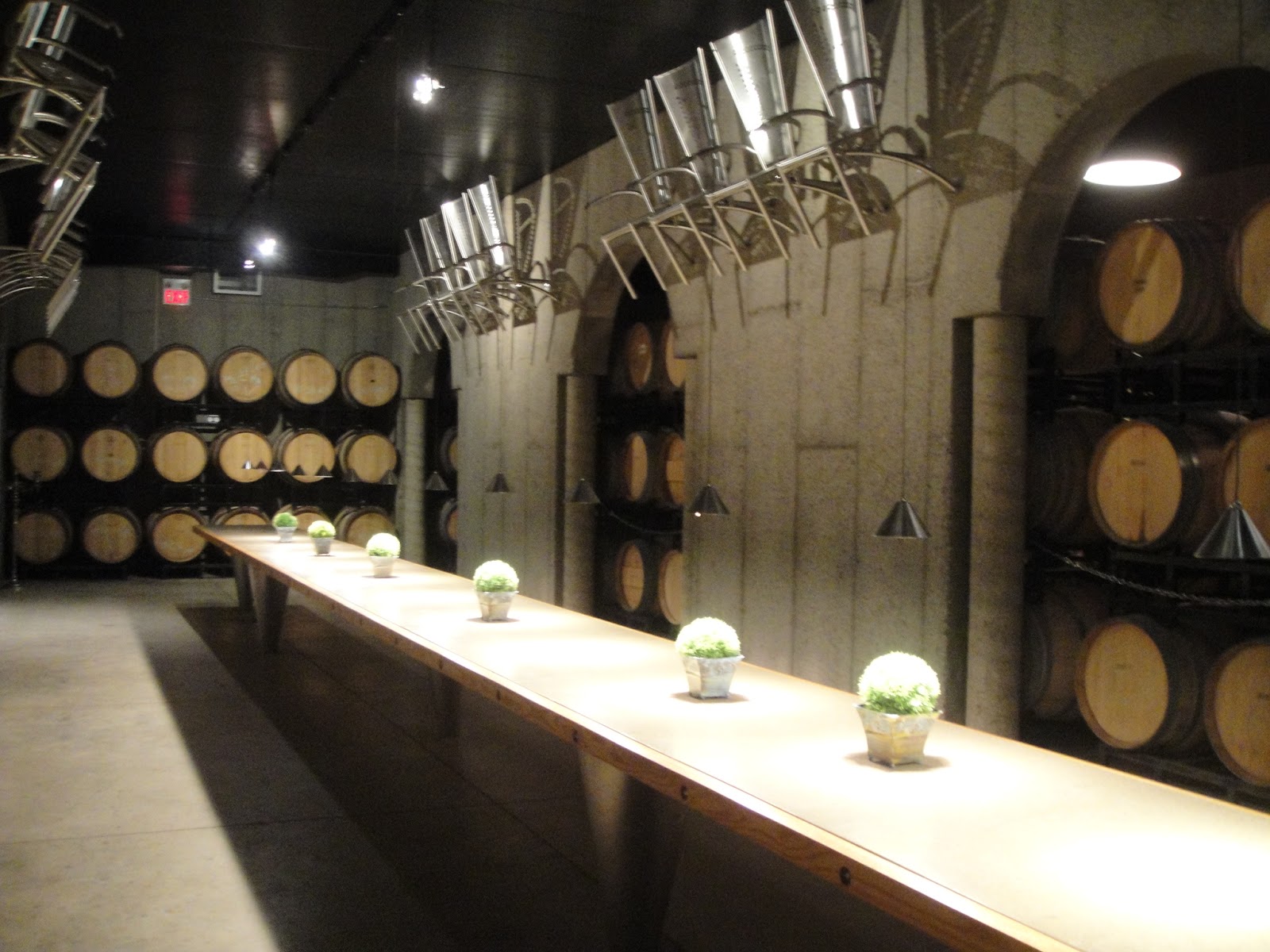
The cellar at Pilliterri.  The 2nd longest poured concrete table in the world.  Don't try moving it alone.

As for the plays, the first was a play by Somerset Maughan called "Our Betters" and the second by an Irish playwright called Brian Friel was called "Faith Healer".  The first was fun being a light hearted Roaring 20's style romp but the second was ... interesting, well if you consider it was about a drunk, Irish faith healer who was beaten to death by some home town bhoys for not being able to cure their paraplegic friend, his drunk wife who ultimately left him and committed suicide and his drunk cockney manager who simply shook his head and said 'what a shame'.


Sets for 'Our Betters' (top) and 'Faith Healer' (below) 

We certainly needed a stiff drink after that day!

The following day we spent on a Taste of the Town tour Viv had found on 'Living Social' -- great site, by the way.  We ate nibbles in 6 places and had a history tour by tour guide Bill who did a great job imbibing a lot of local color for us.

Polish cemetery commemorating the 80,000 US and Canadian volunteers of Polish heritage that trained nearby in 1916-17 to serve in the Great War and later in Russia but died in training.
Great trip.  Thanks Niagara on the Lake!!