Thursday, March 7, 2019

Past Historic

I have basically dropped the ball on following up on our visit to the historic tin town of Ipoh with a post on this blog but in self defense I have been thinking, well a bit anyway, about how I should couch the blog.

If you fancy following the moment by moment stuff, then I would urge you to take a look at my Track My Tour, wonderful app, thanks Chris as usual, which I have attached here. Viv and I really enjoyed our short visit but it wasn't quite what we thought and why we thought it may have been as enjoyable as it was. If you see what I mean (and rereading that last bit, I'm afraid I don't quite know what I was trying to say). Take it as being the things we thought would be good were either absent or underwhelming, those that we hadn't considered or felt were of lesser importance really stepped up and more than filled the gap.

It is the history that I am referring to.

So brief back up again: we wanted to visit Ipoh because it was an important historic town in Malaysia's development and was pretty close to Penang, in fact about an hour and a half on the motorway. Also we had been advised the food was really good there as was the famous Old Town White Coffee (it was).

So history: Ipoh was pretty much nothing more than a collection of huts before tin mining and the devastating series of Tin Wars (see Wikipedia link to the four different but rapidly consecutive wars collectively called the Larut War here) prompted the protagonists, initially competing Chinese regional tin miners but later also the Malay rulers who fell into a civil war in the state of Perak, to call in the British to restore order as they could not. These wars fell between 1861 and 1874 when the final Treaty of Pangkor was signed and this pretty much signaled the start of Ipoh as a place of significance. It also signaled the arrival of the British who to that point in the development of the country had held themselves only in the Straits Settlements -- Penang, Singapore and Malacca.... but also Pangkor, which was the port town for the Perak River, the means by which most tin made its way to the outside world.

The little blue bits are the tin lakes that now dot the area. Imagine 100 years ago these were mostly open cast mines.
Say what you will about the good and bad of British imperialism and Pax Britannica but this treaty brought peace to the area again and a new level of organisation and infrastructure that had previously never existed. It also forced the British to redefine their relationship with Malay states and set the starting point for closer cooperation, then the colonial era which followed. In a nutshell, the British took administration, foreign policy and defense. The Malay sultans kept religion (Islam) and cultural matters. Of course this meant almost total British control. However it wasn't as though the non-British parties didn't go into this eyes open. Probably though they may not have thought through the exact level of control they would be giving up by inviting the British in. Or for how long it would last.

In Ipoh, we went to two Chinese tin mining museums. One outside Ipoh and one in the old town. Both of these were private museums funded by in the first case a wealthy Chinese tin mine owner and in the second case by the Haka Tin Miner's Association. So both I knew would be as politically incorrect as could be imagined... and they were, all with the perfectly acceptable intention of providing the truth, the whole truth and nothing but the truth (Jack Nicholson speech in "A Few Good Men" springs to mind here).


Pre-1800 tin mining was pretty much a fringe thing conducted by local Malays. It wasn't until global demand picked up during the Industrial Revolution along with prices that the Chinese became interested. That also coincided with numerous rebellions and civil unrest in the fin de siecle period of the Ming dynasty, so people left China in droves for peace and an economic uptick.


Open cast mining was not eco-friendly and was very labour intensive. It also required massive volumes of water to be diverted from the Perak River and pumped through hoses to wash away soil and other detritus from the underlying tin ore.

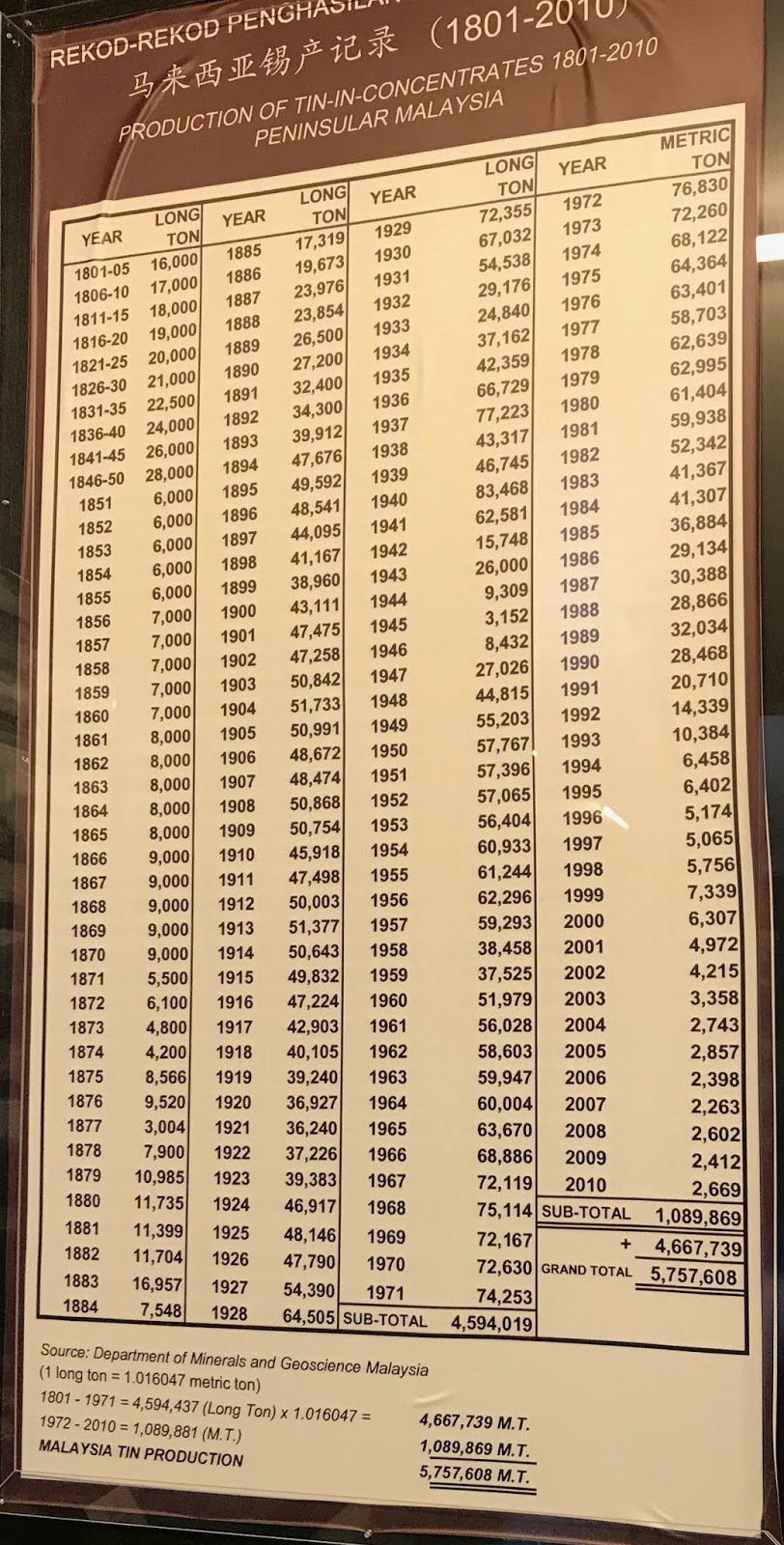
This is wonderfully documented by the first museum as the owner has all the industry statistics you could possibly want for this industry and dutifully and relentlessly published the lot of them on frame boards in the museum along with dioramas 'interpreting' those statistics.

Data going back to 1800!

Mostly they were statues of Chinese workers 'coolies' holding some sort of tool connected with mining. In this time tens of thousands of mainly men came each year for the next 60 years. In all about just over 1 million. Most came for the mining which was centred around this area. I haven't read anything that talks about the demographic impact of having this many new immigrants in a specific location, in a specific industry, and in such a short period of time. But it must have been overwhelming for the indigenous population and obviously contributed in no small measure to the Larut Wars, which were essentially inter-Chinese turf wars squabbling over resources. No wonder the sultan lost control of things. (Malaya's population in 1950 was still just 6 million!).


We had a guide for both days we were in Ipoh who was very informative and in his non PC way told us: "The Chinese miners were only here for the money. They didn't care about who controlled what or how they got the tin. They just knew that tin was worth money and that was it." He was more direct than that on a wider variety of subjects too but I just restrict myself to this.

So there you have Malaya in a nutshell (and still pretty much modern day Malaysia too, from what I have seen). The Chinese just want to do business and don't care about how they go about it, whose toes they trample on, who is the 'ruler' and that other stuff like personal freedoms, rights, rules about intellectual property, all of that. So for them in 1874, getting the British in was a no brainer. Obviously the Malays may have had different priorities.

One downside to this is heritage. Living in a UNESCO world heritage site (Penang) it is almost ironic that this should be the case for this UNESCO accreditation comes with specific rules and regulations governing what you can and cannot do to 'heritage' buildings and other artifacts. The practical downside in Penang is the almost endless number of colonial era mansions that are derelict and left to rot. Conflicting reasons for this. One is that the UNESCO rules make it very expensive to renovate (ironically McDonalds and KFC have taken over and renovated mansions for their purposes) and the other main one being that they are owned by old time trusts (Chinese clans presumably) with many different strands of ownership meaning that nobody can agree on anything, so nothing happens.

Specific to Ipoh and the reason that I have taken the path in this post are the railway station together with the city administrative building right opposite. Both are WWI constructs in the Imperial fashion -- massive long white buildings -- the railway station is in use but much changed to accommodate modern traffic whilst the city council building has been abandoned and is being left to rot whilst the current city employees work in their new blinged up glass and concrete high rise just down the road. So from a 'heritage' position ... and this is something that Ipoh Tourism really focuses on (that is if you read their website blurb and visit the Tourist Information office) and if you have followed my trail to this point, you will remember that prior to 1874 Ipoh did not exist so anything 'old' from then will perforce have had to be .... Imperial era construction, which sad to say is being ignored probably to ruin at some point. You can already see green plants growing out of the walls of the old city building. As Ipoh virtually burned down in 1892 it had to almost entirely be rebuilt. This is where the town's grid layout dates from.... again here heritage = Imperial era construction.

The magnificent railway station in Ipoh. Its derelict brother lies just across the road... in fact I took this picture standing right in front of it
Heritage wise, this visit for us really didn't work out as we thought but then again it did. For those parts that did elevate our time here were those specific private museums and the energy and dedication put into those. So all of what I said about the general attitude completely falls apart when you consider just how conscious these private benefactors (who were outside the norm) are in preserving the history of the tin miners of Ipoh. They did a great job. Other heritage, not so much. You can see it being ignored on a daily basis as younger people in the modern times presumably simply don't care about the past so much. I think it's a shame but then again I just turned 65 so am what is now considered 'past historic'.

PH definitely looking past it on the left hand side in front of some Ipoh street art that our guide rather amusingly dismissed out of hand. He was right though, most of it was just graffiti masquerading as something else
Looking at it a different way, heritage is expensive and a question of priorities. As a lover of Italy, I am continually amazed by the almost total disregard by the population of the old ruins of this and that that lie around everywhere. To restore everything to its former glory (and define that if you can) would be prohibitively expensive and time consuming. In the US by contrast, a country with virtually no similar heritage or history, every speck of rock that can be deemed 'heritage' of some sort or other has its own national park surrounding it with display panels, interpretive films and tourist centers. Last year we visited the site where the 1850's go west homesteaders covered wagon tracks can still be seen. You can't see anything. The site is a huge..... prairie covered in grass.

I will leave this post with some comments from a magazine that I just read whose editorial reported that even though 2020 has been designated Visit Malaysia Year, Tourism Malaysia is cutting funding for marketing purposes. One should remember that the country is up to its ears in debt from past corruption scandals and over spending on infrastructure that nobody needs or uses, so the new government is presumably doing its best in prioritizing what it can without continuing the damaging debt trend. This said it could also up its game a bit for as this same magazine says "it does suffer a bit from the all too common local hallmarks of subpar service and mediocre maintenance."

Ipoh was great fun though. And the food.... well who wouldn't love to find a fantastic tandoori restaurant laid out just like a high end steakhouse in the US? Visit the Tandoori Grill!!!


Sunday, January 20, 2019

Remembering 2018

Being a rock music lover, I try to take a moment to remember some of the greats that passed last year and for that thanks go to the website Ultimate Classic Rock dot com for helping me out here. As time goes by more and more rockers pass as well so that the list seems to be getting smaller over the years. I will remember each of those that I knew well in turn. Also gives me a chance to watch them strut their stuff in their prime. They were great!!


Marty Balin

Marty started Jefferson Airplane and was THE singer of the late 1960's. Never a Frank Sinatra but he and Grace Slick out in front always made me tingle. They were so good together that it surprised me to read (in both Grace's and Marty's) autobiographies that they'd never well you know had relations together. Grace had apparently had relations with everyone in the band.... except Marty. Maybe that's why he quit after Volunteers, maybe not. He was a great though and I will miss him.... and in fact I will probably put on a JA record onto my newly acquired turntable right now.


Danny Kirwan

Danny was one of the awesome guitar lineup that was the original Fleetwood Mac. Or rather to give it it's full name Peter Green's Fleetwood Mac Featuring Jeremy Spencer. Danny was a Peter Green protege and PG wanted him in the band for when he wanted to just stretch out and jam. Jeremy Spencer mostly played slide and loved the old blues guys and didn't want any of that so Peter got Danny in and they were just awesome together. He wrote a lot of Mac's tunes of the times when he arrived, still a teenager. And that is how I will remember him for he had a sad life later on.

Just listen to him and Peter Green go though. Just electric.


Otis Rush

What a guitarist. Not much more that I can add for although I loved how he played I sadly don't know much about him other than from what I picked up listening to his work on tunes I'd first heard from mainly English blues players.

Fast Eddie Clarke

Is it fashionable to like Motorhead? Not sure as people sneer at their down and dirty heavy metal but the metal heads love them. Why? Well of course who doesn't like Lemmy? He was dirty, drunk, fun and funny. He could play too and he wanted to play loud and fast. So he needed a loud and fast guitarist and who better than Fast Eddie? I don't care what people think, I love them!!


Ed King

I think I've written about Lynyrd Skynyrd's visit to my home town Southend on Sea supporting Golden Earring and playing their first album. That must have been in 1974. They were brilliant of course but I was more fazed about a really cute girl that I had been trying to meet whom I saw backstage with one of the cuter guitarists than Ed King. Talk about devastated. Mind you as I said the band were brilliant. Ed quit reasonably early so avoided the plane crash which wiped out the early band, as he didnt like touring apparently. Can't imagine why. That girl was really cute.

Ed wrote a lot of the tunes including Sweet Home Alabama where he played lead, and truly fantastic lead solos they were. In fact I recently watched a YouTube video of an early Skynyrd show and it was all Ed playing solos. Not the other two so much. Here's a 1974 video from You Tube from a show in Germany promoting the tune as their new single. Fantastic playing by Ed.


RIP all you guys.

Yodeling and Mooing

It is interesting sometimes to consider how people see themselves. We all have our opinion of how old we are mentally, for example. Me, I think I am 25. I know I am not of course. My knees and other joints tell me something quite different. But on our recent Christmas trip to see Indy and Cat in Zurich, it rebounded quite strongly. Not my knees, this thought.

You'll no doubt have followed our every move on Chris' fantastic and now beautifully updated travel app, Track My Tour, which if you haven't you can catch up with right here.  I alluded to our arrival and departure interludes when on the airport shuttle trundling you between terminals, the voice over charmingly welcomes you to Switzerland (in English) and when finished is replaced by these sounds that you think really cannot be. Surely that cannot be alpine bells tinkling, alpine horns moaning and ... wait for it... contented Swiss cows mooing. Can it? But yes, it is. We listened to it going in and out and both Indy and Cat confirmed that it is a standard thing. So the Swiss who are some of the most sophisticated people in the whole darn world think these cutesie little things are those things that most completely describe them??

Why not fondue? OK well it is a solid cheesy mass that sits in (and on if you are a bit messy like me) your tummy for days and days afterwards. 

Apparently so, and as for myself I do like a chuckle or two so appreciate self deprecation but really the Swiss are all about milk, bells and yodeling?? No I don't think so and I am glad we spent some jolly hours in the Swiss National Museum to straighten things out for myself. Mind you I could have just walked down Bahnhofstrasse past all those watch shops, private banks and name brand designer shops selling hideously expensive stuff to realize that that milk, bells and yodeling stuff is just plain hogwash. (Spoiler alert here... I did walk down Bahnhofstrasse on several occasions).

So where do I start?

Switzerland was a nonentity waypoint in Roman Empire days so not much is made of that and it became more important when Charlemagne's grandson's daughters found they liked Zurich enough to build an abbey there. In the 9th century Zurich was a mildly unimportant rural town in the Holy Roman Empire but these ladies upped their importance and dignity for with religious buildings like cathedrals, monasteries and abbeys comes people and lots and lots of money. However although this is a key point in Swiss history, it is almost forgotten now as Zurich in particular was an amazingly focal point in the Reformation. Some of the key men that took the Reformation onwards and upwards came from here and of course they needed pulpits and found plenty to chose from, including the abbey which these days is called the Fraumunster. The then abbess around 1524 politically decided to cede the abbey to the town (and hence the reformation) and go somewhere they felt more welcome leaving the place free to the fire breathing reformers that were the new breed to howl at the moon and their congregations. We know this for the pamphlets provided by the churches said so and more. Very open they were. Apparently these new breed were so vociferous that when one of the main voices died, the congregation of course paid for a statue but also took a loooong deep breath before settling back to enjoy the more charming cocktail party manners of his successor. Who apparently had a long and happy life there.

The Fraumunster on the river

I love this story as it is just like the early days of the Christians who had the hard nosed, fire breathing evangelists discussing fire and brimstone and of course love everyone who were followed by St. Paul who had to tone it down a bit and put the whole thing onto a more stable footing... and of course more remunerative along with his buddy St. Luke. They basically wrote most of the New Testament and I don't think I can read St. Paul's letters to the Corinthians without laughing out loud. His attempts to suggest that when our lord talked about loving everyone, he was talking rather more spiritually than physically and the Sodom and Gomorrah that Corinth had become in the first century AD was actually a bit of an anachronism as opposed to a model community.

Apologies for the digression but it certainly is curious how things repeat.

But I was talking about the Swiss, wasn't I? Well they dumped the Empire back in the late 13th century (maybe the Empire noticed, who knows these days?) and started off on their own.

An early freedom fighter from Empire days... or a terrorist? Depends on the viewpoint

One massive irony came almost immediately after the Reformation when they decided to remain neutral during the 30 Years War that started in 1618. That's right, leaving all their protestant buddies in countries nearby whom they had done so much to convert to be ritually slaughtered over the next 30 years as the war utterly devastated Central Europe, particularly Germany. One of the reasons for the civil disturbances of 1649-50 in Switzerland came as a result of demand for Swiss products declining in the aftermath of the war as local economies started getting back on their feet. Just like the general strike of 1918 (the main display in the museum when we visited) when you know demand for Swiss products declined as their major customers (Germany and Austria) stopped buying. And again just after WWII when nobody would speak to them as they had sided with the Nazis (stopping short of being a part of the Axis of course). Some of the key trading items during these times in no particular order were Lenin, looted Jewish gold and flat packed log cabins used for military purposes by the SS in Eastern and Central Europe..... they had to apologize to the Soviets before they were allowed in to the UN.

How do you write about this stuff and say as little as you can so that people don't think that you are really despicable? But you have to say it. Or at least something approximating it. At least they are better than the Japanese at owning up.

So much for being moral arbiters.

The country itself is picture postcard perfect although Zurich as we discovered is in a valley where it may not snow that often but which more than makes up for it with fog, mist and rain. Lots of drizzle too so I felt just like back in England.


Ridiculously beautiful

Speaking of whom I can't let the current Brexit situation pass without comment and Switzerland is a perfect example of what Britain could be if they chose this path. Now of course Switzerland isn't physically separated from the continent like Britain but it is not a part of the EU but has open borders being part of the Schengen system. It is almost laughably expensive but has zero unemployment and has a population that is totally OK with buying Swiss made stuff. So almost every brand you can think of has a Swiss plant that produces stuff at double the price of the not quite so laughably expensive EU.

$17 for a burger.......no fries

Why hasn't anyone in Britain thought about discussing the "Swiss Model"? That is, if Brexit is to happen.

But it works. Spectacularly so. The standard of living is one that can only be dreamed of for the rest of the world. And that is totally normal. For everyone I think (although I don't know this for sure but it sure seemed that way). Mind you Swiss people are forever popping over the border for a shopping experience which their EU neighbors happily manage by placing supermarkets, shopping malls and every manner of retail experience right there, walking distance away from a very large car park on the border in Switzerland. For while it is not legal to drive back with stuff that has no duty paid on it, you can certainly trundle it back by hand.

All in all I loved it warts and all.

Wednesday, December 12, 2018

Another Road Trip


It has been a while since we went on another road trip from Penang ultimately down to Singapore via the orang utan reserve at Bukit Merah, Taiping, the Cameron Highlands and Malacca accompanied by our Bermuda friends Charmaine and Dave. I did the Track My Tour thing here but wanted to add some other bits as an afterthought.

Orang Utans

Everyone has seen these hairy but gentle apes on TV programs like the BBC's Earth or something like that and to my surprise we discovered that there's a refuge just over an hour away in Bukit Merah. I thought it was great as the apes are housed on an island but visitors are within a caged tunnel so you can view but the apes are free to roam. It is home to the early stage apes saved from death in the wild. There is another 2nd stage which gets the apes more used to fending for themselves and then its vroom, out into the big wide world.

The island at Bukit Merry

Except if you're a full grown male that is. The really big ones get to 200 kgs (that is huge!) and they don't much like moving around in the trees as that's a heck of a lot to swing from branch to branch. They also don't like the rain largely because they are massively hairy and if wet, that adds another ton of weight for them too. So all those pictures you see of those cuties swinging and playing are the tiddlers, before they are grown.

Growing up is tough too... and this isn't a comment aimed at the orang utans alone. It applies across the spectrum. They live in single grown male family groups and the only way for an adult male to live past a certain age is to kill the alpha male and take his place otherwise it is curtains for you! The one on the island comes in at a growing 145 kgs and he made it to number 1 by killing the former alpha male who was the 200 kg guy.

Talk about survival of the fittest. There must be an analogy to all grown males there somewhere.

Tea in the Highlands

One of the many things the British did during colonial times was to create hill stations. The Cameron Highlands is an example in Malaysia. Actually so is The Hill in Penang. At sea level it is hot and sticky and in past years, colonials may have ranked at the top of the social tree but they also ranked at the top of the diet for a multitude of bugs, bacteria and various viruses. You can see it anywhere there's an old church and cemetery. In Bermuda the big killer was typhoid and it seemed that almost everyone in the graveyard was less than 23. My doctor once told me during a physical that if I didn't die of a particularly nasty disease before I hit 70 that I should be OK for another 30 or 40 years. Not sure about that but I suppose that means if you have good resistance to fell diseases, you'll survive. At least from fell diseases.

The hill stations are particularly nice. Including Penang, I've now been to three (Penang, Cameron Highlands, Sri Lanka... the oldest) and I can certainly see why they would be popular. So much cooler, fewer bugs and great views. Also tea. Now of course tea isn't indigenous but introduced and even now it forms a massive part of the local economies. More in Sri Lanka than Malaysia but when we visited the Cameron Highlands, what is apparent is the massive scale of development. I should have thought about this before as every time you buy veggies in the supermarket here, all the local ones come from some Cameron Highlands farm or other.

Tea harvesting in action. No technology here

Sadly they are really, really ugly.

Endless greenhouses. They are everywhere

Tacky Stuff

I know that we are all sophisticated and would normally look down our noses at tacky stuff. I mean who needs another fake handbag or pair of Gucci shoes? We wouldn't go there, would we? Also who would want to ride around a Unesco World Heritage city that was one of the oldest European settlements in the Far East riding around in a floral pink trishaw decorated with little ponies also pink and a soundtrack of Asian rap?


Nyonya Cuisine

The term nyonya refers to Chinese immigrants who came to Malaysia during the 19th century mainly to work in the mainland tin mines or to escape one of the endless wars or famines prevalent in China. They settled and in many cases married locally and generally found they couldn't get the same ingredients for their cuisine as back home so they adapted to what was available locally... hence nyonya cuisine. The nyonyas are also known as Perankans and other names too, but this one seems to to be the one used mostly for cooking.

Some well known dishes have a nyonya twist. I am thinking of curries here and of course beef rendang is a nyonya curry varietal. So when I saw the chance of having a day of cooking classes, yes please!

Heavy coconut cream? Yup. Thanks Kathy, nyonya chef supreme

One thing we'd omitted to pay attention to was the fact that much nyonya cooking is really heavy so it was a little rash to expect to want to do anything energetic after eating as we'd originally planned. If you have the chance to try nyonya cooking, try it!! You do like chillies though, don't you?

Markets in particular Night Markets

One thing I have discovered here is that whenever guide books say such and such Night Market is a blast and shouldn't be missed, you should take that with a distinct pinch of salt. For sure markets and in particular night markets are busy places with hordes of probably mostly tourists scouring through endless stalls of vendors selling... well junk really. You may want a fake handbag for example or yet another little zip bag with elephants embroidered onto it, or some such like that. But you can go to daytime markets for that too. If you're expecting an authentic cultural experience, forget it. This is all about selling stuff to you.

The Jonker Street Night Market in Malacca was like that although the upside to all of these places is that the street food is fun, very creative and often very tasty. And at the end of the day, yes it is still pretty fun too. Remember that decorated pink trishaw I wrote about before? Well they also have fairy lights on them for nighttime so in addition to all the other stuff, they are a cascade of lights too!

First take wooden satay sticks about 8 inches long. Lay them in what looks like a waffle press like this but in the specially crafted grooves. In the little holes that are under these grooves, crack small quail eggs and wait for a second or two et voila you now have a yummy snack of 5 cooked quail eggs on a stick that you can drench in your favorite chilli...

Cricket

There's a guy at the Penang Sports Club, John, who is a long time ex-Singapore hand and at some point was the President of the Singapore Cricket Club. Now I've been playing cricket for over 50 years and know quite a few club presidents. Most are nice guys but have had a history of presiding over, say, Leigh on Sea CC whose pitch is one of the two connecting pitches on the big field at Chalkwell Park in Southend on Sea. My home town. It has a nice elevated view of the Thames Estuary too but can in no way compete for the location of the Singapore club. My goodness. It reminds of the story of the rollers at Centre Court Wimbledon. The lovingly maintained grass courts depend on this big, heavy roller to keep the surface so pristine and one year someone asked to borrow the roller for Court One. The groundsmen said OK, hasn't been asked for before and then tried to move it over discovering in the process that the roller was too big for the exits. It simply could not be moved from Centre Court. This caused much head scratching until the early records were consulted and it was discovered that because in the old days there was no lifting mechanism capable of moving the thing far away from Centre Court, they simply built the stadium around it. Yes folks, the roller came first.

It strikes me that Singapore CC is very much the same. It occupies an unbelievable location on the Esplanade and if you know Singapore and can visualize the sky scrapers and development in the city, you'd be amazed that such an anachronism could still exist. But exist it does and it is, yes, right there in the middle of the most expensive, most exclusive, most desirable, most demanded part of town. I guess they simply built the new city around it.


IP Theft

My school in Southend was called Eton House and was for some years after I left school the cause of much confusion. At one interview when I was I think 21 or 22, the first thing I was asked was "who do I know from my school days?" Well of course I know loads of people: Pete, Kev, Gary, Ronnie. It took a little while for me to realize that the interviewer was looking for something else. As in which member of the royal family, nobility or political class was I at school with? It made me laugh sort of (I didn't get the job as after I explained and we all dutifully laughed, they lost interest completely) as I knew that our Headmaster (and owner of the school) chose the name in 1926 specifically for this reason. He felt that Southend School for Boys may not have had the same cachet and PR hook as a vague and unexplained Eton connection.

In Singapore! Bloody cheek!!

He was an interesting character all by himself. His nickname was Bubble as that was what his bald head looked like in later years but his name was SHT (before the acronym became tarred by another similar word made by inserting the letter 'I'). His twin died in WW1 and he took part in the Los Angeles Olympic Games as a 400 meter runner ("too upright, see, so no good, flagged at the end due to me gassing at Loos in 1917"). He was an unforgettable character!

Management on Steroids

I think you either love or hate Singapore. Maybe not, but its just a gut feel that I have for what they have done to transform a tiny island swamp into this sparkling megalopolis is just stunning. And to think that most of it happened after independence and the rather embarrassing split with the rest of Malaysia. I have heard it described as 'Asia Light' and the more I think on that, the more apt I think is that description. We have friends that spent a couple of years working there that seems to have given them a bedrock in life and while they visited Angkor Wat and some of the other cultural high points, I'm pretty sure they never visited a hawker centre, or Little India, or some of the more Asian bits. Certainly Singapore is in the midst of Asia, but at times it doesn't feel it.

I loved it and going back to the tacky comments from earlier, who wouldn't love to stand on a balcony 57 stories up in a 3 tower hotel that reminds you of Las Vegas? The view is stunning.


Talk about planning. I simply cannot imagine the meetings they all had. I worked in a quango for a time in Bermuda and the meetings we had barely rose above the mundane. There must have been some powerful thinkers, strategists and personalities to get this done.

Great trip though with my favorite traveling companion!!


Friday, December 7, 2018

A Very Bad Year

I subscribe to various news services to keep up to date with what's going on. I have to say that it is really difficult to get balanced reporting on most issues. Every media outlet has its own agenda that it is trying to put out and I suppose if you share those views then you like that. But if you don't the reporting on the other side is just as slanted. It becomes a self fulfilling prophecy that people then tend to read only those things they agree with. That is sad and in my view quite dangerous as in many instances (say 50%) you are most likely wrong so hearing another view can actually be pretty helpful.

Don't worry though I don't plan to preach or anything like that. It is just that I read a truly fascinating piece that suggests that the year 536 was the worst ever time to be alive.

So this is a non-controversial subject as nobody alive today would have been back then either and if you read the full piece it seems that simply managing that (i.e. staying alive) was a real big win.


So what happened, Michael? The year 536 AD was just about 100 years after the fall of the western Roman Empire when the barbarians trampled over the remnants of that once great empire... but only 200 years into the eastern Roman Empire's over 1,000 year history, most latterly as Byzantium. In Europe the barbarians were not intent on making too many friends, they were far more intent on rape, pillage and enslavement as a pastime. So simply by virtue of the fact of being in Europe in what was a pretty horrible time was made worse by something???


Now this is climate change.  I sometimes complain about the weather but...

Given that this has now been documented, how on earth did people actually verify this? And this was the bit that fascinated me and caught my attention. It was the polar ice cap. Antarctic not Arctic.


Inside this thing scientists bore into the ice cap and from studying the various levels and aging them, they can tell pretty much what happened scientifically. Given this data, historians are able to interpret it from the often weird writings of contemporary scribes and come to amazing conclusions about our world's history, both natural as well as social.

This is the full litany of woe...


I would post the full article or at least attach a link but somehow I have lost it and cannot find it at the moment. It is definitely worth reading and remembering that climate change is just as much about natural phenomena as it is about human interference. That doesn't of course mean that we should be complacent about things but it is worth remembering. A couple of days ago, for instance, I read another piece about how the global insect population is down 70%+ since the 1970's with the result that some parts of China have to employ people to pollinate their plants as there's nothing else left to do it for them. Now that was human interference.


Sunday, December 2, 2018

The Honorable Lanka

Living in Penang you see the word 'Sri' all the time in front of a group of other words and for the longest time I had no thought really about what it meant, if it meant something, or it was something else. It took our visit to Lanka in October to settle things. The word 'Sri' is an honorific which I take to mean something like 'the honorable' or something like that. As the pre-Colonial name for the country was Lanka, that is what they first named the country after 'Ceylon' was ditched after independence adding the 'Sri' only a little later. Claro?

I used Chris' wonderful app Track My Tour for the day to day stuff and if you want to follow that you can do so here but wanted to add some other bits that I didn't write about or thought about after.

First up, great country. Lovely people. Hopeless infrastructure. My goodness, does it rain. Animals everywhere.

OK that's it all done.... well not quite. Any people that do read my posts know that I probably drone on at too much length so a post this short and sweet just isn't going to happen. So here it is, the memories that will stay with me in no particular order.

1. Elephants

Nothing more to add, just that it was fabulous to see them in the wild

2. History

In a later post I will refer to Malacca in Malaysia as part of a recent road trip that Viv and I did with some friends from Bermuda. It bears striking similarities to Sri Lanka as it was the Portuguese who were the first colonial settlers and it was they who were summarily kicked out by the next settlers, namely the Dutch, who in turn were removed by the British who then never left and generally fixed the things that the others hadn't.


The Portuguese settlements were very much at the fringes, seaside settlements in the south with just the one in the pointy bit at the top, which is Jaffna. So easy meat for the Dutch who came in force over 100 years later and kicked them out. They tried to take over the entire island but couldn't manage the middle section (which was where Buddha's tooth ended up, Kandy) and made a big mistake by not preventing the British from settling Trincomalee (sort of top right, below Jaffna but above the middle fat bits on the right hand side) and creating a naval base there opposing the French in Madras. The British liked the place so when the French marched into Holland in 1792, the Dutch presumably much against their will and definitely their better judgement asked the British to care of things for a while. Until the French left. No problem, thanks. Trouble was when in 1815 they asked for it back (as they did in Malacca and other places further east) the British said no thanks, we like it here. Oh yes and if you want to try and take it back, let me introduce you to the Duke of Wellington who just thrashed Boney up and down Europe... and some of his friends in red jackets.

Well that wasn't going to work so getting the best deal out of a pretty poor situation was all they had left so the Dutch said OK you can have Ceylon (they called it Ce-lun apparently, a corruption of a misheard Portuguese word) and Malacca and if you must Singapore, but we wouldn't mind having back Java and Sumatra. Probably don't fit in with your imperial plans. The Brits had no imperial strategy of course, only the East India Company, a bunch of penny pinching capitalists and absolutely no desire to take on anything else after that ruinously expensive 30 year war against the French so said thanks and generally history moved on.

Having acquired the new territories though meant actually doing things with them and in general the British did fairly well by Ceylon, as it was now called. Or so it seems to me. Certainly when we visited the big historical and archaeological sites, it was the British who 'discovered' them. Apparently even the locals had forgotten about these places as they were abandoned centuries beforehand and the previous colonizers being typically inefficient and generally useless had walked right past them.

3. Tea

I suppose if you don't much care for tea, then this bit will be irrelevant for you, but as a tea lover I was totally taken with the tea plantations. Even today, the tea industry is the single largest industry in Sri Lanka. 


This picture tells you all you need to know about when, where and how tea came to be in Sri Lanka. Apparently the original plants were not from the already entrenched Indian plantations but came straight from original Chinese plants which is what gives Ceylon Tea its distinct flavor. We bought loads!

4. Infrastructure

The subtext to the above note on tea is actually a very sad one as reliance on a tea industry as the number one component of the economy means that that economy is not very developed. It isn't. One of the key reasons why stems from the 30-year civil war between the majority Sinhalese (mostly in the south) and the minority Tamils (in the north). Add religion into the mix too: Buddhist vs Hindu, and the mix was very toxic indeed.

I read a little about it from my first point of contact for most things these days, Wikipedia, and what was written was sad enough but you just know the reality was worse.

So to dates. Independence finally in 1972, add 30 years and a few before and after the civil war and you come to now. The war itself ended within the last 5 years so there simply has been no time to repair or even build any infrastructure. Also factor in the unforeseen catastrophe that was the Boxing Day Tsunami in 2004 which absolutely devastated the southern part of the island particularly around Galle, and this is the situation Sri Lanka finds itself in. You can see it or rather the lack of it everywhere however all the people we met were some of the nicest, friendly, most optimistic people I have ever met. 

The tuk tuk is the solution!

5. The Weather

People in England talk about the weather all the time, particularly the rain and the deadly grayness of the country between November and March. That is true of course and I personally think it is the greyness that is the worst thing. After weeks of it, things are so depressing. My birthday is in February and it always rained.  Ugh. But not like Sri Lanka.

My goodness does it rain. I had to chuckle that the England cricket team were touring Sri Lanka just about at the same time as us and I really wondered if anyone that did the schedule actually bothered to ask what the weather would be like around then because it is in one of the many rainy seasons here and when they say rainy, they do mean rainy.

Facing a broadly similar issue in Penang about determining exactly when the seasons start and end I asked Fernando, our guide, and he told me that now was the rainy season. He may have said it was the North West monsoon but could also easily have said the South East one for apparently there are many rainy seasons here. Our time until December for one, then becomes dry for the month of January. After that comes the different direction (maybe SW) monsoon season for Feb-March and then another month of comparative dry before the NE monsoon season kicks in during May and which lasts to the end of July. August is most likely relatively dry but then you get the slow drag that is the beginning of the NW monsoon season that really gets going in October again and ....

So the island is very green and you often see scenes like this where only the day before was dry land.

Love the water buffaloes though!
Loved it. Ready to return at any time! And I didn't even get to talk about the dogs and cows ...

Wednesday, November 21, 2018

Odious Comparisons

I just found this post that I wrote back in 2012 when the global economy was in tatters following the Great Recession and I was trying to make sense (to myself) of some of the why's and wherefore's as to why Bermuda was struggling while Cayman was booming. Why should I care? Well my company has offices in both locations so clearly from a business perspective it is absolutely essential to figure out where to use your precious and limited resources. Why do I do it this way? Well some people are able to talk about things. I am not one of those people. I have to write things out in full to make sense of things. This is what I did. Does it make sense today? Is it even relevant today? Well not entirely relevant as there have been 2 elections in Bermuda and at least one in Cayman so what was envisaged back then has actually happened/or not and other things have moved into prominence.

I read only today some 6 years after I drafted this post that 99.7% of all businesses in the US are small businesses and employ 90% of the total workforce. That means that what goes on at Apple or General Electric, say, is irrelevant to the greater population hard as it is to imagine that in all the hype that accompanies their every movement. Of much greater import is the small business. Where small business goes, so goes the national economy.

In a Bermuda/Cayman context it is difficult to see this is the same thing but I would think that a far larger than 50% amount of the local workforces work for smaller companies. Like ours. So despite the fact that small business is largely ignored by both media and decision makers in government, it really it us that still makes it all happen. As a small business owner we knew this and were perennially aggrieved that decision makers didn't really care about our needs despite our relative importance to the economy. Amazing as it is to hear, government actually said that the trickle down effect well known in economic theory does not apply.

I never posted this note as at the time I thought it was potentially inflammatory in the same way as my note on a Bermuda bank (that I prepared for my business' clients) was inflammatory. This bank had fallen foul big time of sub-prime mortgages in its investment book to the point that it was realistically insolvent (the CFO tried really hard to tell me it was all a question of timing... but it wasn't). I spent a lot of time reviewing this and talking openly to the CFO who very generously gave of his time and I just knew they'd need to get massive outside assistance (which did happen). However I was left with a very tough decision. Do I make public my findings and create the self fulfilling prophecy in which there very may well have been a run on the bank, or do I not do this and make a decision based on what was best for the public who had no idea this was the case (just read a 10k issued by a listed company and tell me if you undertsand any of it. I do because that was my job but it takes a heck of a lot of training and then work). The bank took the bail out and has survived with no depositor losing any money as opposed to the Greek and Italian banks whose depositors took a haircut when they had to seek support from their 'friends' in the EU and the IMF. So, happy ending there.

However time is a great healer and what was inflammatory back in 2012 is today merely history. And history as the name suggests is merely a story about what transpired at a certain time according to the person who followed it -- that's me. So please bear this in mind when/if you read the following. It is how I saw things at the time.

***

25 years ago when I was working at the Bermuda Monetary Authority in my first Bermuda role as sole regulator -- essentially the only Banking Supervisor pre-these Basel I, II or III days, collator of Balance of Payments, Controller of the Currency and the then in situ Interest Rate controls as well as the supervisor of the Bermuda Stock Exchange -- I had a staff issue where I wanted to hire another person and needed both budget approval from the Ministry of Finance and permission from some obscure government department whose name I forget.  It couldn't happen until a Board agreed and the MofF signed off -- quite why is beyond me as the BMA was and remains a quango responsible for setting its own budget.  I was assigned a member of this department who would plead my case in front of the board -- I was not permitted to talk at all although I could observe.  I briefed this person in detail and agreed a strategy that he totally ignored starting his presentation with the immortal words: "I know comparisons are odious but..."

Our case was thrown out and ever since I've always tried to never, ever use that ridiculous statement in any way shape of form however with this post I simply cannot think of another way to head it.  My intent is to try to compare some key elements of Bermuda and Cayman, their politics, economy, etc. -- similarities there are but also differences, both cultural and economic.

I care because I have spent considerable time in both countries and my firm has an office in both jurisdictions. I simply don't want either to fail.

The first similarity is the airport.  Both are aging and in need of a spruce up for sure and both don't have those pod things that slide out at door level to allow passengers easy access straight into the arrivals area -- the old fashioned ways rule.  You climb up or down stairs and walk along the tarmac (see note at the end of this post for an update).

Another and probably more relevant comparison is the fact that both are offshore financial centers; Bermuda primarily insurance related while Cayman is big in banks and funds.

Both too have UK common law systems but this is where things are a little different for Bermuda is self-governing whilst Cayman is still just a colony.  This means that Bermuda charts its own course even though it has a UK appointed Governor who has titular responsibility over the Police and certain government functions such as the office of the Auditor General.  Bermuda also has responsibility for its own budget.  Cayman's UK appointed Governor is still the head of government although there are elected officials as well, the leader of whom carries the unofficial title of 'Premier' is actually legally titled 'Head of Government Business'.  Cayman does not have responsibility for its own budget and must seek approval from the UK each year.

And herein lies the rub.  Bermuda has been able to finance its ongoing deficits with increasingly large amounts of borrowing that they drive whilst Cayman has been denied that privilege by the mandarins in Whitehall.  On the day I arrived in Cayman, the front page of a local newspaper carried a story in which the Premier was triumphantly announcing the final agreement of the 2013 expenditure budget with the UK in the amount of $575 million.

I'm not as close to Cayman's budget issues as I am to Bermuda's (I used to compile the BMA's own contribution to the Bermuda budget so retain a keen interest still) but this seems either an awful lot or an awful little... and I cannot figure out which it is.

The reason for my being in Cayman is business development which means visiting as many local businessmen as I can in my allotted time here.  In practice, you don't talk about the real thing that you want to talk about, you edge into it.  You chat.  My 30 or so meetings in 10 days therefore have taken me to talk to a number of highly placed business people who have opinions extending beyond their business and like me want to see their jurisdiction succeed.  Many have very strong opinions and some even have specific knowledge -- Cayman like Bermuda is small so people tend to know other people's business in far greater detail than they may in a larger jurisdiction.

Distilling it all down for Cayman is the over spend on 2 new schools for Caymanians.  In itself a laudable project of course for raising education levels across all classes is a vital way for a country to stay ahead of the competition.  It was the cost apparently that was the issue: I heard figures of $80 to $100 million for each of the schools from different people.  Now I haven't a clue what a true cost should be but know that the Berkley project in Bermuda a few years back was budgeted around $60 million and came in around $150 million so government overspend isn't that unlikely an outcome.  Its just the size that is the variable.  Again the same people suggested that these Caymanian schools could have been built at half the cost which suggests to me that government overspend on these projects could be around $100 million.

That's a lot of money for a population of 55,000.

But is it?  Well, it sure sounds it of course but when you consider that Cayman's population is just about the same as Bermuda's and its land mass is somewhere between 4 and 5 times larger but Bermuda's expenditure budget is around $1.2 billion -- doesn't that make Cayman sound fiscally prudent?  Or putting it another way, how on earth can Bermuda spend twice as much as Cayman?

It sure beats me but I suspect much of it comes down to economics.  Everything ultimately does.  I've just finished reading a great book entitled "The Lords of Finance" -- a book about the 4 leading central bank heads just after World War I faced with a world in recession, then depression, war debts of such enormity that even today look to be completely unrealistic (way worse than what the bankers have done to the world), reparations that the victorious nations imposed upon the losers and the inflexible, outdated gold standard.  Essentially this is a book that Ben Bernanke of the Fed must know inside and out for those 4 men (heads of the Bank of England, New York Fed, Banque de France, Central Bank of Germany) did everything that could be done to fix things but using solutions that were outmoded and not of a size able to dent the problems facing them, everything they did made things much, much worse.  But do read the book.  Just wonderful if you like that sort of thing.

The point I was coming round to was that the root cause of WWI was actually not the inherent distrust of the French for the Germans, or the desire for territorial gains but simply economic: Germany resented Great Britain's economic dominance of the world, the French were trying to get back the reparations they were forced to pay in the 1870/71 war with Germany that they cataclysmically lost, the Brits wanted to keep every foreigners hands off their foreign possessions and trade routes and the Russians ... well they were different and nobody really knew why they fought the war.  Every one of these countries was warned categorically by their advisors in the years leading up to the conflict that going to war with another great power was economic suicide.  That was why the French and Germans didn't go to war in 1911/12 -- both backed away as their advisors told them they couldn't afford it.  So sadly both nations went away and built up their gold reserves to the point where the rulers felt that they could ignore the accountants -- they were wrong!  Accountants are always right.

I don't believe that in either Cayman of Bermuda governments really comprehend the basic GDP equation: GDP = C + I + (X - M) + G.  By far the largest component of GDP is C -- which is we the consumer.  C is all the stuff we buy, eat, wear and generally consume.  Typically in advanced economies this is around 65-70% of the total.  I represents business investment, typically 15-20% depending on the business cycle. X is exports and M of course imports -- which offset one another typically. G is government, and in developed economies comes in at around 15%.

When times are tough, governments step in with 'stimulus' raising G in the equation.  By far the most important part is the consumer and then businesses.  Business will not invest in uncertainty and consumers won't spend if they don't have a job or are concerned that they may not.  But when G is already more than 30% (as it is in Bermuda, I don't know about Cayman) how on earth do things turn around?

Cayman is lucky in that there is the Dart family willing and able to throw billions of dollars into infrastructure -- Camana Bay is the highest profile example of the ultimate "Field of Dreams".  This is a billion dollar new city built on swamp to a very high standard where it is almost impossible to consider that there will be a return on capital any time soon.  Stunning place, simply wonderful.  Other projects including re-siting the dump and building another near billion dollar new resort on Seven Mile Beach including the redirection of the by-pass roads, which under Dart supervision is nearly complete already.  I wish there was someone like him willing to take that sort of chance in Bermuda!

That is the I part of the GDP equation and thanks to the Dart family, Cayman's GDP is somewhat bolstered during a tough time for both the banking and fund business, their financial services staple.

Obviously there is a quid pro quo for a couple of billion dollars of speculative investment and the Cayman government has made significant concessions (tax and work permit) apparently in the greater good.  I wish it would be so in Bermuda where government seems resistant at almost every opportunity to make concessions other than the most minor kind.  For example, waiving the 60/40 rule only for Bermuda listed entities means that only 4 or 5 of the larger companies will seek this waiver and while it is nice to think that foreign capital would flow in via this source, the question has to be: into what?  More likely the waiver is being sought to provide greater liquidity to the individual company's shares as chances are step 2 will be a listing on NASDAQ, TSX or FTSE.  Why not make it a blanket 60/40 waiver for all companies?  There's far greater chance that new capital (or I) will come into Bermuda if you actually enable it.

Both Bermuda and Cayman face impending elections at some point in the next 6 months so politicking is growing and the hot air of rhetoric is blowing from all corners.  Bermuda has constituencies and a 1 man, 1 vote system based on the UK's first past the post system so pretty straight forward ignoring the perennial boundary changes every government does seemingly all the time.

Cayman's system to the outsider (well this outsider at least) is unfathomable.  There are constituencies but for some reason they are grouped so in West Bay, for example, there are 4 seats. In Georgetown 6 and in Bodden Town 4 more.  The East End and North Side have 1 each and the outlying islands a further 2.  If you live in Georgetown, you get 6 votes and so on, so technically speaking someone from Georgetown could be seen to have 6 times as much political say as someone from the East End (actually not so as you cannot vote for the same person 6 times).  Cayman's 1 man, 1 vote referendum to change to the individual constituency vote system was defeated earlier this year not necessarily because it wasn't wanted (it was) but because neither of the parties gave official and vocal sanction to it so the turnout was of a level whereby the required majority simply couldn't be achieved.  I can't say I understand why this would be so for as someone explained to me the opposition party strongholds are in Georgetown and Bodden Town so the possibility for them to lose the vote at the next election is actually very high.

Both countries have party politics, Cayman's being the more recent.  Personally speaking I am an opposer of party politics as all that does is generate a divide between the parties making consensus for the good of the country being impossible on occasion.  The US is a prime example of this at the moment.  The entire world (well certainly my financial services world) is watching and hoping like hell that the politicos climb down off their high horses (actually there are pretty low in my estimation) and agree on something, anything really that moves the country away from falling over their fiscal cliff. Not doing so is irresponsible.  Doing what's right in this day and age though seems to be going out of fashion.

Party politics also stifles debate.  There's no debate really any more as on the one side, you have one opinion and one party line and on the other, there's the other one.  The ruling party wins because everyone votes the party line for to not do so means the potential end of their comfortable sinecures, which is the lot of today's professional politician.  The 'good of the country' therefore becomes whatever the ruling party says it is.  How is that democratic?  History has shown us that governments get it wrong all the time.  Human nature doesn't change.  But because we say so, it is so.  No wonder politicians the world over are increasingly detested by the voters.

And finally back to the present day (2018) for the moment. The following comment is truly timeless...

And then there's the beaches and OK here I am truly biased.  Bermuda's pink coral sand beaches are the most beautiful beaches I have ever seen anywhere.  Grand Cayman has Seven Mile Beach which while lovely white sand and mainly very calm water simply cannot compete.

***

Note: Since writing this in 2012, Bermuda has committed to building a new airport as has Cayman but utilising very different means. Cayman has also stated that they have the intention of growing their population to 100,000. Bermuda has not made any announcement of any sort related to this. Infrastructure building in Cayman is still massively ongoing. Go visit both places and enjoy them for what they are.